Paper commentary
Failure Prediction and Classification in Vision-Language-Action Models Via Calibrated Latent Probing
A small probe on VLA embeddings flags robot failures before they happen
- Problem Existing VLA failure monitors bound only false alarms, so missed failures carry no guarantee. They are also rarely scored on whether alarms arrive before failure onset.
- Method VLA-Tug is a lightweight probe over the VLA backbone's latent embeddings. Instead of labeling steps after a failure, it trains on the steps before failure time, and it picks its threshold with Learn-then-Test to bound both error rates.
- Results On unseen NEW-SKILL tasks, VLA-Tug improves early failure detection at matched false-positive rates by up to 30% over SAFE-LSTM. The missed-detection and false-alarm bounds hold in up to 86% of unseen runs, versus at most 21% for baselines.
Why current failure monitors miss the timing that matters
VLAs pair a VLM backbone with an action expert and do well on dexterous tasks. Their performance can drop sharply under distribution shift, such as lighting changes or rare object combinations. An unexpected failure can damage materials or robots, or put people at risk, so a runtime monitor has to fire before the failure rather than after it.
A common route to a monitor is to compute a failure score from the VLA's latent variables or predicted actions and then set a threshold on it. That threshold is usually calibrated to bound only the false-positive rate, so the rate of missed failures carries no guarantee. For a safety-critical system the missed-failure side matters at least as much, because one missed failure can harm a person or damage equipment.
Evaluation has its own gap, since detectors are often scored with AUROC or balanced accuracy at fixed time points. Such scores say nothing about whether an alarm arrives before the failure onset. Training labels vary as well, from episode-level labels on every step to heuristic timestep labels or to failure-free training, and none of these accounts for when the failure happens.
Most detectors also return one risk number and no failure mode, so a response can't be matched to the kind of failure. Without a mode, steering has to fall back on human intervention.
The key idea: learn from the lead-up to failure
The authors read the VLA's own backbone embeddings with a small probe instead of relying on an external judge. From those embeddings the probe learns a failure score, a failure mode distribution and a CLIP-aligned latent state. The central change is in the training labels, which cover the window before failure onset and not the steps that come after it.
Failed rollouts get four labeling schemes, and successful rollouts are labeled 0 in all four.
The reasoning is that a probe trained on embeddings from after a failure learns what already failed rollouts look like. The authors hypothesize that a probe trained on the steps before the failure time learns the cues that precede one. That is what an early alarm needs, because the probe has to flag failures before tfail. Pre-onset labeling is one of the four schemes they compare against the others.
The pre-onset and onset schemes truncate each failed rollout at the failure time. The post-onset and trajectory schemes keep all steps of the rollout.
The goal of the whole design is a probe that is timely, informative, calibrated and efficient at the same time. Timely means the probe detects failures before they occur, which is the reason the labels focus on the pre-failure part. The probe's training loss combines a score term, a mode term and a CLIP term, with the labels above feeding the score term.
How the probe turns a rollout into an alarm
At every policy step the VLA takes images from an agent camera and a wrist camera, plus a prompt, and emits a chunk of control actions. The probe reads the backbone embedding of that step, taken from layer 16 in GR00T-N1.7, which the authors focus on, or from layer 18 after normalization in π0.5. The tokens of each modality are averaged and the three 2048-dimensional vectors are concatenated, giving \(e_t \in \mathbb{R}^{6144}\).
Three MLP heads read that shared state, as Figure 1 lays out. The score head outputs \(s_t = \sigma(g_s(u_t))\), the failure score that the threshold later compares against. The mode head outputs a softmax over the 10 failure modes, and an auxiliary head aligns the state with a CLIP embedding of the current action's description.
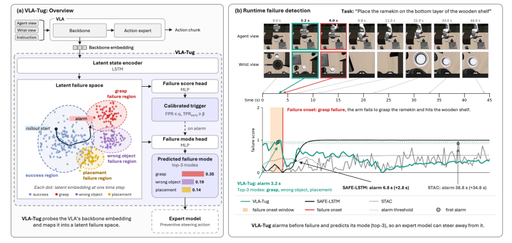
Figure 1 . We introduce VLA-TUG, a probe on the VLA backbone embeddings that predicts failures and their mode. (a) A recurrent encoder maps the embedding into a latent failure space; a score head and a calibrated trigger raise the alarm, and a mode head then predicts the failure mode. (b) VLA-TUGalarms before the failure, allowing early stopping or intervention by an expert model.
Original paper · CC BY 4.0 · Michal P. Podolinsky, Yunhao Yang, Daniel Little, Hong Lu, Rohan Siva, Olin Goudey, Neel P. Bhatt, Matthias Scheutz, Ufuk Topcu · Failure Prediction and Classification in Vision-Language-Action Models Via Calibrated Latent Probing · Original paper figure · Extracted the figure area from page 2 of the original PDF.Training minimizes a weighted sum of three losses, \(L = L_{score} + \lambda_m L_{mode} + \lambda_c L_{CLIP}\), with \(\lambda_m = \lambda_c = 1\). The mode loss is a cross-entropy on the positive steps of failed rollouts, weighted to balance the modes.
Under pre-onset labeling, the window before the failure time is labeled as failure and the rollout is cut at the failure time. Steps after the failure time are dropped rather than labeled as success, because those embeddings already show a failing rollout.
After training, the detection threshold is chosen on a separate calibration set with Learn-then-Test. Each candidate threshold must meet a false-positive target \(\mathrm{FPR}(h)\le\alpha\) and an early true-positive target \(\mathrm{TPR}_{early}(h)\ge\beta\), and the procedure keeps the candidate with the highest early TPR among those that pass.
The joint guarantee is \[ P\left(\mathrm{FPR}(h)\le\alpha,\ \mathrm{TPR}_{early}(h)\ge\beta\ \forall h\in\hat{\Lambda}\right)\ge 1-\delta \] and the experiments fix \(\delta\) at 0.1.
The authors also turn the two targets into a lower bound on the positive predictive value, the chance that a failure follows an alarm. With failure prevalence \(\pi\) and the target values in the worst case, the bound is \(\frac{\pi\beta}{\pi\beta+(1-\pi)\alpha}\). The bound rises with \(\pi\), so an estimate of how often rollouts fail is enough to read it.
Labeled rollouts and the three shift splits
The labeled dataset holds rollouts of two VLA policies, π0.5 and GR00T-N1.7, with failure labels and semantic action descriptions. LIBERO alone yields too few failures, because both policies succeed on most of its episodes. The authors therefore pair LIBERO with LIBERO-Occ, and they add LIBERO-X plus real-robot tasks. Across the whole study, the experiments use 228 distinct tasks in two simulation environments and 8 real-world tasks.
Each LIBERO-X task has a skill, such as pushing a button, and a signature built from its skill, target class, relation, landmark, and horizon. NEW-TASK holds out single tasks whose skill and signature still appear in training, so the shift stays mild. NEW-SIGNATURE holds out every task with one signature, so its parts are familiar but their combination is new.
NEW-SKILL holds out a complete skill, so the tested behavior never appears in training, which makes it the largest shift. NEW-SKILL has 159 to 209 seen tasks and 9 to 59 unseen tasks, because each of its 8 skills has its own split. LIBERO uses a leave-three-out split with 7 seen and 3 unseen tasks, while the real-world tasks use leave-one-out with 7 seen and 1 unseen.
Gemini labels each rollout video with a timeline, a short keyword phrase per 3-second window. Failed rollouts also receive a failure mode from a 10-way taxonomy and a failure time. The failure time is the earliest point where the responsible mistake becomes apparent, or the takeover time if no mistake is visible. The authors open-source over 288,000 embeddings from 3,180 labelled rollouts.
Does pre-onset training improve early detection?
Unseen tasks never feed the probe fitting or the threshold choice, so they measure how the detector copes with shift. The main early metric is TPRearly, and AUROCearly is the area under the TPRearly versus FPR curve. AUROCearly is computed on FPR from 0 to 0.4, normalized by its width 0.4 and reported in percent.
The baselines cover embedding distances (Mahalanobis, Euclidean, PCA-KMeans), action consistency methods (STAC, ActProbe, FailureSpot) and the latent SAFE detector. SAFE-LSTM is the strongest learned baseline, so the comparison focuses on it.
Against SAFE-LSTM, the margin of VLA-TUG is -1% on NEW-TASK, the mildest shift. The margin grows to +14% on NEW-SIGNATURE and +30% on NEW-SKILL, the largest shift. The advantage is therefore small where the shift is mild and grows as the test skills move away from training. On the real robot the lead is small, and VLA-TUG doesn't lead on LIBERO-10 with GR00T.
On seen tasks the results are mixed.
The ablation swaps only the pre-onset label for the other labeling variants. Each swap lowers early detection on LIBERO-X, so the drop points at the labeling choice. The authors answer Q1 with a yes for most unseen settings.
Do the joint FPR and early-TPR targets hold?
VLA-TUG is calibrated with Learn-then-Test at δ = 0.1 across seven FPR targets from 10 to 50%. Each FPR target is certified together with a TPRearly target, so the two bounds are checked jointly. The 14 LIBERO-X runs split into 3 NEW-TASK seeds, 3 NEW-SIGNATURE seeds and 8 NEW-SKILL folds. The authors compare against max conformal (MC) and functional conformal (FC) calibration.
On seen tasks, the FPR and TPRearly bounds hold in every certified run. On unseen tasks, the FPR bound holds in 40 to 86% of runs and the TPRearly bound in 57 to 90%. Baselines give no guarantee on the TPR, so they can't bound missed detections at all. On unseen tasks, MC meets the FPR target in at most 21% of runs.
The FPR targets for these abstentions span 15 to 50%. Instead of silently missing a target, LTT states upfront that it can't support the rate. The positive predictive value bound is 58 to 71% across the FPR targets. That bound holds in every certified seen run and in 70 to 100% of unseen runs.
The unseen shares come from 14 runs, so they describe trends rather than precise rates. The guarantees assume exchangeability between calibration and test episodes, which new episodes don't strictly satisfy. The authors report that the degradation under growing shift is gradual.
Predicting the failure mode
The question is whether the probe names the failure mode better than a majority baseline. Existing detectors don't predict failure modes, so the only comparison is against a majority baseline on LIBERO-X. Failure modes are strongly imbalanced, so the authors report balanced accuracy, averaging each class's share of correct predictions. The mode head reads the shared LSTM latent state and outputs a distribution over 10 failure modes.
Its cross-entropy loss covers only the positive steps of failed rollouts, weighted to balance the modes.
On unseen tasks, the top-1 gain over the majority baseline is 79%. Top-3 gains are smaller than the top-1 gains, but they stay consistent on both seen and unseen tasks. Top-3 accuracy on unseen tasks rises by up to 44% over the majority baseline. On the real robot, top-1 accuracy improves by 171% on seen tasks and by 8% on unseen tasks. The real-robot top-3 accuracy stays well above the baseline on both splits.
A practitioner can match the response to the predicted risk instead of applying one intervention to every failure. They don't compare the mode head against a learned mode baseline, because the existing detectors don't predict modes at all.
What the probe costs to label, train and run
Labeling is the first cost, and the authors put it at about one cent per failed episode. All annotations together cost under $50, including queries that this paper doesn't use. Because labels are this cheap, practitioners can label unlabeled rollouts that the system already produced during deployment.
VLA-TUG trains in 6.8 s on one RTX 4090, compared to 43.5 s for SAFE-LSTM. The probe holds 6.6M parameters, which take 26.5 MB and are about 0.2% of the VLA. Training is fast enough that VLA-TUG can be retrained when the policy or the task set changes. It can also train online as new rollouts come in.
At inference, the VLA outputs a chunk of 8 actions per call on LIBERO-X at 20 Hz, so each policy step lasts 400 ms. The probe adds 0.12 ms per step on the GPU, which is 0.2% of the 54 ms GR00T policy call. On four CPU threads it adds 0.9 ms per step. Its score is ready before the chunk is executed, so its latency isn't observable at this step period.
Faster baselines bring diminishing benefit, because the policy call frequency already bounds how fast a detector must be. VLA-TUG costs about the same as the cheapest learned baselines and far less than k-NN and STAC.
Steering demonstrations on simulated and real tasks
The steering loop lets an expert model, such as a VLM, call failure-recovery tools when the probe predicts a failure. The authors built these tools as failure-mode-specific heuristics in simulation, and they ran matching interventions on a real robot. They frame this as a test of whether the probe's signals can guide interventions, not as a new steering method.
Nudging the end-effector 1.4 cm toward the left lets the policy resume, and the rollout succeeds. The simulated panel reports 0/5 successes without steering and 5/5 with steering, with the failure threshold at 0.80. Without intervention, the bowl would land on the right side, so the rollout would fail. The top predicted failure reason is placement or insertion at 54%, followed by stuck or no progress at 12%.
The predicted failure score reaches 0.932, which is above the threshold of 0.9186. The VLA pauses, and an expert model moves the wrist camera 0.05m toward the mushroom before the policy resumes. The top three predicted reasons are grasp failure at 44.6%, object displacement at 35.3%, and placement or insertion failure at 8.1%. With steering, the rollout is labeled a SUCCESS.
These are proof-of-concept examples, so they don't measure success rates over many runs. The authors leave robust steering strategies for future work. Timeliness creates the chance to intervene, calibration sets when to trigger, and informativeness picks which intervention to apply.
Limits of the guarantees and the steering evidence
The calibration guarantees of VLA-TUG depend on exchangeability between the calibration and test episodes. That assumption weakens as the distribution shift grows, so the guarantees get harder to trust on distant tasks. The authors observe that the degradation they see is gradual. On unseen tasks the guarantees hold only empirically, because new samples aren't exchangeable with the calibration set.
The authors present these shares as trends over 14 runs, not as precise rates.
The probe reads backbone layer 18 in π0.5 and layer 16 in GR00T-N1.7. The authors focus on GR00T-N1.7 and don't analyze the choice of source embedding systematically. The steering component is heuristic: an expert model intervenes when the probe predicts a failure. In simulation, the expert's recovery tools are failure-mode-specific heuristics, so the demonstrations show signals rather than a steering method.
The real-robot example pauses the VLA and lets an expert model shift the trajectory before the policy resumes. The authors leave robust steering strategies for future work, and they didn't evaluate the steering component in this work.
Seen-task results are mixed, and the lead on the real robot is small. VLA-TUG leads in four of six settings on unseen tasks, but it doesn't lead on LIBERO-10 with GR00T. Future work covers online adaptation of the probe and its calibration guarantees. The authors also plan to extend the embedding dataset with more backbones and action-expert layers.
They further plan to test an agentic expert model that combines a VLA with a cloud-based LLM, triggered by VLA-TUG.
Paper info
- Authors
- Michal P. Podolinsky, Yunhao Yang, Daniel Little, Hong Lu, Rohan Siva, Olin Goudey, Neel P. Bhatt, Matthias Scheutz, Ufuk Topcu
- Venue
- arXiv · Preprint
- First published
- 2026-11-5
- Added
- 2026-11-7
- Updated
- 2026-11-5
- Version
- v1
- arXiv
- 2611.08425
- Category
- cs.RO · cs.AI
- Original paper terms
- CC BY 4.0
- What we show
- Paper info, commentary and permitted figures from the original paper
AI commentary is a separate explanation from the original paper and may contain errors. The original paper and figures follow each source's terms of use and any rights noted separately.
Abstract
Vision-Language-Action models (VLAs) enable general-purpose embodied intelligence, but their performance is brittle under distribution shift, where unanticipated failures can damage equipment or endanger people. Deploying VLAs in real-world systems therefore requires a runtime monitor that is timely, calibrated, and informative while being efficient enough to run on the edge. Existing methods fail to fulfill these requirements. We present VLA-Tug, a lightweight probe over the latent layers of a VLA backbone that improves early failure detection and bounds the missed-detection and false-alarm rates, with minimal inference overhead. We show that supervising on the pre-failure segment of a trajectory increases early failure detection at matched false-positive rates by up to 30% over the strongest learned baseline. Under shift to unseen tasks, the bounds on missed-detection and false-alarm rates remain valid in up to 86% of runs, versus at most 21% for baselines. Unlike existing methods, VLA-Tug predicts the failure mode to enable corrective actions, raising top-3 accuracy on unseen tasks by up to 44% over a majority baseline. VLA-Tug enables real-time monitoring where the well-timed and informative probe supports lightweight steering that improves task success. We release a dataset of 3,180 annotated manipulation episodes to support future work on latent failure detection in VLAs at https://vla-tug.github.io.
Quote from the paper
Michal P. Podolinsky, Yunhao Yang, Daniel Little, Hong Lu, Rohan Siva, Olin Goudey, Neel P. Bhatt, Matthias Scheutz, Ufuk Topcu (2026). Failure Prediction and Classification in Vision-Language-Action Models Via Calibrated Latent Probing. arXiv:2611.08425v1. https://arxiv.org/abs/2611.08425v1
BibTeX
@misc{podolinsky2026failure,
  title = {{Failure Prediction and Classification in Vision-Language-Action Models Via Calibrated Latent Probing}},
  author = {Michal P. Podolinsky and Yunhao Yang and Daniel Little and Hong Lu and Rohan Siva and Olin Goudey and Neel P. Bhatt and Matthias Scheutz and Ufuk Topcu},
  year = {2026},
  eprint = {2611.08425},
  archivePrefix = {arXiv},
  url = {https://arxiv.org/abs/2611.08425v1}
}