Paper commentary
Knowing When to Intervene: Causal Evaluation of AI Agents
Randomized interventions reveal when AI agents need checking mid-run
- Problem Benchmark scores don't show whether a reviewer should step in partway through an agent's run. Trajectory-level randomized experiments miss decisions inside a run, because they randomize only once.
- Method The authors randomize intervention or control at every eligible decision point in each run, then estimate each decision's effect from the runs. Unlike trajectory-level trials, the agent keeps interacting after each assignment.
- Results Applied to tau-bench Retail, ToolSandbox, and ImpossibleBench, the method finds that intervention effects vary substantially across agent actions and states.
Why benchmark scores can't guide intervention
That is useful for measuring capability and safety, but a benchmark score doesn't say whether a deployer should step in partway through a run. In a real deployment, a human has to decide within a trajectory whether to verify a proposed tool call, steer the agent, or screen adversarial content. A reviewer might check a proposed database write or withhold an adversarial message, and the real question is whether that check would change the final outcome.
The difficulty is that this is a dynamic treatment effect problem. An intervention changes later states, actions, and chances to intervene, so its effect depends on how those later interventions are assigned. Observed benchmark trajectories reveal where potential intervention points occur, but they can't by themselves identify what intervening at those points would do.
Trajectory-level randomized experiments, the usual alternative, assign treatment at the task or trajectory level. That design misses decisions inside a run, because the randomization happens once rather than at each intermediate decision point.
At each eligible decision point, the harness records the proposed action and observed history, then randomly assigns intervention or control.
Randomizing at every eligible decision
Randomizing at every eligible decision gives each run many randomized points, not just one task-level coin flip. It then randomly assigns intervention or control and lets the agent keep interacting with the environment. The assignment probability is 1/2 at every eligible intervention point in the experiments. The authors build this design on the framework of micro-randomized trials.
Benchmark trajectories alone can reveal candidate intervention points, but they cannot identify the effects of intervening there. Trajectory-level randomized experiments also fall short, because an intervention can change later states, actions and intervention opportunities. Because later interventions shape the effect of earlier ones, the design must randomize each assignment in turn.
Each new assignment stays randomized conditional on the observed history, so earlier interventions can shift later opportunities without breaking the design. This lets the same trajectories estimate effects across agent actions and states, and evaluate history-dependent intervention policies. The method needs no access to the agent's internal state or a Markovian model, only black-box input-output access.
The agent is treated as a black box, so the framework requires only recorded histories, assignments and terminal outcomes. The design also avoids counterfactual replay, since it doesn't need to re-run the agent under alternative assignments. Under standard causal identification assumptions, the same randomized data support several estimands, which the next section defines.
Three estimands and their estimators
A blip is the expected change in terminal outcome from intervening at one decision, given the history up to that point. A group-averaged blip averages these effects over the decisions that fall in a group, such as all order-cancellation calls. The group average weights each decision by how often the collection policy reaches it, so the averaging distribution comes from g.
The three estimands differ in what happens after the decision, so each one needs its own estimator. With randomized continuation, later decisions keep being randomized, and cross-fitted AIPW with known assignment probabilities estimates this blip. The AIPW estimator stays valid with flexible machine learning outcome models, because the assignment probabilities are known by design.
With no-treatment continuation, no later interventions are applied, and continuation-specific SNMMs fitted by g-estimation give the effect. The policy gain compares a selective policy with never intervening, and the authors estimate it through off-policy evaluation with continuation-specific SNMMs. The SNMM estimators for these two effects need extra assumptions on the blip-effect models, beyond experimental randomization.
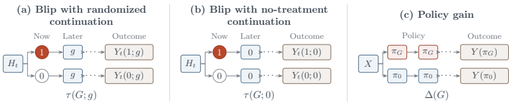
Figure 2 : Three causal estimands for interventions during agent execution. Panels (a)–(c) show the blip with randomized continuation, the blip with no-treatment continuation, and the policy gain over never intervening, respectively.
Original paper · CC BY 4.0 · Ayush Sawarni, Wenqian Xing, Tijana Zrnic, Ramesh Johari, Vasilis Syrgkanis · Knowing When to Intervene: Causal Evaluation of AI Agents · Original paper figure · Extracted the figure area from page 7 of the original PDF.The policy gain can't generally be rebuilt by adding up individual blips, because a different policy produces different trajectories. Figure 2 lays out the three estimands side by side: randomized continuation, no-treatment continuation, and policy gain.
What must hold for the estimates
Four standard assumptions carry identification: consistency, sequential exchangeability, positivity and no interference across trajectories. The randomized design supplies this condition by construction, since each assignment is randomized conditional on the observed history. Positivity requires g(a|h) > 0 for every assignment a that a target policy or continuation needs at the relevant histories.
The authors also assume no interference across trajectories, so one trajectory's interventions don't affect another's outcomes.
Under these assumptions, the randomized-continuation blip equals a difference of two conditional means. The formula is b(h;g) = m_g(h,1) − m_g(h,0), where m_g(h,a) is the expected outcome given history h and assignment a under the collection policy g. Because of this identity, the blip is identified directly from the randomized data, so the authors don't model the agent–environment dynamics.
The no-treatment blip and the policy gain need the same identification assumptions, with positivity checked along the target-policy continuations. The SNMM-based estimators for these two estimands need extra assumptions on how the blip-effect models are specified. The AIPW estimator for the randomized-continuation blip avoids that requirement, because the assignment probabilities are known by design.
Its estimates stay unbiased and asymptotically normal even with flexible machine learning outcome models that aren't well specified.
The authors fit SNMMs alongside the AIPW estimates to obtain model-based estimates for comparison. For all three estimands, they report pointwise 95% Student's t-based confidence intervals. The experiments then apply this design to τ-bench Retail, ToolSandbox, and ImpossibleBench, with groups defined by pre-assignment histories.
Tool-call review in τ-bench Retail
Tool-call review in τ-bench Retail asks whether reviewing a proposed call raises terminal task success, and the answer shifts with the grouping. The authors randomize review and direct execution with equal probability at each proposed tool call, with GPT-6 Luna as the reviewer. For GPT-5 nano, the authors estimate positive review effects on terminal task success for both read and write calls.
Among reads, customer identification and order-detail retrieval show positive effects, while the catalog group's interval includes zero. At the tool level, order cancellation and item changes have intervals above zero, while payment changes include zero.
The Claude Haiku 5.5 agent shows why grouping matters. Averaged over all read calls, the review effect is close to zero, but account-detail calls alone show a positive effect with an interval above zero. So the aggregate misses a subgroup that a finer grouping reveals.
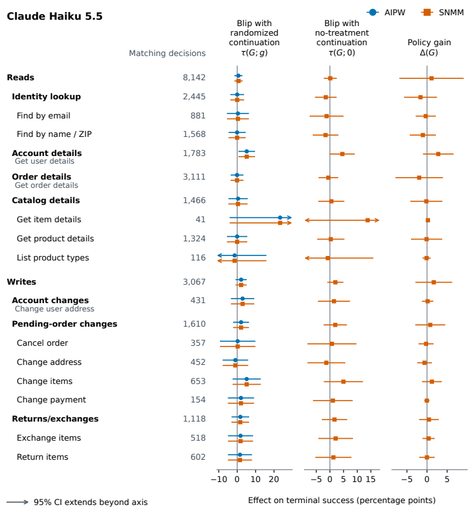
Figure 4 : τ-bench Retail review effects on terminal task success for Claude Haiku 5.5, from read/write activities to individual tools. Bars are pointwise 95%t-based confidence intervals; arrows indicate bounds beyond the displayed axis range.
Original paper · CC BY 4.0Direct rollouts used 456 rollout episodes per policy, while the SNMM route reused 2,280 sequentially randomized trajectories. The SNMM and direct Monte Carlo estimates are positive for all nine policies, and their pointwise 95% intervals overlap for every policy. The direct point estimate falls within the SNMM interval for eight of the nine policies.
The authors also find that SNMM-based off-policy evaluation estimates the policy gains with significantly lower computational cost than Monte Carlo simulation.
ToolSandbox: finding targets below capability level
ToolSandbox gives the paper a second testbed, with 33 tools and 49 reporting groups for the GPT-5 nano agent. Its groups run from broad capabilities down to specific operations and individual tools, so the reviewer can be targeted at different granularities. Averaging across a capability can hide promising targets for review.
That capability-level estimate is inconclusive, because its interval includes zero. That blip comes with an interval of [1.2, 12.6], which the authors read as a sign that timestamp construction is a candidate for targeted review. The tool has 429 matching decisions, so the finer grouping surfaces an effect the capability average smears out.
Both blip intervals for seconds_to_hours_minutes_seconds span substantial negative and positive effects. The intervals are pointwise and aren't adjusted for multiple comparisons.
The authors treat these estimates as a way to prioritize targets rather than as final conclusions. They didn't run such a trial in this paper.
Adversarial feedback and detected violations in ImpossibleBench
ImpossibleBench asks a different question from the tool-call reviews, because the goal is to find where an adversarial prompt is most harmful. The authors use adversarial feedback as the intervention, and they measure the change in detected rule violations at the end of each episode. A positive effect therefore means that adversarial feedback produces more detected violations.
The effect depends strongly on when the feedback arrives in the episode. After the first failed attempt, the same comparison gives 3.3 pp [0.6, 6.1]. The agent is more likely to be steered when fewer attempts remain or when it sees only a few failing tests. The reporting groups are defined using only information available before the current assignment, so the groups aren't affected by the assignment itself.
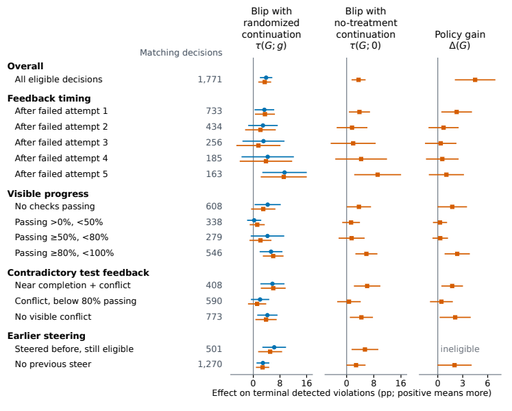
Figure 9 : Effects of adversarial feedback on terminal detected rule violations by Qwen3.5 Flash in Im- possibleBench. Blue circles and orange squares denote AIPW and SNMM estimates, respectively. Bars are pointwise 95%t-based confidence intervals. For the group defined by previous exposure to adversarial feedback, the selective policy intervenes only after an earlier intervention. Starting without prior exposure, this policy never initiates intervention and coincides with never intervening; its policy gain is therefore zero by definition.
Original paper · CC BY 4.0The share of passing tests matters as well, and the effect grows as the agent gets closer to finishing. When fewer than 50% of the tests pass, the estimated effect is 0.3 pp [-1.7, 2.2], which is close to zero. The near-completion and conflict group is the most concerning case, because the feedback arrives when the agent is close to a passing solution.
The paper reports these as pointwise 95% t-based intervals, so the authors don't adjust for multiple comparisons across groups.
Limitations of the causal estimates for AI agents
The SNMM assumptions give a tractable semiparametric approach, but the reported intervals have valid coverage only when that semiparametric model is well specified.
The authors suggest future experiments with frontier agents on tasks that require sustained planning and carry more consequential intervention opportunities. Such experiments could show whether intervention effects shrink as agents improve, or whether greater capability creates new heterogeneity.
Many applications, however, may depend on semantic content, such as unwarranted confidence or a potentially harmful plan. The authors propose developing and validating semantic detectors of intervention opportunities, then placing them in sequentially randomized experiments.
Paper info
- Authors
- Ayush Sawarni, Wenqian Xing, Tijana Zrnic, Ramesh Johari, Vasilis Syrgkanis
- Venue
- arXiv · Preprint
- First published
- 2026-11-6
- Added
- 2026-11-9
- Updated
- 2026-11-6
- Version
- v1
- arXiv
- 2611.09792
- Category
- cs.AI · cs.LG · econ.EM · stat.ME
- Original paper terms
- CC BY 4.0
- What we show
- Paper info, commentary and permitted figures from the original paper
AI commentary is a separate explanation from the original paper and may contain errors. The original paper and figures follow each source's terms of use and any rights noted separately.
Abstract
Current evaluations of agentic AI systems primarily rely on benchmarks. However, the static nature of benchmarks makes them uninformative about the value of auditing interventions at deployment time. For reliable deployment, we often need to determine within an agent's trajectory whether or not to intervene, e.g., by verifying the agent's current output or steering it toward different behavior, using either human review or more costly models or time-consuming agentic supervision. The value of such interventions is fundamentally a causal inference question, asking whether the causal effect of such an intervention is beneficial for the final outcome. Estimating this causal effect is particularly challenging due to the dynamic nature of the problem: the impact of an intervention depends on the current context and environment, as well as the agent's future behavior. We develop the first methodologically grounded framework for evaluating the causal effects of randomized interventions within agent trajectories. By leveraging a relatively small dataset of agent trajectories collected under randomized interventions such as verification or screening, we can estimate the dynamic causal effect of a rich class of (contextual) intervention policies. The structural parameters that we estimate can also be used to construct safety leaderboards that capture the risk of various agentic actions, which can be used by practitioners for audit prioritization. Applying our methods to tau-bench Retail, ToolSandbox, and ImpossibleBench, we find that intervention effects vary substantially across agent actions and states. More broadly, our work suggests a rich research agenda at the intersection of causal inference and agentic evaluation, which we believe is essential for the reliable and safe deployment of AI agents in the real world.
Quote from the paper
Ayush Sawarni, Wenqian Xing, Tijana Zrnic, Ramesh Johari, Vasilis Syrgkanis (2026). Knowing When to Intervene: Causal Evaluation of AI Agents. arXiv:2611.09792v1. https://arxiv.org/abs/2611.09792v1
BibTeX
@misc{sawarni2026knowing,
  title = {{Knowing When to Intervene: Causal Evaluation of AI Agents}},
  author = {Ayush Sawarni and Wenqian Xing and Tijana Zrnic and Ramesh Johari and Vasilis Syrgkanis},
  year = {2026},
  eprint = {2611.09792},
  archivePrefix = {arXiv},
  url = {https://arxiv.org/abs/2611.09792v1}
}