Paper commentary
Lost in Rounding: bf16 Recurrent State Makes Hybrid Reasoning Models Think Longer
Round-to-nearest bf16 state makes hybrid reasoning models reason longer
- Problem Hybrid reasoning models store recurrent state in bf16 with round-to-nearest, so small per-step updates get rounded away. Over long traces the bias builds up, and models reason longer and hit the token cap more often.
- Method The authors replace round-to-nearest with stochastic rounding when writing the recurrent state to the same bf16 cache. Each step then rounds without systematic bias, so small updates survive on average.
- Results On Qwen3.5-9B, stochastic rounding restores accuracy to 87.6%, compared with 70.8% under bf16 round-to-nearest.
Why bf16 state can make models reason longer
Each decoding step, a recurrent layer reads its state from the cache, applies one update and writes the result back. Because the stored value is re-rounded at every step, a small rounding bias gets many chances to build up over a long trace.
A bf16 cache uses half the memory of FP32, and on the authors' servers it admitted twice as many requests per GPU. That saving doesn't settle whether bf16 is safe, because earlier reports disagreed on it. For FP16, Nemotron 3 Super showed verbosity rising by up to 37% and linked the rise to round-to-nearest bias. A vLLM fix reported runaway generations from bf16 rounding in one Nemotron model.
Moving that model to FP32 cut generations hitting the token cap from 23% to 0.25%. LeapQuant found that bf16 state lowered Qwen3.5-9B's AIME score from 87.9% to 72.1%. Yet it found that stochastic rounding helped little for state error.
DAMP attributed FP16's advantage over bf16 at equal storage to its finer resolution. So the open question is whether the effect is a bias that accumulates over steps, or simply too little resolution. The authors test this with same-width stochastic rounding, which writes to the same bf16 cache as RTN. Such a test would show little change if resolution were the whole story.
The study covers six open hybrid reasoning models, against FP32 on the same prompts. Under both sampling and greedy decoding, bf16 RTN lengthens reasoning in five of the six models and raises cap hits. The authors don't claim the mechanism is settled, but the paired design isolates the state dtype as the only change.
How nearest rounding erases a slow decay
Serving engines compute the Mamba-2 update in FP32 and then store the result in the cache dtype. For one head, the update is h_t = e^(−Δ_t a) h_(t−1) + Δ_t B_t x_t, with a > 0 and Δ_t = softplus(· + b_Δ). The GDN head uses a gated delta rule on a matrix state instead, so the rounding question applies to both mixers.
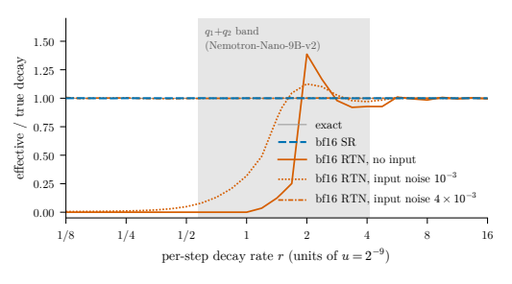
Figure 1 : Effective per-step decay of a quiet leaky integratorh←round (e−rh +ϵ)stored in bf16, relative to the true rate, over 20,000 trajectories. Input noiseϵ has the given standard deviation relative to the initial state. RTN freezes slow decay and distorts it up to about4u; SR is unbiased at every rate. The shaded band is the decay range of the Nemotron-Nano-9B-v2 heads whose SR removes the length effect (§8); the toy explains its upper edge but not its lower edge.
Original paper · CC BY 4.0Round-to-nearest discards any per-step change that is smaller than about u relative to the stored value. When that happens, RTN rounds the update away and the state doesn't move at all. The authors use a one-line leaky integrator, h ← round(e^(−r h)), to show the regimes. RTN freezes decay completely for r ≲ u and distorts it for u < r ≲ 4u.
Above 4u, RTN is nearly unbiased.
Because of that, SR is unbiased at every decay rate, not only above 4u. Figure 1 compares the effective per-step decay over 20,000 trajectories, with RTN, RTN with input noise, and SR. Its shaded band marks the q1+q2 decay range of Nemotron-Nano-9B-v2, the heads whose SR removes the length effect. The toy explains the band's upper edge but not its lower edge, and it doesn't predict which heads matter.
Six models, one switch
Weights and activations stay in bf16 in every arm, so the recurrent state dtype is the only thing that changes. The six models cover two related Mamba-2 models, a Mamba-2 MoE, two GDN models and a parallel hybrid. Nemotron-Nano-9B-v2 and its parent Nemotron-Nano-12B-v2 form one lineage, while Falcon-H1R-7B runs attention and Mamba-2 in parallel in every layer.
Qwen3.5-9B and Qwen3-Next-80B-A3B-Thinking are the two GDN hybrids in the set. The comparison is paired, so each FP32 and bf16 RTN arm sees the same prompts.
Two models also ran 175 LiveCodeBench problems, which the paper uses for its code results. Each model keeps its card's sampling settings, for example temperature 0.6 with top-p 0.95, and Nemotron-3 uses temperature 1.0 and top-p 1.0. Greedy arms set temperature to 0, and the output cap is 32,768 new tokens unless stated.
The authors control for this on Nemotron-3, and on Qwen3.5-9B the cap never binds. Stochastic rounding adds 16 random bits below the bf16 mantissa, so storage and concurrency limits match the bf16 RTN arms.
Where bf16 round-to-nearest lengthens outputs
Five of the six models produce longer outputs when the recurrent state is stored in bf16 with round-to-nearest, compared with FP32 on the same prompts. Nemotron-Nano-9B-v2 reaches ×1.197 and its parent Nemotron-Nano-12B-v2 reaches ×1.188, with caps rising from 1 to 31 and from 0 to 17. Falcon-H1R-7B stays at ×1.008, with caps moving from 26 to 27, so the paper reports no effect for that model.
Figure 2 plots the share of the 590 items finished within each output length, and bf16 round-to-nearest shifts that curve to the right. Each curve ends at one minus the cap rate, so the unfinished items show up at the 32K end of the plot. Under greedy decoding, Nemotron-Nano-9B-v2 reaches ×1.211, with caps rising from 5 to 49. A second Nemotron-Nano-9B-v2 seed gives ×1.231, with caps rising from 0 to 32.
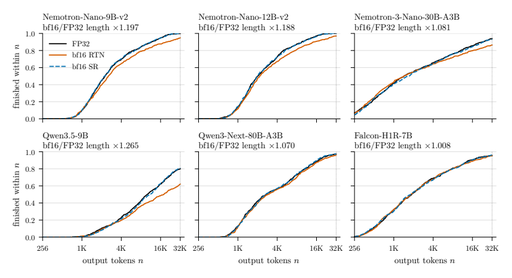
Figure 2 : Share of the 590 items finished withinn output tokens; items that hit the 32K cap never finish, so each curve ends at one minus the cap rate. Titles give the bf16/FP32 length ratio (Table 1).
Original paper · CC BY 4.0 · Yuchuan Weng, Xin Chen, Chi Liu · Lost in Rounding: bf16 Recurrent State Makes Hybrid Reasoning Models Think Longer · Original paper figure · Extracted the figure area from page 4 of the original PDF.On Nemotron-Nano-9B-v2 the length ratio grows with difficulty, from ×1.15 on MATH-500 to ×1.48 on AIME24, ×1.40 on AIME25 and ×1.68 on HMMT. Qwen3.5-9B shows ×1.27, ×1.32, ×1.31 and ×1.16 on the same four sets, so it doesn't follow that pattern. Matching the bf16 arm's per-rank concurrency to the FP32 arm, at 43 requests, leaves a ×1.098 ratio on Nemotron-3.
A second FP32 seed agrees with the first at ×0.982, which the paper reads as the effect not being seed noise.
Longer reasoning or runs that never finish
Rerunning capped items at 128K shows how much of the Qwen3.5-9B accuracy loss survives a larger budget. The 268 Qwen3.5-9B items capped in either arm were rerun at 128K with the same sampling settings. Relaxed accuracy over all 590 items was 93.6% for FP32 and 86.6% for bf16 round-to-nearest.
Much of the remaining loss comes from runs that never finish, and these are more common under bf16. 93 bf16 runs were unfinished at 128K, compared with 44 under FP32. Of the 93 unfinished bf16 runs, 79 (85%) are exact repetition loops. At 32K, exact loops among capped runs had already risen from 72 to 113, while the other five models had at most two per arm.
The authors therefore treat looping as a Qwen3.5-9B result.
Nemotron-Nano-9B-v2 shows a different mix of the two failures in an exploratory 128K rerun of 32 items. bf16 reasoning on these items is ×2.29 longer by geometric mean, yet relaxed accuracy is 89.7% versus 89.8%. So for this model the cost of bf16 round-to-nearest is mainly extra tokens, while Qwen3.5-9B also has runs that never end. A both-finished split misses these non-terminating runs, since it keeps only items that both arms finish.
On that subset accuracy is near ceiling, at 99.7% for Qwen3.5-9B.
Does unbiased rounding at the same width remove the effect
On Qwen3.5-9B, SR on all heads gives a length ratio of ×1.031 and 111 cap hits, versus 223 under bf16 RTN. SR recovered 121 items that bf16 RTN lost and lost 22, and the pre-registered tests for Nemotron-Nano-12B-v2, Qwen3.5-9B and Qwen3-Next passed.
Nemotron-3-Nano-30B-A3B is the exception, because its pre-registered test fails with F_log at 0.38. Full SR removes most of the runaway tail, with 40 of the 45 extra caps gone. Accuracy under SR is 92.2%, close to 92.5% for FP32, but the length shift stays.
The GDN SR arms used Triton's default Philox generator, which makes that kernel slow. A rerun with the integer hash lowbias32 (Wellons, 2018) removes the effect fully, with F_log at 0.97 and interval [0.70, 1.37]. The hash run ends with 113 cap hits and 85.6% accuracy, matching FP32's 118 caps and 85.6%. End to end, the hash run produced 10,393 tokens/s, against 10,163 for a same-day bf16 RTN run.
At matched batch size, the hash variant decodes at 102 to 113% of that run's speed across batch bins.
Resolution still matters for RTN, because FP16 RTN on Nemotron-Nano-9B-v2 is much milder than bf16 RTN. SR keeps the same bf16 storage as RTN, so on Qwen3.5-9B it costs bf16 memory and speed rather than FP32. They didn't test SR on prefill, since prefill still uses RTN.
Code generation: does the length effect carry over to competitive code?
The authors checked whether the bf16 length effect also appears on competitive code, using 175 LiveCodeBench v6 problems. They ran Nemotron-Nano-9B-v2 and Qwen3.5-9B with two samples per problem, under the same settings as the math runs. The unit of analysis is the problem, so log lengths are averaged over its two samples before bootstrapping over problems.
Qwen3.5-9B shows a length ratio of ×1.09 with interval [1.05, 1.13] under bf16 RTN against FP32. More problems gain cap hits than lose them: 65 versus 2 for Nemotron-Nano-9B-v2, and 39 versus 3 for Qwen3.5-9B. Stochastic rounding removes most of the excess, with an F log of 0.95 for Nemotron-Nano-9B-v2 and 0.73 for Qwen3.5-9B.
Pass@1 falls by 12.6 points, with interval [6.9, 18.3], for Nemotron-Nano-9B-v2 under bf16 RTN. Qwen3.5-9B already caps 48% of its FP32 samples, which compresses its length ratio toward 1. On the 86 problems with no FP32 cap, the ratio is ×1.20, an exploratory result the authors had committed in advance to report. Qwen3.5-9B pass@1 falls by 13.4 points, with interval [8.3, 19.1], and stochastic rounding recovers 12.6 of them.
Pass@1 among finished samples is higher under bf16 RTN, at 85.1% against 65.0% for Nemotron-Nano-9B-v2. A finished-only metric would therefore rank bf16 RTN above FP32, which is the selection effect seen on math. Exact loops don't explain the extra caps: 10 of 162 capped Nemotron samples are loops under bf16 RTN, against 12 of 36 under FP32.
Which decay octiles carry the effect
Teacher-forced KL is a natural way to pick heads, because it runs fixed text under each state policy and measures divergence from FP32. The authors ranked Nemotron-Nano-9B-v2's 3456 Mamba heads into octiles by weights-only decay rate. The slowest octile q0 accounts for the most, at 49%, followed by q1 at 37% and q2 at 15%. The order holds on the 50 FP32-generated traces alone (47%, 34%, 16%), so the ranking doesn't come from conditioning on bf16 text.
In closed loop the order changes, and the KL ranking no longer predicts which octiles carry the length effect. SR on q1+q2, which is 25% of heads with per-step decay between 0.57u and 4.1u, removes essentially all the excess, with Flog = 1.03 and interval [0.86, 1.23]. SR on q0 has no detectable effect, with an Flog CI upper bound of 0.07.
The size-matched q0+q3 control removes nothing, so the q1+q2 result isn't a head-count effect.
Q1 and q2 contribute about equally, at 0.40 and 0.43, and together they give 1.03 against a sum of 0.83. The authors read the joint gains as a lead for future work, since groups of heads may need SR together to restore the dynamics. Covering part of the band doesn't give a proportional part of the effect, so the authors don't read these arms as a dose-response curve.
Among four teacher-forced markers, only 'Alternatively' clearly rises in generation under bf16 round-to-nearest, from 1.14 to 1.39 per 1K output tokens, with Wilcoxon p = 2× 10⁻¹⁰.
'Wait', 'Hmm' and 'But' don't rise in closed-loop generation, with p ≥ 0.12. All three pre-registered band tests fail for Qwen3.5-9B, so the concentration in one decay band is specific to Nemotron-Nano-v2. Any such head selection should be validated by closed-loop generation length, since the slowest octile alone recovers nothing.
Where the findings stop
Most arms have a single seed, so the seed-to-seed spread is measured only on a few arms. Nemotron-Nano-9B-v2 has two seeds per main arm, Nemotron-3 has two FP32 seeds, and Qwen3.5-9B has two bf16 RTN runs. The 128K analysis covers two models, and only 32 rerun items exist for Nemotron-Nano-9B-v2.
Concurrency is a confound where the FP32 request cap binds, since FP32 and bf16 arms then run with different concurrency. The authors matched concurrency on Nemotron-3, and on Qwen3.5-9B the cap never binds. Stochastic rounding covers decode only, so prefill still uses RTN. At matched batch size, SR decodes at 96 to 101% of same-day bf16 RTN throughput on the Mamba-2 models.
The main-arm GDN kernel with Triton's default 10-round Philox decodes at 30 to 60% on Qwen3.5-9B and 36 to 85% on Qwen3-Next, and the gap grows at larger batches.
In a kernel microbenchmark at batch 240 with Qwen3.5-9B shapes, the Philox kernel takes ×20 the RTN kernel time. A 4-round Philox or the integer hash lowbias32 brings this to ×1.01 in that benchmark. Head localization holds in one lineage, where band sufficiency replicates in the 12B parent with Flog = 0.84.
The localization fails to transfer to Nemotron-3 and to Qwen3.5-9B, where SR also leaves an unexplained bulk shift in Nemotron-3. The Falcon-H1R null is unexplained, and the prior-art search covered only arXiv and the SGLang and vLLM repositories.
What to report in evaluations
Serving engines disagree on the default state dtype, so evaluators can't assume one value for a given model. For a Qwen3.5 config without mamba_ssm_dtype, vLLM 0.33 uses the model dtype, usually bf16. SGLang 0.5.21 uses FP32 for the same config, so the two engines can give different results for one checkpoint. The paper's Appendix B confirms the fallback: deleting the field from the Qwen3.5-9B config leaves SGLang on its float32 default.
Cap rate and output length should appear next to accuracy, because the precision change moved accuracy mainly through cap hits. On Qwen3.5-9B, cap hits rose from 118 to 223 while accuracy fell from 85.6% to 70.8%. Budget choice changes measured gaps, so a single cap value can hide the effect.
An accuracy split on items that both arms finish can look clean while hiding a real loss. In this study that subset sat near ceiling, at 99.7% for Qwen3.5-9B, so it couldn't reveal the cost of bf16 beyond the budget. Evaluators should rerun capped items at a larger budget, which separates longer reasoning from runs that never end. They should also count exact loops, since 85% of the unfinished bf16 runs were exact loops.
Teacher-forced KL is cheaper than generation, but here it ranked the head groups differently from their closed-loop effect. The slowest octile carried the largest KL share, yet SR on it alone had no detectable effect on length. So the authors recommend validating any state-precision change with closed-loop generation rather than KL alone.
For the fix itself, the authors suggest preferring FP32 state or 16-bit with SR, and checking SR per model because it failed on Nemotron-3. bf16 SR was not yet available in SGLang at the time, and the hash-generator SR run needed no extra memory and was no slower than RTN on Qwen3.5-9B.
Paper info
- Authors
- Yuchuan Weng, Xin Chen, Chi Liu
- Venue
- arXiv · Preprint
- First published
- 2026-11-9
- Added
- 2026-11-10
- Updated
- 2026-11-9
- Version
- v1
- arXiv
- 2611.12127
- Category
- cs.CL · cs.AI
- Original paper terms
- CC BY 4.0
- What we show
- Paper info, commentary and permitted figures from the original paper
AI commentary is a separate explanation from the original paper and may contain errors. The original paper and figures follow each source's terms of use and any rights noted separately.
Abstract
Hybrid reasoning models interleave attention with recurrent mixers such as Mamba-2 and Gated DeltaNet, whose state is cached between decoding steps. Prior work showed that storing this state in FP16 or INT8 with round-to-nearest (RTN) makes Mamba-2 and GDN hybrids more verbose, and that stochastic rounding (SR) fixes it. We study the other 16-bit format that serving engines expose, bf16, on six open hybrid reasoning models and 590 competition-math problems. With bf16 RTN state, five of six models reason longer (geometric-mean length 1.07x to 1.27x; also under greedy decoding in the two models tested) and hit the 32K token cap more often. On Qwen3.5-9B, cap hits rise from 118 to 223 and accuracy falls from 85.6% to 70.8%. On LiveCodeBench, both models tested also reason longer and lose 12.6 and 13.4 points of pass@1. Rerunning the capped items with a 128K budget halves the accuracy gap but does not close it (93.6% vs. 86.6%): bf16 runs that never finish are twice as common, and 85% of them are exact repetition loops. On Nemotron-Nano-9B-v2, by contrast, 30 of 31 extra caps finish at 128K, so the cost there is mostly extra tokens (exploratory). Same-width bf16 SR removes the length increase in four of five affected models, restores Qwen3.5-9B to 87.6% and brings code length and pass@1 near FP32 levels, so the failure is mostly rounding bias, not missing resolution. With an integer-hash random generator, SR on Qwen3.5-9B matches FP32 on cap hits and accuracy (113 vs. 118; 85.6% for both) at the memory and decoding speed of bf16 RTN. In the Nemotron-Nano-v2 lineage, SR on 25% of heads (an intermediate-decay band) removes the effect, while random heads and the top teacher-forced-KL octiles do not; in Nemotron-3 and Qwen3.5-9B the effect is spread across heads. We recommend that evaluations of hybrid models report the state dtype, cap rate and output length alongside accuracy.
Quote from the paper
Yuchuan Weng, Xin Chen, Chi Liu (2026). Lost in Rounding: bf16 Recurrent State Makes Hybrid Reasoning Models Think Longer. arXiv:2611.12127v1. https://arxiv.org/abs/2611.12127v1
BibTeX
@misc{weng2026lost,
  title = {{Lost in Rounding: bf16 Recurrent State Makes Hybrid Reasoning Models Think Longer}},
  author = {Yuchuan Weng and Xin Chen and Chi Liu},
  year = {2026},
  eprint = {2611.12127},
  archivePrefix = {arXiv},
  url = {https://arxiv.org/abs/2611.12127v1}
}