Paper commentary
AdsorbML: A Leap in Efficiency for Adsorption Energy Calculations using Generalizable Machine Learning Potentials
Machine learning potentials can find low-energy adsorbate configurations far faster than DFT
- Problem Finding the lowest-energy adsorbate placement needs many DFT relaxations, and each system can take days or weeks. ML potentials are much faster but their energy error of 0.3 eV is too large for accurate screening.
- Method AdsorbML lets ML potentials relax many candidate placements, then ranks them by energy. Only the best k placements go on to a DFT single-point check or full relaxation.
- Results With k=3, eSCN-MD-Large with ML+SP reaches 87.36% success at a 2296x speedup. DFT-Heur reaches 87.76% at 1.81x.
Why placement search is expensive
The adsorption energy is the global minimum across all potential adsorbate placements and configurations, so one relaxation isn't enough. Finding that minimum is hard because each binding site can be entered in several orientations, and every candidate must be relaxed to a local energy minimum. DFT is the usual tool for that relaxation, and it first runs a single-point calculation that returns the energy and per-atom forces.
Complexity rises as surfaces and adsorbates grow, and a flexible adsorbate adds its own degrees of freedom on top of the placement search.
DFT scales as O(N 3) with the number of electrons, so a single full relaxation can take ∼24 hours. Because many configurations are explored per system, all the DFT calculations for one adsorbate-surface pair can take days or even weeks. As a hypothetical, screening 100,000 materials with 5 adsorbate descriptors, ∼90 surfaces per material, and ∼100 sites per surface would need ∼4.5 billion CPU-days.
ML potentials run orders of magnitude faster than DFT, but their error on relaxed energies in OC20 is 0.3 eV, while the authors want 0.1 eV for accurate screening.
OC20 relaxes only one configuration per adsorbate-surface combination, so its energies are unlikely to be the global minimum. Because of that, OC20 isn't a suitable dataset for finding the minimum binding energy, so the authors built OC20-Dense to test whether a method finds the true minimum. OC20-Dense uses about 1,000 combinations per split, with about 250 from each of the ID, OOD-Adsorbate, OOD-Catalyst, and OOD-Both subsplits.
For each combination, the authors run a dense sampling of initial configurations with DFT to build a strong baseline.
The idea: cheap search, expensive check
AdsorbML lets ML potentials handle the wide search, while DFT only checks a short list of candidates. The authors sample many adsorbate configurations with both heuristic and random strategies and relax each one with an ML potential. Heuristic placements follow commonly used literature strategies, and random placements sample sites across the surface.
The ML relaxed energies are then ranked, and only the best k relaxed energies move on to DFT. Relaxations on GPUs produce these ranked energies, which makes the ML stage cheap relative to DFT.
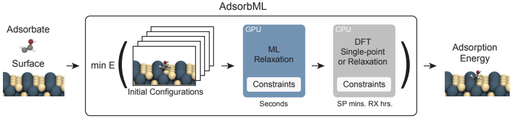
FIG. 2 . The AdsorbML algorithm. Initial configurations are generated via heuristic and random strategies. ML relaxations are performed on GPUs and ranked in order of lowest to highest energy. The best k systems are passed on to DFT for either a single-point (SP) evaluation or a full relaxation (RX) from the ML relaxed structure. Systems not satisfying constraints are filtered at each stage a relaxation is performed. The minimum is taken across all DFT outputs for the final adsorption energy.
Original paper · CC BY 4.0 · Lan, Janice, Palizhati, Aini, Shuaibi, Muhammed, Wood, Brandon M., Wander, Brook, Das, Abhishek, Uyttendaele, Matt, Zitnick, C. Lawrence, Ulissi, Zachary W. · AdsorbML: A Leap in Efficiency for Adsorption Energy Calculations using Generalizable Machine Learning Potentials · Original paper figure · Extracted the figure area from page 6 of the original PDF.The DFT check can be a single-point evaluation, called ML+SP, on each of the best k structures. Alternatively, the DFT check can be a full relaxation started from the ML structure, called ML+RX. Choosing k and the type of DFT check sets the balance between accuracy and speed. For example, eSCN-MD-Large reaches a 87.36% success rate at k = 3 with a speedup of 2296x.
Speedups fall as k grows, because each extra candidate needs more DFT work.
The authors expected this to help because ML potentials are much faster than DFT, while DFT remains the accuracy reference. Small force errors add noise to ML relaxations, so the relaxations can reach configurations the DFT search never explored. That noise is why the ML stage works as a source of candidates rather than as the final answer.
A success means the final energy is within 0.1 eV or lower than the DFT adsorption energy. The authors didn't rely on ML energies alone, because an evaluation without a lower bound could be gamed by predicting low energies.
How a run proceeds step by step
A run starts by generating two kinds of placements for each adsorbate and surface pair. Heuristic placements come from symmetry-based site enumeration in Pymatgen or CatKit, with a random rotation about the z axis and a slight wobble. Random placements sample M=100 sites on the surface, and the adsorbate is placed on each selected site. Placements that sit off the slab or too deep in it are removed before any relaxation.
The random set is meant to be a more exhaustive enumeration, although it can still miss some configurations.
Each ML relaxation stops after 300 steps or once the maximum per-atom force norm reaches 0.02 eV/Å, whichever comes first. All models used these same optimization parameters, and the ML relaxed energies rank the placements from lowest to highest. The best k placements from this ranking are the only ones that go on to DFT.
Relaxed structures are then checked for desorption, dissociation and significant surface changes. Dissociation is detected by comparing connectivity matrices of the adsorbate before and after relaxation. Desorption uses a cushion of 1.5 times the covalent radii, so only systems with no surface interaction are discarded. The clean-slab reference term assumes the surface stays comparable, so a violated case gives an inaccurate adsorption energy.
The authors chose electronic steps as the speedup unit because they track DFT compute time better than ionic steps do. They excluded ML relaxation costs from the speedup, because CPU and GPU timings are hard to normalize. The minimum over the remaining DFT outputs becomes the final adsorption energy.
Test set results for ML+SP and ML+RX
On the OC20-Dense test set, the DFT-Heur baseline is the reference point the hybrid method has to match. DFT-Heur reaches a success rate of 87.76% at a speedup of 1.81x. Success is measured against the DFT-Heur+Rand ground truth, which adds random placements to the heuristic ones. Heuristic placements come from symmetry-based enumeration, so the baseline only searches the sites those rules produce.
With ML+SP, eSCN-MD-Large at k=5 reaches a success rate of 88.27%, slightly better than the DFT-Heur baseline. At k=3, eSCN-MD-Large keeps a success rate of 87.36% while its speedup reaches 2296x. GemNet-OC-MD-Large reaches 84.43% at k=3 with a speedup of 2299x. The authors call the k=3 setting a balanced trade-off between accuracy and speed.
SchNet and DimeNet++ fall far behind under ML+SP, with success rates as low as 3.13% and 7.99%. The authors read this as a sign that their predicted relaxed structures are highly unfavorable. SchNet and DimeNet++ have an average fmax of 2.00 eV/Å and 1.21 eV/Å, respectively. For eSCN-MD-Large and GemNet-OC-MD-Large, the average fmax is 0.15 eV/Å and 0.21 eV/Å, which is closer to valid structures.
Refining the best k with full DFT relaxations, which is ML+RX, raises the success rates further. eSCN-MD-Large and GemNet-OC-MD-Large reach 90.60% and 91.61% success at k=5 under ML+RX. The extra DFT cost reduces speedups, so at k=5 eSCN-MD-Large reaches 215x. At k=5, GemNet-OC-MD-Large reaches a speedup of 172x, while SchNet and DimeNet++ reach 42x and 55x.
Why ML-only energies fall short
Taking ML predictions alone, eSCN-MD-Large reaches 56.52% success on the OC20-Dense test set, with an energy MAE of 0.1739 eV. Table I lists the same metrics for each model, and a prediction counts only if it lies within 0.1 eV of its DFT evaluation. The success rate is measured against the DFT evaluation, so a prediction that lands far from DFT doesn't count as a success.
Energy MAE is computed between predicted ML and DFT energy minima, which tracks how far the ML energies drift from DFT. Of the models, eSCN-MD-Large and GemNet-OC-MD-Large are the top performers on both OC20 and OC22. Those top models still leave a large gap, because the ML-only success rates stay well below the 0.1 eV target.
The authors conclude that ML relaxations without any subsequent DFT aren't yet accurate enough for practical applications. Even the best models like GemNet-OC and eSCN-MD-Large show impressive success rates on OC20-Dense, yet they still miss the threshold. The authors then list observations that can guide future modeling work on this challenge.
Because of that correlation, the authors suggest that relaxation-based IS2RE and S2EF metrics can serve as proxies when training models on OC20.
The ground truth energies in OC20-Dense are an upper bound, since a lower adsorption energy may still exist. An evaluation metric without a lower bound can be gamed by predicting low energies. So the authors recommend a DFT single-point calculation on the OC20-Dense validation set when reporting results. The OC20 validation data shouldn't be used for training when evaluating on OC20-Dense, because OC20-Dense's validation set is a subset of it.
The authors also plan a public evaluation server for DFT evaluation, if there's interest.
Random sampling, deduplication and compute cost
Random sampling shows diminishing returns once most random placements are in the search. On the OC20-Dense validation set, going from heuristic + 80% random to heuristic + 100% random raised success by only 1.6%. By contrast, adding the first 10% of random configurations lifted success from 71.12% to 79.45%. Speedup fell from 2.87 to 2.45 over the same first step, so each added random batch buys less search.
The authors checked these numbers in the SI, where they vary the heuristic-to-random ratio.
Deduplication addresses the case where different initial configurations relax to nearly identical sites. Without it, the best k list can waste DFT calls on redundant structures, and this matters more as random placements grow. The authors cluster configurations with DBSCAN on their ML relaxed energies, then take the lowest energy in each cluster.
The cluster threshold ΔE sets the maximum energy difference between points in one cluster. A ΔE of 0.01 eV gave a minor improvement over no deduplication, and ΔE of 0.02 eV lowered success at every k. The authors call the gains marginal and leave structure-based deduplication for future work.
Compute cost changes the picture once ML time is counted in the speedup. For SCN-MD-Large with ML+SP at k = 1, the speedup drops from 3596x to 1147x when ML compute is included. GemNet-OC-MD-Large falls from 3885x to 1686x in the same setting. For ML+RX, the slowdown is smaller, at 24.6% for SCN-MD-Large and 14.2% for GemNet-OC-MD-Large. The authors note that these models ran off the shelf, without optimization for inference, so ML throughput could improve.
Limits of the search and the benchmark
The enumeration isn't exhaustive, and the authors say so directly. Here they enumerated initial adsorbate-surface configurations instead of searching for the global minimum with smarter methods. They name minima hopping, constrained optimization, Bayesian optimization and a directly learned approach as likely more efficient alternatives. Minima hopping [20] and constrained optimization [19, 21] appear in that list, but the paper doesn't test any of them.
The DFT-Heur+Rand ground truth is an upper bound, since a lower adsorption energy may still exist. Success is therefore judged against a reference that can't prove the true minimum was found.
Random sampling had diminishing returns: the change from heuristic + 80% random DFT to heuristic + 100% random DFT was only 1.6%. Removing systems with nearly the same ML energies gave marginal benefit, so the authors left the question open. The heuristic code changed between splits, so the DFT-Heur baseline reads 71.12% at 2.87x on validation.
On the test split, the same baseline reads 87.76% at 1.81x. Despite these differences, the authors report that results across all models keep the same trends between the two splits.
The authors note that ML relaxations alone aren't accurate enough for practical use, so DFT must follow. Fine-tuning could extend them to metal-organic frameworks and zeolites, but the paper doesn't test that. All models were trained at revised Perdew-Burke-Ernzerhof with no spin-polarization, so other functionals remain untested. Generalizing beyond DFT, to more diverse materials and molecules, is a challenge the authors leave for the community.
Paper info
- Authors
- Lan, Janice, Palizhati, Aini, Shuaibi, Muhammed, Wood, Brandon M., Wander, Brook, Das, Abhishek, Uyttendaele, Matt, Zitnick, C. Lawrence, Ulissi, Zachary W.
- Venue
- arXiv · Preprint
- First published
- 2022-11-29
- Added
- 2026-11-6
- Updated
- 2023-9-15
- Version
- v3
- arXiv
- 2211.16486
- DOI
- 10.1038/s41524-023-01121-5
- Category
- cond-mat.mtrl-sci · cs.LG
- Original paper terms
- CC BY 4.0
- What we show
- Paper info, commentary and permitted figures from the original paper
AI commentary is a separate explanation from the original paper and may contain errors. The original paper and figures follow each source's terms of use and any rights noted separately.
Abstract
Computational catalysis is playing an increasingly significant role in the design of catalysts across a wide range of applications. A common task for many computational methods is the need to accurately compute the adsorption energy for an adsorbate and a catalyst surface of interest. Traditionally, the identification of low energy adsorbate-surface configurations relies on heuristic methods and researcher intuition. As the desire to perform high-throughput screening increases, it becomes challenging to use heuristics and intuition alone. In this paper, we demonstrate machine learning potentials can be leveraged to identify low energy adsorbate-surface configurations more accurately and efficiently. Our algorithm provides a spectrum of trade-offs between accuracy and efficiency, with one balanced option finding the lowest energy configuration 87.36% of the time, while achieving a 2000x speedup in computation. To standardize benchmarking, we introduce the Open Catalyst Dense dataset containing nearly 1,000 diverse surfaces and 100,000 unique configurations.
Quote from the paper
Lan, Janice, Palizhati, Aini, Shuaibi, Muhammed, Wood, Brandon M., Wander, Brook, Das, Abhishek, Uyttendaele, Matt, Zitnick, C. Lawrence, Ulissi, Zachary W. (2022). AdsorbML: A Leap in Efficiency for Adsorption Energy Calculations using Generalizable Machine Learning Potentials. arXiv:2211.16486v3. https://doi.org/10.1038/s41524-023-01121-5
BibTeX
@article{janice2022adsorbml,
  title = {{AdsorbML: A Leap in Efficiency for Adsorption Energy Calculations using Generalizable Machine Learning Potentials}},
  author = {Lan, Janice and Palizhati, Aini and Shuaibi, Muhammed and Wood, Brandon M. and Wander, Brook and Das, Abhishek and Uyttendaele, Matt and Zitnick, C. Lawrence and Ulissi, Zachary W.},
  year = {2022},
  eprint = {2211.16486},
  archivePrefix = {arXiv},
  doi = {10.1038/s41524-023-01121-5},
  url = {https://arxiv.org/abs/2211.16486v3}
}