Paper commentary
GGDriver: Glance at What Is Shared, Gaze at What Differs for Perception-Free Planning
GGDriver lets each planned trajectory pick the camera patches it checks
- Problem Planners score every candidate trajectory against one compressed scene summary, so small cues and plan-specific evidence get washed out. A left turn needs the crosswalk, while a straight path needs the far lane.
- Method GGDriver projects each trajectory's corridor into the camera views and uses the resulting mask to attend to full-resolution patch features. Unlike shared-summary planners, each candidate reads evidence along its own path, both when refining and when ranking.
- Results On the WOD-E2E test set, GGDriver scores 8.110 RFS, and on NAVSIM-v1 it scores 94.2 PDMS, compared to 93.1 for DrivoR.
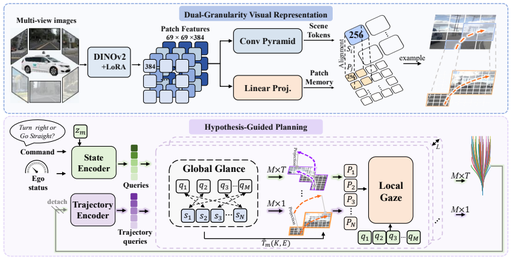
Figure 2 . Overview of GGDriver.Every decoder layer performs a global glance over shared scene tokens, predicts a trajectory, projects its corridor into the cameras, and gazes at the full-resolution patches of the covered blocks. The scorer ranks each proposal after the same gaze along that proposal’s path. The projection needs only the trajectory and the camera calibration. Sizes are per camera, height×width×channels.
Original paper · CC BY 4.0 · Jiawei Sun, Maosen Li, Jiamin Shi, Xiaoxu Zheng, Jiun Tian Hoe, Yechao Bai, Michael Bi Mi · GGDriver: Glance at What Is Shared, Gaze at What Differs for Perception-Free Planning · Original paper figure · Extracted the figure area from page 4 of the original PDF.Why one shared scene summary falls short
Many end-to-end planners pool the scene into one fixed summary before they know which trajectory they will propose, and every candidate then reads that same summary. Perception-free planners drop the 3D boxes, map and motion labels, and DrivoR reports that 16 registers per camera match or exceed perception-heavy planners on NAVSIM.
Different plans need different evidence. A left turn has to check the crosswalk at the exit, while a straight path has to check the far lane, and one shared summary must hold both. Small cues are the second problem: a pedestrian 40m ahead covers only a few patches, and pooling a camera into a few tokens can wash it out.
Letting the trajectory choose the evidence
The key idea is that a planner's own hypotheses decide which image evidence each hypothesis reads. The authors expected this to work because the choice of evidence follows from geometry: the ego trajectory and the camera calibration already say which image regions a vehicle will drive through.
Projection therefore makes the trajectory itself the attention mask, and no learned observation policy is needed. The authors contrast this with a learned selector that would score blocks and keep the top k, which they argue can at best imitate the projection. The acquired evidence is used twice: it refines each hypothesis in the trajectory decoder, and it conditions the scorer that ranks the final proposals.
How one decoder layer runs
Images pass through a DINOv2 ViT-S/14 fine-tuned with LoRA, and the class and register tokens are discarded. A linear layer maps the patch features to width D, and learned position and camera embeddings are added to form the patch memory. The patch memory keeps the backbone's native resolution because it isn't downsampled.
A convolutional pyramid turns the patches of each block into one glance token, so the glance reads a compact summary of all cameras. The authors use a 4 by 4 block grid, which gives 64 blocks over four cameras and 64 glance tokens.
That coarse trajectory, written \( \tilde{T}^{\ell}_{m} \), states where this glance-level intention leads. Its corridor is projected into the cameras to get the set \( \Omega^{\ell}_{m} \) of image blocks it crosses, and this projection has no parameters and no gradient. Each query then runs a masked cross-attention over the patch memory, limited to the blocks in its own set, and a new trajectory is predicted from the updated query.
The corridor is built by extending the path to a minimum length, resampling it at fixed spacing, and placing points at lateral offsets and at heights of 0 and 1 m. A block is included when at least one projected point with depth above d_min lands inside it.
Ranking each proposal on its own path
DrivoR ranks final proposals with one scorer that reads the same scene tokens, so every candidate is judged on a summary shared by all. GGDriver instead fixes each final proposal's corridor, projects it once, and adds a masked cross-attention to those patches after each global cross-attention. At inference the model outputs the highest-scoring proposal.
Training keeps DrivoR's losses and adds one term, a winner-take-all loss applied to the glance trajectory of each layer. Apart from that term, the gaze adds no loss and no label.
Benchmark results for the full model
Its 8.110 RFS comes from a ViT-S backbone trained with imitation learning only, without a language model, world model or perception labels.
On NAVSIM-v1 navtest, GGDriver scored 94.2 PDMS, compared to 93.1 for DrivoR. Most of the 1.1 PDMS gain comes from ego progress, which rose 2.4, and from drivable-area compliance, which rose 0.7. On NAVSIM-v2 navhard it scored 48.6 EPDMS, compared to 48.3 for DrivoR and 48.1 for ZTRS, which is trained with reinforcement learning.
In closed loop on Bench2Drive, GGDriver scored a Driving Score of 72.18 with a 45.0% success rate. That is 8.0 above DriveAdapter, which distills a privileged expert, and 26.4 above UniAD. The authors link the largest margins, in merging and overtaking, to plans that must check the lane they are about to enter.
Where the gain comes from
The authors hold the architecture fixed and change only which patches each hypothesis reads, on the WOD-E2E validation split and NAVSIM-v1 navtest. Random blocks, matched in number to the path corridor, score 7.71 RFS and 83.23 PDMS, compared to 7.87 RFS and 88.21 PDMS for the glance-only model. The NAVSIM-v1 values are means of three runs.
Evidence from outside the hypothesis's own path does not stay neutral, and here it lowers both scores. Reading all 64 blocks gives 7.98 RFS and 90.15 PDMS, compared to 8.07 and 94.20 for the path gaze. The authors attribute this to shared context diluting the evidence where the hypotheses differ, so the path gaze is a better inductive bias rather than a cheaper approximation of dense attention.
Compared with the glance-only model, the scorer gaze adds 0.15 RFS and 4.4 PDMS, and the decoder gaze adds 0.06 RFS and 2.2 PDMS. Ranking therefore carries more of the gain, and using both uses together reaches 8.07 RFS and 94.20 PDMS. The WOD-E2E rows share one schedule and seed.
Figure 3 shows six NAVSIM-v1 scenes in which the glance trajectory is 2.3 to 3.4m off, and the gaze reads the blocks that hold the evidence against it. These six cases illustrate the mechanism, and the paper gives no rate for them.
Moving the gaze across planners
The gaze needs only the trajectory and the calibration, so the authors add it unchanged to DrivoR and keep its registers as the glance. PDMS rises from 93.1 to 93.8 and EPDMS from 48.3 to 50.9.
On DiffusionDrive, a diffusion planner on a perception-supervised BEV with a ResNet-34 backbone, the gaze raises PDMS from 88.1 to 90.1 and EPDMS from 27.5 to 30.1.
The token grid is GGDriver's glance, and without the gaze it scores 88.2 PDMS, compared to 93.1 for DrivoR registers. The authors conclude that the gain over DrivoR comes from the gaze rather than from the scene tokens.
Cost and limits
The head grows from 2.2 to 40.5 GFLOPs, but the backbone dominates, so total compute grows by 2.1%. These costs are measured on NAVSIM-v1 with 672×1148 images from four cameras.
The method also depends on accurate camera calibration, and the closed-loop evaluation is limited to simulation. All benchmarks use one corridor width of 3 m, so the corridor choice was not varied in these experiments.
Paper info
- Authors
- Jiawei Sun, Maosen Li, Jiamin Shi, Xiaoxu Zheng, Jiun Tian Hoe, Yechao Bai, Michael Bi Mi
- Venue
- arXiv · Preprint
- First published
- 2026-11-20
- Added
- 2026-11-23
- Updated
- 2026-11-20
- Version
- v1
- arXiv
- 2611.27330
- Category
- cs.AI
- Original paper terms
- CC BY 4.0
- What we show
- Paper info, commentary and permitted figures from the original paper
AI commentary is a separate explanation from the original paper and may contain errors. The original paper and figures follow each source's terms of use and any rights noted separately.
Abstract
A planner deciding whether to turn left or continue straight needs to inspect different parts of the scene for each maneuver. Yet many end-to-end driving planners evaluate every candidate trajectory against the same compressed scene representation. We let each candidate select the visual evidence used to refine and score it. A global glance first produces trajectory hypotheses from shared scene features. We then project a corridor around each trajectory into the camera views and use the resulting mask to attend to patch features at the backbone's native resolution. After refinement, the scorer projects each final proposal again and ranks it using evidence along its own path. This geometric selection requires only the predicted trajectory and camera calibration. On three planners with different scene representations (learned registers, a perception-supervised bird's-eye-view grid, and a coarse image-token grid), adding this gaze improves planning scores. In ablations, path-aligned patches outperform both a matched number of randomly selected patches and attention over all patches. Using the gaze for ranking yields larger gains than using it for refinement alone. With a ViT-S backbone and no perception labels, GGDriver achieves a rater feedback score of 8.110 on the WOD-E2E test set, 94.2 PDMS on NAVSIM-v1, 48.6 EPDMS on NAVSIM-v2, and a closed-loop Driving Score of 72.18 on Bench2Drive.
Quote from the paper
Jiawei Sun, Maosen Li, Jiamin Shi, Xiaoxu Zheng, Jiun Tian Hoe, Yechao Bai, Michael Bi Mi (2026). GGDriver: Glance at What Is Shared, Gaze at What Differs for Perception-Free Planning. arXiv:2611.27330v1. https://arxiv.org/abs/2611.27330v1
BibTeX
@misc{sun2026ggdriver,
  title = {{GGDriver: Glance at What Is Shared, Gaze at What Differs for Perception-Free Planning}},
  author = {Jiawei Sun and Maosen Li and Jiamin Shi and Xiaoxu Zheng and Jiun Tian Hoe and Yechao Bai and Michael Bi Mi},
  year = {2026},
  eprint = {2611.27330},
  archivePrefix = {arXiv},
  url = {https://arxiv.org/abs/2611.27330v1}
}