Paper commentary
Prune Gradually, Adapt Sparsely: Efficient Pruning of Large Language Models at Extreme Sparsity
ETAPS prunes LLMs gradually and beats ELSA at extreme sparsity
- Problem One-shot pruning loses quality as sparsity rises, and strong mask-optimizing methods like ELSA need model-sized optimizer state. Recovery after pruning also degrades sharply at 90% to 99% sparsity.
- Method ETAPS removes weights a fraction at a time and trains a small sparse delta on frozen weights between stages. The adapted model supplies gradients that guide the next mask, without model-sized optimizer state.
- Results ETAPS reaches 20.98 WikiText-2 perplexity at 90% sparsity on LLaMA2-7B, compared with 27.98 for ELSA.
Why pruning stalls at extreme sparsity
Weight sparsity matters for inference because it cuts parameter storage and weight traffic, and the savings grow as more weights are removed. The catch is that pruning becomes least forgiving exactly where the rewards are largest, at 90% to 99% sparsity. Conventional methods degrade sharply at high compression, so the paper targets this regime where recovering quality is hardest.
One-shot methods such as Wanda, SparseGPT and Pruner-Zero are the cheapest route into sparsity. They build a mask from a small calibration set with a cheap criterion and no retraining. They stay robust at 50% to 60% compression, but their performance degrades significantly at higher sparsity levels. The authors explain this as a mismatch: local criteria favor solutions misaligned with the end-to-end objective, so errors accumulate as sparsity increases.
Recovery after pruning is the natural fix, because surviving weights can compensate for pruning-induced errors through end-to-end loss gradients. Even so, recovered models degrade sharply at 90% to 99% sparsity, and SEFT's quality depends on the pruning method used to initialize it.
That memory cost is the gap ETAPS sets out to close.
Gradual removal and a sparse delta
ETAPS removes weights a fraction at a time and trains only a small sparse delta on top of frozen pretrained weights. Each pruning step stays small enough for the sparse delta to compensate, so the adapted model can supply gradients for the next mask. The effective weights at stage i are M_i ⊙ (θ + δ_i), where θ stays frozen and each mask M_i is binary.
The masks are strictly nested, so a weight pruned at one stage can't return at a later one.
The delta's support Φ_i is restricted to surviving coordinates, and it holds at most d_ϕ entries fixed from the dense-model budget. Within each stage, the sparse delta adapts under the current support, which compensates for past pruning perturbations. The adaptation also accumulates the gradient statistic that selects the next pruning mask in the same backward passes.
The authors argue that the two ingredients support each other at extreme sparsity. A model with few trainable parameters struggles to recover when most of its weights vanish at once. That same model recovers better when the weights are removed a fraction at a time. The ablations show that progressive pruning beats direct projection, and that the gap grows with sparsity.
The sparsity follows a cubic schedule from S_0 = 0 to S_max over P pruning boundaries. Adaptation intervals grow with the stage index, so later, higher-sparsity stages get longer adaptation time. ETAPS uses this increasing allocation as a scheduling choice, and the paper compares it against a uniform allocation.
What happens inside one stage
The sparsity target follows the cubic profile of Zhu and Gupta, with the schedule starting at zero and ending at the maximum sparsity. Because the cube makes early increments the largest, a large share of the sparsity is added in the first stages. Each stage i keeps exactly K_i = floor((1 - S_i) d_theta) weights, so the mask shrinks along a strictly nested sequence.
ETAPS applies the cubic profile over P pruning boundaries, so the sparsity steps are set by the stage index alone.
Adaptation time is split separately from the sparsity profile, so boundaries are placed on a different curve. The boundary b_i is round(T i(i+1) / (P(P+1))) and the interval k_i equals b_i minus b_{i-1}, which makes later intervals longer. With the default P of 32 and T of 4096, the interval grows from 8 steps to 248 steps. The last interval is a fixed-mask recovery phase that takes 6.1% of the budget and collects no statistic for another boundary.
Inside an interval, the sparse delta is trained under the current mask to minimize the end-to-end loss over its support. The same backward passes accumulate the gradient statistic, which averages the absolute micro-batch gradient for each weight over the interval. The absolute value is taken per micro-batch before averaging, so the statistic isn't the absolute value of an accumulated gradient.
No extra forward or backward pass is needed, although the dense backward and a dense saliency buffer remain.
At the next boundary, ETAPS scores each surviving weight by its effective magnitude multiplied by its accumulated gradient statistic. The globally highest-scoring K_{i+1} coordinates survive, which the authors select with a streaming histogram and residual ranking. That selection keeps no second dense score buffer while enforcing the requested global cardinality.
The delta support moves too, since surviving entries keep their state and freed slots go to coordinates with the largest accumulated gradients. Each module's delta budget stays fixed, so a module with too few survivors shrinks its active delta instead of borrowing budget.
Results against ELSA and recovery baselines
ETAPS keeps its lead over ELSA across six models, from 125M to 13B parameters. ETAPS achieves lower perplexity than ELSA at every sparsity from 50% to 90%, with reductions reaching up to 42%. At 70% sparsity on LLaMA-2-13B, ETAPS reaches 9.37 and 9.29, compared to 11.14 and 12.20 for ELSA. The ELSA numbers for LLaMA-2-13B come from Lee et al.
(2026), so the authors didn't re-run that baseline.
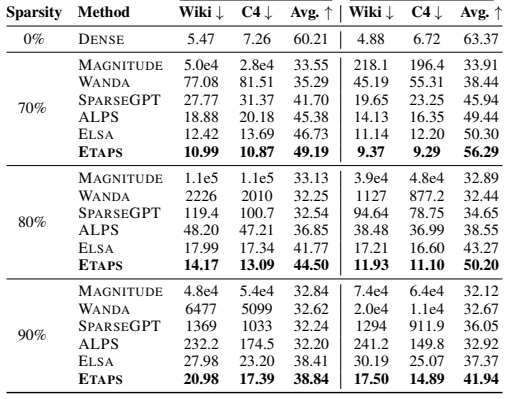
Table 1 : LLaMA-2-7B and LLaMA-2-13B at 70%–90% sparsity: perplexity (↓) and average zero- shot accuracy (↑, %). The ELSA13-B results are taken from (Lee et al., 2026).
Original paper · CC BY 4.0 · Jean Lucien Randrianantenaina, Hung Nguyen, Nasib Ullah, Jinbin Zhang, Nilesh Gupta, Inderjit S. Dhillon, Rohit Babbar · Prune Gradually, Adapt Sparsely: Efficient Pruning of Large Language Models at Extreme Sparsity · Original paper figure · Extracted the figure area from page 6 of the original PDF.At 95% and 99% on LLaMA-2-7B, ETAPS reaches 28.56 and 46.13 WikiText-2 perplexity. ELSA reaches 33.22 and 55.58 at those same two sparsities, so the gap widens as sparsity rises. Across six dataset-sparsity comparisons from 90% to 99%, ETAPS has 14.0% to 25.0% lower perplexity than ELSA. The authors read this as evidence that building the support during adaptation beats recovering from a fixed starting mask.
Recovery quality depends on the starting checkpoint, because SEFT lands at different quality depending on its initialization.
On LLaMA-2-7B, ETAPS has the lowest perplexity of all evaluated methods across 50% to 99% sparsity. On LLaMA-2-13B, ETAPS leads at each level from 70% to 90%, reaching 17.50 and 14.89 at 90% sparsity.
Scaling ETAPS to 27B to 70B models at 90% sparsity
ELSA-L uses quantized optimizer and auxiliary state, and it was reproduced only on Gemma-2-27B, its largest reported scale. On DeepSeek-67B, ETAPS reaches 13.00 WikiText-2 and 14.65 C4 perplexity. On LLaMA-2-70B, ETAPS reaches 11.69 WikiText-2 and 11.00 C4 perplexity. These two models have no ELSA number, so they are compared only with one-shot baselines such as Wanda and SparseGPT.
On both models, Wanda and SparseGPT reach far higher perplexity than ETAPS at the same sparsity. The authors run the same pruning procedure at these sizes without changing its core formulation. The multi-GPU runs serve memory capacity rather than throughput. So they show that execution is feasible, but they don't establish an efficient multi-GPU implementation.
The pruning cost comparison on LLaMA-2-7B is reported separately, at 90% sparsity on NVIDIA H200 NVL GPUs. One-shot methods are substantially cheaper there, but they degrade sharply at this sparsity. Post-pruning recovery improves quality, but it adds compute cost. The state metrics exclude activations and transient buffers, so they aren't peak runtime VRAM.
They didn't tune each model-sparsity configuration separately. The reported results come from single experimental runs. The delta budget and module-wise sparsity allocation remain largely empirical choices.
Memory and GPU-hour cost against ELSA
On LLaMA-2-7B at 90% sparsity, ETAPS reaches 20.98 WikiText-2 and 17.39 C4 perplexity in 1.66 GPU-hours on one H200. ELSA reproduction reaches 27.98 and 23.20 perplexity using 3.24 GPU-hours across four H200s. Because ETAPS uses 49% fewer aggregate GPU-hours while reaching lower perplexity, the accuracy gain doesn't come from extra compute.
ELSA's parallel execution gives it a shorter wall-clock time, at 0.81 hours against 1.66 for ETAPS. The comparison counts aggregate GPU-hours, so the four ELSA GPUs are charged for their combined running time.
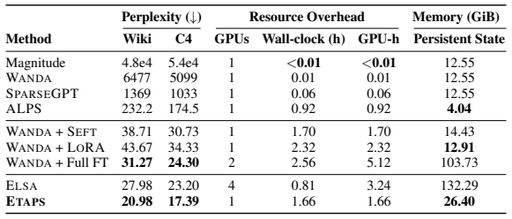
Table 4 : Resource overhead and perplexity (↓) for 90%-sparse LLaMA-2-7B on NVIDIA H200 NVL GPUs. Persistent state denotes aggregate batch-independent model, optimizer, auxiliary, and saliency memory (excluding activations).
Original paper · CC BY 4.0Memory is the other side of the trade-off, and ETAPS needs 26.40 GiB of aggregate persistent pruning state. The persistent state covers model, optimizer, auxiliary and saliency memory, but it excludes activations and other transient buffers. Those excluded buffers mean the numbers are not a peak runtime VRAM figure.
Cheaper one-shot runs exist, and ALPS takes 0.92 GPU-hours on one GPU. ALPS reaches only 232.2 WikiText-2 perplexity at that cost, so cheapness alone doesn't give quality. Among the methods in Table 4, ETAPS is the only one that combines low perplexity with a moderate GPU-hour budget. The ablations that follow in Section 4.4 test which design choices produce this gain.
Under the same comparison, ETAPS's lower perplexity than ELSA holds at 90% sparsity.
Which design choices carry the gain
Direct projection versus progressive pruning isolates the pruning trajectory under the same adaptation budget. At 90%, direct projection reaches 34.17 WikiText-2 and 23.14 C4, versus 20.98 and 17.39 for ETAPS. The authors attribute this gap to removing 90% of the weights in one step, which the fixed-budget delta can't fully offset. Moving from one stage to four stages lowers WikiText-2 perplexity from 34.17 to 22.04.
Going further, up to 32 stages, gives smaller gains, from 22.04 down to 20.98. The authors read the advantage as coming mainly from using multiple stages, not from a fine-grained schedule with many stages.
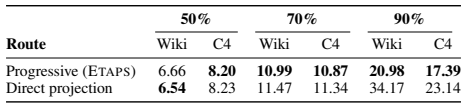
Table 5 : Direct versus progressive pruning on LLaMA-2-7B (perplexity↓).
Original paper · CC BY 4.0Keeping the total optimizer budget fixed, the next control compares increasing adaptation intervals with uniform ones. At 50%, the two allocations perform comparably. At 90%, the increasing allocation reaches 20.98 WikiText-2 and 17.39 C4, against 23.19 and 18.63 for uniform intervals.
The saliency control compares three criteria for choosing which weights survive the next pruning step. At 50%, the three scores stay close, with the default reaching 6.66 WikiText-2. At 90%, magnitude-only selection rises to 32.64 WikiText-2 and 24.52 C4, against 20.98 and 17.39 for the default.
Setting the delta budget to zero turns off sparse-delta adaptation while the progressive mask updates continue. At 90%, this control collapses to 463.15 WikiText-2 and 349.50 C4 perplexity. A small budget with r=8 recovers to 20.70 WikiText-2 and 18.80 C4 on LLaMA-2-7B. Here r is a LoRA-equivalent parameter budget, not a low-rank parameterization of the delta.
The authors didn't tune r per model or sparsity, and they fixed the default at r=32. They conclude that sparse adaptation is essential in the high-sparsity regime.
Limitations and what the measurements leave out
The measurements don't cover backward compute, because the backward pass stays dense in ETAPS. The bf16 saliency accumulator is also dense, so the savings come from optimizer state rather than from backward FLOPs. The state metrics exclude activations and transient buffers, so they shouldn't be read as peak runtime VRAM. For the 27B to 70B models, the authors used multi-GPU execution mainly to fit memory capacity, not to scale throughput.
That shows execution feasibility, but it doesn't establish an efficient multi-GPU implementation.
Hyperparameter tuning was limited, since the authors picked one model-specific peak learning rate at 90% sparsity. They kept the other protocol choices fixed rather than tuning each model and sparsity configuration. The reported results come from single experimental runs, though the pruning support is strictly monotonic. The pruning schedule, delta budget and module-wise sparsity allocation remain empirical choices, with no principled method given.
Perplexity and multiple-choice zero-shot accuracy don't capture open-ended generation, reasoning, calibration or safety preservation. The authors didn't evaluate end-to-end sparse inference latency. The ELSA-L comparison exists only on Gemma-2-27B, so the DeepSeek-67B and LLaMA-2-70B results have no ELSA-L counterpart. Those two larger models are compared only against scalable one-shot baselines such as WANDA and SPARSEGPT.
Paper info
- Authors
- Jean Lucien Randrianantenaina, Hung Nguyen, Nasib Ullah, Jinbin Zhang, Nilesh Gupta, Inderjit S. Dhillon, Rohit Babbar
- Venue
- arXiv · Preprint
- First published
- 2026-10-30
- Added
- 2026-11-7
- Updated
- 2026-10-30
- Version
- v1
- arXiv
- 2610.41968
- Category
- cs.AI
- Original paper terms
- CC BY 4.0
- What we show
- Paper info, commentary and permitted figures from the original paper
AI commentary is a separate explanation from the original paper and may contain errors. The original paper and figures follow each source's terms of use and any rights noted separately.
Abstract
Weight pruning can reduce the storage and inference cost of large language models (LLMs), but preserving quality at high sparsity levels remains challenging. Existing methods face a quality-cost trade-off in this regime. One-shot pruning is cheap but degrades sharply as sparsity increases, even when followed by post-pruning recovery. A growing line of work instead optimizes the mask directly from the dense model under the end-to-end objective; among these methods, [Lee et al.,2026], the recent state of the art at extreme sparsity, reaches high quality but at the cost of model-sized optimizer state and auxiliary variables. To address this gap, we propose ETAPS, which prunes gradually and adapts sparsely: it tightens a global sparsity constraint in progressive stages while training a sparse delta with a small, fixed budget. Our key observation is that gradual weight removal keeps each pruning step small enough for sparse adaptation to compensate, allowing the adapted model to provide end-to-end gradients that guide the next pruning decision without model-sized optimizer state. Across six models from 125M to 13B parameters, ETAPS achieves lower perplexity than ELSA at every evaluated sparsity from 50% to 90%, with perplexity reductions of up to 42%. ETAPS is also far cheaper: at 90% sparsity, it prunes LLaMA2-7B on a single H200, where ELSA uses four, with $5.0\times$ smaller total persistent state and 49% fewer GPU-hours. Together, our findings point to a promising direction for achieving high quality in demanding regimes such as extreme sparsity at substantially lower cost.
Quote from the paper
Jean Lucien Randrianantenaina, Hung Nguyen, Nasib Ullah, Jinbin Zhang, Nilesh Gupta, Inderjit S. Dhillon, Rohit Babbar (2026). Prune Gradually, Adapt Sparsely: Efficient Pruning of Large Language Models at Extreme Sparsity. arXiv:2610.41968v1. https://arxiv.org/abs/2610.41968v1
BibTeX
@misc{randrianantenaina2026prune,
  title = {{Prune Gradually, Adapt Sparsely: Efficient Pruning of Large Language Models at Extreme Sparsity}},
  author = {Jean Lucien Randrianantenaina and Hung Nguyen and Nasib Ullah and Jinbin Zhang and Nilesh Gupta and Inderjit S. Dhillon and Rohit Babbar},
  year = {2026},
  eprint = {2610.41968},
  archivePrefix = {arXiv},
  url = {https://arxiv.org/abs/2610.41968v1}
}