Paper commentary
MOMASPLAT: Dynamic Novel-View Demonstration Augmentation for Mobile Manipulation
MOMASPLAT renders demonstrations from unseen base poses, including object interactions
- Problem Visuomotor policies fail when the robot base ends up at a different pose than during demonstration. Prior augmentation methods assume a static scene, so they cannot re-render the manipulated object after contact.
- Method MOMASPLAT models the static scene and the manipulated object as separate 3D Gaussian splat models. It re-renders both from sampled base poses and retargets the actions to match.
- Results MOMASPLAT succeeds on 37% of unseen-pose evaluations averaged over five tasks. One-Thousand Trajectories reaches 17% on the same evaluations.
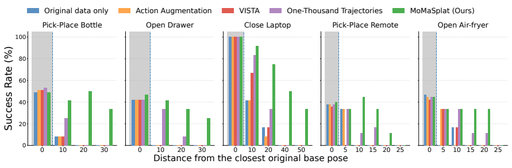
Fig. 4 :Policy success across base poses.For each task, we evaluate 12 unseen base locations distributed across categorical distance bins that vary per task, with 3 trials per pose, and report success rate by distance to the nearest demonstration pose. The shaded gray region denotes the original base poses; locations 5–50 cm away are unseen deployment poses. MOMASPLATmaintains substantially higher success as the base pose shifts away from the source demonstrations (whereSource Onlyis labeled “Original data only”).
Original paper · CC BY 4.0 · Sateesh Kumar, Arnav Balaji, Arpit Bahety, Skand Peri, Georgios Pavlakos, Roberto Martín-Martín · MOMASPLAT: Dynamic Novel-View Demonstration Augmentation for Mobile Manipulation · Original paper figure · Extracted the figure area from page 7 of the original PDF.Why base pose shifts break augmentation
A policy trained at one base pose often fails once the camera sits somewhere else. Mobile manipulators rarely return to the same spot, because navigation uncertainty, localization drift, obstacle avoidance, and imperfect planning move the base. Robust deployment therefore needs a visuomotor policy that generalizes across a distribution of base poses, not a single viewpoint.
Collecting demonstrations from many robot locations would solve this, but large-scale teleoperation is expensive and hard to scale. Prior NVS methods assume a static scene, so they fail during object interaction, the most important part of manipulation. Because the manipulated object moves throughout the demonstration, these methods cannot consistently re-render it during the post-contact interaction phase.
As a result, they restrict augmentation to pre-contact motions or produce geometrically inconsistent generations.
The related work makes the same point for specific methods. VISTA and Yang et al. focus on third-person tabletop settings and require multi-camera pre-scans. One-Thousand Trajectories supports moving eye-in-hand cameras, and EgoDemoGen generates paired egocentric observations and actions. Even so, these methods don't explicitly reconstruct dynamic objects, so they stay limited to pre-contact motion.
MoMaSplat instead models the static scene and manipulated objects jointly, so augmentation covers both pre-contact and post-contact phases.
Splitting the scene from the moving object
MOMASPLAT models the static scene and the manipulated object as two separate 3D models instead of one static scene. Navigation trajectories keep the object static, so they act as the bridge that registers both models in one metric frame. The authors build on the observation that standard mobile manipulation data already provides multi-view coverage of both the scene and the object.
Manipulation trajectories capture the object in motion, which lets the object model follow its trajectory during the interaction.
For the scene, the robot's camera during navigation supplies diverse viewpoints, so no external cameras or scanning are needed. The photometric loss is paired with WildGaussians, which down-weights transient content that changes between navigation runs. Pixels of the manipulated object and the robot are masked during scene fitting, so the object isn't baked into the scene as a static ghost.
The authors take the scale from the robot's onboard depth sensor, using the median per-pixel ratio between measured and rendered depth.
The object model starts from object-masked frames, because correspondence methods like COLMAP fit small, weakly-textured objects poorly. Instance-level pose trackers would need an existing 3D model of the object, which the authors don't have. Instead, FastVGGT receives the object-masked frames and predicts object-relative camera poses in its own internal frame.
Because the object poses lie in a different frame than the scene, the Umeyama algorithm estimates a Sim(3) transform using navigation frames as shared references. Navigation frames are the right bridge because the object is static there, so the recovered motion comes only from the camera. The aligned object poses are then optimized jointly with the Gaussian parameters of the object model, backpropagating the photometric loss through both.
For articulated objects, the moving rigid link, such as a laptop lid, becomes the object model while the static remainder stays in the scene.
Object model and frame alignment
The object model starts from a problem that the scene model does not have, because COLMAP-style correspondence works poorly on small, weakly textured objects. Instead, MOMASPLAT segments the manipulated object in each frame and passes only the masked frames to FastVGGT. These object-relative poses live in the model's internal frame v, with arbitrary scale, orientation and origin.
The scene is expressed in the metric world frame w, so the two reconstructions still have to be registered. The navigation frames serve as the bridge, because the object stays static there and any pose change comes from the robot's camera. On those selected frames, the same cameras are posed once by the feed-forward model in v and once by structure-from-motion in w.
The two trajectories therefore describe the same motion up to an unknown Sim(3) transformation. The authors solve for this transformation S in closed form with the Umeyama algorithm, using 50 frames from one navigation demonstration. Applying S to the estimated poses gives the aligned object trajectory in the world frame.
The aligned poses are then refined together with the Gaussian parameters of the object model G obj. The photometric loss is backpropagated through both the poses and the Gaussians, which yields a pose-disentangled representation. This representation can be rendered at arbitrary 6-DoF poses when composited into novel-pose observations. For articulated objects, a moving part such as a laptop lid or an air fryer basket is modeled as G obj, while the static remainder stays in the scene.
Rendering and retargeting at new base poses
MOMASPLAT sets the heading of each sampled base pose so the object stays centered in the egocentric camera's view. A sampled pose is kept only if the source arm trajectory has a valid inverse-kinematics solution at several probe timesteps. Infeasible poses are rejected and resampled, so every kept pose can reproduce the end-effector motion relative to the object.
MOMASPLAT places the egocentric camera at its mounted offset from the sampled base, using forward kinematics and the recorded configuration. It renders the scene from the scene model, and it renders the object from the object model moved to its source-demonstration pose. The robot is rendered in OmniGibson after inverse kinematics finds joints that keep the end-effector at the same place relative to the object.
The three RGB layers are sorted per pixel by depth and merged with front-to-back alpha compositing. The merged color is c equals the sum over i of c_i alpha_i times the product of (1 minus alpha_j) for j below i, with layer 1 nearest. Nearer layers therefore block farther ones, so the rendered view matches what a physical camera at the sampled location would see.
Proprioception and actions are both expressed in the robot base frame, so a base move changes both of them. The end-effector pose is moved by the base transform, while the gripper state is kept unchanged. Translation deltas are rotated by the rotation part of the transform, so they express the same world-frame displacement. Rotation deltas are conjugated by that rotation, which turns the rotation axis but keeps the rotation angle.
The gripper command passes through unchanged, and the retargeted action is paired with the virtual images as one synthetic demonstration.
Policy success at unseen base poses
At the original base poses, the authors report that all methods perform comparably, so the gains appear only at unseen poses. Each method generates 10 synthetic demonstrations per source demonstration, and training minimizes the noise prediction loss over the mixed dataset.
VISTA performs poorly throughout, because it was designed for static-base settings and doesn't transform actions to match the synthesized viewpoints. VISTA's lack of temporal consistency also produces jittery camera trajectories that further degrade its augmented data.
One-Thousand Trajectories degrades more gracefully than the other baselines, but it still falls off at large distances. It augments only the free-space approach motion, so it doesn't cover the post-contact interaction phase. MOMASPLAT achieves the highest overall unseen-pose success rate on every task. At 30 cm on Pick-Place Bottle, MOMASPLAT reaches 33%, and at 40 cm on Close Laptop it reaches 50%.
At those distances every baseline has dropped to zero success.
The scale study varies the number of source demonstrations on the Pick-Place Bottle task only, using 10, 50, and 90 demonstrations. Because the study covers one task, it doesn't show how this trend holds on the other tasks. One-Thousand Trajectories was limited on Pick-Place Bottle to demonstrations whose initial object pose matched its static reconstruction.
That restriction leaves it with 400 synthetic demonstrations there, while the other methods produce 750 to 900.
Fidelity against simulator ground truth
Simulation gives MOMASPLAT an exact reference that the real world cannot provide, because the transformed actions can be replayed. Here the distance measure is how far each generated view lies from the views used to build the reconstruction, not the distance between base poses.
The static scene does not change within a demonstration, so the scene is scored once per demonstration instead of on every frame. The scene splat and the empty simulated scene are rendered from the same camera pose for this comparison. PSNR, SSIM, and LPIPS are reported over the full image, the scene, and the robot and object regions, with masks taken from the simulator's segmentation.
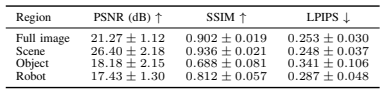
Figures from the paper TABLE I:Generated-observation fidelity against simulator ground truth.Mean±std over75generated demonstrations spanning viewpoints with distances of0.4–27.3cm from the reconstruction views.Full image, object, androbotuse every tenth frame (2486total frames), with object and robot restricted to their masks;scene PSNRevaluation uses one frame per demonstration (75in total).
Original paper · CC BY 4.0The lower object score reflects the harder problem of reconstructing a moving object from limited viewpoints. The robot error comes mainly from lighting and shadow differences introduced during compositing.
On real data, the authors mask out the robot and the manipulated object before scoring the scene. The authors skip full-image metrics on real data, because the simulated robot looks different from the real one and that difference dominates the pixel error.
Limits of static assumptions and non-physical replay
The authors list these as the conditions where the method's reconstruction becomes challenging, so they don't claim it handles them. Regions the object covered in its initial state, such as the surface beneath a lifted bottle, are never observed. Those regions stay unmodeled when they are uncovered later in the demonstration.
MOMASPLAT replays the source object trajectory without modeling contact forces or dynamics. Because of that, the synthesized demonstrations are non-physical even when the rendered images look right. The method also depends on consistent open-world segmentation, so segmentation errors propagate into the reconstruction. View quality depends on the coverage of the navigation data, so sparse navigation limits which viewpoints can be rendered.
They don't test these settings in the paper, so the reported gains apply to the five tasks and three scenes studied. The paper's conclusion still reports gains across those five real-world tasks, with the baselines failing at larger distances.
Paper info
- Authors
- Sateesh Kumar, Arnav Balaji, Arpit Bahety, Skand Peri, Georgios Pavlakos, Roberto Martín-Martín
- Venue
- arXiv · Preprint
- First published
- 2026-11-5
- Added
- 2026-11-7
- Updated
- 2026-11-5
- Version
- v1
- arXiv
- 2611.08372
- Category
- cs.RO · cs.AI · cs.CV
- Original paper terms
- CC BY 4.0
- What we show
- Paper info, commentary and permitted figures from the original paper
AI commentary is a separate explanation from the original paper and may contain errors. The original paper and figures follow each source's terms of use and any rights noted separately.
Abstract
Visuomotor policies trained through imitation learning are highly sensitive to changes in camera viewpoint. This is particularly problematic for mobile manipulation (MoMa), where robots rarely execute manipulation from the exact same base pose used during demonstration collection due to navigation uncertainty, localization drift, and environmental constraints. Recent approaches use novel-view synthesis (NVS) to augment demonstrations with unseen viewpoints, but they assume static scenes and therefore fail to re-render the manipulated object during the post-contact interaction phase, leaving the most critical parts of the demonstration unaugmented. We present MOMASPLAT, a novel-view demonstration augmentation framework for mobile manipulation that synthesizes full manipulation trajectories from unseen robot base poses, including dynamic object interactions. Our key insight is that standard MoMa data collection naturally provides the multiview observations needed to reconstruct both the static scene and the manipulated object in 3D. MOMASPLAT combines 3D Gaussian Splatting, feed-forward 3D foundation models, and kinematics-based action retargeting to separately reconstruct the scene and manipulated object, render them from novel viewpoints, and generate geometrically consistent synthetic demonstrations paired with transformed actions. We evaluate MOMASPLAT on five real-world mobile manipulation tasks involving both rigid and articulated objects across three scenes, and validate the fidelity of its synthesized demonstrations against ground truth in simulation. MOMASPLAT substantially improves robustness to unseen base poses, more than doubling the average success rate of the strongest baseline and maintaining non-trivial success at large base displacements where all baselines fail, while reducing the need for largescale real-world data collection.
Quote from the paper
Sateesh Kumar, Arnav Balaji, Arpit Bahety, Skand Peri, Georgios Pavlakos, Roberto Martín-Martín (2026). MOMASPLAT: Dynamic Novel-View Demonstration Augmentation for Mobile Manipulation. arXiv:2611.08372v1. https://arxiv.org/abs/2611.08372v1
BibTeX
@misc{kumar2026momasplat,
  title = {{MOMASPLAT: Dynamic Novel-View Demonstration Augmentation for Mobile Manipulation}},
  author = {Sateesh Kumar and Arnav Balaji and Arpit Bahety and Skand Peri and Georgios Pavlakos and Roberto Martín-Martín},
  year = {2026},
  eprint = {2611.08372},
  archivePrefix = {arXiv},
  url = {https://arxiv.org/abs/2611.08372v1}
}