Paper commentary
From Twisted Facts to Rogue Agents: Can LLMs Reliably Detect Multi-Dimensional Hallucinations?
HaluCheck benchmark shows LLMs struggle to locate and correct hallucinations
- Problem Existing hallucination detection benchmarks are split across tasks and languages and usually give only a sample-level verdict. They rarely test whether a model can find the wrong span or propose a correction.
- Method HaluCheck injects controlled errors into known source texts and agent trajectories. Each altered span stays traceable, so every sample gets a sample-level label and every changed span gets a span-level label.
- Results Gemini3.1-Pro reached about 84% detection accuracy on HaluReal, while most other models landed between 50% and 70%. Localization scores sat well below detection accuracy for almost all models.
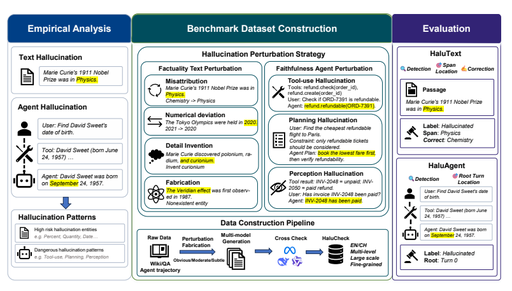
Figure 2 : Overview of HALUCHECK. We construct a bilingual, multi-level benchmark covering factuality hallu- cinations in text and faithfulness hallucinations in agent trajectories. By injecting controllable perturbations into Wikipedia/QA passages and real agent interactions, HALUCHECKsupports hallucination detection, span localization and correction, and root-turn tracing in agent trajectories.
Original paper · CC BY 4.0 · Hanyu Qiu, Ze Liu, Zhe Zhao, Kuang Xiong, Blaze Chen, Zhenxiang Yan, Renfen Hu · From Twisted Facts to Rogue Agents: Can LLMs Reliably Detect Multi-Dimensional Hallucinations? · Original paper figure · Extracted the figure area from page 2 of the original PDF.Why detection is harder to test than generation
Hallucinations in modern LLMs are hard to spot because the errors arrive in fluent, confident prose. That matters most in agents, where a wrong statement can become a wrong action. Reading every generated output by hand is not an option at this volume, so the practical question is whether an LLM can check outputs itself.
Much research has measured how often models hallucinate, while post-generation detection has received much less attention. The detection resources that exist are split across tasks and languages, and they usually return a sample-level verdict. They rarely support finding the wrong span or proposing a correction, which a user needs before acting on a verdict.
Agent hallucinations and non-English settings are also less explored than English text.
The comparison table places HaluCheck beside benchmarks such as TruthfulQA, HaluEval, RAGTruth and AgentHallu. What the HaluCheck row combines is controlled factual perturbations with real agent trajectories, scored with span, correction and root-turn metrics.
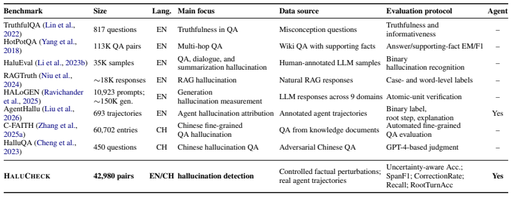
Table 2 : Comparison between HALUCHECKand representative benchmarks.
Original paper · CC BY 4.0Planting controlled errors to get labels
The key move is to plant the errors instead of waiting for them to appear. Natural hallucinations are infrequent, unpredictable and costly to annotate, so the authors inject controlled errors into known source data. Each injected fragment is traceable, so every sample gets a sample-level label and every altered span gets a span-level one.
Generating samples dynamically also helps keep the benchmark from leaking into training data.
HaluText has two parts with different origins. HaluReal starts from real Wikipedia passages and factual QA items and perturbs them. HaluFake is the fabrication side, with encyclopedia-style descriptions of entities that do not exist. HaluReal draws on HotPotQA, PopQA, HalluQA and CMRC2018, and the Chinese and English subsets are built separately.
The original text stays as the hallucination-free reference, so the untouched span sits next to the altered one.
To choose the perturbation types, the authors ran FactScore on LLM outputs and tagged each atomic fact's entities with spaCy. They computed an entity-level hallucination rate, the share of extracted entities that appear in hallucinated atomic facts. Numerical entities such as numbers and dates stood out with relatively high rates, and human and artifact entities did too.
This led to three patterns: Misattribution, Numerical deviation and Detail Invention. Misattribution moves attributes, relations or events from one entity to another, Numerical deviation shifts values such as numbers, dates or ratios, and Detail Invention adds plausible details that do not exist.
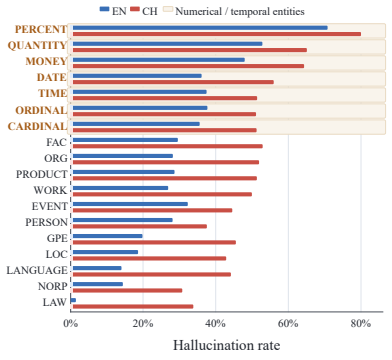
Figure 3 : Hallucination rates across different entities.
Original paper · CC BY 4.0Each text sample also gets one of three perturbation degrees: Obvious, Moderate or Subtle. Obvious cases have clear entity mismatches or large numerical errors, while Subtle cases hide attribute errors, implicit relation errors or fabricated details. Candidates then go through multi-model cross-checking, and only samples that several models score highly stay in the dataset.
Perplexity-based fluency checks and manual verification add two more quality steps.
HaluAgent covers multi-turn tool use, where an error can enter during planning, tool calling or reading tool results. It focuses on three types: planning hallucination, tool-use hallucination and perception hallucination. The source trajectories come from AgentFLAN, AgentBank, AgentTraj-L, ToolACE and MSAgent-Bench, and the authors perturb them into hallucinated versions.
The full set holds about 42k factual-hallucinated pairs with fine-grained annotations. The lite test sets have 1,000 Chinese and 1,000 English samples for HaluReal and HaluAgent, and 500 each for HaluFake. Stratified sampling keeps no factual sample together with its own hallucinated counterpart, while covering all degrees and types.
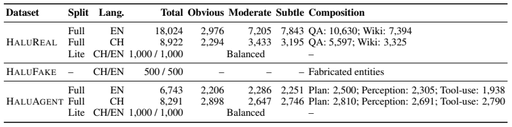
Table 1 : Statistics of HALUCHECK. The full sets contain balanced pairs of factual and hallucinated samples, while lite sets are used for evaluation. Perturbation-degree and composition statistics cover only hallucinated samples.
Original paper · CC BY 4.0Scoring abstention, spans and root turns
Each prediction is Hallucinated, Non-hallucinated or Uncertain, while the gold label is binary. Uncertain earns a partial score of 0.5, so abstaining beats a wrong guess but scores below a correct answer. The authors cite cost-sensitive evaluation and the goal of avoiding unsupported answers as the reasons for this weighting. They also report UncertainRate, which tells you how often a model abstains.
A model that flags a hallucination then faces the fine-grained tests. For HaluReal, SpanF1 matches predicted spans against gold hallucinated spans, and an LLM performs the matching. CorrectionRate checks whether correctly localized spans are also corrected accurately. For HaluFake, Recall and UncertainRate are read at the sample level, asking whether a model finds fabricated entities and admits uncertainty.
For HaluAgent, RootTurnAcc checks whether the model names the earliest hallucinated step in a hallucinated trajectory. The LLM judge checks agreement with the ground-truth annotations rather than detecting hallucinations directly. Decoding temperature was set to 0 for all runs, so repeated runs stay comparable.
Together, these metrics separate overall detection from abstention, span localization and correction, and root-cause attribution. The paper also applies rule-based checks alongside the LLM-judge span evaluation.
Detection is moderate, and localization lags
The authors tested fourteen LLMs from six model families on the balanced lite sets, both closed and open source. Gemini3.1-Pro reached the highest HaluReal detection accuracy, around 84%, and also led on localization and correction. Most other models landed between 50% and 70% on both the Chinese and English datasets. Accuracy alone says little about the top model, so its localization results need to sit beside it.
Localization is where the scores fall away, because SpanF1 and CorrectionRate sit well below detection accuracy for almost all models. The authors read this as the gap between noticing that an error exists and locating and repairing it.
On fabricated entities, the models differ mainly in how often they answer Uncertain. In general, stronger models express uncertainty more often about unknown entities, so they seem to know what they don't know. Gemini3.1-Pro and GPT5.4 show high UncertainRate on English HaluFake, with relatively lower Recall. Lighter and mini models give direct verdicts instead, which brings higher Recall and lower UncertainRate.
The authors read that pattern as possible overconfidence in hallucination detection. They frame the trade-off as helpfulness, meaning attempting to answer, against honesty, meaning admitting ignorance.
The agent task shows a different pattern, with the best sample-level accuracy at 64.55% in Chinese and 72.36% in English. Models rarely express uncertainty there, so their judgments are often unreliable even when they commit.
Agent trajectories are the weak spot
The best agent score sits well below the roughly 84% that Gemini3.1-Pro reaches on HaluReal. On HaluAgent, the best sample-level accuracy reaches only 64.55% in Chinese and 72.36% in English. Models rarely express uncertainty on this task, so their judgments are often unreliable.
Factual checks can lean on pre-training knowledge, but agent hallucinations need faithfulness to the context. A judge has to compare each step against user instructions, reasoning steps, tool calls and observations. Trajectories are longer and contain more intermediate states and step dependencies, so the check spans many turns. Root-cause localization is weak too, which means finding where the trajectory first goes wrong is hard for models.
Benchmark scores correlate strongly with natural-hallucination detection across the 14 models. The authors take this as evidence that HaluCheck can serve as a useful proxy, and they add that models which hallucinate less localize spans more accurately.
Thinking, web search and fine-tuning as partial fixes
Explicit thinking is the first lever, compared on the Qwen3 series with thinking turned on and off. With thinking on, the models identify hallucinated spans more accurately and correct erroneous content better on HaluReal. On HaluFake, thinking mode increases Recall while reducing UncertainRate, so the models become more willing to give definitive judgments.
Figure 4 reports these as means across five Qwen3 models, with standard deviations shown. Thinking recovers some missed errors and avoids some false positives, but it still runs on the model's own knowledge.
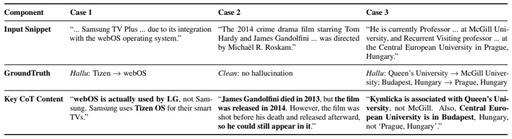
Table 4 : Representative cases where enabling thinking corrects hallucination detection decisions.
Original paper · CC BY 4.0Web search is the second lever, and it is the usual remedy for factual hallucinations. Averaged over five Qwen3 models, adding web search results improves detection, localization and correction. The same integration also lowers UncertainRate, so the models abstain less often. The gains are generally larger than those from enabling explicit reasoning alone.
Stronger models gain only marginally, whereas weaker models gain more yet still trail top models without retrieval.
Supervised fine-tuning is the third lever, and the authors use it to test whether models learn hallucination patterns. Qwen3-8B and Qwen3-14B are fine-tuned with LoRA, and both gain consistently in HaluReal detection, localization and correction. On external test sets built from HaluEval, C-Faith and AgentHallu, the fine-tuned models improve on Chinese text tasks.
Performance drops on English text and agent-based tasks, which the authors attribute to distribution differences between synthetic training data and external benchmarks. Out-of-distribution generalization is therefore the open problem these results leave.
Across the three levers, none of them fully closes the gap the benchmark exposes.
What the Limitations leave open about carrying these results over
The authors concede that constructed hallucinations may differ from naturally occurring ones, so the benchmark is a proxy rather than a direct measure. They argue for using it as a proxy because the observed correlations in evaluation metrics support that use. Still, the paper doesn't test natural hallucinations directly, so the link rests on correlation alone.
The benchmark covers representative factual-text and agent scenarios, so broader real-world settings remain untested.
No independent human detection baseline was established, because factual verification and trajectory tracing require extensive effort. The authors did conduct manual verification to check data quality, but that step doesn't stand in for a human detection baseline. The SFT gains from Qwen3-8B and Qwen3-14B don't carry over to English text or agent tasks in the external tests.
The authors attribute that drop to distribution differences between the synthetic training data and the external benchmarks. The thinking and web search results come from five Qwen3 models, so they don't speak for all 14 models.
Paper info
- Authors
- Hanyu Qiu, Ze Liu, Zhe Zhao, Kuang Xiong, Blaze Chen, Zhenxiang Yan, Renfen Hu
- Venue
- arXiv · Preprint
- First published
- 2026-11-5
- Added
- 2026-11-7
- Updated
- 2026-11-5
- Version
- v1
- arXiv
- 2611.08231
- Category
- cs.CL
- Original paper terms
- CC BY 4.0
- What we show
- Paper info, commentary and permitted figures from the original paper
AI commentary is a separate explanation from the original paper and may contain errors. The original paper and figures follow each source's terms of use and any rights noted separately.
Abstract
Large language models (LLMs) are widely used for information access, content production, and agent-based task execution, but their outputs remain vulnerable to subtle, high-risk hallucinations. To systematically evaluate and advance post-generation hallucination detection, we introduce HaluCheck, a large-scale, bilingual benchmark comprising over 42k instances spanning both factual hallucinations in text and faithfulness hallucinations in agent trajectories. HaluCheck features fine-grained, multi-level annotations for detection, localization, and correction, covering different tasks and perturbation degrees. Experiments on fourteen LLMs reveal that, while models show basic sample-level detection ability, they struggle with fine-grained localization, correction, and agent hallucination detection. Further analysis demonstrates that thinking, web search, and supervised fine-tuning each offer partial improvements, but none fully solve the problem. HaluCheck thus provides a solid basis for benchmarking and diagnosing LLM reliability across text and agent scenarios.
Quote from the paper
Hanyu Qiu, Ze Liu, Zhe Zhao, Kuang Xiong, Blaze Chen, Zhenxiang Yan, Renfen Hu (2026). From Twisted Facts to Rogue Agents: Can LLMs Reliably Detect Multi-Dimensional Hallucinations?. arXiv:2611.08231v1. https://arxiv.org/abs/2611.08231v1
BibTeX
@misc{qiu2026from,
  title = {{From Twisted Facts to Rogue Agents: Can LLMs Reliably Detect Multi-Dimensional Hallucinations?}},
  author = {Hanyu Qiu and Ze Liu and Zhe Zhao and Kuang Xiong and Blaze Chen and Zhenxiang Yan and Renfen Hu},
  year = {2026},
  eprint = {2611.08231},
  archivePrefix = {arXiv},
  url = {https://arxiv.org/abs/2611.08231v1}
}