Paper commentary
Auditing AI peer reviewers: a benchmark on real scientific papers
Benchmark shows AI peer reviewers miss subtle errors and often flag correct math
- Problem Most tests of LLM peer reviewers compare them with human reviews, so they never measure whether a planted error gets caught. Few studies vary error severity or count false alarms on clean papers.
- Method The authors inject graded errors into real arXiv LaTeX sources and score each reviewer's detections. Skepthical is a multi-agent reviewer that checks citations against retrieved papers, math with computer algebra, and numbers with executed code.
- Results Model choice changes detection most, with three frontier LLMs differing by about 50 percentage points. Skepthical has the highest citation detection on astrophysics, at 46.7 %, while no other system exceeds 26.7 %.
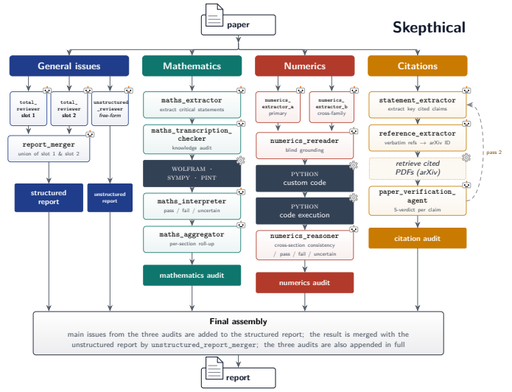
Figure 3 : The SKEPTHICALpipeline. The paper PDF is processed in parallel by four specialist modules (general issues, mathematics, numerics, citations); each module is a short chain of LLM agents (robot icons) interleaved with mechanical or deterministic engines (gear icons). Module outputs converge in a final assembly step that produces the markdown review: main issues from the three audits are added to the structured general-issues report, the result is merged with the unstructured report byunstructured report merger, and the three audits are also appended in full.
Original paper · CC BY 4.0 · Íñigo Zubeldia, Boris Bolliet, Francisco Villaescusa-Navarro, Pablo Villanueva-Domingo, Miles Cranmer · Auditing AI peer reviewers: a benchmark on real scientific papers · Original paper figure · Extracted the figure area from page 14 of the original PDF.Why AI reviewer evaluation falls short
LLM-based peer review already runs at production scale, but the ways people test these reviewers haven't kept pace. Most evaluations frame the task as alignment with human-written reviews, so they don't measure whether a reviewer catches a planted error. The remaining studies inject synthetic errors, but only into ML papers. Two measurements are usually missing from this work: error detection as a function of error severity, and false-positive rates on clean papers.
Severity matters because a reviewer that only catches blatant errors gives authors little protection against subtle ones. False-positive control matters because a reviewer that wrongly flags correct mathematics is hard to rely on in either direction. The authors note that the first AI-reviewer benchmarks exist, yet evaluation methodology has generally lagged behind them.
Planting graded errors in real papers
The authors take a real arXiv paper and plant one error of each of four types into its LaTeX source. Each error type is injected at a chosen severity, and each injected copy carries four errors, one per type. An unedited clean copy serves for counting false alarms, so a reviewer's flags on it can be scored as false positives. Because the planted errors have known locations, a reviewer's report can be checked against them.
The benchmark uses two corpora of 15 papers each, one from astrophysics and one from machine learning. Both corpora are capped at 20 pages, which keeps the cost of each review manageable. Both chosen days come after the knowledge cut-off of every model used, so the reviewers couldn't have memorised these papers.
An LLM proposes one atomic edit for each sub-type of error, and a mechanical validator checks it. Each error type has a three-level scale from subtle to blatant, calibrated within each type rather than across types. A citation edit, for example, can nudge a cited value by about 1.1σ at the subtle level, while the cite key stays unchanged.
A cross-family panel of judges from Anthropic, OpenAI and Google decides whether each report detected each injection. Mathematics and numerics also get mechanical checks, which sit on top of the panel's verdicts. The 357 injected errors across both corpora form the base of the scores reported later.
How SKEPTHICAL is built
SKEPTHICAL splits review into four modules that run in parallel, and each module hunts a different kind of error. The general-issues module asks two cross-family LLMs, Claude Opus 4.7 and Gemini 2.5 Pro, for two independent reports. A third-family model, GPT-5.1, merges those reports, and a reasoning model, GPT-5.4, adds a free-form reading of the paper.
The mathematics module extracts the paper's key mathematical statements first. It then checks internally-verifiable claims with wolframscript for symbolic equality or with pint for dimensional analysis.
The numerics module doesn't trust the model's arithmetic, because it checks the consistency of numerical statements with Python code. The citations module works differently: it gives an LLM the cited papers in its context, so each factual claim is judged against the source text. The authors retrieve the PDFs of cited papers for this check, rather than relying on the model's memory of the literature.
Across the design, SKEPTHICAL verifies LLM-flagged issues with tools where possible. Only the general-issues module leaves the final judgement to models, which is why its ensemble is cross-family.
Which system catches the most errors
SKEPTHICAL catches the most citation errors on astrophysics, and that lead drives its overall ranking there. On astrophysics, SKEPTHICAL reaches 46.7 % on citations, while no other system exceeds 26.7 %. The benchmark reports this as a 95 % bootstrap confidence interval per system, and the table lists every reviewer by error type. Table 2 gives total and per-error-type detection rates for all reviewers on both corpora.
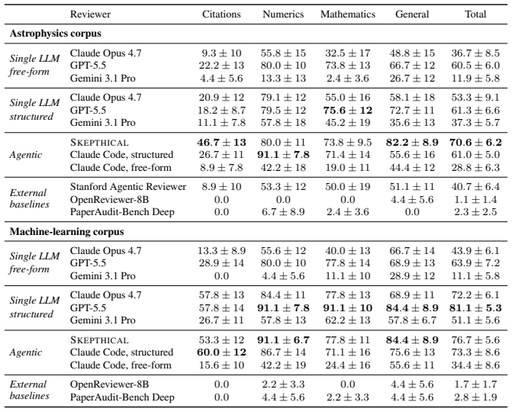
Table 2 : Error detection rate (as %) by error type for all the reviewers on the astrophysics corpus (177 injections, top block) and the ML corpus (180 injections, bottom block). Quoted uncertainties are paper-level bootstrap 95 % confidence intervals (CIs); bold corresponds to column-best within each block.
Original paper · CC BY 4.0Across the two corpora, the citation lead does not carry over to ML. On ML, structured Claude Opus 4.7, structured GPT-5.5, and structured Claude Code reach 57.8 to 60.0 %. SKEPTHICAL reaches 53.3 % on ML citations, which is statistically indistinguishable from the best single LLM. The authors suggest the models already know the ML literature better, so retrieval matters less there.
On ML, the same free-form comparison spans 52.8 percentage points, so the model matters more than the architecture in this setup.
Prompt versus tools
The prompt drives most of the gain, and the tools add a smaller step on top of it. With the structured prompt fixed, a single Claude Opus 4.7 call goes from 53.3 to 61.0 to 70.6 % on astrophysics as tools and then SKEPTHICAL are added. On ML the same path moves from 72.2 to 73.3 to 76.7 %, so the tools change little there. Claude gains less from the same change, at +16.6 and +28.3 pp on the two corpora.
For GPT-5.5 the structured prompt is near-negligible on astrophysics, at +0.8 pp, but reaches +17.2 pp on ML.
Inside Claude Code the model, sandbox and tools stay fixed, so the prompt alone moves detection by +32.2 pp on astrophysics and +38.9 pp on ML. The structured agent used tools heavily, with a median of 9 turns and a maximum of 26. It also wrote and ran 21 multi-line Python scripts, while the free-form agent wrote none. The free-form agent read the PDF and replied, so the prompt changes behaviour as well as the score.
Neither configuration used wolframscript, even though the structured prompt encourages its use.
The concise prompt tests whether the gain comes from naming the error kinds or from the longer instructions. The authors wrote a 471-word concise structured prompt that only names the four kinds of error to check. Inside Claude Code the concise prompt accounts for 24.3 of the 32.2 pp gain on astrophysics.
Does detection rise with severity
The strongest systems catch 57 to 73 % of subtle injections at S1, namely SKEPTHICAL, structured GPT-5.5, and structured Claude Code.
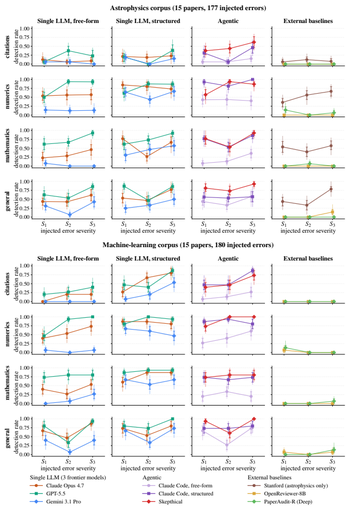
Figure 1 : Error detection rate across error severity, error type, and architectural family for all our reviewers, on the astrophysics corpus (top block) and the ML corpus (bottom block). In each panel, the x-axis is the injected error severity, the y-axis the detection rate, and the error bars are paper-level bootstrap CIs, with the solid whisker showing the 68 % interval and the thinner half-transparent overlay the 95 % interval.
Original paper · CC BY 4.0Its error bars show paper-level bootstrap intervals, with a 68 % whisker and a 95 % overlay. The trend is tested on the pooled reviewers with non-negligible detection, which are all systems except OpenReviewer-8B and PaperAudit-Bench Deep. Pooling cuts the number of tests from one per reviewer and error type, 48 on astrophysics and 44 on ML, down to four.
The authors use Page's L statistic with mid-ranks for ties, and permute severity labels within papers to get the p-value.
Numerics falls just short, with a raw p of 0.026 against a corrected threshold of 0.025. Mathematics and general issues show no monotone trend, since their S2 rates sit below S1. On ML, citations, numerics, and mathematics all show a significant upward trend.
Testing each reviewer and error type separately on binary outcomes rejects only a few combinations.
False alarms on clean copies
Every reviewer also reads a clean copy of each paper, so any flag there is a false positive. SKEPTHICAL's false-positive rate is 2.8 % on astrophysics, from 106 flags, and 4.0 % on ML, from 99 flags. The structured single LLMs range from 3.4 to 22.7 %, so SKEPTHICAL stays at the low end on both corpora. Six of nine systems stay below 10 % on ML, and the three structured single LLMs are the exceptions.
The rate depends on both the count of false positives and the total number of flags. A short bar can therefore carry a high rate, so cells with fewer than five flags on one error type are unreliable. Claude Opus 4.7 reaches 1.0 % on astrophysics, and Gemini 3.1 Pro reaches 3.5 % on ML.
Mathematics flags are the least reliable, judged false about 30 % of the time on astrophysics and 67 % on ML among the frontier systems.
How far the judge panel can be trusted
Of the 144 decisions, twelve concerned three reviews with no panel verdict, leaving 132 comparisons. On those 132, the annotator and the panel agree on 127, which is 96.2 %, with Cohen's κ of 0.914. All five disagreements run the same way: the panel credited detections the annotator rejected. The check covers one paper and detection only, so it is evidence about the panel on that paper, not a corpus-wide validation.
The authors asked whether detection depends on the severity of the other errors in the same copy. Severities were drawn independently for each error type, so an error's neighbours vary at random from copy to copy. A logistic model controlling for severity, type, reviewer, and paper finds no significant neighbour effect in either corpus. This test can't show whether the mere presence of other errors matters, since every copy carries four.
The authors also removed one judge family at a time from the first-round panel to test its size. Removing Google in the worst case for SKEPTHICAL, with strict ties, drops its astrophysics rate from 70.6 % to 63.3 %. That change is 7.3 pp, with a confidence interval of 3.9 to 11.5. On ML, structured GPT-5.5 stays first whichever judge is removed, while SKEPTHICAL and structured Claude Code swap places in two of six variants.
What the benchmark cannot tell us about AI reviewers
The benchmark measures only part of peer review, and its limits matter for reading the numbers. It covers objective, localisable defects and false alarms on clean papers, not novelty, significance or overall review quality. So the results aren't a holistic measure of review quality.
The neighbour-severity test found no measurable dependence, but it can't show whether the mere presence of other errors matters. Answering that would need copies with a single error, which the cost constraints ruled out.
The comparisons involving SKEPTHICAL aren't capacity-matched, because it uses more calls and three providers. So its gains can't be attributed to the pipeline design alone.
The released pipeline, paper lists, injections and adjudication records keep the benchmark reusable. Deployment at scale brings three risks: false confidence from uneven detection, adversarial gaming, and concentration on a few providers. Cross-family ensembling and auditable verification mitigate these risks but don't remove them.
Paper info
- Authors
- Íñigo Zubeldia, Boris Bolliet, Francisco Villaescusa-Navarro, Pablo Villanueva-Domingo, Miles Cranmer
- Venue
- arXiv · Preprint
- First published
- 2026-11-12
- Added
- 2026-11-14
- Updated
- 2026-11-12
- Version
- v1
- arXiv
- 2611.17052
- Category
- cs.CL · astro-ph.IM · cs.AI · cs.DL
- Original paper terms
- CC BY 4.0
- What we show
- Paper info, commentary and permitted figures from the original paper
AI commentary is a separate explanation from the original paper and may contain errors. The original paper and figures follow each source's terms of use and any rights noted separately.
Abstract
LLM-based peer review is now used at production scale, but its evaluation remains limited. We introduce a benchmark that injects objective, localisable errors of four types (general issues, mathematics, numerics, citations) at three severity levels into real papers and measures each reviewer's detection rate by error type and severity, together with its false-positive rate on clean copies. We also present Skepthical, a multi-agent reviewer that verifies citation-backed claims by retrieving the cited papers, mathematics with computer algebra, and numerical claims with executed code. We apply the benchmark to two corpora of 15 recent arXiv preprints each, one in astrophysics and one in machine learning (ML), injecting a total of 357 errors, and evaluate twelve reviewer systems: six single-LLM reviewers, two Claude Code configurations, three publicly available reviewers, and Skepthical. The choice of model has the largest impact on detection rate: given the same prompt, three frontier LLMs differ by about 50 percentage points in total detection on both corpora. Tools and scaffolding help when they contribute what the model cannot supply on its own. In particular, on astrophysics, Claude Code improves on a single Claude call in mathematics and numerics detection, and enforced citation retrieval gives Skepthical the highest citation error detection rate of all systems by a large margin. This citation lead, however, is not observed on ML, where the models appear to know the literature better and Skepthical's citation detection rate is statistically indistinguishable from that of the best single LLM. False-positive rates are below 10% for most systems, but vary with prompt, model, and scaffolding, with mathematics flags the main source of false positives. The evaluation pipeline, the injected errors, and the adjudication logs are released as a benchmark.
Quote from the paper
Íñigo Zubeldia, Boris Bolliet, Francisco Villaescusa-Navarro, Pablo Villanueva-Domingo, Miles Cranmer (2026). Auditing AI peer reviewers: a benchmark on real scientific papers. arXiv:2611.17052v1. https://arxiv.org/abs/2611.17052v1
BibTeX
@misc{zubeldia2026auditing,
  title = {{Auditing AI peer reviewers: a benchmark on real scientific papers}},
  author = {Íñigo Zubeldia and Boris Bolliet and Francisco Villaescusa-Navarro and Pablo Villanueva-Domingo and Miles Cranmer},
  year = {2026},
  eprint = {2611.17052},
  archivePrefix = {arXiv},
  url = {https://arxiv.org/abs/2611.17052v1}
}