Paper commentary
Sable: A Small-Field Sumcheck Argument for Bit-Exact Inference of Large Language Models
Sable proves that a quantized LLM's outputs can be checked bit for bit
- Problem A client calling a hosted model cannot check which weights produced its text. Earlier proofs covered models up to 13 billion parameters, because production-size inference raises obstacles like floating-point rounding and wrap-around in small prime fields.
- Method Sable defines an integer version of the transformer, FO, with no floating-point step, and proves it with a constraint system that never wraps modulo the 31-bit KoalaBear prime.
- Results On one GPU, Sable proves a 4,096-token Qwen2.5-32B sequence in 92.5 s, which is 41 to 50 times the serving time.
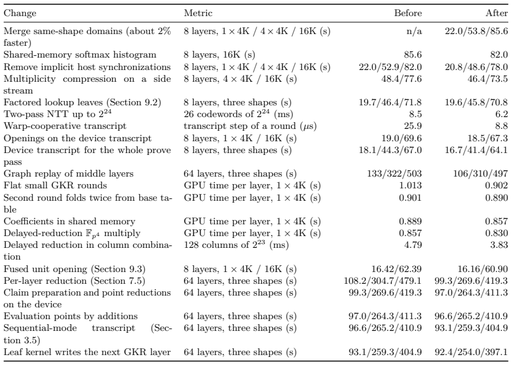
Table 10 : Effect of individual optimizations, in the order they were applied, each measured against the state just before it. Baselines of consecutive rows differ slightly because of run-to-run variation (about2%) and small unrelated changes in between.
Original paper · CC BY 4.0 · Tomer Solberg · Sable: A Small-Field Sumcheck Argument for Bit-Exact Inference of Large Language Models · Original paper figure · Extracted the figure area from page 43 of the original PDF.Why exact proofs of inference are hard
A client that calls a hosted model gets text back and little else, so it can't tell which weights or sampling choices produced that text. Cryptographic proofs could close that gap, but earlier systems covered much smaller inference, such as language models of up to 13 billion parameters in under fifteen minutes per inference. This work targets the production-size case, which raises three obstacles.
One changed argmax or sampling decision then changes every later token, so a proof needs a precisely defined integer function that the server serves exactly.
The second obstacle is wrap-around in small prime fields, which are attractive because their arithmetic is fast. Intermediate values of a transformer, such as dot products and softmax denominators, can exceed the field size.
The number of lookups exceeds the field size, so the LogUp multiset argument is unsound unless the lookups are partitioned.
Fixing the model as one integer function
The central idea is to settle every rounding decision of the model in advance, so the model becomes a deterministic integer function. FO is that function for Qwen2-style decoder-only transformers, with 24-bit activations and 8-bit inputs to matrix products. The same definition extends to the QK-norm and mixture-of-experts layers of Qwen3.
Each layer works through a fixed sequence of steps, and each step has its own exponent and rounding shift. The attention step takes the quantized queries and keys, forms the scores, and maps them through a clipped exponential table. Attention weights are summed in key blocks of 2^12 positions, and each block is rounded by a per-row shift before the blocks are added.
The tables for the exponential, SiLU, reciprocal and RoPE values are correctly rounded, so they don't depend on the platform's floating point.
A deterministic program maps a BF16 checkpoint to FO. The calibration text is English technical text, chosen so each exponent fits the largest magnitude it must represent.
This Q/K split moves only calibration constants, so the exponential table, the bounds of Section 6 and the proof's size and cost stay the same. The program also runs every vocabulary token at position 0 and lowers the residual's fractional bits until the attention and down outputs fit. FO is undefined on some inputs, such as a SiLU input above 2^14 or a shift outside [−16, 24], and an honest prover detects such an input and aborts.
Proving the integer function in streamed passes
The trace for one 16,384-token sequence through Qwen2.5-32B is too large for GPU or host memory. Because the number of lookups exceeds p, the multiset argument of LogUp is unsound unless the lookups are partitioned. One GKR over the table then proves all chunks at once, so the table side is shared across chunks. Each constraint is read as an identity over the integers, with both sides bounded below the prime p.
The identity then holds over the field exactly when it holds over the integers.
The lookup term draws one coefficient per tuple coordinate, rather than powers of one challenge.
The prover streams the model layer by layer, and the weight commitment is computed once per model and shape. The per-layer reduction removed two of the three rebuild passes, which brought the final proof times down.
The authors analyze the interactive proof and then apply the Fiat–Shamir transform, treating the transcript hash as a random oracle. The verifier checks every sumcheck and GKR round, the per-chunk fraction sums and the unit openings.
Proving times on one GPU
The authors time the prover on one NVIDIA RTX PRO 6000 Blackwell GPU, for all 64 layers of Qwen2.5-32B. One 4,096-token sequence takes 92.5s, four such sequences take 253s in one proof, and one 16,384-token sequence takes 398s. Each timed shape is a mean of three warm runs, and the warm-up run is excluded from the timing. The weight commitment is computed beforehand, so it isn't counted in the prover's wall-clock time.
Compilation of the kernels takes about 24 minutes per machine and GPU type, the first proof in an empty cache takes 1,530s, and it's excluded from the timings. Set against the authors' own serving engine, which computes the same work, a proof takes 41 to 50 times as long.
The same prover covers Qwen3-32B, which adds QK-norm, and proves 4,096 tokens in 121.8s.
How much accuracy the integer model keeps
Exactness has a price in accuracy, and the authors measure it on WikiText-2 against the BF16 model. FO's greedy tokens match the BF16 model's at 86.3% of positions, and its perplexity is 8.3% higher. The authors trace about a third of this perplexity gap to the 8-bit queries and keys. Wider queries and keys would recover that third, at an estimated 30 to 68% more proving time.
The authors haven't located the rest of the gap.
The program picks each group's split by minimizing the rounding noise of the scores over the calibration text. On Qwen3, the split removes 53% of the perplexity gap of Qwen3-30B-A3B and 23% of the gap of Qwen3-32B. The split moves only calibration constants, so Eattn, the exponential table and the gadget bounds stay the same. Because of that, the size and cost of the proof don't change.
The split isn't applied to Qwen2.5, because that model has no QK-norm. Calibration also lowers the residual's fractional bits for Qwen3-32B from 10 to 8.
Task accuracy also stays close to BF16 on both Qwen3 models. On MMLU, FO is within 1.6 points of BF16 on Qwen3-30B-A3B and Qwen3-32B. On GSM8K, FO is within 1.7 points of BF16 on the two Qwen3 models. The losses on the tasks are larger for Qwen3 than for Qwen2.5, for reasons that perplexity doesn't show.
Limits of the claim
FO is undefined on inputs that break one of its stated conditions, and an honest prover aborts on them. Three conditions are not implied by the formats: the SiLU input bound with gate shift, the attention output and down projection shifts in [−16, 24], and an output in A for a left shift. QK-norm adds a condition on the unclamped head shift, and a mixture-of-experts layer adds two more on the router shift and the slot alignment.
The program that builds the integer model is published with CW, so anyone can recompute CW from an open checkpoint. The program uses 32-bit floating point for the rotation and weight scales, so another machine can differ in rare ties. The integer model it produces, fixed by CW and hcirc, is what defines FO, and quantization stays outside FO.
The attention cost grows with context, so the long-context case is where the proof is heaviest. At long contexts attention dominates the proof, and the 16K proof already uses 72 of the GPU's 96GiB. Sliding-window attention in most layers would remove most of these entries, as some current models use.
The recursion is not yet complete, and the authors have not measured the commitment of their BLAKE3 trace. Hiding commitments, masked sumcheck and GKR messages, and per-chunk lookup roots would be needed, and their combination with a streamed prover needs its own analysis.
Paper info
- Authors
- Tomer Solberg
- Venue
- arXiv · Preprint
- First published
- 2026-11-10
- Added
- 2026-11-11
- Updated
- 2026-11-10
- Version
- v1
- arXiv
- 2611.14083
- Category
- cs.CR · cs.AI · cs.LG
- Original paper terms
- CC BY 4.0
- What we show
- Paper info, commentary and permitted figures from the original paper
AI commentary is a separate explanation from the original paper and may contain errors. The original paper and figures follow each source's terms of use and any rights noted separately.
Abstract
We present Sable, an argument system and single-GPU prover for the statement that a committed, integer-quantized transformer produced a given token sequence from a given prompt, bit for bit. Sable fixes an integer function F_O with no floating-point step, in which every rounding, normalization, softmax and sampling decision is determined by its inputs, and proves it with a constraint system whose relations provably never wrap modulo the 31-bit KoalaBear prime. The proof batches zerochecks and LogUp-GKR lookups into one sumcheck per domain, and commits to every witness tensor and weight in one multilinear commitment built from Reed-Solomon codes, BLAKE3 Merkle trees and a mixed-length BaseFold opening. The prover streams the model layer by layer on one GPU. On one NVIDIA RTX PRO 6000 Blackwell GPU, Sable proves all 64 layers of Qwen2.5-32B in 92.5 s for 4,096 tokens and 398 s for 16,384 tokens, and covers Qwen3-32B and the mixture-of-experts Qwen3-30B-A3B (4,096 tokens in 121.8 and 84.7 s). A proof costs 41 to 50 times the serving time, or 6.4 cents per 4,096-token request at public GPU prices, and 40 to 64 times less time per parameter and token than zkLLM. On WikiText-2, F_O's greedy token matches the BF16 model's at 86.3% of positions; on Qwen3, F_O is within 1.6 points of BF16 on MMLU and 1.7 points on GSM8K. A verifier with a compiled core checks a proof on one CPU core in 19 to 56 s. In the random-oracle model, the interactive proof has round-by-round soundness error 2^-103. The proof is not zero-knowledge, so the system targets open-weight models. Code: https://github.com/moonmath-ai/Sable
Figures from the paper
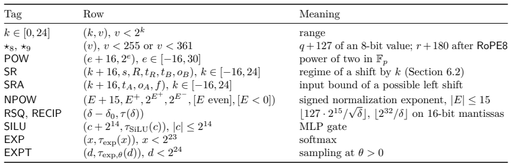
Table 1 : Tags of the static lookup tableT . Dynamic lookups (gathers) use tags of their own, outside this table.
Original paper · CC BY 4.0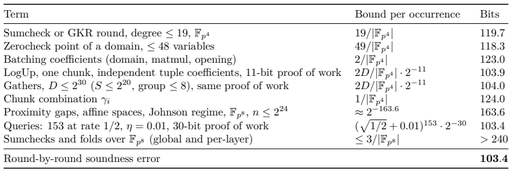
Table 2 : Soundness budget of the main proof. Gathers:D counts the gathered key rows of an attention group of at most 8 query heads per key-value head (5 in Qwen2.5-32B, 8 in the Qwen3 models); the router’s slot multiset has fewer. Bits arelog2(1/ϵ)per occurrence; a prover makingQ random-oracle queries succeeds with probability at most aboutQ·2−103.4.
Original paper · CC BY 4.0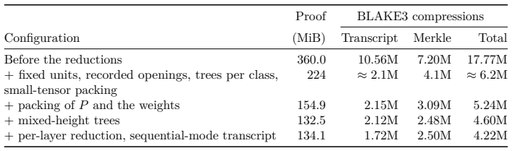
Table 3 : Proof size and verifier BLAKE3 compressions for Qwen2.5-32B, 64 layers, one 4,096-token sequence. In the first four rows the transcript used BLAKE3’s tree mode, and its compressions are counted as absorbed bytes over 64 plus two per challenge, a lower bound, since every challenge then needs one compression per level of the chunk tree; the second row’s count is estimated from its absorbed bytes and its number of challenges. Two range lookups per layer that close no-wrap gaps, and the row clamps of the gate shift (Section 6.2), bring the final proof to134.8MiB. The last row is an exact count of the sequential mode (Section 3.5).
Original paper · CC BY 4.0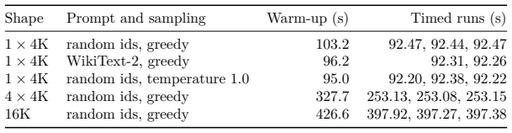
Table 5 : Individual proving times behind Table 4, 64 layers, each row in a fresh process whose first proof is the warm-up.
Original paper · CC BY 4.0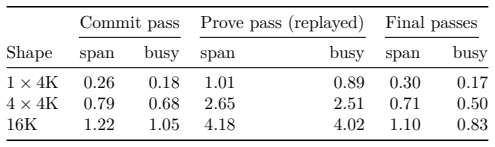
Table 6 : Seconds per layer of the final prover by phase (Nsight Systems, 8-layer proofs, kernels inside replayed graphs traced). Span: wall time of the phase on the GPU; busy: GPU busy time, during which some kernel was running. Final passes: the global evaluation proof and the query pass.
Original paper · CC BY 4.0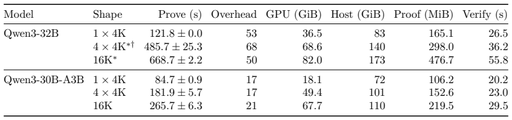
Table 7 : Proving the Qwen3 models on one RTX PRO 6000, with the columns of Table 4: mean and standard deviation of three warm runs after a warm-up run in the same process.∗Without graph replay, whose captured graphs do not fit in GPU memory at these shapes.†The three runs took 462,482and512s with the same time in every timed phase of the prover, so the spread lies outside the timed phases, and we did not locate it; the same prover on this model calibrated without the Q/K split took464.7±5.3s.
Original paper · CC BY 4.0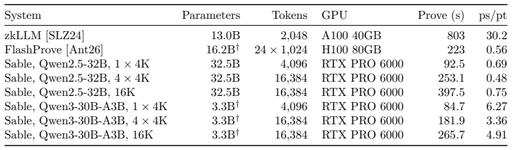
Table 8 : Proving time against zkLLM’s largest reported configuration (LLaMa-2-13B, its Table 1) and FlashProve’s (Llama 4 Maverick, batch 24), normalized per parameter and token (ps/pt: picoseconds per parameter and token; per active parameter for mixtures of experts). zkLLM is zero-knowledge, works over BLS12-381 and approximates non-linear functions; it also commits the model once, in986s. FlashProve: a batch of 24 prompts of 1,024 tokens, each proof checking one token;†parameters used per token of a mixture of experts (30.5B in total for Qwen3-30B-A3B, 400.7B for FlashProve’s model); it is zero-knowledge and commits the model once, in2,324s.
Original paper · CC BY 4.0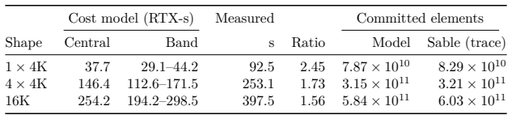
Table 9 : Cost model for the RTX PRO 6000 against measurement (64 layers). Band: the model’s high and low hardware scenarios. Ratio: measured over central. The model’s stated accuracy is [0.5×, 2×]. Committed elements of Sable are the trace units of the final layout, without the weights and fixed units, which the model charges separately.
Original paper · CC BY 4.0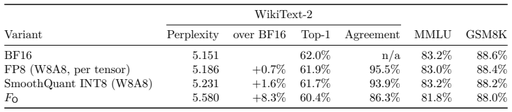
Table 12 : Accuracy ofFO and of two 8-bit quantizations against BF16 Qwen2.5-32B-Instruct. Over BF16: excess perplexity; paired 95% intervals are0.6–0.8%,1 .4–1.8%and7 .3–9.5%. Single perplexities have intervals of about±0.33, mostly from the varying difficulty of the windows. Agreement: the fraction of WikiText-2 positions at which the greedy next token equals BF16’s.
Original paper · CC BY 4.0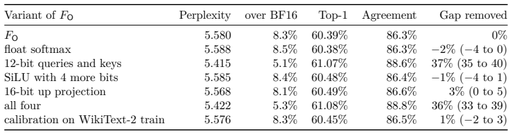
Table 13 : Accuracy attribution on the WikiText-2 test split. Gap removed: the share ofFO’s excess log perplexity over BF16 that the variant removes, with its paired 95% interval. None of these variants is provable as it stands.
Original paper · CC BY 4.0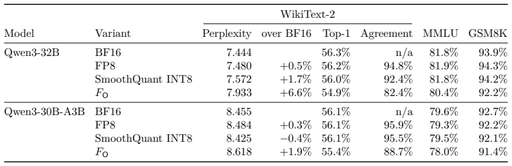
Table 14 : Accuracy ofFO and of two 8-bit quantizations of the Qwen3 models, as in Table 12, with GSM8K generations of up to 1,024 tokens. Paired 95% intervals of the excess perplexity:0.4–0.6%, 1.6–1.9%and6.3–6.9%for Qwen3-32B,0.2–0.4%,−0.5–−0.2%and1.6–2.3%for Qwen3-30B-A3B; single perplexities have intervals of about±0.35and ±0.40. The checkpoints are prompted as base models, without a chat template.
Original paper · CC BY 4.0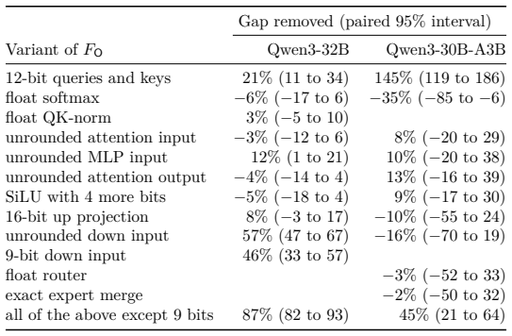
Table 15 : Accuracy attribution on Qwen3, on the first 24 WikiText-2 windows: the share ofFO’s excess log perplexity over BF16 (6.4%and2 .0%on these windows) that each variant removes, as in
Original paper · CC BY 4.0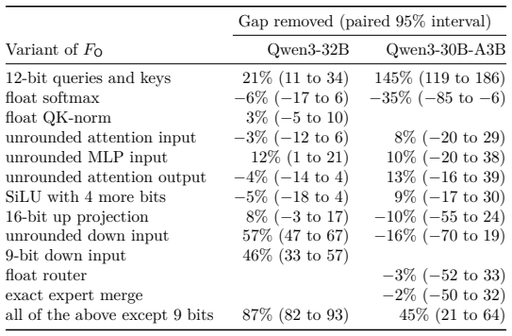
Table 13 . Unrounded: the row enters the next product with every entry exact, at the same direction and scale. On Qwen3-30B-A3B the unrounded down input also makes the merge of the experts exact. None of these variants is provable as it stands.
Original paper · CC BY 4.0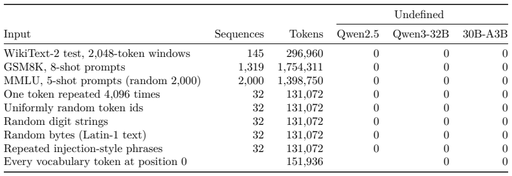
Table 16 : Sequences on whichFO is undefined. The adversarial inputs are 4,096 tokens long. The Qwen3 tokenizer gives the same token counts; the last row counts first tokens.
Original paper · CC BY 4.0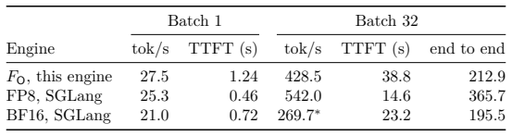
Table 17 : Serving Qwen2.5-32B on one RTX PRO 6000: prompts of 4,096 tokens, 512 generated tokens per sequence, greedy decoding. tok/s: decoding throughput after the first token; TTFT: time to the first token of the whole batch; end to end: generated tokens over total time.∗BF16 weights leave room for 89,581 cached tokens, fewer than the147,456of 32 sequences, so SGLang ran about 19 at a time.
Original paper · CC BY 4.0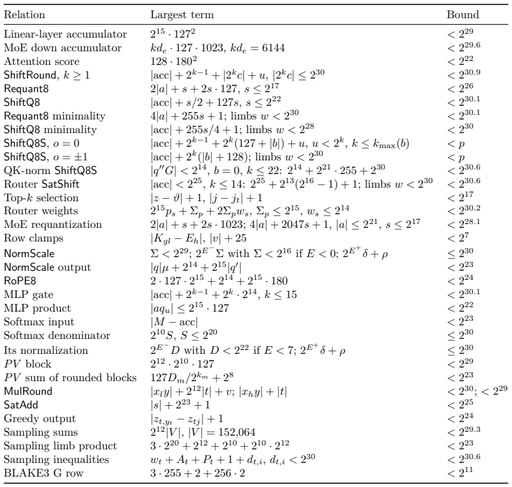
Table 18 : Integer bounds behind Theorem 6.1.
Original paper · CC BY 4.0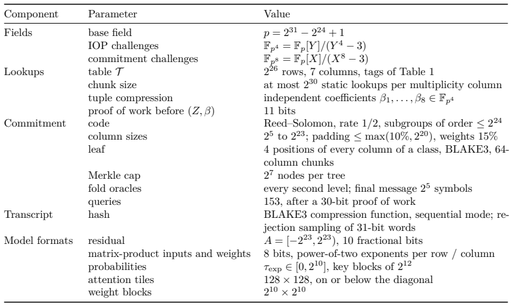
Table 19 : Parameters of the evaluated prover.
Original paper · CC BY 4.0Quote from the paper
Tomer Solberg (2026). Sable: A Small-Field Sumcheck Argument for Bit-Exact Inference of Large Language Models. arXiv:2611.14083v1. https://arxiv.org/abs/2611.14083v1
BibTeX
@misc{solberg2026sable,
  title = {{Sable: A Small-Field Sumcheck Argument for Bit-Exact Inference of Large Language Models}},
  author = {Tomer Solberg},
  year = {2026},
  eprint = {2611.14083},
  archivePrefix = {arXiv},
  url = {https://arxiv.org/abs/2611.14083v1}
}