Paper commentary
Roboclock: A Unified Benchmark for Time-Aware Robotic Intelligence
RoboClock is a benchmark that adds time limits to robot manipulation tests
- Problem Robot benchmarks pause the simulated world while the policy thinks, so slow agents look better than they are. Their scores overstate what a deployed robot would do.
- Method RoboClock advances environment time by measured inference latency, so slow answers arrive too late. Tasks are scored on three temporal rules.
- Results Over 30 methods were evaluated, and the best, a trained VLA, reached only 8.3% temporal success even on Easy tasks.
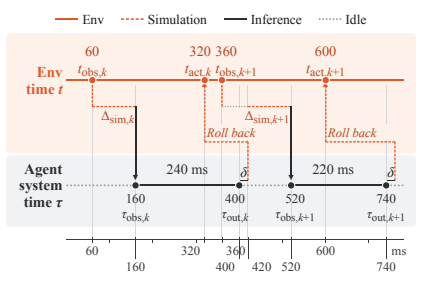
Figure 3 .Temporal alignment between environment and agent. Environment time t advances with inference, control delay, and actions; simulation overhead∆ sim,k affects only agent timeτ.
Original paper · CC BY 4.0 · Yujie Zhao, Anthony L. Hu, Zimeng Huang, Zhijing Wu, Luobin Wang, Richard Li, Shrivas Sudharsan, Henrik I. Christensen, Jishen Zhao · Roboclock: A Unified Benchmark for Time-Aware Robotic Intelligence · Original paper figure · Extracted the figure area from page 4 of the original PDF.Why turn-based evaluation overstates robot success
Most robot benchmarks ask whether a task is eventually completed in the right logical order. They pause the simulated world while the policy computes, so the policy's thinking time never reaches the scene. That loophole lets an agent retry, roll back actions and wait as long as it likes between steps. The authors argue this turn-based paradigm inflates success, so benchmark scores overstate what a deployed robot would do.
A survey of 800 industry leaders found over 75% see sub-100-ms latency as essential for critical robots. The gap shows up when the authors profile RoboClock tasks. For π0.5, inference takes 9% of an episode that lasts roughly 70 seconds. OpenWAM-α spends 56% of about 145 seconds on inference, and Qwen3.8-Flash-Next spends 78% of about 285 seconds.
Figure 2 splits each episode into inference, robot motion, idle time and failed calls, so the wasted time is visible.
A clock that keeps running during inference
The core idea is to let the scene keep moving while the agent thinks, so a slow answer arrives after the moment it was needed. Each observation is stamped with the environment clock, and environment time advances during inference before the resulting action takes effect. Simulation and rendering overhead affects only the agent's wall-clock time, so hardware-dependent costs are kept off the scene clock.
The physics step is 4 ms, and commands update every 20 ms.
Each of the three task types puts a different timing rule on the agent. A Temporal Window task requires actions inside a specified interval, and an Event-Reactive task requires fast responses to events whose onset is randomized. A Throughput task requires a minimum completion rate over repeated demands.
Four metrics then separate what the agent did from when it did it. PS tracks physical progress, PSR tracks physical success, TSR scores temporal compliance with inference paused, and LTSR scores it with measured latency.
The VLM agents use Tool-augmented EEF, which works from images, the instruction, the task clock and measured tool and gripper state. Its tools never read object poses, task state or event times, so the agent gets no privileged information. Every query is charged its latency.
Fine-tuning helps seen tasks more than held-out ones
The authors start from RoboDojo checkpoints and fine-tune two VLAs and two WAMs on oracle demonstrations from 45 tasks.
After training, OpenWAM-α has the highest PSR at 14.8%, with 10.0% TSR. π0.5 has the highest TSR at 10.3%, with 12.8% PSR. The gains come mostly from Event-Reactive tasks, where three of four models exceed 17% TSR, while Throughput TSR stays at or below 1.8%. Table 2 lists all 60 tasks with the released and fine-tuned models side by side.
Seen-task TSR rises to 8.2–13.8%, but the 15 held-out tasks show almost nothing. Only X-VLA reaches nonzero TSR on held-out tasks, at 2.0%. So the demonstrations mostly teach familiar tasks, and the gain stops at the training set.
Latency removes part of the gain for the end-to-end policies. π0.5 keeps most of its temporal success, reaching 8.3% LTSR against 10.3% TSR. OpenWAM-α falls from 10.0% TSR to 3.8% LTSR, and InternW0-∆ falls from 8.0% to 2.2%. The authors tie the difference to inference speed, since the WAMs take longer per step.
VLM agents: zero-shot success that latency erodes
The VLM agents need no robot-specific training, and they run through Tool-augmented EEF. Gemini 4 Argon reaches 24.5% PSR and 18.2% TSR, and GPT-6 Astra reaches 22.8% PSR and 19.0% TSR. Once measured latency is charged, Gemini 4 Argon drops to 8.2% LTSR and GPT-6 Astra to 3.0%. GPT-6.1 Sol and Claude Opus 5.5 fall further, to 2.3% and 1.0%.
Open-weight VLMs do worse under latency, and none exceeds 1.2% LTSR in these runs. This suggests that the number of turns matters as much as the speed of each turn.
To isolate decoding delay, the authors assume decode speeds from 35 to 3K tokens/s and rerun GPT-6 Astra in closed loop. Overall LTSR rises from 5.7% to 18.0% as the assumed speed increases. Completed Throughput jobs rise from 55 to 92 over the same range. Event-Reactive tasks gain most, from 6.2% to 26.3% LTSR.
Across policy families, the ratio of LTSR to TSR shows how much each family loses to delay. Figure 6 plots TSR and LTSR against inference time per action step, with the ratio shown separately.
Training clock sensitivity and the real-robot check
Later events also drive 66% premature responses, while earlier events keep success.
The duration test shows the same reliance on demonstration timing. When A5's instruction asks for 15 s, the lift still happens at 16.1 s, about 3 s early. So the policy seems to follow the timing it saw in training, not the time the prompt states.
The real-robot pilot uses one xArm 6 and six tasks in the three temporal categories. Six VLMs each run 10 episodes per task, 360 episodes in total. Rankings agree with simulation, with Spearman ρ of 1.00 for PS, 0.93 for PSR and 0.85 for LTSR. No model completed a Throughput task, and the best PS there was 21.5 on C1.
Limits
LTSR also depends on inference hardware and serving conditions, so systems should be compared with care. The real-robot pilot covers six tasks, and the B1 case study ran once per model. Held-out transfer rests on 15 tasks, where only X-VLA reaches nonzero TSR. Open-weight models ran on eight A100 GPUs with speculative decoding, while proprietary models were charged API latency.
Paper info
- Authors
- Yujie Zhao, Anthony L. Hu, Zimeng Huang, Zhijing Wu, Luobin Wang, Richard Li, Shrivas Sudharsan, Henrik I. Christensen, Jishen Zhao
- Venue
- arXiv · Preprint
- First published
- 2026-11-24
- Added
- 2026-11-25
- Updated
- 2026-11-24
- Version
- v1
- arXiv
- 2611.32233
- Category
- cs.RO · cs.AI
- Original paper terms
- CC BY 4.0
- What we show
- Paper info, commentary and permitted figures from the original paper
AI commentary is a separate explanation from the original paper and may contain errors. The original paper and figures follow each source's terms of use and any rights noted separately.
Abstract
Time is a fundamental dimension of robotic intelligence: a robot may fail despite physically correct actions if it acts outside a valid time window, responds too slowly to an event, or fails to meet required throughput. Yet existing robotic benchmarks primarily emphasize spatial correctness and logical task completion, largely overlooking the temporal constraints of real-world applications. We present RoboClock, a unified benchmark for time-aware robotic manipulation featuring 60 tasks across five application domains. Mirroring these failure modes, RoboClock structures tasks around three types of temporal constraints: Temporal Window, Event-Reactive, and Throughput. Furthermore, RoboClock incorporates a Latency-Aligned evaluation protocol that continuously advances environment time during model inference and control-interface delays, paired with time-sensitive metrics. Evaluating over 30 methods, we find that the best-performing approach is the trained VLA, yet it achieves only 8.3% temporal success even on Easy-level tasks, with persistent challenges in generalization and transfer. These findings reveal fundamental limitations in current robotic systems and highlight the need to jointly optimize physical competence, temporal reasoning, and execution latency.
Quote from the paper
Yujie Zhao, Anthony L. Hu, Zimeng Huang, Zhijing Wu, Luobin Wang, Richard Li, Shrivas Sudharsan, Henrik I. Christensen, Jishen Zhao (2026). Roboclock: A Unified Benchmark for Time-Aware Robotic Intelligence. arXiv:2611.32233v1. https://arxiv.org/abs/2611.32233v1
BibTeX
@misc{zhao2026roboclock,
  title = {{Roboclock: A Unified Benchmark for Time-Aware Robotic Intelligence}},
  author = {Yujie Zhao and Anthony L. Hu and Zimeng Huang and Zhijing Wu and Luobin Wang and Richard Li and Shrivas Sudharsan and Henrik I. Christensen and Jishen Zhao},
  year = {2026},
  eprint = {2611.32233},
  archivePrefix = {arXiv},
  url = {https://arxiv.org/abs/2611.32233v1}
}