Paper commentary
HIST3R: Decomposing and Rectifying State Updates with History for Streaming 3D Reconstruction
HIST3R corrects streaming 3D reconstruction drift by using history to rectify state updates
- Problem One compact state lets bad frame updates pile up into long-video drift.
- Method HIST3R fixes update direction and magnitude using recent historical states.
- Results On ScanNet with 1000 frames, HIST3R reduces ATE by 23.87% compared with TTSA3R, the second-best method. It keeps the memory footprint and inference speed of CUT3R.
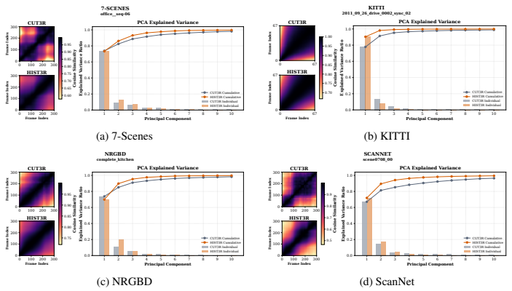
Figure 6 :Empirical local structure in CUT3R and HIST3R state evolution.We visualize recurrent state evolution on one representative sequence from each of 7-Scenes [47], KITTI [50], NRGBD [48], and ScanNet [45]. In each subplot, the left panel shows the cosine affinity between recurrent states over time, while the right panel shows PCA analysis of state variations. CUT3R recurrent states naturally exhibit strong local affinity and low-dimensional variation, and HIST3R further accentuates this structure through history-guided rectification.
Original paper · CC BY 4.0 · Yang, Kenneth, Wang, Yu-Chiang Frank · HIST3R: Decomposing and Rectifying State Updates with History for Streaming 3D Reconstruction · Original paper figure · Extracted the figure area from page 15 of the original PDF.Why one compact state drifts
CUT3R is an implicit-memory streaming model that compresses all past frames into one fixed-size recurrent state, so memory stays bounded. Every later prediction depends on that state, so an unreliable candidate update can overwrite useful history. Each incoming frame can write a bad update into the only compact memory of the scene. Over many frames, these errors accumulate into long-horizon geometric drift.
Such a bias is not a one-off error, because the recurrent state carries past information forward and the bias persists.
The authors split each candidate update into two parts: the update gain, which sets how strongly an observation is written, and the geometric intent, which sets where the state is driven. TTT3R and TTSA3R estimate a scalar gate from auxiliary signals and use it to scale the update gain. Their geometric intent stays fixed, so a biased direction still drives the state, only with a smaller step.
Magnitude-only gating can therefore attenuate an unreliable or redundant update, but it cannot correct the geometric intent. The authors argue that a smaller step alone isn't enough, because the biased direction still compounds over long sequences. That is why HIST3R targets both the direction and the magnitude of the update.
Splitting each update into direction and gain
Splitting an update into two parts lets the method control how strongly an observation is written and where the state is driven. The magnitude is called the update gain, and it sets how strongly the observation is committed to the recurrent state. The direction is called the geometric intent, and it determines what geometric content the update contributes.
Vanilla CUT3R commits both parts as they come, without any revision. TTT3R and TTSA3R only rescale the magnitude and leave the direction fixed.
Each state token's candidate update is the difference between its candidate state and its previous state. The magnitude is the L2 norm of this difference, and the direction is the difference divided by that magnitude plus a small constant. Gating alone can shrink a biased update, but the state still moves along the same biased direction. Over long sequences, this uncorrected intent accumulates and pulls the state away from coherent evolution.
HIST3R keeps this split but replaces both parts, so it controls the direction and the gain with history. The final update is the previous state plus the modulated gain times the rectified direction.
The rectification step starts from the claim that recent CUT3R states form a local reference for plausible evolution. HIST3R corrects the endpoint that defines the direction, which is the missing control axis the authors identify.
Rectifying the direction with recent states
History changes the update direction by replacing the candidate endpoint with one that recent states can explain. HIST3R uses this observation to correct the endpoint that defines the geometric intent, instead of only shrinking the step.
HIST3R keeps a sliding buffer of the last k recurrent states and their visual summaries, with the window set as T_t from t minus k to t minus 1. For each state token, it scores every buffered state by the cosine affinity to the candidate endpoint and turns those scores into local history weights with a softmax. The history-proposed endpoint is the weighted sum of those buffered states, so it expresses the candidate through nearby history.
The default window is k = 8, the smallest window that the window-size ablation found to be stable.
The candidate endpoint and the history-proposed endpoint are blended through an alignment gate. The gate is a sigmoid of the cosine between the two endpoints, shifted by a threshold and scaled by a sharpness constant. High alignment means recent states give a reliable reference, while low alignment marks a genuine change that history should not override.
The blended endpoint R_t defines the rectified direction as its difference from the previous state, normalized by its L2 norm with a small constant added. When the gate is 0, the rectified direction reduces to the candidate direction of vanilla CUT3R.
The ablation removes each stage of this direction rectification in turn to test its contribution. Adopting the rectified endpoint directly as the new state also degrades performance, so the direction and magnitude need separate control.
Scaling the update gain by visual discrepancy
HIST3R sets the update gain by asking how much new evidence a frame brings relative to what the recent history already shows. A frame that is already consistent with recent visual history can perturb the recurrent state redundantly, while a frame with complementary evidence needs a stronger write. A single global average over image tokens would discard the evidence that each state token relies on, so HIST3R summarizes each frame per state token.
Each state token builds its visual summary from the first-layer state-to-image attention map At, which weights the image tokens Fj. Each summary Vt(i) represents the visual evidence that state token i observed, and the resulting Vt is stored in the history buffer Ht.
The discrepancy score compares the current summary with each buffered summary through a normalized L2 distance. That distance is divided by the norm of the historical summary, and a small constant epsilon is added for stability. The per-state distances are then averaged with the same history weights w used for the endpoint, so the most similar past states dominate the score.
A sigmoid gate turns the discrepancy score r into the gain beta, with sharpness lambda_disc and threshold theta_disc controlling its shape. The gated magnitude m-hat equals beta times the candidate magnitude m-tilde, and the final update then uses the rectified direction d-hat. A small discrepancy means the observation is largely explained by recent history, so the gain stays low and suppresses redundant state changes.
A large discrepancy signals new evidence and allows a stronger update along the rectified direction.
The authors ablate this magnitude modulation against the direction rectification, and the combined HIST3R update uses both. In the magnitude-only ablation, state-token-specific attention pooling clearly outperforms global average pooling on the TUM ATE and KITTI metrics. The default uses one attention layer, and the paper reports that it performs on par with aggregating several layers.
Experiments on pose, reconstruction, and depth then use this gain together with the rectified direction, with all hyperparameters fixed on the ScanNet training split.
Long-sequence pose and reconstruction
Camera pose is the first test, run on ScanNet and TUM-Dynamics with ATE after Sim(3) trajectory alignment as the metric. HIST3R keeps the lowest ATE on both datasets across long input sequences, and its lead grows as the sequence gets longer. At 1000 input frames, HIST3R reduces ATE by 23.87% on ScanNet and 33.65% on TUM-Dynamics compared to the second-best method, TTSA3R.
The authors read this trend as support for controlling geometric intent, not only update gain, over long horizons.
For 3D reconstruction, Table 1 compares methods on 7-Scenes and NRGBD at 300, 400 and 500 frames. On 7-Scenes, HIST3R obtains the best accuracy and completeness across the long input sequences, while normal consistency stays competitive. Against CUT3R, TTT3R and TTSA3R, HIST3R outperforms the CUT3R family across nearly all datasets, sequence lengths and metrics.
At 500 frames, HIST3R improves median accuracy over TTSA3R by 56.52% on 7-Scenes and 33.96% on NRGBD. Compared with InfiniteVGGT and Point3R, no single method leads on every metric, and HIST3R stays competitive in accuracy and completeness. The authors credit the efficiency to the compact recurrent state, which needs less memory and runs faster than explicit-memory methods.
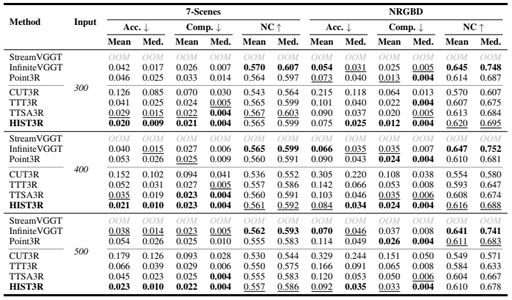
Table 1 :3D reconstruction results on 7-Scenes [ 47] and NRGBD [48]. Best results are shown in bold, and second-best results are underlined.
Original paper · CC BY 4.0Video depth on Bonn and KITTI
Depth is evaluated on KITTI and Bonn, which cover outdoor driving and dynamic indoor scenes. Two protocols are used, and the first is scale-aligned evaluation, which aligns each predicted sequence to the ground truth with one per-sequence scale.
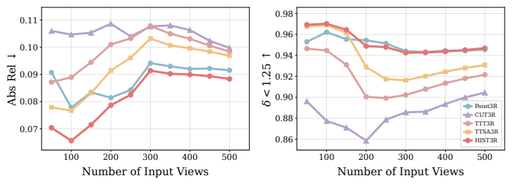
Figure 4 :Metric depth evaluation on Bonn [ 49].We exclude VGGT-based methods that do not support metric depth prediction.
Original paper · CC BY 4.0Under metric depth on Bonn, HIST3R achieves the strongest performance on both AbsRel and δ <1.25. The lead is most visible at longer input sequences, as the Bonn curves show. On KITTI under scale-aligned evaluation, HIST3R ranks second behind Point3R. It still stays competitive there, so the depth gain depends on both the protocol and the dataset.
Direction rectification alone reaches AbsRel 0.109 and δ 0.907, while magnitude modulation alone reaches AbsRel 0.109 and δ 0.909. The full HIST3R update reaches AbsRel 0.108 and δ 0.912, so the two controls are complementary on this depth measure.
Which control does the work?
The decomposition ablation isolates the two update controls, so each one's contribution can be read on its own. Direction rectification alone and magnitude modulation alone each improve over the CUT3R baseline on camera pose, video depth and 3D reconstruction. Combining both gives 0.026, the best of the four settings, which the authors read as support for rectifying direction and modulating gain jointly.
On 7-Scenes, accuracy drops from 0.070 for the baseline to 0.020 for the full HIST3R update, which is also the lowest value in that column.
Table 3 varies the design choices inside each control at the 200-frame setting, with scale-aligned depth. Direction rectification has three stages: cosine-weighted aggregation of historical states, the alignment gate, and direction-only use of the rectified endpoint. Removing the alignment gate, which lets history act unconditionally, raises TUM ATE from 0.024 to 0.037, the largest drop in that group.
Replacing cosine weights with uniform averaging raises TUM ATE to 0.026, a smaller degradation.
An overly long window adds less relevant states, so the authors chose k = 8 as the smallest stable window. For magnitude modulation, attention pooling gives a TUM ATE of 0.021 where global average pooling gives 0.043. The authors attribute this gap to different state tokens relying on different image regions.
Where the results and design rest on narrower support
The hyperparameters were chosen once on the ScanNet training split and kept fixed for every dataset, task, and sequence length. That fixed setting means the reported gains don't come from per-dataset tuning, but they also aren't tuned to each benchmark. The direction rectification rests on the idea that adjacent CUT3R states are locally smooth and low-dimensional.
The authors support this local structure with Appendix A.1, so the design depends on that appendix holding for the scenes they test. The history-proposed endpoint is built from only the most recent k states, with k set to 8 as the default.
On 7-Scenes, HIST3R doesn't take the best normal consistency, staying competitive against the other methods instead. Against explicit-memory methods, no single method dominates every metric, so HIST3R's lead isn't uniform across the table. On NRGBD, HIST3R reaches the best or second-best result on most metrics, not all of them. On KITTI scale-aligned depth, HIST3R ranks second behind Point3R, as the paper reports it.
The metric-depth gains on Bonn are shown in Figure 4, and the scale-aligned KITTI result is shown in Figure 5.
Paper info
- Authors
- Yang, Kenneth, Wang, Yu-Chiang Frank
- Venue
- arXiv · Preprint
- First published
- 2026-11-9
- Added
- 2026-11-10
- Updated
- 2026-11-9
- Version
- v1
- arXiv
- 2611.12011
- Category
- cs.CV
- Original paper terms
- CC BY 4.0
- What we show
- Paper info, commentary and permitted figures from the original paper
AI commentary is a separate explanation from the original paper and may contain errors. The original paper and figures follow each source's terms of use and any rights noted separately.
Abstract
Streaming 3D reconstruction with recurrent states enables long-video scene understanding under bounded memory, but turns reconstruction into a state-evolution problem: each incoming frame updates a compact scene memory on which all subsequent predictions depend, so unreliable updates overwrite historical context and accumulate into long-horizon geometric drift. We analyze CUT3R-style recurrent updates through a direction--magnitude decomposition, in which the magnitude sets the update gain, i.e., how strongly an observation is written into the state, and the direction encodes the geometric intent, i.e., where the update drives the state. This decomposition provides a unified view of CUT3R and its variants, revealing that existing training-free extensions perform magnitude-only control: they can attenuate an unreliable update but cannot correct its direction. We propose HIST3R, a training-free framework built on CUT3R that controls both components using history. HIST3R rectifies the update direction using locally consistent historical states, and modulates the update magnitude according to the visual discrepancy between the current observation and its history, suppressing redundant updates while preserving complementary evidence. Across camera pose estimation, 3D reconstruction, and video depth estimation, HIST3R consistently improves long-horizon performance while retaining the memory footprint and inference speed of CUT3R. With 1000 input frames, it reduces ATE by 23.87% on ScanNet and 33.65% on TUM-Dynamics relative to the strongest competing method; with 500 frames, it improves median reconstruction accuracy over the strongest CUT3R-based variant by 56.52% on 7-Scenes and 33.96% on NRGBD.
Quote from the paper
Yang, Kenneth, Wang, Yu-Chiang Frank (2026). HIST3R: Decomposing and Rectifying State Updates with History for Streaming 3D Reconstruction. arXiv:2611.12011v1. https://arxiv.org/abs/2611.12011v1
BibTeX
@misc{kenneth2026hist3r,
  title = {{HIST3R: Decomposing and Rectifying State Updates with History for Streaming 3D Reconstruction}},
  author = {Yang, Kenneth and Wang, Yu-Chiang Frank},
  year = {2026},
  eprint = {2611.12011},
  archivePrefix = {arXiv},
  url = {https://arxiv.org/abs/2611.12011v1}
}