Paper commentary
POKE: Probe Offline, Keep Efficiently for Vision-Language-Action Models
- Problem Attention-based pruning scores for VLA visual tokens do not measure how a token changes the predicted action, and scoring each frame on the full graph online costs more than the pruning saves.
- Method Not stated in the paper.
- Results At B=32 of 512 tokens on LIBERO, POKE (MMDP) reached 95.15% success on OpenVLA-OFT at 1.85× speedup and 90.80% on π0.5 at 1.26× speedup.
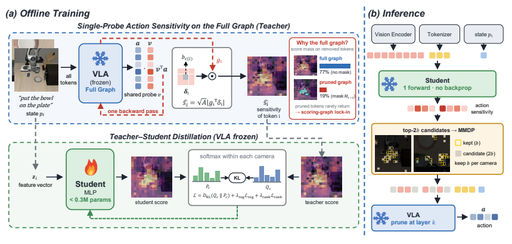
Figure 2 . Method overview. (a) Offline training: a frozen full-graph VLA produces single-probe action-sensitivity labels, which are distilled into a lightweight student. (b) Inference: student predicts token scores, and MMDP selects diverse tokens from scoring candidates.
Original paper · CC BY 4.0 · Jaehyuk Lee, Yeajin Lee, Suhyun Bae, Donghun Lee · POKE: Probe Offline, Keep Efficiently for Vision-Language-Action Models · Original paper figure · Extracted the figure area from page 3 of the original PDF.Why attention is a weak proxy for pruning
Visual token pruning lowers the inference cost of VLA policies by removing image tokens before the later Transformer layers, so the choice of which tokens survive decides both the cost and what the policy can still see. Existing pruners mostly rank tokens by attention, whether the attention a visual token receives, a temporal aggregation of action-to-visual attention, or attention combined with inter-frame similarity.
In the example of Figure 1a, attention-based masks keep the bowl and gripper, while action sensitivity also keeps the target plate.
Measuring sensitivity exactly needs one backward pass per action dimension, which is 56 for a chunk of eight 7-D actions in OpenVLA-OFT.
Action sensitivity and its single-probe estimate
For token \(i\) in camera \(c(i)\), the camera-wise mean \(b_{c}=\frac{1}{|I_c|}\sum_{j\in I_c}x_j\) replaces the token, and the replacement direction is \(\delta_i=\operatorname{stopgrad}(x_i-b_{c(i)})\), which keeps the sequence length fixed. A first-order expansion of the policy \(a_\theta\) around the original observation gives a change \(u_i=J_i\delta_i\), with \(J_i=\partial a_\theta/\partial x_i\), and the action sensitivity is \(s_i=\lVert u_i\rVert_2\).
The authors contrast this with a Jacobian norm, which responds to arbitrary input perturbations, since the sensitivity here is measured along the direction that pruning removes.
To avoid computing \(A\) backward passes, the method draws one direction \(v\) uniformly from the unit sphere in \(\mathbb{R}^A\) and runs one backward pass through \(v^\top a_\theta\), which gives \(g_i=J_i^\top v\) for every token at once. The single-probe estimate is \(\hat s_i=\sqrt{A}\,|g_i^\top\delta_i|=\sqrt{A}\,|v^\top u_i|\), and because \(E[vv^\top]=I/A\), the squared estimate \(\hat s_i^2\) is unbiased for \(s_i^2\).
The authors use \(A=56\) for OpenVLA-OFT and \(A=70\) for π0.5, so the probe replaces dozens of backward passes with one.
Lock-in on the pruned graph
The authors replay probe scoring on 3,157 OFT Long demonstration frames at B=32, with a conditioning mask drawn at random for each frame.
In closed loop, where each mask is the probe's own previous selection, the share of score outside the previous mask is 77% on the full graph and 19% on the pruned graph, measured on LIBERO-Long at B=32. Pruned-graph scoring keeps returning to the same tokens, so the cumulative number of distinct tokens retained grows slowly.
Full-graph history restores success to 69.4% and 84.4% for those two cases. The complete VP changes less, from 78.6% to 82.4% on the same kind of comparison, which the authors attribute to its current-frame semantic route re-admitting tokens.
From teacher labels to a deployed selector
Offline, the frozen full-graph policy is probed on fine-tuning demonstration frames to produce one sensitivity label per token, and labeling takes under one GPU-hour per suite. The student is trained once per policy and suite pair on these P=1 labels, and the policy itself is never updated.
Standardizing inside each camera removes scale differences between cameras and keeps the ordering of the scores above the floor, since selection only uses within-camera rankings.
Each visual token is projected to 32 dimensions after non-affine LayerNorm and GELU, and the scorer combines the token with camera and scene context, language, state, patch coordinates and a log RMS feature. The two-layer MLP has hidden width 64, and the parameter counts are 271,297 for OFT with |p|=8, 140,225 for π0.5 with d=2048, and 270,785 for OpenVLA with no state.
The training loss combines a KL term between per-camera softmax distributions of teacher and student, a Smooth L1 term with weight 0.1, and a pairwise ranking term with weight 0.2. The ranking term uses 256 within-camera index pairs per iteration and excludes pairs whose teacher scores differ by 0.1 or less.
At inference the student scores the current frame in one forward pass, with no backpropagation and no previous mask, and the scores are used either for top-k ranking or for MMDP, which selects diverse tokens among the top 2b candidates and keeps b per camera. The method overview places the offline teacher on the left and the deployed scoring and selection path on the right.
Main LIBERO results at a budget of 32 tokens
These results exceed VLA-Pruner by 5.90 and 15.75 percentage points, on the same LIBERO suites and at comparable speeds.
Against MAP†, which also combines distilled importance with diversity selection, POKE (MMDP) is higher by 1.7 pp on OFT and 4.45 pp on π0.5.
On the autoregressive OpenVLA at B=32 of 256 tokens, Vanilla averages 73.50, POKE (MMDP) 71.75 and VLA-Pruner 63.80, so the pruned selector stays below the unpruned policy on average. On the π0 SimplerEnv WidowX check, Vanilla averages 68.23, POKE (MMDP) 50.63 and both POKE (top-k) and VLA-Pruner 44.27, and the student there is trained on real BridgeData V2 frames.
What the supervision and diversity contribute
Distilling attention labels instead of action-sensitivity labels lowers success in all eight tested combinations of suite, policy and selection rule.
Adding MMDP to top-k scoring raises success by 11.75 pp on π0.5, 4.70 on OpenVLA and 1.35 on OFT, which the authors read as top-k spending budget on redundant high-sensitivity patches. On OFT Long the MMDP gain is concentrated in a few tasks: task 2 gains 28, 30 and 24 pp across the three seeds, while tasks 5 and 8 regress for every seed.
Denser teacher labels narrow the gap to the online probe: on π0.5 Long, P=8 improves top-k by 7.0 pp and MMDP by 6.6 pp, at a label cost of 5.4 GPU-hours. Single-seed P=1 labels cost 0.3 to 0.7 GPU-hours per suite, so the denser labels trade offline compute for accuracy.
Behaviour under LIBERO-Plus perturbations
On π0.5 the total retention is 0.82 for POKE (MMDP), 0.63 for POKE (top-k) and 0.49 for VLA-Pruner, with the largest gap in the Camera and Noise categories. Per suite, POKE (MMDP) averages 67.4 on OpenVLA-OFT against a Vanilla average of 74.6, and 68.4 on π0.5 against 83.7.
Limitations
Unlike training-free pruners, POKE needs offline teacher labelling and student training on demonstrations. Action sensitivity is a first-order, token-wise surrogate, so it does not model joint interactions between tokens, although candidate-restricted diversity selection reduces redundancy in practice.
On π0.5 the ten-step denoising loop is not changed by token pruning, which caps the end-to-end gain. On π0.5 the student trails the online probe under top-k (79.05% against 88.85% on average), and MMDP closes most of that gap to 90.80%.
All closed-loop evaluations reported are in simulation, and real-robot evaluation remains open.
Paper info
- Authors
- Jaehyuk Lee, Yeajin Lee, Suhyun Bae, Donghun Lee
- Venue
- arXiv · Preprint
- First published
- 2026-11-16
- Added
- 2026-11-17
- Updated
- 2026-11-16
- Version
- v1
- arXiv
- 2611.21033
- Category
- cs.CV
- Original paper terms
- CC BY 4.0
- What we show
- Paper info, commentary and permitted figures from the original paper
AI commentary is a separate explanation from the original paper and may contain errors. The original paper and figures follow each source's terms of use and any rights noted separately.
Abstract
Visual token pruning reduces the inference cost of Vision-Language-Action (VLA) models, but attention-based scores do not directly measure a token's effect on the predicted action. We define action sensitivity as the magnitude of the first-order action change when a token is replaced by its camera's mean token and estimate it for all tokens with a single backward pass. Computing it online is costly: scoring on the full (unpruned) graph needs an extra forward pass at every control step. Scoring on the pruned forward pass is cheaper but causes scoring-graph lock-in: removed tokens lose their direct paths through later layers and tend to receive lower scores, making those locations less likely to return. On replayed observations, even with a random conditioning mask, pruned-graph scoring re-selects 59% of the mask's tokens, versus 6% expected by chance; attention histories show a similar bias. POKE (Probe Offline, Keep Efficiently) computes full-graph action sensitivities offline and distills them into a student with under 0.3M parameters. At inference, the student scores the current observation without backpropagation or previous masks, and score-guided diversity selection retains the tokens. Keeping 32 of 512 visual tokens on LIBERO, POKE achieves 95.2% success on OpenVLA-OFT and 90.8% on $π_{0.5}$ at $1.85\times$ and $1.26\times$ speedups, outperforming attention-, diversity-, and distillation-based pruners, with larger margins on LIBERO-Plus.
Quote from the paper
Jaehyuk Lee, Yeajin Lee, Suhyun Bae, Donghun Lee (2026). POKE: Probe Offline, Keep Efficiently for Vision-Language-Action Models. arXiv:2611.21033v1. https://arxiv.org/abs/2611.21033v1
BibTeX
@misc{lee2026poke,
  title = {{POKE: Probe Offline, Keep Efficiently for Vision-Language-Action Models}},
  author = {Jaehyuk Lee and Yeajin Lee and Suhyun Bae and Donghun Lee},
  year = {2026},
  eprint = {2611.21033},
  archivePrefix = {arXiv},
  url = {https://arxiv.org/abs/2611.21033v1}
}