Paper commentary
Precise and Dexterous Robotic Manipulation via Human-in-the-Loop Reinforcement Learning
- Problem Real-world RL for precise, dexterous, vision-based manipulation is limited by sample cost, reward design and optimization stability.
- Method Combines a pretrained ResNet-10 backbone, a binary classifier reward, RLPD updates from demonstration and RL buffers, human interventions, and a DQN grasp critic for gripper actions.
- Results Reached 100% success on nearly all tasks within 1 to 2.5 hours of real-world training, against 49.7% average success for the HG-DAgger baseline.
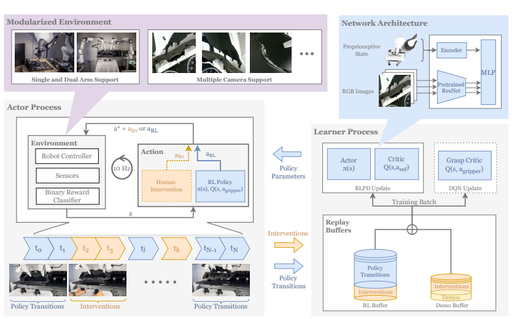
Figure 2 : Overview of HIL-SERL. This figure illustrates the architecture of HIL-SERL, which comprises three primary components: the actor process, the learner process, and replay buffers. These components communicate asynchronously to facilitate efficient data flow. The actor process receives updated policy parameters from the learner process, interacts with the environment, and sends collected interaction data to the replay buffers. The environment is modular, supporting various external devices and multiple robotic arms. A human operator can intervene via teleoperation tools, such as a SpaceMouse. The learner process samples data evenly from two replay buffers and updates the policy using RLPD. When gripper control is required, a grasp critic is additionally trained with DQN.
Original paper · CC BY 4.0 · Jianlan Luo, Charles Xu, Jeffrey Wu, Sergey Levine · Precise and Dexterous Robotic Manipulation via Human-in-the-Loop Reinforcement Learning · Original paper figure · Extracted the figure area from page 6 of the original PDF.Why real-world RL has been hard to use on dexterous tasks
RL could in principle produce skills fitted to the exact hardware and task, potentially beating hand-written controllers and human teleoperation. On a physical robot, three obstacles limit this: the number of trials needed, the need for an accurate reward function, and unstable optimization. Simulation and large existing real-world datasets have supported RL, and hand-designed features have served narrowly defined tasks.
General vision-based methods that learn physically complex skills beyond the level of imitation learning and hand-designed controllers have lagged behind.
The target here is a vision-based RL pipeline that trains directly on hardware and covers tasks with very different control needs. Some tasks need reactive closed-loop control for precise contact, while others, such as whipping a block out of a tower, need open-loop motions that are hard to specify by hand. The task set includes single-arm and dual-arm setups, and the state and action spaces are high-dimensional.
Figure 1 gives an overview of the experimental tasks, including the Jenga whipping, object flipping and assembly tasks.
Components of the HIL-SERL pipeline
HIL-SERL pairs a pretrained visual backbone, which addresses optimization stability, with a sample-efficient off-policy learner, which addresses sample cost. Human demonstrations and corrections are then added to that learner, so the human data enters the same off-policy update.
Each camera image is cropped and resized to 128x128 before it reaches a ResNet-10 pretrained on ImageNet. The same backbone is shared across cameras, and the output embeddings are concatenated with processed proprioception.
Rather than hand-shaping a reward, the system trains one binary classifier per task. That classifier gives a reward only when the task completes and zero otherwise. The authors estimate that collecting about 200 positive and 1000 negative samples by teleoperation is roughly equivalent to 10 human trajectories and takes around 5 minutes. The trained classifier reaches greater than 95% accuracy on the evaluation data set.
Proprioception is expressed relative to the end-effector pose at the start of each episode, and that start pose is randomized within a pre-defined workspace area. Actions are relative to the current end-effector frame, so a moved object looks like a shifted target, and the policy can still succeed when the object is perturbed mid-episode.
Dynamic tasks receive feedforward wrenches in the end-effector frame with no closed-loop acceleration control, which the authors found sufficient for the tasks considered.
Gripper actions and the RLPD learner
Two MDPs share the same observations: a continuous one for arm motion and a discrete one for gripper choices. The arm policy is updated with RLPD, while a separate grasp critic evaluates the discrete gripper options. For one gripper the discrete choices are open, close and stay, and two grippers give 9 combinations.
The critic follows DQN with a target network. Its bootstrap target uses the online network to select the next action and the target network to score it, and the target network follows the online parameters by Polyak averaging. At inference, the policy supplies the continuous action, the critic's argmax supplies the discrete action, and both are applied to the robot together.
Interaction data from the actor is sent to these buffers. During an intervention the human action replaces the policy action, and the intervention data is stored in both the demonstration and RL buffers. The policy transitions before and after an intervention go only into the RL buffer.
The intervention scheme resembles HG-DAgger, in which a human takes over to collect corrections. Here the corrections feed a reinforcement learning update instead of supervised learning.
From reward data to a converged policy
Then 20 to 30 human demonstrations fill the offline demo buffer before online training starts.
Resets are either scripted or performed by the human operator, depending on the task. Human intervention continues during online training until the policy converges.
Early on the operator intervenes often to show ways of solving the task from different states. As success rate and cycle time improve, the amount of intervention is reduced.
Long sparse interventions that end in task success should be avoided. The authors argue that such interventions overestimate the value function early in training and can destabilize learning.
Jenga whipping is the exception: its offline dataset holds 30 expert demonstrations and no real-time human corrections. The authors judged that adding human feedback during this training would be impractical and unsuitable for the task.
HIL-SERL against HG-DAgger and behavioral cloning
The HG-DAgger baseline pretrains a behavioral cloning policy on offline human demonstrations, matched in amount to those given to HIL-SERL. It then runs for the same number of episodes as HIL-SERL, with a comparable number of interventions, so the human effort matches RL training.
Jenga whipping and Object Flipping are handled differently, because interventions there are hard and undesirable. Their baselines are flat BC policies trained on 50 and 200 demonstrations, while HIL-SERL uses 20 to 30 demonstrations.
Average cycle time is 9.6 s for BC and 5.4 s for HIL-SERL, a 1.8 times faster cycle. The authors explain the speed gap by noting that discounted RL favors reaching rewards sooner, while imitation copies demonstrations that include suboptimal motion.
Training took 1 to 2.5 hours on nearly all tasks. For HIL-SERL this rate falls as training proceeds, while the HG-DAgger intervention rate does not consistently decrease.
On Object Flipping, BC reached 47% success with 20 demonstrations and 46% with 200, so more demonstrations alone did not raise success.
Removing corrections and comparing other RL baselines
RL from scratch, with no demonstrations and no corrections, reached 0% success on all tasks. This points to the offline demonstrations as a necessary starting point for these tasks.
Enlarging the offline buffer tenfold, from 20 to 200 demonstrations, without online corrections gave lower success than HIL-SERL. On Car Dashboard Assembly that variant reached 0%.
Residual RL, IBRL and DAPG were each initialized with 200 demonstrations. Residual RL depends on a pretrained BC base policy, which the authors say performs poorly on precise tasks such as car dashboard assembly and RAM insertion.
The IBRL actor mixes a BC policy with an RL policy, so the authors say it stays BC-like and struggles where BC performs poorly. DAPG regularizes actions toward the stored demonstrations, and the authors note that its results therefore track the BC policies.
Diffusion Policy was trained on 200 demonstrations for each task. The text reports 27% on RAM Insertion, 28% on the car dashboard panel task and 56% on Object Flipping. The authors attribute the gap to these tasks needing closed-loop reactive correction, which an expressive policy distribution does not supply.
Why the learned policies are so reliable
The authors attribute the 100% reliability to RL's ability to self-correct through policy sampling, learning from both successes and failures. They contrast this with imitation approaches, including interactive ones, which lack that self-correction loop.
RAM Insertion is used for this analysis because it is precise and its randomization is symmetric in X and Y, which makes state visitation easy to plot. Heatmaps of visitation over end-effector Y and Z positions across policy checkpoints show a funnel that links the initial states to the target and narrows near it.
Critical states are those where the Q-function variance is large. The variance is the expectation, over action perturbations drawn from \([-c,c]\), of the squared deviation of \(Q(\mathbf{s},\mathbf{a}+\epsilon)\) from its own mean over the same perturbations. Noise from [-0.2, 0.2] is added to the normalized action at each state, and the variance is estimated with 100 Monte Carlo samples.
The authors read this as the policy robustifying the region and connecting important states to actions with high Q-values through dynamic programming.
HG-DAgger visitation on the same task is sparser and less funnel-shaped, with states visited more uniformly. The authors explain this by RL exploring autonomously under reward-directed dynamic programming, while DAgger explores only around the current policy.
Their version differs because perceptual inputs are used directly and RL exploration forms the funnel, with demonstrations and corrections acting as nominal trajectories.
Reactive and predictive behavior in the learned policies
High-precision tasks need a closed-loop reactive policy that responds to immediate sensory feedback. Dynamic tasks such as Jenga whipping and object flipping are better served by an open-loop predictive policy that plans ahead and executes consistently.
The analysis uses Jenga Whipping and RAM Insertion, plotting the mean and standard deviation of the computed Gaussian policy actions over time. Three successful trajectories are analyzed for each task.
In Jenga Whipping the standard deviation stays very close to 0 at every time step. The authors read this as a confident policy that executes a pre-planned motion, refined through environmental interaction, in a way similar to a reflex.
RAM Insertion shows a different pattern, with the policy adjusting from sensory feedback and sometimes breaking contact and re-approaching the target. The higher variance in this case, which also appears in timing belt installation, is read by the authors as readiness to react to changing conditions.
Limits of the tested scope
Whether the method extends to tasks with significantly longer horizons remains uncertain. The authors suggest that improved pretraining, or automatic segmentation of a long-horizon task into shorter sub-tasks with a vision-language model, might ease this.
Randomization was not extensive in the experiments, and generalization to unstructured environments was not tested. The authors propose longer training with the desired randomization level, and vision foundation models pretrained on diverse data, as possible remedies.
Each task still requires training from scratch. The authors suggest pretraining a value function across tasks with different robot embodiments to shorten this.
The reward classifier can produce false negatives and false positives, which may call for extra collected data. The whole-assembly result rests on 10 trials, and each sub-policy is allowed at most two attempts.
The Diffusion Policy, IBRL, Residual RL and DAPG comparisons used 200 demonstrations, which is much more than the 20 to 30 demonstrations HIL-SERL uses. Those comparisons therefore do not match HIL-SERL's demonstration budget.
Where the authors see the method used next
The authors see the approach as a way to generate training data for robot foundation models, since each task trains quickly and largely autonomously. Policies that converge could be executed to collect data that is then distilled into generalist models.
The authors also point to High-Mix Low-Volume manufacturing, or make-to-order production, as a setting where fast per-task skill acquisition is valuable.
Paper info
- Authors
- Jianlan Luo, Charles Xu, Jeffrey Wu, Sergey Levine
- Venue
- arXiv · Preprint
- First published
- 2024-10-29
- Added
- 2026-11-6
- Updated
- 2025-3-20
- Version
- v3
- arXiv
- 2410.21845
- Category
- cs.RO · cs.AI
- Original paper terms
- CC BY 4.0
- What we show
- Paper info, commentary and permitted figures from the original paper
AI commentary is a separate explanation from the original paper and may contain errors. The original paper and figures follow each source's terms of use and any rights noted separately.
Abstract
Reinforcement learning (RL) holds great promise for enabling autonomous acquisition of complex robotic manipulation skills, but realizing this potential in real-world settings has been challenging. We present a human-in-the-loop vision-based RL system that demonstrates impressive performance on a diverse set of dexterous manipulation tasks, including dynamic manipulation, precision assembly, and dual-arm coordination. Our approach integrates demonstrations and human corrections, efficient RL algorithms, and other system-level design choices to learn policies that achieve near-perfect success rates and fast cycle times within just 1 to 2.5 hours of training. We show that our method significantly outperforms imitation learning baselines and prior RL approaches, with an average 2x improvement in success rate and 1.8x faster execution. Through extensive experiments and analysis, we provide insights into the effectiveness of our approach, demonstrating how it learns robust, adaptive policies for both reactive and predictive control strategies. Our results suggest that RL can indeed learn a wide range of complex vision-based manipulation policies directly in the real world within practical training times. We hope this work will inspire a new generation of learned robotic manipulation techniques, benefiting both industrial applications and research advancements. Videos and code are available at our project website https://hil-serl.github.io/.
Quote from the paper
Jianlan Luo, Charles Xu, Jeffrey Wu, Sergey Levine (2024). Precise and Dexterous Robotic Manipulation via Human-in-the-Loop Reinforcement Learning. arXiv:2410.21845v3. https://arxiv.org/abs/2410.21845v3
BibTeX
@misc{luo2024precise,
  title = {{Precise and Dexterous Robotic Manipulation via Human-in-the-Loop Reinforcement Learning}},
  author = {Jianlan Luo and Charles Xu and Jeffrey Wu and Sergey Levine},
  year = {2024},
  eprint = {2410.21845},
  archivePrefix = {arXiv},
  url = {https://arxiv.org/abs/2410.21845v3}
}