論文解説
LEDGE: Separating Critic and Editor Failures in Text-to-Image Self-Correction
LEDGE:テキストから画像への自己修正における批評者と編集器の失敗の切り分け
- 課題 テキストから画像への自己修正では、失敗が批評者の誤った診断によるものか、編集器の実行失敗によるものかを、最終スコアだけで見分けるのは困難です。
- 手法 生成画像と編集器を固定し、GenEvalの判定からオラクル編集指示を作ります。そのラベルで批評者をLoRAファインチューニングし、診断精度を高めます。
- 結果 SD1.5でVAREdit編集器を固定すると、オラクル指示はGenEvalマクロスコアを42.2%から64.3%に上げました。オラクル教師あり学習の批評者は59.4%で、基準批評者の50.9%を上回りました。
終点スコアだけでは失敗原因を分けられない問題
テキストから画像への自己修正ループは、VLM批評者が画像を診断して編集指示を作り、編集器がその指示を実行する構造です。ただしループ全体のスコアだけを見ると、失敗が批評者の誤った診断によるものか、編集器が正しい指示を実行できなかったことによるものか区別できません。この区別が重要なのは、編集器を改善しても誤った指示は補えず、批評者を改善しても編集器が指示を実行できなければスコアは上がらないからです。LEDGEはこの2つのボトルネックを分けて捉えるように設計されています。
GenEvalの判定からオラクル指示を作る方法
LEDGEは、生成画像と編集器を固定したまま、GenEvalが提供するプロンプトごとの要件と検出器の失敗理由を読み取ります。失敗理由は、オブジェクトの欠落、過剰、色の不一致、関係の不一致、基準オブジェクトの不在の5種類に分けられます。コンパイラは各理由をadd、remove、recolor、move編集に変換し、同じ固定テンプレートで指示文をレンダリングします。こうして作られた指示をオラクル指示と呼びます。批評者と同じテンプレートを使うため、2つの方式の違いは診断内容にだけ残ります。ただしオラクルは評価器の判定を読み取るため、テスト時に使える方法ではありません。また1つの有効な編集にすぎず、あり得るすべての指示の上限でもありません。
オラクルラベルで批評者を学習する手順
著者らは、オラクルは学習時にラベル生成器として使えると考えています。ベンチマークや仕様と重ならない学習プロンプトで生成したSD1.5画像にオラクルを適用し、編集リストとkeepラベルを作成しました。このラベルを使い、Qwen3-VL-8B言語モデルにLoRAアダプタを付けて、画像、元のプロンプト、ルールプロンプトを受け取り目標JSONを出力するよう学習させました。ビジョンエンコーダは固定しました。チェックポイントは、DEVプロンプトでの正確診断率を基準に選びましたが、正解画像の編集率を10%以下に制限するルールは学習前に決めておきました。公式ベンチマークは、選択したチェックポイントで1回だけ実行しました。
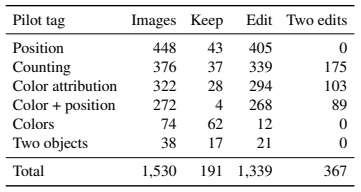
Table 9 . Oracle labels on pilot training images (SD1.5, corrected metadata).
出典 · CC BY 4.0 · Vyom Agarwal, Mokshda Gangrade, Samet Ayhan, Giacinto Paolo Saggese · LEDGE: Separating Critic and Editor Failures in Text-to-Image Self-Correction · 論文の図を引用 · 元のPDFの13ページ目から図の部分を抽出しています。SD1.5で見られた2つの格差と批評者の改善
SD1.5画像でVAREdit編集器を固定し、指示の出所だけを変えて比較しました。元のスコアはGenEvalマクロ平均42.2%で、オラクル指示を使うと64.3%まで上がりました。基準のQwen批評者は50.9%に上がり、指示との差13.4ポイントのうち約39%を埋めました。オラクル教師あり学習の批評者は59.4%を記録し、差の63%を埋めました。修正は420件、悪化は18件でした。基準批評者の修正226件、悪化23件と比べると、同じ画像でも違いがあります。診断面では、正確診断率が33.3%から70.8%に上がりました。一方、オラクル指示を適用してもSD1.5の失敗1,324件のうち812件(61.3%)は復旧しませんでした。
著者らは、この残存する失敗を編集器ギャップと定義し、カウンティングのように編集器がほとんど成功しないタスクではボトルネックが大きくなると解釈しています。
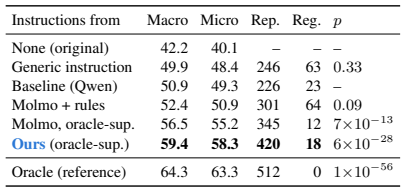
Table 1 . GenEval on SD1.5 images with the same V AREdit editor and the same 2,212 images. Rep./Reg.: repairs and regressions against the original images;p: exact McNemar test against the baseline critic on the same images. Best non-oracle results in bold.
出典 · CC BY 4.0 · Vyom Agarwal, Mokshda Gangrade, Samet Ayhan, Giacinto Paolo Saggese · LEDGE: Separating Critic and Editor Failures in Text-to-Image Self-Correction · 論文の図を引用 · 元のPDFの4ページ目から図の部分を抽出しています。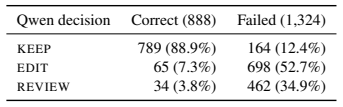
Table 2 . Baseline critic decisions against GenEval’s verdict on the original SD1.5 images (left) and its diagnoses of failures against the oracle (right).
出典 · CC BY 4.0 · Vyom Agarwal, Mokshda Gangrade, Samet Ayhan, Giacinto Paolo Saggese · LEDGE: Separating Critic and Editor Failures in Text-to-Image Self-Correction · 論文の図を引用 · 元のPDFの6ページ目から図の部分を抽出しています。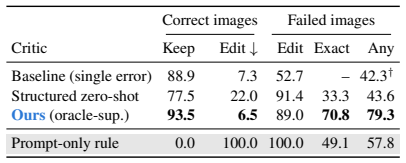
Table 3 . Diagnosis on official SD1.5 images (888 correct, 1,324 failed) against the oracle, without editing.Exact: same edit set as the oracle;Any: at least one matching edit ( †type-level only, not directly comparable). The gray row ignores the image and is tuned on the test failures, an upper bound for prompt-only critics. Best critic results in bold.
出典 · CC BY 4.0 · Vyom Agarwal, Mokshda Gangrade, Samet Ayhan, Giacinto Paolo Saggese · LEDGE: Separating Critic and Editor Failures in Text-to-Image Self-Correction · 論文の図を引用 · 元のPDFの6ページ目から図の部分を抽出しています。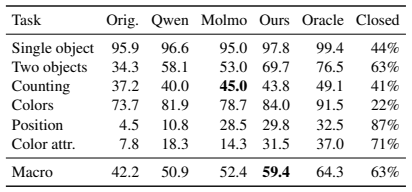
Table 4 . Per-task accuracy on SD1.5 after editing. Qwen: baseline critic; Molmo: Molmo + rules; closed: share of the baseline-to- oracle gap closed by the oracle-supervised critic. Bold marks the best non-oracle result for counting and for the macro average.
出典 · CC BY 4.0 · Vyom Agarwal, Mokshda Gangrade, Samet Ayhan, Giacinto Paolo Saggese · LEDGE: Separating Critic and Editor Failures in Text-to-Image Self-Correction · 論文の図を引用 · 元のPDFの6ページ目から図の部分を抽出しています。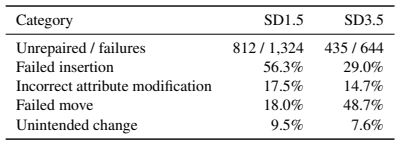
Table 13 . Unrepaired images under oracle instructions (V AREdit), by failure category. Categories overlap; percentages are of unre- paired images.
出典 · CC BY 4.0 · Vyom Agarwal, Mokshda Gangrade, Samet Ayhan, Giacinto Paolo Saggese · LEDGE: Separating Critic and Editor Failures in Text-to-Image Self-Correction · 論文の図を引用 · 元のPDFの15ページ目から図の部分を抽出しています。別の生成器・編集器・判定器への転移
批評者はSD1.5画像だけで学習しましたが、SD3.5-Large画像でもGenEvalスコアを72.0%から76.0%に上げました。同じ条件でオラクル指示は81.2%まで上がり、指示による差の27%だけを埋めました。2つ目の編集器FLUX.1 Kontextでも、同じ指示ファイルを使うと、基準批評者は51.6%、提案批評者は61.5%を記録し、指示による差の74%を埋めました。GenEvalの検出器とは独立したT2I-CompBench判定器でSD1.5画像を採点し直すと、平均は元の47.45から提案批評者の61.17に上がり、基準批評者は53.89でした。
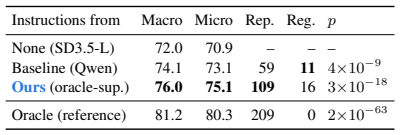
Table 5 . Results on SD3.5-Large (downscaled to512 2) with the same V AREdit editor. The oracle-supervised critic was trained only on SD1.5 images.p: exact McNemar test against the origi- nal images. Rep./Reg.: repairs and regressions. Best non-oracle results in bold.
出典 · CC BY 4.0 · Vyom Agarwal, Mokshda Gangrade, Samet Ayhan, Giacinto Paolo Saggese · LEDGE: Separating Critic and Editor Failures in Text-to-Image Self-Correction · 論文の図を引用 · 元のPDFの7ページ目から図の部分を抽出しています。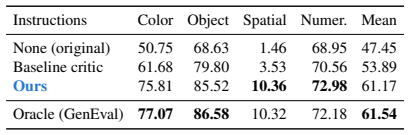
Table 6 . Re-scoring GenEval images with T2I-CompBench’s judges (SD1.5, V AREdit, 2,016 images; scores×100). Color: GenEval’s colors and color attribution; object: single and two ob- jects (BLIP-VQA); spatial: position; numer.: counting (UniDet). Mean: unweighted mean of the four columns. Oracle instructions come from GenEval, not from these judges. Best results in bold.
出典 · CC BY 4.0 · Vyom Agarwal, Mokshda Gangrade, Samet Ayhan, Giacinto Paolo Saggese · LEDGE: Separating Critic and Editor Failures in Text-to-Image Self-Correction · 論文の図を引用 · 元のPDFの8ページ目から図の部分を抽出しています。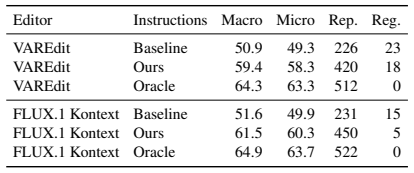
Table 7 . A second editor on SD1.5 (GenEval, same 2,212 images and instruction files). Rep./Reg.: repairs and regressions against the original images.
出典 · CC BY 4.0 · Vyom Agarwal, Mokshda Gangrade, Samet Ayhan, Giacinto Paolo Saggese · LEDGE: Separating Critic and Editor Failures in Text-to-Image Self-Correction · 論文の図を引用 · 元のPDFの8ページ目から図の部分を抽出しています。評価の共有と残る格差
最大の制約は、ラベル生成、チェックポイント選択、主評価のすべてがGenEvalの検出器を共有している点です。そのため、独立した判定器の結果と合わせて読む必要があります。独立判定器では、オラクルと提案批評者の差が0.37まで縮まりました。著者らは、オラクルの優位性の一部はGenEval検出器に合わせた修正から来ていると考えています。学習は単一シードで行い、8Bの批評者と8Bの編集器を使っているため、より大きな生成器と同じ計算量で比較した主張はしていません。編集器のギャップ自体は、色属性と位置でなお大きいため、編集器の改善が別途必要です。
論文情報
- 著者
- Vyom Agarwal, Mokshda Gangrade, Samet Ayhan, Giacinto Paolo Saggese
- 学会・ジャーナル
- arXiv · プレプリント
- 公開日
- 2026年11月16日
- 登録日
- 2026年11月17日
- 更新日
- 2026年11月16日
- バージョン
- v1
- arXiv
- 2611.20446
- カテゴリ
- cs.CV
- ライセンス
- CC BY 4.0
- 掲載内容
- 論文情報・解説・論文の図
この解説は、Refivuの韓国語解説をAIで翻訳したものです。不正確な翻訳や誤りが含まれる可能性があります。論文と図の利用条件は各出典に従います。
アブストラクト
Text-to-image (T2I) self-correction combines a vision-language model (VLM) critic that diagnoses errors and proposes instructions with an image editor that executes them. End-to-end evaluation obscures whether failures arise from incorrect diagnoses or an editor unable to execute valid instructions. We introduce LEDGE (Learning Error Diagnosis in Generation and Editing), a framework that separates these bottlenecks. LEDGE compiles oracle edit instructions from GenEval while holding the generated images and the editor fixed, isolating the editor's correction capability from the critic's diagnostic accuracy. On Stable Diffusion 3.5 Large, oracle instructions raise GenEval from 72.0% to 81.2%, versus 74.1% for the baseline VLM critic. Yet 435 of 644 failed images remain unrepaired, exposing a substantial editor gap. We also use oracle labels from disjoint training prompts to supervise the critic. Oracle supervision raises exact diagnosis from 33.3% (the same VLM with our structured output, untrained) to 70.8%. With the same editor, the resulting critic improves GenEval from 42.2% (uncorrected) to 59.4% on Stable Diffusion 1.5, against 50.9% for the baseline critic, and from 72.0% to 76.0% on Stable Diffusion 3.5 Large, despite training only on Stable Diffusion 1.5. Improvements transfer to unseen object classes, a second editor, and independent T2I-CompBench judges and prompts. A small human evaluation confirms the ranking in estimated net corrections but suggests a smaller gain than detector-based evaluation. LEDGE thus distinguishes two limits of self-correction: knowing what to fix and being able to fix it.
この論文を引用
Vyom Agarwal, Mokshda Gangrade, Samet Ayhan, Giacinto Paolo Saggese (2026). LEDGE: Separating Critic and Editor Failures in Text-to-Image Self-Correction. arXiv:2611.20446v1. https://arxiv.org/abs/2611.20446v1
BibTeX
@misc{agarwal2026ledge,
  title = {{LEDGE: Separating Critic and Editor Failures in Text-to-Image Self-Correction}},
  author = {Vyom Agarwal and Mokshda Gangrade and Samet Ayhan and Giacinto Paolo Saggese},
  year = {2026},
  eprint = {2611.20446},
  archivePrefix = {arXiv},
  url = {https://arxiv.org/abs/2611.20446v1}
}