論文解説
Detection-Efficient Watermarking for Vision--Language Agents via Risk-Constrained Strength Allocation
Vision--Languageエージェント向けの検出効率型ウォーターマーキング:リスク制約付き強度割り当て
- 課題 視覚言語エージェントの出力は再利用されるため出どこの確認が必要ですが、固定強度のウォーターマークは検出と応答品質の両方を揺らします。
- 手法 各デコーディング段階でエントロピーと関連性リスクのスコアを合わせて見たうえで、λで調整されるリスク制約付きの強度割り当てを適用します。
視覚言語エージェント出力のウォーターマーク問題
視覚言語エージェントの応答は、レポート、後続のエージェント、自動化ワークフローで再利用されるため、出どこを確認できるウォーターマークが必要です。しかし統計的なウォーターマークはトークンの分布を変えるため、強度を上げると検出は良くなる一方で、単語選択、likelihood、タスクに関連する内容も一緒に揺らぎます。既存の方法はすべてのトークン決定に同じ強度を適用しますが、画像に基づく物体や空間関係を表すトークンは、文体上のトークンよりはるかに有害になりえます。この論文は、この問題を検出と品質のあいだの運用曲線として扱います。
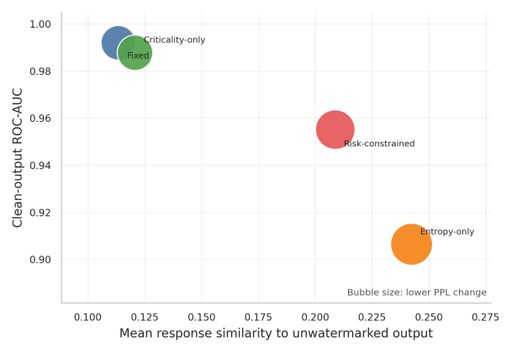
Fig. 1 . Quality–detection operating points for the default watermarking configurations. The horizontal axis shows response similarity to the unwatermarked output, the vertical axis shows clean-output ROC-AUC, and bubble size represents lower perplexity change.
出典 · CC BY 4.0 · Dumindu Samaraweera, Prashant Shekhar · Detection-Efficient Watermarking for Vision--Language Agents via Risk-Constrained Strength Allocation · 論文の図を引用 · 元のPDFの10ページ目から図の部分を抽出しています。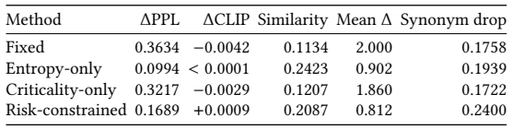
Table 2 . Automatic quality results on 1,000 image–query instances. Lower perplexity change is better, while higher response similarity is better.
出典 · CC BY 4.0 · Dumindu Samaraweera, Prashant Shekhar · Detection-Efficient Watermarking for Vision--Language Agents via Risk-Constrained Strength Allocation · 論文の図を引用 · 元のPDFの11ページ目から図の部分を抽出しています。不確実性と関連性リスクによる強度の決定
提案手法は、各デコーディング段階で正規化エントロピーg_tと関連性リスクスコアc_tを計算し、Δ_t = min(Δmax, g_t / (2λ(c_t+ε)))によってウォーターマークの強度を決めます。g_tは次のトークン分布が複数の候補に広がっているほど大きくなり、c_tは現在の分布の確率質量が関連性スコアの高いトークンに集まるほど大きくなります。λは関連性リスクに応じた介入抑制の度合いを決めるポリシーパラメータで、モデル、パーティション、検出器を変えずに運用点を選べます。関連性スコアr(v)は、文脈、局所変動、画像類似度の3つのスコアを合計してmin-max正規化した値です。著者らはこれを検証済みの意味的重要度の推定値ではなく、運用上のリスク信号として扱っています。
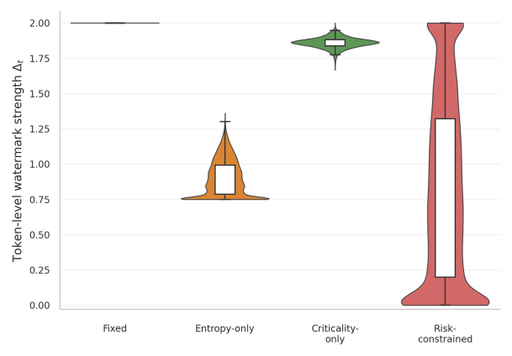
Fig. 2 . Token-level watermark-strength distributions across the full evaluation set. Adaptive methods redistribute watermark strength across decoding steps rather than applying a uniform intervention.
出典 · CC BY 4.0 · Dumindu Samaraweera, Prashant Shekhar · Detection-Efficient Watermarking for Vision--Language Agents via Risk-Constrained Strength Allocation · 論文の図を引用 · 元のPDFの11ページ目から図の部分を抽出しています。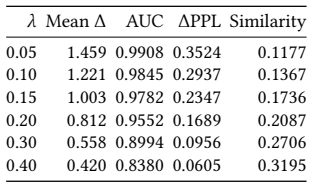
Table 4 . Risk-constrained operating points across𝜆.
出典 · CC BY 4.0 · Dumindu Samaraweera, Prashant Shekhar · Detection-Efficient Watermarking for Vision--Language Agents via Risk-Constrained Strength Allocation · 論文の図を引用 · 元のPDFの13ページ目から図の部分を抽出しています。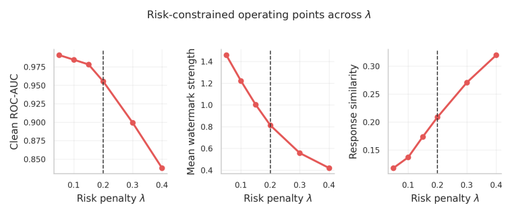
Fig. 4 . Risk-constrained operating points across 𝜆. Increasing 𝜆 reduces mean watermark strength and generally improves response similarity, while decreasing detection performance. The dashed line marks the selected value𝜆=0.20.
出典 · CC BY 4.0 · Dumindu Samaraweera, Prashant Shekhar · Detection-Efficient Watermarking for Vision--Language Agents via Risk-Constrained Strength Allocation · 論文の図を引用 · 元のPDFの14ページ目から図の部分を抽出しています。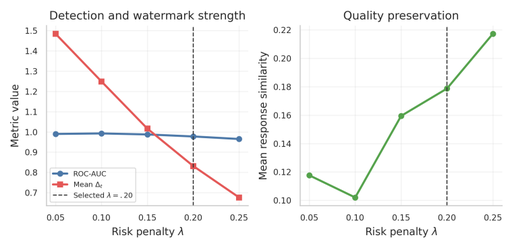
Fig. 5 . Calibration trade-off across risk penalties. The selected configuration uses 𝜆= 0.20as an intermediate operating point between detection strength and response preservation.
出典 · CC BY 4.0 · Dumindu Samaraweera, Prashant Shekhar · Detection-Efficient Watermarking for Vision--Language Agents via Risk-Constrained Strength Allocation · 論文の図を引用 · 元のPDFの14ページ目から図の部分を抽出しています。基本設定と平均強度をそろえた比較
基本設定は、Δmax=2.0、λ=0.20で、LLaVA-1.5-7BによりAMBERの最初の1,000個のインスタンスに適用しました。固定強度ウォーターマークの平均Δは2.000で、リスク制約付きの手法では0.812でした。clean ROC-AUCは0.9921から0.9552に下がりました。この結果は、平均介入が低いだけでは説明できないという著者らの解釈を裏付けるものですが、同じ環境でVLA-Markと比較した結果ではありません。
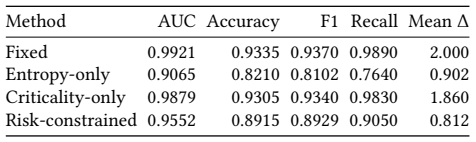
Table 1 . Default detection and watermark-strength results on 1,000 image–query instances.
出典 · CC BY 4.0 · Dumindu Samaraweera, Prashant Shekhar · Detection-Efficient Watermarking for Vision--Language Agents via Risk-Constrained Strength Allocation · 論文の図を引用 · 元のPDFの10ページ目から図の部分を抽出しています。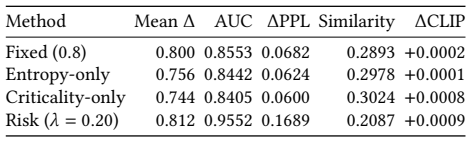
Table 3 . Matched-strength comparison near observed mean watermark strength0.8.
出典 · CC BY 4.0 · Dumindu Samaraweera, Prashant Shekhar · Detection-Efficient Watermarking for Vision--Language Agents via Risk-Constrained Strength Allocation · 論文の図を引用 · 元のPDFの12ページ目から図の部分を抽出しています。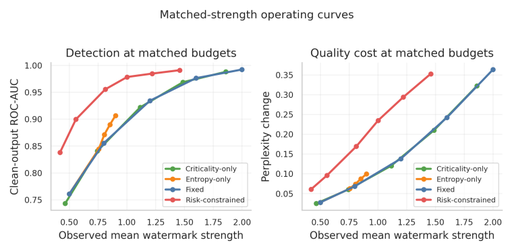
Fig. 3 . Matched-strength operating curves across watermarking strategies. The left panel shows clean-output ROC-AUC as a function of observed mean watermark strength. The right panel shows perplexity change as a function of observed mean watermark strength.
出典 · CC BY 4.0 · Dumindu Samaraweera, Prashant Shekhar · Detection-Efficient Watermarking for Vision--Language Agents via Risk-Constrained Strength Allocation · 論文の図を引用 · 元のPDFの13ページ目から図の部分を抽出しています。限界と残る課題
関連性リスクのプロキシはzero-shotのスコアで、人の判断やタスク損失で学習されていないため、著者らはこれを意味的重要度の検証済み推定値とは主張していません。頑健性評価は、測定したsynonym substitutionとparaphraseの手順に限られ、適応型攻撃や検出器を意識した攻撃は評価していません。CLIPの変化量は自動の代理指標なので、視覚的事実やタスク性能が保たれたという証拠としては読めません。
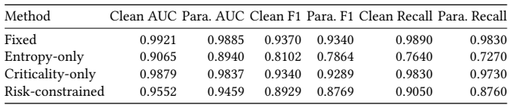
Table 5 . Clean and paraphrased detection performance on 1,000 instances.
出典 · CC BY 4.0 · Dumindu Samaraweera, Prashant Shekhar · Detection-Efficient Watermarking for Vision--Language Agents via Risk-Constrained Strength Allocation · 論文の図を引用 · 元のPDFの15ページ目から図の部分を抽出しています。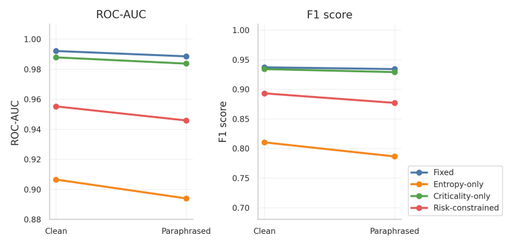
Fig. 6 . Detection stability under the evaluated paraphrase transformation. Lines connect clean and paraphrased ROC-AUC and F1 values for each watermarking strategy.
出典 · CC BY 4.0 · Dumindu Samaraweera, Prashant Shekhar · Detection-Efficient Watermarking for Vision--Language Agents via Risk-Constrained Strength Allocation · 論文の図を引用 · 元のPDFの15ページ目から図の部分を抽出しています。論文情報
- 著者
- Dumindu Samaraweera, Prashant Shekhar
- 学会・ジャーナル
- arXiv · プレプリント
- 公開日
- 2026年11月16日
- 登録日
- 2026年11月18日
- 更新日
- 2026年11月16日
- バージョン
- v1
- arXiv
- 2611.21488
- カテゴリ
- cs.CR · cs.CL
- ライセンス
- CC BY 4.0
- 掲載内容
- 論文情報・解説・論文の図
この解説は、Refivuの韓国語解説をAIで翻訳したものです。不正確な翻訳や誤りが含まれる可能性があります。論文と図の利用条件は各出典に従います。
アブストラクト
Vision--language agents generate descriptions, decisions, and instructions that may be reused by users, downstream agents, and automated workflows, creating a need for provenance mechanisms that support content authenticity and post-deployment auditing without unnecessarily degrading response quality. We present a risk-aware semantic watermarking framework that combines predictive uncertainty with a zero-shot multimodal relevance-risk proxy to allocate watermark strength during decoding. A single risk penalty $λ$ exposes a continuous operating frontier, allowing deployment-time selection of a detection--quality trade-off without model retraining. At a selected operating point, mean watermark strength is reduced by approximately 59.4\% relative to fixed-strength watermarking, while perplexity change falls from 0.3634 to 0.1689 and clean/paraphrased ROC-AUC reaches 0.9552/0.9459. A matched-strength analysis shows that this advantage reflects the allocation policy rather than lower average intervention: at comparable mean strength, risk-constrained allocation achieves substantially higher ROC-AUC than fixed, entropy-only, and criticality-only policies, identifying it as detection-efficient rather than quality-dominant. We further show that threshold calibration on finite samples produces substantial false-positive-rate drift, motivating calibration variance reporting as standard practice for auditable provenance.
この論文を引用
Dumindu Samaraweera, Prashant Shekhar (2026). Detection-Efficient Watermarking for Vision--Language Agents via Risk-Constrained Strength Allocation. arXiv:2611.21488v1. https://arxiv.org/abs/2611.21488v1
BibTeX
@misc{samaraweera2026detection,
  title = {{Detection-Efficient Watermarking for Vision--Language Agents via Risk-Constrained Strength Allocation}},
  author = {Dumindu Samaraweera and Prashant Shekhar},
  year = {2026},
  eprint = {2611.21488},
  archivePrefix = {arXiv},
  url = {https://arxiv.org/abs/2611.21488v1}
}