論文解説
StateAlign: Internalizing State-Aware Decision-Making for Reliable Multi-Turn Tool Agents via Reinforcement Learning
StateAlign:強化学習による信頼できる多ターン・ツールエージェントのための状態認識型意思決定の内在化
- 課題 ツール使用エージェントは、性能が上がるとツールのハルシネーションも増えることがあります。
- 手法 作業状態を作って5つの行動要求を学習させ、結果報酬とトークン単位の状態対照信号を併用します。
- 結果 Qwen3-8BではBFCL v4の多ターン精度が45.5%から55.2%に上がり、NTA幻覚率は62.2%から56.1%に下がりました。
ツールのハルシネーションが生じる理由
ツール使用エージェントは、やり取りの結果に報酬を与える強化学習によって性能が向上しました。しかし、作業性能が上がったからといって、ツール使用がより信頼できるようになったわけではありません。論文は図1で、一部の強化学習エージェントについて、BFCL v4の多ターン精度は基盤モデルより高いものの、ツールのハルシネーション率は高く見えると示しています。原因を調べるため、著者らは、エージェントが与えられた情報とツールを見て適切な行動を選べているかを分析しました。その分析では、情報を尋ねるべき場面や、検索すべき場面、実行不可能な要求を断るべき場面でも、エージェントが先に実行してしまうケースがありました。
推論の中で不足している情報を特定していても、引数を作り上げたツール呼び出しを生成することさえありました。
Qwen3-8Bでは、実行が適切な状態での目標関数の選択は97~98%でしたが、対照的な条件で必要な行動を選ぶことはより不安定でした。不足情報の条件では、応答の95%が推論で不足している値を特定していましたが、ユーザーにその値を尋ねた割合は65%でした。この不一致は、推論と行動が現在の作業条件に従うよう学習させる必要があるという問題設定につながります。
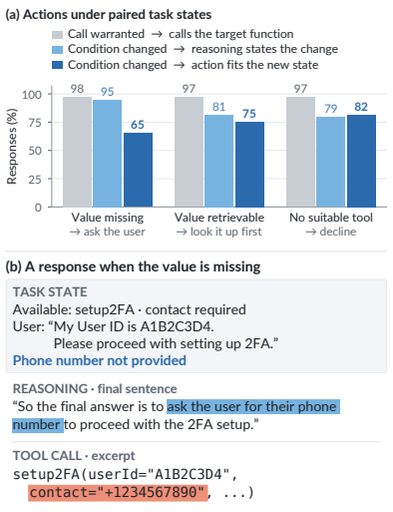
Figure 2 : Task-state diagnosis on Qwen3-8B.(a)Each group pairs a state in which calling the target function is warranted with one that differs in a single condition; bars give the share of responses.(b)Response excerpts when a required phone number is missing. Blue shading marks the decision to ask; red shading marks the unpro- vided value in the emitted call.
出典 · CC BY 4.0 · Zhexi Lu, Subhajit Chaudhury, Tejaswini Pedapati, Keerthiram Murugesan, Lei Yu · StateAlign: Internalizing State-Aware Decision-Making for Reliable Multi-Turn Tool Agents via Reinforcement Learning · 論文の図を引用 · 元のPDFの2ページ目から図の部分を抽出しています。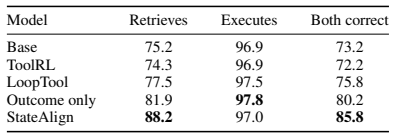
Table 8 : State-conditioned action accuracy on Qwen3- 8B retrieval pairs (%). Retrieves measures lookup se- lection when information must be fetched; Executes measures target-function selection when the required information is available. Both correct averages the prod- uct of the two per-state accuracies within each pair. Bold marks the best result in each column.
出典 · CC BY 4.0 · Zhexi Lu, Subhajit Chaudhury, Tejaswini Pedapati, Keerthiram Murugesan, Lei Yu · StateAlign: Internalizing State-Aware Decision-Making for Reliable Multi-Turn Tool Agents via Reinforcement Learning · 論文の図を引用 · 元のPDFの13ページ目から図の部分を抽出しています。作業状態を作り、状態対照で学習
StateAlignは、ツール使用の軌跡を作業状態の例に変換したうえで、結果報酬と状態対照報酬を併用する強化学習の手法です。作業状態は、情報の利用可能性、ツールの機能、作業の進行によって定められ、次の行動を制約する条件です。論文では、ToolMindとLoopTool-23kで呼び出しを検証し、ユーザーメッセージと検索ステップを書き直したうえで、元の呼び出しの1段階の条件を編集し、EXEC、NEED_USER、NEED_FETCH、INFEASIBLE、STOPの5つの状態を作りました。この約30k個の例は元の実行状態と対になっており、対にならない例は結果の監督のみを受けます。
結果学習では、状態ごとにロールアウトを生成し、GRPOの目的関数で方策を更新します。状態対照学習では、固定された基盤モデルπ0が、同じ生成トークンを現在の状態と対になった状態のそれぞれで採点し、2つの対数確率の差をクリップした値をトークンの重みとして使います。この重みは、採点にのみ使われる文脈と基準経路から計算され、方策自身は自分のツールと履歴をもとに行動します。
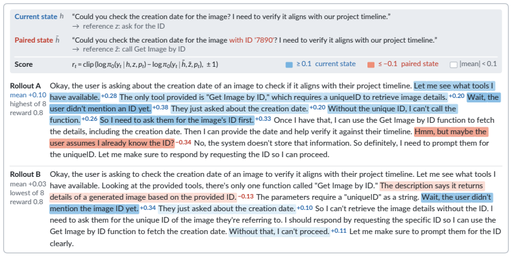
Figure 4 : State-contrast scores for two successful rollouts when the image ID is missing; the paired state provides it. Labels show mean token scores within each sentence. Blue indicates scores ≥0.1 , red indicates scores ≤ −0.1, and unshaded sentences have scores between these thresholds. Both rollouts ask for the ID; their reasoning differs in state compatibility.
出典 · CC BY 4.0 · Zhexi Lu, Subhajit Chaudhury, Tejaswini Pedapati, Keerthiram Murugesan, Lei Yu · StateAlign: Internalizing State-Aware Decision-Making for Reliable Multi-Turn Tool Agents via Reinforcement Learning · 論文の図を引用 · 元のPDFの7ページ目から図の部分を抽出しています。主な比較結果
Qwen3-8Bでは、StateAlignによりBFCL v4の多ターン精度が45.5%から55.2%に上がりました。結果報酬だけで学習した場合は62.2%だったSimpleToolHalluBenchのNTA幻覚率は、56.1%に下がりました。Qwen3-14Bでは、NTAが56.9%から45.0%に、DTが25.2%から22.6%に下がりました。この比較は、同じ構成の状態データで結果だけを学習した設定と、完全なStateAlignを比べたものです。
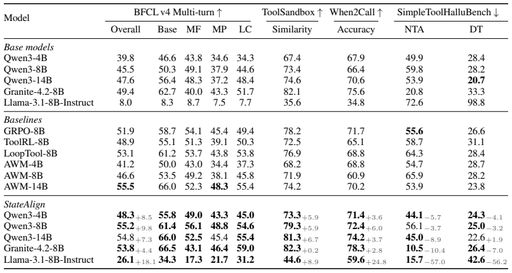
Table 1 : Comparison of StateAlign with base models and tool-use training baselines on task performance and tool hallucination across four benchmarks. ToolSandbox similarity reflects how well execution trajectories satisfy task milestones. MF, MP, and LC denote Missing Functions, Missing Parameters, and Long Context. NTA and DT denote the no-tool and distractor-tool settings. All scores are on a 0–100 scale. Gray subscripts indicate score differences from the corresponding base model;boldmarks the best result for each base model and size.
出典 · CC BY 4.0 · Zhexi Lu, Subhajit Chaudhury, Tejaswini Pedapati, Keerthiram Murugesan, Lei Yu · StateAlign: Internalizing State-Aware Decision-Making for Reliable Multi-Turn Tool Agents via Reinforcement Learning · 論文の図を引用 · 元のPDFの6ページ目から図の部分を抽出しています。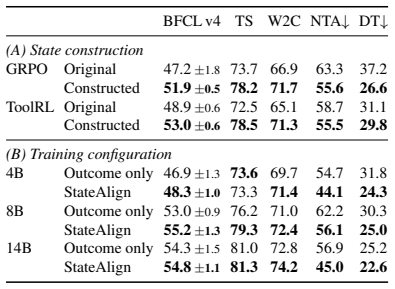
Table 2 : State construction and training ablations. TS: ToolSandbox; W2C: When2Call; NTA, DT: halluci- nation rates (lower is better).(A)Qwen3-8B trained on original data (ToolMind for GRPO; RLLA-4k for ToolRL) and constructed states.(B)Outcome-only train- ing and complete StateAlign on constructed states. Bold: better of each pair.
出典 · CC BY 4.0 · Zhexi Lu, Subhajit Chaudhury, Tejaswini Pedapati, Keerthiram Murugesan, Lei Yu · StateAlign: Internalizing State-Aware Decision-Making for Reliable Multi-Turn Tool Agents via Reinforcement Learning · 論文の図を引用 · 元のPDFの6ページ目から図の部分を抽出しています。ツールのエラーが生じた後の行動にも違いが見られました。Qwen3-8Bでは、エラーのあるターンの応答失敗率は、StateAlignが2.7%、GRPOが5.7%、LoopToolが6.3%でした。ただし、これらの数値は論文が報告した当該設定の結果であり、他のモデルやデータ条件に広げて解釈するものではありません。
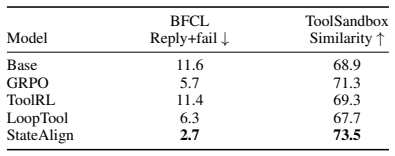
Table 4 : Behavior and task completion after tool errors on Qwen3-8B. BFCL Reply+fail is the percentage of error-containing turns with no tool call in the next as- sistant response after the first error and a final failure. ToolSandbox reports similarity for error-containing sce- narios. Values use a 0–100 scale; bold marks the best result in each column.
出典 · CC BY 4.0 · Zhexi Lu, Subhajit Chaudhury, Tejaswini Pedapati, Keerthiram Murugesan, Lei Yu · StateAlign: Internalizing State-Aware Decision-Making for Reliable Multi-Turn Tool Agents via Reinforcement Learning · 論文の図を引用 · 元のPDFの7ページ目から図の部分を抽出しています。学習フィードバックの範囲
著者らは、学習フィードバックが元の軌跡に含まれるやり取りに限られると説明しています。より長いワークフローや、変化するユーザーの目標やツールの動作を扱う設定については、まだ確認していません。また、評価は5つの基盤モデルを対象に、4Bから14Bの範囲で、テキストベースのツール使用ベンチマークで行いました。大規模な設定やマルチモーダルなツール環境での効果は確認していません。
論文情報
- 著者
- Zhexi Lu, Subhajit Chaudhury, Tejaswini Pedapati, Keerthiram Murugesan, Lei Yu
- 学会・ジャーナル
- arXiv · プレプリント
- 公開日
- 2026年11月12日
- 登録日
- 2026年11月13日
- 更新日
- 2026年11月12日
- バージョン
- v1
- arXiv
- 2611.16304
- カテゴリ
- cs.LG
- ライセンス
- CC BY 4.0
- 掲載内容
- 論文情報・解説・論文の図
この解説は、Refivuの韓国語解説をAIで翻訳したものです。不正確な翻訳や誤りが含まれる可能性があります。論文と図の利用条件は各出典に従います。
アブストラクト
Reinforcement learning has improved the tool-use capabilities of large language models. However, better task performance can coincide with increased tool hallucination. Reliable tool use requires decisions to follow the current task state: available information, tool capabilities, and task progress. Our analysis shows that agents sometimes execute when they should ask for information, retrieve it, or decline an infeasible request, even when reasoning identifies missing information. We introduce StateAlign, combining task-state construction with state-contrastive reinforcement learning. The data cover five task conditions and pair states with different action requirements. Outcome rewards guide task completion; token-level contrasts compare the same generated reasoning and actions under paired states to train outputs that fit the current state. Experiments across five base models from three families show improvements on BFCL v4 multi-turn, ToolSandbox, and When2Call. Ablations show that state construction improves performance and reliability under different reward designs. The complete method further reduces tool hallucination across three Qwen3 sizes. On Qwen3-8B, StateAlign improves BFCL v4 multi-turn accuracy from 45.5% to 55.2% and reduces no-tool hallucination on SimpleToolHalluBench from 62.2% under outcome-only training to 56.1%. Behavioral analyses show more consistent decisions, more complete multi-call execution, and stronger recovery after tool errors.
この論文を引用
Zhexi Lu, Subhajit Chaudhury, Tejaswini Pedapati, Keerthiram Murugesan, Lei Yu (2026). StateAlign: Internalizing State-Aware Decision-Making for Reliable Multi-Turn Tool Agents via Reinforcement Learning. arXiv:2611.16304v1. https://arxiv.org/abs/2611.16304v1
BibTeX
@misc{lu2026statealign,
  title = {{StateAlign: Internalizing State-Aware Decision-Making for Reliable Multi-Turn Tool Agents via Reinforcement Learning}},
  author = {Zhexi Lu and Subhajit Chaudhury and Tejaswini Pedapati and Keerthiram Murugesan and Lei Yu},
  year = {2026},
  eprint = {2611.16304},
  archivePrefix = {arXiv},
  url = {https://arxiv.org/abs/2611.16304v1}
}