論文解説
Efficient and Accurate Causal Validation of Training Data Attribution
Training Data Attributionの効率的で正確な因果検証
- 課題 LDSはTDA評価の標準指標ですが、再学習のコストが大きいため、同じ精度をより少ない再学習で得る方法が必要です。
- 手法 学習ノイズの分散を推定して差し引き、有限部分集合のバイアスをU統計量で取り除き、小さなアンサンブルから大きなアンサンブルのLDSを予測します。
- 結果 CIFAR-10では4つの部分集合で相対RMSEが3.2%でした。3つのベンチマークでは、標準的な5シードのLDSを2–5倍少ない再学習で再現しました。
LDS評価における再学習コストの問題
Linear Datamodeling Score(LDS)は、TDA手法の因果予測を評価する標準的な指標として定着していますが、学習データの複数の部分集合ごとにモデルを何度も再学習する必要があるため、コストが大きくなります。この論文では、このコストを部分集合数M、部分集合ごとの再学習シード数R、アテンションアンサンブルのメンバー数Eという3つの軸で減らす方法を扱っています。著者らは、3つの軸それぞれがLDS推定にバイアスを生むとし、そのバイアスを取り除けば、同じ精度をより少ない再学習で得られると主張しています。
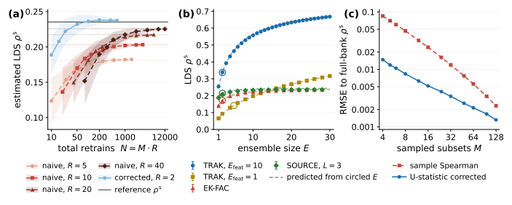
Figure 1 :Three ways to reduce LDS evaluation cost on CIFAR-10/ResNet-9. (a)Correcting for training variance approaches the Spearman reference computed from held-out retraining seeds with fewer retrainings, while naive seed averaging plateaus (EK-FAC). Curves show mean estimates±1 SD over random draws, see Section D for details.(b)The circled small attribution ensembles predict the LDS of larger ensembles (dashed lines).(c)Correcting finite-subset Spearman bias reduces RMSE against the 300-subset reference (TRAK).
出典 · CC BY 4.0 · Simon Vary, Alireza Mousavi-Hosseini, Roger Grosse · Efficient and Accurate Causal Validation of Training Data Attribution · 論文の図を引用 · 元のPDFの2ページ目から図の部分を抽出しています。学習ノイズ分散の補正
シードを平均した再学習の出力は、学習ノイズが混ざった信号です。論文では、同じ部分集合にあるR個のシード間の分散から学習ノイズの分散σε²を推定し、観測された出力分散からσε²/Rを引いて信号の分散を復元します。このとき、単純なシード平均のPearson相関はρpE/√(1+λ/R)へと減衰します。λは学習ノイズ対信号の比率です。補正推定量は、この減衰を取り除くように設計されています。
PearsonからSpearmanへの変換
ノイズ補正はPearson相関の共分散の形から導かれますが、標準的なLDSはSpearman相関を用いています。論文では、(G(S), F(S))が同時ガウス分布に従うと仮定し、ρs = (6/π)arcsin(ρp/2)によって2つの相関を変換しています。この変換はガウス仮定の下での関係なので、実際のデータでこの仮定がどの程度成り立つかが重要になります。
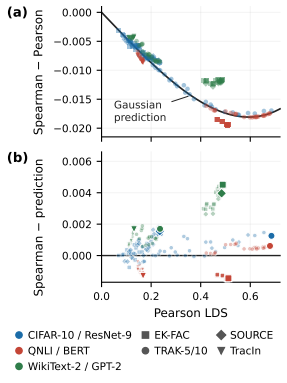
Figure 3 :Spearman versus Pearson LDS. (a)Spearman minus Pearson LDS; curve: Gaussian prediction.(b)Residual from the finite-MGaussian expectation. Large markers: full ensemble, all seeds.
出典 · CC BY 4.0 · Simon Vary, Alireza Mousavi-Hosseini, Roger Grosse · Efficient and Accurate Causal Validation of Training Data Attribution · 論文の図を引用 · 元のPDFの6ページ目から図の部分を抽出しています。有限部分集合によるバイアスの補正
標本Spearman推定量は、有限の部分集合数のもとでバイアスを持ちます。論文では、期待値がE[ρ̂s]=((m−2)ρs+3τ)/(m+1)となることを示し、バイアスは3(τ−ρs)/(m+1)であると整理しています。これを取り除くため、Kendall tau-aを用いたU統計量推定量ρ̂s,unb=((m+1)ρ̂s−3τ̂)/(m−2)を使用します。この推定量は、m≥3かつ周辺分布が連続である場合の不偏推定です。
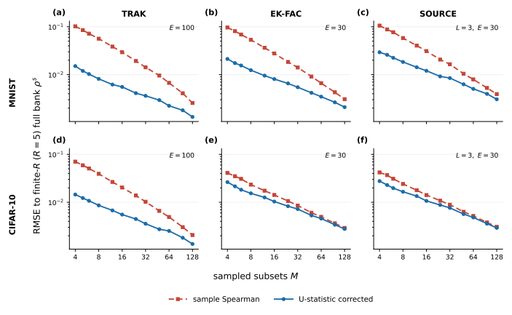
Figure 9 : Comparing RMSE in estimating the full-bank LDS using finite-sample Spearman and the finite-bank correction (18). All experiments useR= 5retraining seeds.
出典 · CC BY 4.0 · Simon Vary, Alireza Mousavi-Hosseini, Roger Grosse · Efficient and Accurate Causal Validation of Training Data Attribution · 論文の図を引用 · 元のPDFの20ページ目から図の部分を抽出しています。小さなアンサンブルによる大きなアンサンブルのLDS予測
TDAメンバーのノイズ対信号比cを推定すれば、小さなアンサンブルで得た補正相関をもとに、より大きなアンサンブルの学習ノイズのないLDSを予測できます。実験では、CIFAR-10とQNLIにおけるK=2メンバーの予測は、測定された補正Spearman LDSと0.008以内で一致しました。ただし、TRAK-1のCIFAR-10の予測は分散が大きかったため、K=2の代わりにK=5を使用しました。
再学習コスト削減の結果
CIFAR-10/ResNet-9の実験では、有限部分集合デバイアシングが4つの部分集合で3.2%の相対RMSEを記録しました。また、ResNet-9/CIFAR-10、BERT/QNLI、GPT-2/WikiText-2において、学習ノイズ分散の推定によって、標準的な5シードのLDSを2–5倍少ない再学習で再現しました。著者らは、学習ノイズが大きいCIFAR-10で効果が最も大きいと解釈しています。
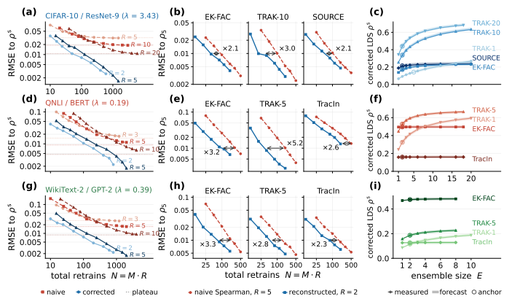
Figure 2 :Noise correction reduces the cost of LDS evaluation.Rows: CIFAR-10/ResNet-9, QNLI/BERT, WikiText-2/GPT-2.(a, d, g)RMSE to the noise-free Spearman LDS versus total retrainings, for naive R-seed averaging and the noise correction (EK-FAC); dotted: predicted naive plateaus.(b, e, h)Reconstructing the five-seed Spearman target ρ5 from two seeds matches naive averaging with 2.1–5.2× fewer retrainings.(c, f, i)Measured noise-corrected Spearman LDS and predictions from the circled small ensembles. The first two columns use E= 1 and disjoint retraining seeds for estimation and reference.
出典 · CC BY 4.0 · Simon Vary, Alireza Mousavi-Hosseini, Roger Grosse · Efficient and Accurate Causal Validation of Training Data Attribution · 論文の図を引用 · 元のPDFの6ページ目から図の部分を抽出しています。ガウス仮定とバイアス推定の限界
QNLIとWikiText-2では、シード平均を増やしても、ガウス仮定から外れた差が残りました。また、Spearman変換の結果は、同時ガウス仮定が成り立たない設定では保証されず、補正後の分散が小さすぎる場合には安定化の仕組みを使用しました。
論文情報
- 著者
- Simon Vary, Alireza Mousavi-Hosseini, Roger Grosse
- 学会・ジャーナル
- arXiv · プレプリント
- 公開日
- 2026年11月14日
- 登録日
- 2026年11月17日
- 更新日
- 2026年11月14日
- バージョン
- v1
- arXiv
- 2611.19451
- カテゴリ
- cs.LG · stat.ME · stat.ML
- ライセンス
- CC BY 4.0
- 掲載内容
- 論文情報・解説・論文の図
この解説は、Refivuの韓国語解説をAIで翻訳したものです。不正確な翻訳や誤りが含まれる可能性があります。論文と図の利用条件は各出典に従います。
アブストラクト
Causal validation of training data attribution (TDA) methods is costly, since evaluation involves retraining a model on many different subsets of the original training set. For example, the Linear Datamodeling Score (LDS), which has become a standard metric for evaluating TDA methods, measures the correlation between TDA predictions and expected retrained model outputs. In this paper, we reduce the amount of computation needed to estimate the LDS along three axes: the number of sampled training subsets, the number of retraining seeds per subset, and the number of models in the attribution ensemble. Each of these factors induces a form of bias in the LDS estimation, and removing these sources of bias significantly reduces the number of retrainings needed to match the same accuracy in LDS estimation. On ResNet-9/CIFAR-10, finite-subset debiasing achieves $3.2\%$ relative RMSE with as few as $4$ subsets, and $32$ subsets match the accuracy of ordinary Spearman using $96$ subsets, measured against a 300-subset reference. On ResNet-9/CIFAR-10, BERT/QNLI and GPT-2/WikiText-2, estimating the training-noise variance allows us to reproduce the standard five-seed LDS at the same accuracy with $2$--$5\times$ fewer retrainings.
この論文を引用
Simon Vary, Alireza Mousavi-Hosseini, Roger Grosse (2026). Efficient and Accurate Causal Validation of Training Data Attribution. arXiv:2611.19451v1. https://arxiv.org/abs/2611.19451v1
BibTeX
@misc{vary2026efficient,
  title = {{Efficient and Accurate Causal Validation of Training Data Attribution}},
  author = {Simon Vary and Alireza Mousavi-Hosseini and Roger Grosse},
  year = {2026},
  eprint = {2611.19451},
  archivePrefix = {arXiv},
  url = {https://arxiv.org/abs/2611.19451v1}
}