論文解説
Eliciting Research Taste in LLMs through Future Research Direction Choice
将来の研究方向の選択によるLLMの研究テイストの引き出し
- 課題 LLMが検証可能な目標のない開かれた研究方向を、どの程度著者と一致して選ぶかを測るのは困難です。
- 手法 研究目標と仮説・結果が与えられた80組のペアで、著者の方向と代替案をA/Bの両方の順序で提示し、選択を集計します。
研究テイストを行動で測る理由
LLMが自律的な研究エージェントとして使われるほど、検証可能な目標のない開かれた研究で、どの方向を選ぶかが重要になります。既存研究は、被引用数などの後から測る科学計量指標を予測する形で研究テイストを扱ってきました。しかし、この指標は研究の質よりも、著者や研究室の知名度、学会の評判、ネットワーク効果をより多く反映すると知られています。本論文では代わりに、研究目標と仮説・主要な結果が与えられたときに次の研究方向を選ぶ小さな課題を設定しています。著者が推薦した方向と、同じ文脈の類似論文から取ってきたもっともらしい代替案のうち一つを選ばせ、その選択が著者と一致するか、また選択肢の順序を入れ替えても同じかを確認します。
80組のペアデータと順序統制の評価
データは、ML論文41本のLaTeX原稿から研究目標、仮説と主要な結果、今後の研究方向を抽出し、方向の文を書き直して作成しました。同じ論文の著者推薦方向と、埋め込みの類似度で選んだ上位5件の論文の候補方向を、長さ、区別しやすさ、妥当性の基準でふるいにかけ、候補が2つ未満の論文は除外しました。結果として19本の論文から80組のペアが得られました。各ペアはA/Bの順序を入れ替えて2回評価しています。モデルはtemperature 0で、順序付きプロンプトごとに1つの応答を出力させました。最終的な選択肢だけで指標を計算し、推論過程の妥当性は評価していません。
著者との整合とstable divergenceの定義
両方の順序で著者推薦の方向を選んだ場合はauthor alignment、両方の順序で代替案distractorを選んだ場合はstable divergence、順序によって選択が変わる場合はunstable choiceに分類します。これら3つの値は、80組のペアを分母とする割合です。したがってstable divergenceは、著者推薦と異なる内容の選択が順序によって揺らがなかった場合だけを数えます。著者らは、この指標は正解の方向を判定する精度ではなく、著者の好みとの整合を見るものだと説明しています。
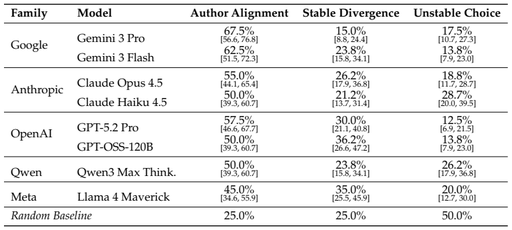
Table 2 : Pairwise future-work selection results (n=80 pairs, 160 ordered queries). Cells report percentages with Wilson 95% confidence intervals in brackets; each outcome uses 80 pairwise comparisons as the denominator.
出典 · CC BY 4.0 · Dhruv Trehan, Paras Chopra · Eliciting Research Taste in LLMs through Future Research Direction Choice · 論文の図を引用 · 元のPDFの17ページ目から図の部分を抽出しています。8モデルの整合と逸脱
すべてのモデルは、ランダムなベースラインである25%を整合で上回りました。stable divergenceの事例は169件で、45組のペアでは少なくとも1つのモデルが、24組のペアでは4モデル以上がその選択を示しました。著者らは、これは特定のモデルの偶然ではなく、複数のモデルとペアにまたがる繰り返しとして読めると解釈しています。
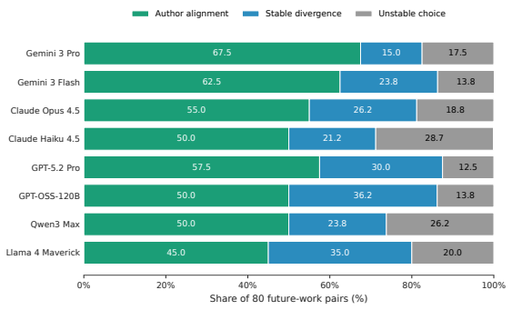
Figure 3 : Outcome shares for future-work selection across evaluated models. All models exceed the 25% random baseline on author alignment and show some substantial stable divergence. Author alignment ranges from 45.0% to 67.5%, and stable divergence from 15.0% to 36.2%. Unstable-choice rates vary from 12.5% to 28.7%, indicating that some models preserve content choices across orderings more consistently than others.
出典 · CC BY 4.0 · Dhruv Trehan, Paras Chopra · Eliciting Research Taste in LLMs through Future Research Direction Choice · 論文の図を引用 · 元のPDFの4ページ目から図の部分を抽出しています。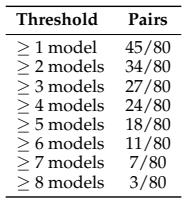
Table 3 : Cumulative stable divergence prevalence across 80 pairwise comparisons at each model-count threshold.
出典 · CC BY 4.0 · Dhruv Trehan, Paras Chopra · Eliciting Research Taste in LLMs through Future Research Direction Choice · 論文の図を引用 · 元のPDFの17ページ目から図の部分を抽出しています。類似度ヒューリスティックで説明できるかの確認
著者推薦の選択肢が文脈により似ているペアは、80組中64組でした。単純な類似度ヒューリスティックだけを使うと著者整合は80.0%になりますが、評価したモデルのなかでこの値に達したモデルはありませんでした。169件のstable divergence事例のうち76.9%は、著者推薦の選択肢が文脈により近いペアで現れました。著者らは、そのためstable divergenceは単純な類似度の信号だけでは説明できないと考えています。ただし、この統制は埋め込みに基づく分割に依拠しており、他の類似度の定義でも同じかどうかは本文では確認していません。
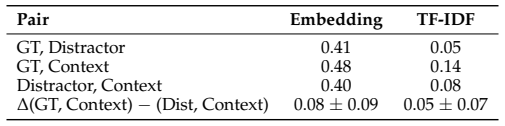
Table 1 : Average semantic (embedding) and lexical (TF-IDF) cosine similarity across 80 unique query pairs.
出典 · CC BY 4.0 · Dhruv Trehan, Paras Chopra · Eliciting Research Taste in LLMs through Future Research Direction Choice · 論文の図を引用 · 元のPDFの17ページ目から図の部分を抽出しています。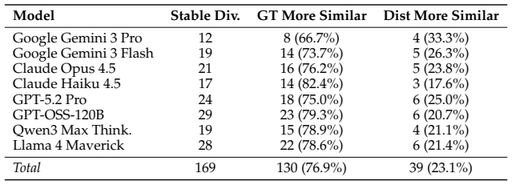
Table 4 : Stable divergence pairs by similarity bucket (embedding). GT More Similar denotes pairs where models preferred the distractor despite GT being more similar to context.
出典 · CC BY 4.0 · Dhruv Trehan, Paras Chopra · Eliciting Research Taste in LLMs through Future Research Direction Choice · 論文の図を引用 · 元のPDFの18ページ目から図の部分を抽出しています。プロンプト変形での維持率
3つの変形は、「研究補助者」という役割を外す、研究目標の節を外す、課題文を変えるという、いずれも要素を1つだけ変えたものです。4つ目は、研究者が自分のプロジェクトでどの方向を選ぶかを予測させる、著者の好みを予測する条件です。加重平均の維持率は66.9%から80.5%でした。低下した事例の多くは、著者の方向へ逆転するというより、順序によって揺らぐ不安定な選択に変わりました。

Table 5 : Prompt ablation results across 169 stable divergence events.
出典 · CC BY 4.0 · Dhruv Trehan, Paras Chopra · Eliciting Research Taste in LLMs through Future Research Direction Choice · 論文の図を引用 · 元のPDFの18ページ目から図の部分を抽出しています。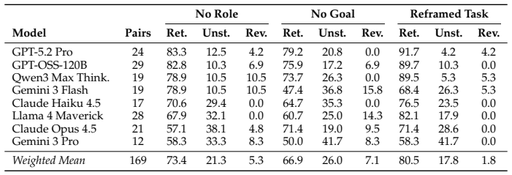
Table 6 : Per-model prompt ablation results. Retained = stable divergence preserved; Unsta- ble = choice became position-dependent; Reversed = flipped to author alignment.
出典 · CC BY 4.0 · Dhruv Trehan, Paras Chopra · Eliciting Research Taste in LLMs through Future Research Direction Choice · 論文の図を引用 · 元のPDFの18ページ目から図の部分を抽出しています。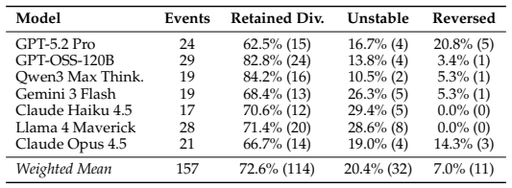
Table 7 : Author-preference prediction check on stable divergence events. Retained di- vergence means the original stable divergence is preserved under the author-preference- prediction framing; unstable means the event is no longer stable across option orderings; reversed means the event flips to author alignment. Parenthesized values are event counts. Gemini 3 Pro is excluded because it was unavailable through our evaluation route at rerun time.
出典 · CC BY 4.0 · Dhruv Trehan, Paras Chopra · Eliciting Research Taste in LLMs through Future Research Direction Choice · 論文の図を引用 · 元のPDFの18ページ目から図の部分を抽出しています。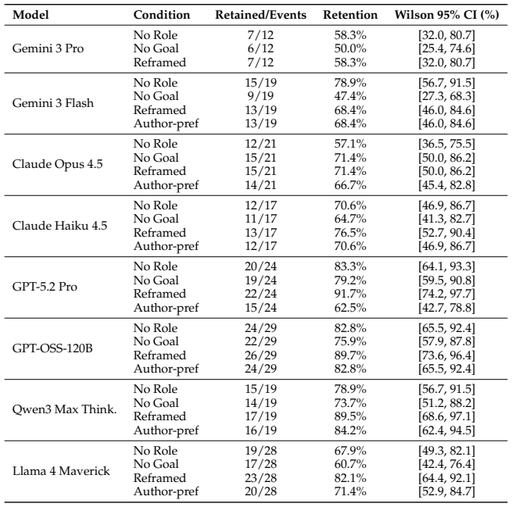
Table 8 : Model-specific retained stable-divergence rates across prompt and author- preference conditions. Wilson 95% confidence intervals are computed over each model’s canonical stable-divergence events. Gemini 3 Pro is not reported for Author-pref because it was unavailable through our evaluation route at rerun time.
出典 · CC BY 4.0 · Dhruv Trehan, Paras Chopra · Eliciting Research Taste in LLMs through Future Research Direction Choice · 論文の図を引用 · 元のPDFの19ページ目から図の部分を抽出しています。パイロットの人間ベースライン
10名の参加者が23組のペアに対して108件の応答を出しました。そのうち13件は棄権で、残りの95件の固定された選択のうち58件(61.1%)が著者推薦の方向でした。参加者はペアの順序を1つだけ見たため、モデルの順序統制の指標とは直接比較していません。この結果はパイロット規模の参考値であり、参加者数もペア数も少ないため、人間全体の傾向に一般化するのは難しいです。
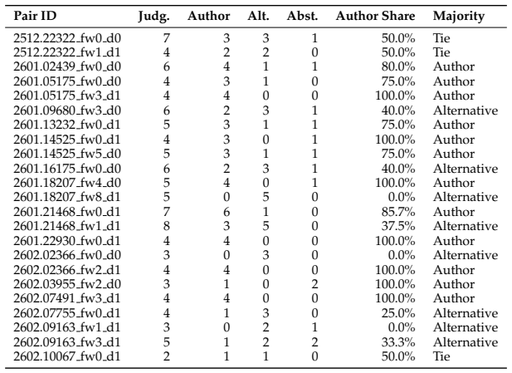
Table 10 : Per-pair human response outcomes for the pilot human baseline. Judgements include fixed choices and abstentions. Author-choice share is computed over fixed choices only, excluding abstentions. Majority denotes whether more participants selected the author- recommended direction or the alternative direction. Equal counts are reported as ties.
出典 · CC BY 4.0 · Dhruv Trehan, Paras Chopra · Eliciting Research Taste in LLMs through Future Research Direction Choice · 論文の図を引用 · 元のPDFの21ページ目から図の部分を抽出しています。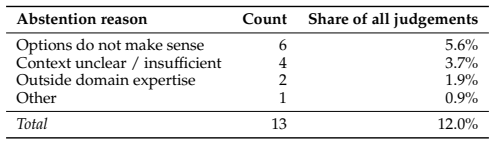
Table 13 : Abstention reasons in the pilot human baseline. Shares use all 108 submitted human judgements as the denominator.
出典 · CC BY 4.0 · Dhruv Trehan, Paras Chopra · Eliciting Research Taste in LLMs through Future Research Direction Choice · 論文の図を引用 · 元のPDFの22ページ目から図の部分を抽出しています。stable divergenceのカテゴリ遷移
著者らは、著者の方向と代替方向を5つのカテゴリに分類しました。169件の事例のうち128件(75.7%)はカテゴリの境界をまたぎ、41件は同じカテゴリ内で異なっていました。最も多かった3つの遷移は、インフラから手法へ(55件)、手法からスケーラビリティ・一般化へ(23件)、応用からスケーラビリティ・一般化へ(12件)でした。この遷移分析はstable divergenceの事例だけを対象とするため、各遷移がどれほど頻繁に提示されたかは反映していません。したがって、モデルの確定した選好とは解釈せず、不一致の構造を記述したものと捉えるべきです。
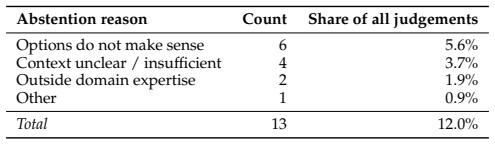
Table 14 : Five-category taxonomy for research direction labelling on both ground truth and distractor directions in the 45 stable divergence pairs. When a future work introduces a stronger model capability that is external to the paper’s main contribution, it is coded as Scaling/Generalization/Robustness rather than Methodological Innovation.
出典 · CC BY 4.0 · Dhruv Trehan, Paras Chopra · Eliciting Research Taste in LLMs through Future Research Direction Choice · 論文の図を引用 · 元のPDFの22ページ目から図の部分を抽出しています。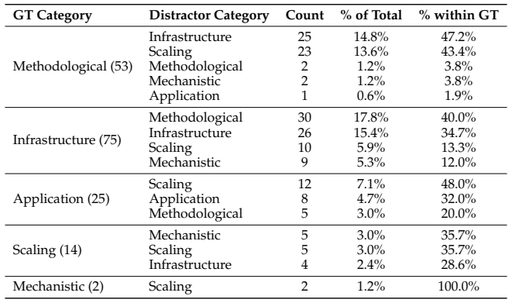
Table 15 : GT-to-distractor category transitions across 169 stable divergence events. The % of Total reflects each transition’s share of all 169 events and the % within GT reflects its share within the corresponding ground-truth category’s divergence events.
出典 · CC BY 4.0 · Dhruv Trehan, Paras Chopra · Eliciting Research Taste in LLMs through Future Research Direction Choice · 論文の図を引用 · 元のPDFの22ページ目から図の部分を抽出しています。構成と一般化の限界
正解は著者の好みを反映したものであり、代替案distractorも実際の研究方向なので、客観的により悪い方向だとは言えません。データは19本のML論文から得られたため、他の科学分野やML全体に一般化することはできません。モデルの学習データのカットオフ以降の汚染も、完全には排除できませんでした。データの抽出と書き換え、distractorの判定には同じClaude Sonnet 4.5を使い、手作業による品質確認も限定的でした。
論文情報
- 著者
- Dhruv Trehan, Paras Chopra
- 学会・ジャーナル
- arXiv · プレプリント
- 公開日
- 2026年11月15日
- 登録日
- 2026年11月17日
- 更新日
- 2026年11月15日
- バージョン
- v1
- arXiv
- 2611.19794
- カテゴリ
- cs.LG · cs.AI · cs.CL
- ライセンス
- CC BY 4.0
- 掲載内容
- 論文情報・解説・論文の図
この解説は、Refivuの韓国語解説をAIで翻訳したものです。不正確な翻訳や誤りが含まれる可能性があります。論文と図の利用条件は各出典に従います。
アブストラクト
Research taste is increasingly discussed in the context of AI scientists, yet remains little studied or measured in LLMs. This judgment matters especially in open-ended research, where a direction must be chosen before a verifiable objective is available. We operationalize research taste through one task of the scientific workflow: choosing which future research direction to pursue given a research goal and current results. Rather than predicting downstream scientometric metrics or treating author choices as objectively correct, we evaluate models against human-authored future-work directions and report author alignment, stable divergence, and unstable choice as behavioral measures of research-direction preference. We construct an order-controlled evaluation of 80 pairwise comparisons from 19 ML papers published between December 2025 and February 2026 across four subdomains. Each query presents a research goal, hypotheses tested with key results, and two candidate future directions: one author-recommended direction and one plausible distractor sampled from a similar paper. Across eight LLMs, author alignment ranges from 45.0% to 67.5%, while stable divergence ranges from 15.0% to 36.2%. These divergences largely persist under similarity controls, prompt ablations, and an author-preference framing check, and inter-model agreement suggests that some non-author preferences are shared across models. We characterize what models diverge toward using transition-category labels and selected reasoning examples, finding recurring movement toward scaling/generalization and trade-offs between methodological and infrastructure/data extensions. We view this as an early descriptive evaluation for eliciting research taste profiles in LLMs, and as a step toward understanding and steering their research preferences as they take on more autonomous roles in novel open-ended scientific discovery.
この論文を引用
Dhruv Trehan, Paras Chopra (2026). Eliciting Research Taste in LLMs through Future Research Direction Choice. arXiv:2611.19794v1. https://arxiv.org/abs/2611.19794v1
BibTeX
@misc{trehan2026eliciting,
  title = {{Eliciting Research Taste in LLMs through Future Research Direction Choice}},
  author = {Dhruv Trehan and Paras Chopra},
  year = {2026},
  eprint = {2611.19794},
  archivePrefix = {arXiv},
  url = {https://arxiv.org/abs/2611.19794v1}
}