論文解説
Certified Improvements to Best-Known Thomson-Problem Configurations with a Search Pipeline Built with Large Language Model Agents
大規模言語モデルエージェントで構築した探索パイプラインによるThomson問題の最良既知配置の検証済み改善
- 課題 Thomson問題では、大きなNにおけるCCDの最良配置を改善するのは難しいです。
- 手法 レプリカ交換basin hopping、共有プール、勾配ベースの仕上げと再結合を組み合わせた探索を使いました。
- 結果 N = 912, 1382, 2502で、整数演算により認証された改善を記録しました。
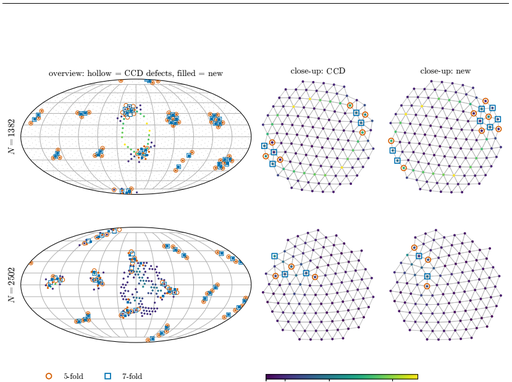
Figure 3 : Where the new configurations for N = 1382 and N = 2502 differ from the CCD configurations. Left: Mollweide projection (centred on the displaced region) of the CCD configuration; points displaced by more than 0.15 ℓ in the new configuration are coloured by displacement (in units of ℓ), hollow markers are defects of the CCD configuration and filled markers those of the new configuration. Middle and right: close-ups of the Delaunay triangulation around the points displaced by more than 0.5 ℓ, with every point coloured by displacement. Correspondence between the configurations is obtained by optimal rotation and a minimum-cost assignment.
出典 · CC BY 4.0 · Hui Shao, Tao Wang, Xiaotian Liu, Yijie Peng · Certified Improvements to Best-Known Thomson-Problem Configurations with a Search Pipeline Built with Large Language Model Agents · 論文の図を引用 · 元のPDFの10ページ目から図の部分を抽出しています。Thomson問題と大きなNの難しさ
Thomson問題は、N個の単位電荷を球面上に置き、Coulombエネルギーを最小化する問題です。Nが大きくなるほど局所最適解の数が速く増え、大域最適を証明するのが難しくなります。現在の最良配置は、Cambridge Cluster Databaseに集められています。
探索パイプラインの構成
組み合わせ段階では、2つの改善配置を幾何学的に付け替えた上で、領域を交換するか変位を重ね合わせて子配置を作ります。子配置が両方の親配置より低いときに限り、プールに入れます。
整数演算による認証と比較基準
点は、立体射影の座標を格子に丸めることで、球面上の有理数点に変換します。各項の上界と下界を整数演算で足し合わせる整数認証を使います。上界がCCD値より低ければ、改善が認証されたとみなします。さらに、仕上げだけでも2つの項目がしきい値を超えて下がる問題が見つかったため、候補をCCD値と仕上げ後のCCD配置のうち低い方と比べるように変えました。
3つの配置の結果と構造変化
3つの配置はいずれも、Hessianで見ると回転を除く局所最小値です。欠陥の一覧はCCD配置と同じです。2502の最終配置は組み合わせ段階で得られましたが、この結果は1回の探索実行に依存しており、別のシードでは同程度に到達できませんでした。
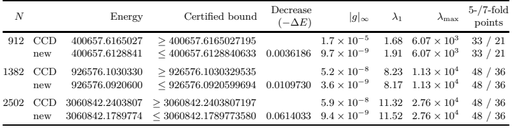
Table 2 : New configurations and the CCD configurations they im prove. Energy: CCD value (rows CCD) or double-precision value with exactly rounded summation ( rows new). Certified bound: integer bounds (2) for the rationalised configurations (lower bound L for the CCD configurations, upper bound U for the new ones), rounded outwards at the tenth decimal. λ1 and λmax: smallest and largest Hessian eigenvalues after removing the three rotational modes (whose eigenvalues hav e magnitude below 10 −8). All six configurations have point group C1 at tolerance 10 −6 and at the CCD’s tolerance of 10 −4.
出典 · CC BY 4.0 · Hui Shao, Tao Wang, Xiaotian Liu, Yijie Peng · Certified Improvements to Best-Known Thomson-Problem Configurations with a Search Pipeline Built with Large Language Model Agents · 論文の図を引用 · 元のPDFの8ページ目から図の部分を抽出しています。局所緩和のエネルギーバイアス
計算時間を減らすために導入した局所緩和は、動かした点の近くの点だけを緩和し、残りは固定します。著者らは、このバイアスのために探索が改善を取り逃がしたと解釈しています。対照実験では、ローカルarmは4 core-hourの間に、CCD値より低い配置を見つけられませんでした。
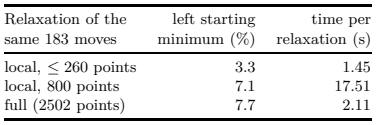
Table 3 : Outcome of the controlled comparison (left: wall-c lock minutes to the first configuration with ∆E≤− 10−3, earlier of the two runs, a dash meaning none within two hours ; best ∆ E after two hours) and relaxation of the same 183 random moves applied to the CCD con figuration (right: fraction of relaxations that left the starting minimum; mean time per relaxation).
出典 · CC BY 4.0 · Hui Shao, Tao Wang, Xiaotian Liu, Yijie Peng · Certified Improvements to Best-Known Thomson-Problem Configurations with a Search Pipeline Built with Large Language Model Agents · 論文の図を引用 · 元のPDFの12ページ目から図の部分を抽出しています。論文情報
- 著者
- Hui Shao, Tao Wang, Xiaotian Liu, Yijie Peng
- 学会・ジャーナル
- arXiv · プレプリント
- 公開日
- 2026年11月13日
- 登録日
- 2026年11月16日
- 更新日
- 2026年11月13日
- バージョン
- v1
- arXiv
- 2611.17776
- カテゴリ
- cs.AI
- ライセンス
- CC BY 4.0
- 掲載内容
- 論文情報・解説・論文の図
この解説は、Refivuの韓国語解説をAIで翻訳したものです。不正確な翻訳や誤りが含まれる可能性があります。論文と図の利用条件は各出典に従います。
アブストラクト
The Thomson problem asks for N unit charges on a sphere with minimum Coulomb energy; for large N the best configurations known are curated in the Cambridge Cluster Database, whose largest-N entries were set in October 2026. We report configurations for N = 912, 1382 and 2502 with energies 0.0036186, 0.0109730 and 0.0614033 below the database values, certified by exact integer arithmetic. All three are numerically strict local minima modulo rotations and keep the defect inventory and scar compositions of the database configurations; the database value for N = 912 had been reached by two different methods. Our search runs unconstrained replica-exchange basin hopping from the database configurations, with a shared pool of minima, recombination of improved regions after relabelling by geometry, and gradient-only polishing; replica-exchange basin hopping alone found the N = 912 and 1382 configurations, the former in one of five runs. We built and ran it with large language model agents (Claude, through a chat interface and the Claude Code agent), and we report every search, including those that failed. Two findings matter for others who search the database. Polishing alone lowers two entries by more than the threshold at which our pipeline reports a candidate, which produced two spurious records until candidates were compared with the polished database energies (the polished baseline). A local-relaxation speed-up passed its exactness test yet found nothing in a controlled comparison in which every arm with full relaxation went below the database value within 15 minutes. We distil three practices for computational discovery with large language model agents: calibrate the search code and verify candidates with code separate from the search, compare candidates with the polished baseline, and test design changes in controlled comparisons with pass criteria fixed in advance.
この論文を引用
Hui Shao, Tao Wang, Xiaotian Liu, Yijie Peng (2026). Certified Improvements to Best-Known Thomson-Problem Configurations with a Search Pipeline Built with Large Language Model Agents. arXiv:2611.17776v1. https://arxiv.org/abs/2611.17776v1
BibTeX
@misc{shao2026certified,
  title = {{Certified Improvements to Best-Known Thomson-Problem Configurations with a Search Pipeline Built with Large Language Model Agents}},
  author = {Hui Shao and Tao Wang and Xiaotian Liu and Yijie Peng},
  year = {2026},
  eprint = {2611.17776},
  archivePrefix = {arXiv},
  url = {https://arxiv.org/abs/2611.17776v1}
}