論文解説
Seeing Isn't Enough: Unlocking Visual Reasoning by Bridging the Reasoning-Access Gap with TIGER
見るだけでは不十分:TIGERで推論-アクセス格差を埋め視覚推論を引き出す
- 課題 MLLMは、テキストでは可能な推論を同じ意味の画像入力では十分に行えず、この低下は認識の失敗だけでは説明できません。
- 手法 TIGERは、テキストの数学問題を描画した合成画像から、テキストでは正解して画像では不正解になった事例を集め、画像条件付きのGRPOで学習します。
- 結果 Qwen2.5-VL-7BとQwen3-VL-8Bでは、MathVerseやEMMAなどの実ベンチマークで、報告された範囲でスコアが向上しました。
マルチモーダルモデルの推論格差の問題
MLLMは言語バックボーンから強いテキスト推論能力を受け継ぎますが、同じ意味の問題を画像で与えると性能が下がります。論文は、この低下が単純な視覚認識の失敗ではないことを問題として設定しています。著者らは、画像からテキストを正確に読み取れる場合でも、画像入力で直接推論すると精度が下がると報告しています。したがって問いは、認識能力を高めるだけで十分か、それとも認識された視覚情報を既存の推論経路につなぐ能力が別に必要かです。本論文は後者を、モダリティ推論アクセス格差(modality reasoning-access gap)と定義し、これを減らす学習方法TIGERを提案します。
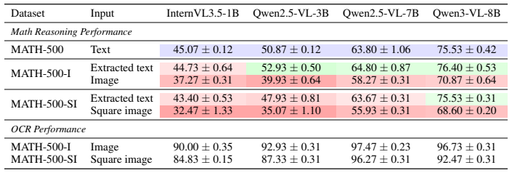
Table 2 : Performance on semantically equivalent text and image versions of MATH-500. Scores are colored relative to each model’s text baseline (purple): compared to the text-level performance, red indicates degradation, while green indicates an increase. Despite identical semantics, all models consistently perform worse on image inputs, revealing a robust modality reasoning-access gap. This gap persists across both rendering schemes (MATH-500-I and MATH-500-SI), indicating that it is not due to a specific transformation. OCR results remain high, suggesting that the bottleneck lies in reasoning from image-conditioned representations rather than reading ability.
出典 · CC BY 4.0 · Gregory Kang Ruey Lau, Minh Huynh Nguyen, Bryan Kian Hsiang Low · Seeing Isn't Enough: Unlocking Visual Reasoning by Bridging the Reasoning-Access Gap with TIGER · 論文の図を引用 · 元のPDFの4ページ目から図の部分を抽出しています。
Table 1 : Contingency table between OCR correct- ness and answer correctness for Qwen3-VL-8B on MATH-500-I. The final column demonstrates that among all incorrect answers, the vast majority (92.36%) occur despite correct visual extraction.
出典 · CC BY 4.0 · Gregory Kang Ruey Lau, Minh Huynh Nguyen, Bryan Kian Hsiang Low · Seeing Isn't Enough: Unlocking Visual Reasoning by Bridging the Reasoning-Access Gap with TIGER · 論文の図を引用 · 元のPDFの4ページ目から図の部分を抽出しています。モダリティ反事実データと画像条件付きGRPO
TIGERは、検証可能な正解を持つテキストの数学問題を、黒字と白背景の画像に描画し、同じ意味の画像問題を作ります。各問題について、テキスト入力と画像入力をそれぞれベースモデルに入れ、テキストの応答は正解で画像の応答は不正解だった事例D10だけを学習に残します。出発点はOpenR1-Math-220の約45K個の検証済み問題で、この過程では正解かどうかをMath-Verifyで判定しました。学習では、D10の画像プロンプトごとに複数の応答をサンプリングし、正解報酬と形式報酬を合わせた値をグループ内で正規化して方策を更新するGRPOを用います。報酬関数は、正解報酬r_aと形式報酬r_fをそれぞれ0.9と0.1の重みで合わせます。
同じD10データに対して、SFTはテキストの正解を画像入力の目標として模倣し、DPOは正解と不正解の応答のペアを選好学習します。
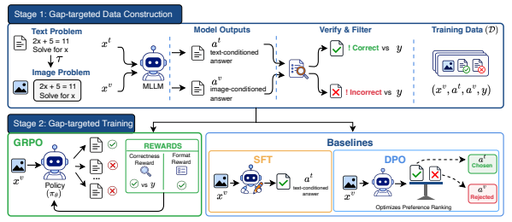
Figure 1 : Overview of the proposed pipeline. In Stage 1, we construct training samples by querying a MLLM with text and image versions of the same problem, then verifying and filtering the resulting outputs to retain pairs with correct text-conditioned answers and incorrect image-conditioned answers. In Stage 2, the resulting data is used for gap-targeted training using GRPO to improve image- conditioned reasoning and comparing with alternatives like SFT and DPO.
出典 · CC BY 4.0 · Gregory Kang Ruey Lau, Minh Huynh Nguyen, Bryan Kian Hsiang Low · Seeing Isn't Enough: Unlocking Visual Reasoning by Bridging the Reasoning-Access Gap with TIGER · 論文の図を引用 · 元のPDFの3ページ目から図の部分を抽出しています。
Table 17 : Ablation on the importance of constructing the gap-targeted training set D for GRPO fine-tuning. Subscripts on post-trained rows report visual performance gains over the base model. Randomly sampled non-overlapping subsets provide some gains, but consistently underperform training onD.
出典 · CC BY 4.0 · Gregory Kang Ruey Lau, Minh Huynh Nguyen, Bryan Kian Hsiang Low · Seeing Isn't Enough: Unlocking Visual Reasoning by Bridging the Reasoning-Access Gap with TIGER · 論文の図を引用 · 元のPDFの43ページ目から図の部分を抽出しています。主要なマルチモーダルベンチマークの結果
主要な結果では、TIGERが学習に使っていない実際のマルチモーダルベンチマークで性能を高めたかを確認しています。Qwen2.5-VL-7Bでは、MathVerseのスコアが43.9から47.5に、EMMAのスコアが22.2から25.7に上がったと報告されています。Qwen3-VL-8Bでは、MathVerseのスコアが54.5から65.8に上がりました。著者らは、SFTとDPOは合成設定では改善が見られることもあるものの、実ベンチマークには一貫して転移しなかったと解釈しています。この結果は、MathVerseやEMMAなど特定のモデルとベンチマークの組み合わせについてのものであり、すべてのタスクで同じ幅の向上があるという意味ではありません。
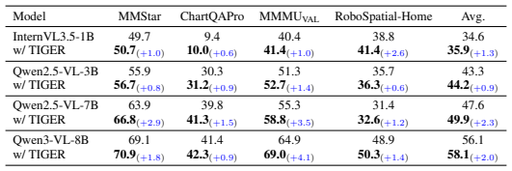
Table 5 : Generalization across diverse multimodal evaluation settings, including multimodal under- standing, visual reasoning, chart reasoning, and spatial reasoning.
出典 · CC BY 4.0 · Gregory Kang Ruey Lau, Minh Huynh Nguyen, Bryan Kian Hsiang Low · Seeing Isn't Enough: Unlocking Visual Reasoning by Bridging the Reasoning-Access Gap with TIGER · 論文の図を引用 · 元のPDFの7ページ目から図の部分を抽出しています。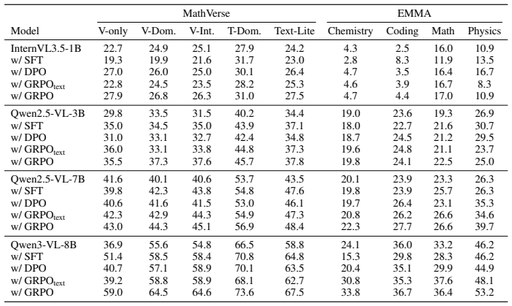
Table 27 : Fine-grained accuracy (%) across MathVerse subsets and EMMA domains.
出典 · CC BY 4.0 · Gregory Kang Ruey Lau, Minh Huynh Nguyen, Bryan Kian Hsiang Low · Seeing Isn't Enough: Unlocking Visual Reasoning by Bridging the Reasoning-Access Gap with TIGER · 論文の図を引用 · 元のPDFの48ページ目から図の部分を抽出しています。統計検定と内部表現の分析
論文では、実ベンチマーク4つと一般化ベンチマーク4つのモデルとデータセットの組み合わせについて、片側Wilcoxon signed-rank検定を行い、p-valueとして4e-7を報告しています。また、Reasoning-Subspace Activationは、テキスト推論の方向から作った部分空間に画像表現がどの程度乗るかを測るもので、GRPOは基準モデルより高い値になっています。活性化パッチングでは、GRPOで後処理した視覚表現を固定したベースモデルに入れると、MATH-500-Iの精度が上がりました。これらの分析は改善の方向を説明する根拠ですが、論文自身も因果メカニズムを完全に証明するものではないと述べています。
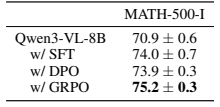
Table 9 : Activation patching results across methods.
出典 · CC BY 4.0 · Gregory Kang Ruey Lau, Minh Huynh Nguyen, Bryan Kian Hsiang Low · Seeing Isn't Enough: Unlocking Visual Reasoning by Bridging the Reasoning-Access Gap with TIGER · 論文の図を引用 · 元のPDFの10ページ目から図の部分を抽出しています。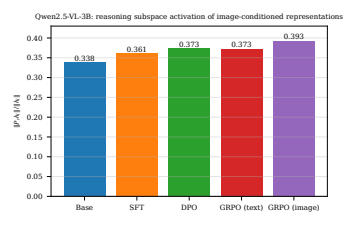
Figure 11 : Relative projection magnitude of image-conditioned representations onto the text-derived reasoning subspace of Qwen2.5-VL-3B on MATH-500-I
出典 · CC BY 4.0 · Gregory Kang Ruey Lau, Minh Huynh Nguyen, Bryan Kian Hsiang Low · Seeing Isn't Enough: Unlocking Visual Reasoning by Bridging the Reasoning-Access Gap with TIGER · 論文の図を引用 · 元のPDFの46ページ目から図の部分を抽出しています。適用範囲と残る限界
著者らは、TIGERはテキストコーパスのドメインの範囲に限られること、また合成画像が実際の視覚資料の曖昧さを十分に表せない可能性があることを述べています。実験は主に数学テキストから作った描画画像を使っており、実際の自然画像に基づく学習データは含まれていません。したがって、結果は合成のモダリティ格差を減らす方法が、複数の実ベンチマークに転移するという範囲で解釈すべきです。
論文情報
- 著者
- Gregory Kang Ruey Lau, Minh Huynh Nguyen, Bryan Kian Hsiang Low
- 学会・ジャーナル
- arXiv · プレプリント
- 公開日
- 2026年11月7日
- 登録日
- 2026年11月10日
- 更新日
- 2026年11月7日
- バージョン
- v1
- arXiv
- 2611.10552
- カテゴリ
- cs.AI · cs.CV · cs.LG
- ライセンス
- CC BY 4.0
- 掲載内容
- 論文情報・解説・論文の図
この解説は、Refivuの韓国語解説をAIで翻訳したものです。不正確な翻訳や誤りが含まれる可能性があります。論文と図の利用条件は各出典に従います。
アブストラクト
Multimodal Large Language Models (MLLMs) inherit strong textual reasoning capabilities from their language backbones and text pretraining, but often fail to apply the same level of competency to visual inputs. We show that this degradation cannot be attributed to only perception failures, by evaluating models on semantically-equivalent text and rendered-text image inputs: models can accurately read text in the images and recover near-text performance when provided their own transcriptions, but just cannot reason well on the images directly. We characterize this discrepancy as a modality reasoning-access gap, where models fail to route perceived visual content into existing reasoning machinery accessible with text. To bridge this, we propose TIGER (Text-to-Image Gap-targeted training for Enhanced Reasoning), which first mines synthetic modality counterfactuals where a model succeeds on a text problem but fails when provided the corresponding rendered image, and post-trains the model on the image input via Group Relative Policy Optimization (GRPO), along with SFT and DPO variants. Importantly, although trained exclusively on synthetic rendered-text images with no multimodal annotations, TIGER results in model performance improvements across diverse real-world visual benchmarks including geometric diagrams (MathVerse), multi-disciplinary sciences (EMMA, MMMU), complex charts (ChartQAPro), and embodied spatial reasoning (RoboSpatial-Home). TIGER also complements existing state-of-the-art RLVR visual reasoning methods, yielding further performance gains. Analysis involving reasoning-subspace activation and activation patching provide support indicating that TIGER helps to align visual-to-reasoning pathways toward text reasoning states. Our implementation is available at https://github.com/minhngh/Tiger.
この論文を引用
Gregory Kang Ruey Lau, Minh Huynh Nguyen, Bryan Kian Hsiang Low (2026). Seeing Isn't Enough: Unlocking Visual Reasoning by Bridging the Reasoning-Access Gap with TIGER. arXiv:2611.10552v1. https://arxiv.org/abs/2611.10552v1
BibTeX
@misc{lau2026seeing,
  title = {{Seeing Isn't Enough: Unlocking Visual Reasoning by Bridging the Reasoning-Access Gap with TIGER}},
  author = {Gregory Kang Ruey Lau and Minh Huynh Nguyen and Bryan Kian Hsiang Low},
  year = {2026},
  eprint = {2611.10552},
  archivePrefix = {arXiv},
  url = {https://arxiv.org/abs/2611.10552v1}
}