論文解説
Representational Change Under Self-Consuming Training: A Sparse Autoencoder Analysis
自己消費学習下での表現の変化:Sparse Autoencoderによる分析
- 課題 自己消費学習がモデル内部の表現と、それを読み取るSAEの信頼性にどう影響するかは、十分に研究されていません。
- 手法 世代0のSAEを固定して適用し、世代ごとに微調整して、実データの対照系列と比較します。
- 結果 Pythia-160Mでは、固定SAEの損傷は世代を重ねるごとに大きくなりました。微調整で再構成のギャップはほぼ縮みましたが、上位少数の潜在変数を使うスパースプロービングの損傷は残りました。
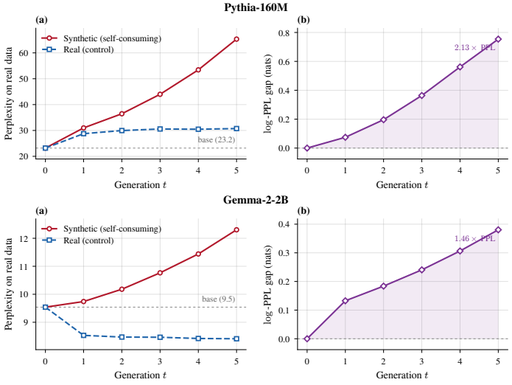
Figure 4 :Self-consumption degrades language modeling.(a) Perplexity on held-out real data for the synthetic lineage and the matched real-data control. (b) Log-perplexity gap between the two lineages. By generation 5, the gap reaches0.75nats (2.13×perplexity) forPythia-160Mand0.38 nats (1.46×) forGemma-2-2B. The control plateaus after the first generation forPythia-160M and improves forGemma-2-2B.
出典 · CC BY 4.0 · Suchit Gupte, Zhongteng Cai, Xueru Zhang, Mohammad Mahdi Khalili · Representational Change Under Self-Consuming Training: A Sparse Autoencoder Analysis · 論文の図を引用 · 元のPDFの16ページ目から図の部分を抽出しています。自己消費学習で表現がどう変わるか
大規模言語モデルは、モデルが生成したテキストで学習される場面が増えており、前の世代の出力を次の世代が学習する自己消費ループが生じています。既存研究は、このループで起きるモデル崩壊を主に出力分布、多様性、下流タスクの性能で測定してきました。この論文は、同じ現象がモデルの内部表現にどのような変化をもたらすかを問い、その変化を読み取る道具であるスパースオートエンコーダ(SAE)が、複数の世代にわたっても信頼できるかを確かめます。著者らはこのために、各世代で合成データを使って学習した系列と、同じ学習予算で実データを学習した対照系列を組にして比較しました。
固定SAEと微調整SAEの2つの評価方法
世代0で学習したSAEを後の世代の活性値にそのまま適用するzero-shot評価と、同じSAEを世代ごとの活性値で学習し直す微調整評価を分けて使いました。両方法は世代0でのみ同じで、それ以降は、固定した辞書がどれだけ古くなったかと、辞書を適応させると損傷が消えるかを区別できます。損傷値は、合成系列と同じ世代の実データ対照系列との差を符号補正して求めるため、正の値は合成系列のほうが悪いことを意味します。線形オートエンコーダの分析は、固定辞書の追加の再構成コストを主成分部分空間のずれで説明する解析的な代理モデルとして示されており、著者らは実際の非線形SAEの学習を正確にはモデル化しないと述べています。
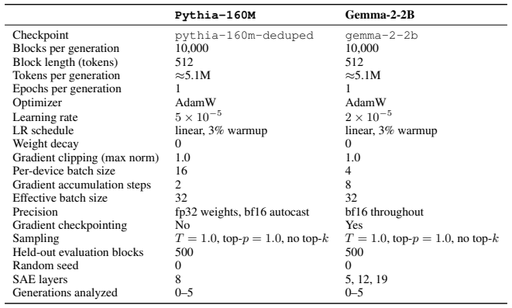
Table 1 : Fine-tuning and sampling settings. Each setting is shared by the real and synthetic lineages of a given model.
出典 · CC BY 4.0 · Suchit Gupte, Zhongteng Cai, Xueru Zhang, Mohammad Mahdi Khalili · Representational Change Under Self-Consuming Training: A Sparse Autoencoder Analysis · 論文の図を引用 · 元のPDFの15ページ目から図の部分を抽出しています。Pythia-160Mの再構成とスパースプロービングの結果
Pythia-160Mでは、固定SAEの損傷は世代が進むにつれて、L0、説明分散、MSEのすべての構成で大きくなりました。幅が最も大きい辞書で損傷が最も大きく、BatchTopK、JumpReLU、Matryoshka-BatchTopKは似た傾向を示しました。微調整により説明分散とMSEのギャップはほとんどなくなり、L0のギャップも大きく縮みましたが、特にJumpReLUではスパース性の損傷が少し残りました。スパースプロービングでは、上位1、2、5個の潜在変数だけを使うと微調整後も損傷が残り、SAE表現全体でプロービングすると対照系列の近くにとどまりました。著者らは、この差をタスク関連情報が失われたのではなく、個々の潜在変数への集中が弱まったことによるものと解釈しています。
Gemma-2-2Bのレイヤーごとのドリフト
Gemma-2-2Bでは、固定SAEの再構成損傷がレイヤーの深さによって大きく異なりました。初期レイヤー5は概ね安定しており、中間レイヤー12では中程度のギャップが見られ、後期レイヤー19ではL0、説明分散、MSEで大きく、次第に拡大する損傷が現れました。微調整は3つのレイヤーすべてで説明分散とMSEのギャップをほぼ解消し、後期レイヤーでも小さなL0のギャップが残るだけでした。特徴レベルの評価はより不規則でした。スパースプロービングで明確に持続する損傷は主に中間レイヤーに現れ、初期レイヤーは安定しており、後期レイヤーは一貫した傾向がなく変動しました。SCRの損傷は深いレイヤーで大きくなり、TPPは世代とレイヤーによって符号が変わりました。
再構成の回復が特徴の回復を保証しない理由
再構成は部分空間を基準に測るため、同じ部分空間を直交変換しても再構成の結果は同じです。しかし潜在座標は変わりうるため、一つの座標に集中していたタスク情報が複数の座標に広がることがあります。すべての潜在ベクトルを使う線形プローブはこの直交変換に不変ですが、一部の座標だけを使うスパースプローブはそうではありません。この論理が示すのは、再構成が良くても個々の特徴が局在しているとは限らない、という点だけです。論文は、これは微調整が必ず特徴を回転させたりスパースな局在性を下げたりすることを証明するものではないとし、再構成の回復だけでは特徴レベルの有用性の回復を確認できないという限界を示していると整理しています。
実験の範囲と限界
実験はPythia-160MとGemma-2-2Bの2つのモデル系列、5世代に限って行い、純粋な合成データのみで学習しました。Pythiaは1つのレイヤー、Gemmaは初期・中間・後期のレイヤーだけを分析しました。微調整は元のSAEを続けて学習したもので、新しく学習したSAEとは比較していません。各モデル系列では学習シードを1つだけ使ったため、報告された誤差バーはSAEの微調整シードのばらつきだけを反映しており、モデルの学習実行間のばらつきは含みません。SAEBenchの指標は、意味的な解釈可能性のすべての側面を捉えるわけではありません。
論文情報
- 著者
- Suchit Gupte, Zhongteng Cai, Xueru Zhang, Mohammad Mahdi Khalili
- 学会・ジャーナル
- arXiv · プレプリント
- 公開日
- 2026年11月16日
- 登録日
- 2026年11月18日
- 更新日
- 2026年11月16日
- バージョン
- v1
- arXiv
- 2611.21348
- カテゴリ
- cs.LG · cs.AI
- ライセンス
- CC BY 4.0
- 掲載内容
- 論文情報・解説・論文の図
この解説は、Refivuの韓国語解説をAIで翻訳したものです。不正確な翻訳や誤りが含まれる可能性があります。論文と図の利用条件は各出典に従います。
アブストラクト
Large language models are increasingly exposed to model-generated text, raising the possibility that future models will be trained recursively on the outputs of their predecessors. Prior work on such self-consuming training loops has largely focused on output quality and downstream performance, leaving their effects on internal representations poorly understood. We study how representations evolve across five generations of self-consumption and whether sparse autoencoders (SAEs) remain reliable under this shift. At each generation, we compare a lineage trained on synthetic data with a matched control trained on real data under the same training settings. We evaluate how well SAEs trained before self-consumption transfer to later generations, measuring reconstruction and sparsity across SAE widths, architectures, and model layers. We then fine-tune the original SAE on each generation and use sparse probing to test whether task-relevant information remains concentrated in a small number of latents or becomes more distributed across the representation. We find that zero-shot SAE performance degrades progressively under self-consumption, with growing reconstruction and sparsity gaps that vary substantially across layers. Fine-tuning largely restores reconstruction, but not feature-level usefulness: task-relevant information remains accessible in the full latent space while becoming less concentrated in individual features. These results show that self-consumption induces representational drift and that reconstruction fidelity alone is insufficient to establish that an adapted SAE remains equally useful for interpretation.
この論文を引用
Suchit Gupte, Zhongteng Cai, Xueru Zhang, Mohammad Mahdi Khalili (2026). Representational Change Under Self-Consuming Training: A Sparse Autoencoder Analysis. arXiv:2611.21348v1. https://arxiv.org/abs/2611.21348v1
BibTeX
@misc{gupte2026representational,
  title = {{Representational Change Under Self-Consuming Training: A Sparse Autoencoder Analysis}},
  author = {Suchit Gupte and Zhongteng Cai and Xueru Zhang and Mohammad Mahdi Khalili},
  year = {2026},
  eprint = {2611.21348},
  archivePrefix = {arXiv},
  url = {https://arxiv.org/abs/2611.21348v1}
}