논문 해설
Ontology-driven weak supervision for clinical entity classification in electronic health records
전자건강기록에서 임상 개체 분류를 위한 온톨로지 기반 약한 지도 학습
- 연구 문제 임상 노트에서 개체를 분류하려면 전문가 라벨이 많이 필요하지만, 이 논문은 의학 온톨로지와 작업별 규칙을 라벨 출처로 써서 라벨 없이 분류기를 학습하는 방법을 검증합니다.
- 연구 방법 Trove는 온톨로지 템플릿과 작업별 규칙으로 라벨링 함수를 만들고, 데이터 프로그래밍 방식의 라벨 모델이 출처 정확도를 추정해 확률 라벨을 생성합니다. 이 라벨로 BioBERT 끝 모델을 학습합니다.
- 주요 결과 라벨 모델은 온톨로지 기반 라벨링에서 다수결보다 평균 4.1 F1 포인트 높았고, 작업별 규칙을 더하면 NER 과제가 완전 지도 학습과 1.3에서 4.9 F1 포인트 범위에 들었습니다.
임상 개체 분류에 라벨 데이터가 필요한 문제
전자 건강기록의 임상 노트에서 질환과 같은 개체를 찾고 그 시간 상태나 부정 여부를 판정하는 일은 여러 분석의 출발점입니다. 그러나 이런 과제의 지도 학습에는 전문가가 직접 붙인 라벨이 필요하며, 이 작업은 시간과 비용이 많이 들고 개인정보 문제로 데이터 공유도 어렵습니다. 특히 팬데믹처럼 빠르게 변하는 상황에서는 라벨을 새로 만들고 고치는 속도가 병목이 됩니다.
이 논문은 라벨을 사람이 직접 붙이는 대신 의학 온톨로지와 작업별 규칙을 라벨 출처로 쓰는 약한 지도 학습을 다룹니다. 그런데 여러 온톨로지는 같은 개념을 서로 다르게 정의하고 서로 충돌하는 라벨을 만들 수 있습니다. 충돌하는 라벨을 단순히 합치면 약한 지도 학습의 성능이 크게 떨어질 수 있으므로, 개별 출처의 오류를 보정하는 방법이 핵심 과제가 됩니다.
논문은 이 문제를 다루는 프레임워크로 Trove를 제시합니다. Trove는 온톨로지 기반 라벨링 함수로 자동 라벨을 만들고, 필요할 때만 작업별 규칙을 더합니다. 논문이 검증하는 범위는 여섯 개 벤치마크 과제와 스탠퍼드 응급실 노트를 이용한 COVID-19 사례 연구입니다.
온톨로지 라벨링 함수에서 확률 라벨까지
Trove의 입력은 라벨이 없는 문서 문장 집합, 온톨로지의 의미 유형을 개체 클래스로 바꾸는 매핑, 그리고 필요하면 추가하는 작업별 규칙입니다. 온톨로지 템플릿은 각 용어를 의미 유형에 따라 클래스로 바꾸는 라벨링 함수가 됩니다. 의미 유형 라벨링 함수는 용어 문자열을 찾고 가장 긴 매칭을 우선하며, 동의어 집합 라벨링 함수는 같은 문맥 안에서 여러 동의어가 함께 나타나는지 확인합니다.
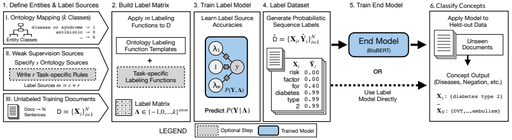
Figure 1 : Trove pipeline for ontology-driven weak supervision for medical entity classification. Users specify: (I) a mapping of an ontology’s class categories to entity classes; (II) a set of label sources (e.g., ontologies, task-specific rules) for weak supervision; and (III) a collection of unlabeled document sentences with which to build a training set. Ontologies instantiate labeling function templates which are applied to sentences to generate a label matrix. This matrix is used to train the label model which learns source accuracies and corrects for label noise to predict a consensus probability per word. Consensus labels are transformed into the probabilistic sequence label dataset which is used as training data for an end model (e.g., BioBERT). Alternatively, the label model can also be used as the final classifier.
원문 · CC BY 4.0 · Jason A. Fries, Ethan Steinberg, Saelig Khattar, Scott L. Fleming, Jose Posada, Alison Callahan, Nigam H. Shah · Ontology-driven weak supervision for clinical entity classification in electronic health records · 원문 그림 인용 · 원본 PDF 3쪽에서 그림 영역을 추출했습니다.이 라벨링 함수들의 출력을 모으면 라벨 행렬이 됩니다. 각 라벨 함수는 단어마다 클래스 또는 기권을 출력하며, 기권은 해당 단어에 대해 아무 클래스도 주지 않는다는 뜻입니다. 다수결은 단순한 가중치로 이 출력을 합치지만, 논문은 출처마다 정확도가 다르다고 보고 데이터 프로그래밍을 사용합니다. 라벨 모델은 라벨 행렬에서 출처 사이의 일치와 불일치를 관찰해 각 출처의 클래스별 정확도를 추정하고, 이를 이용해 단어별 합의 확률을 예측합니다. 논문에서 이 라벨 모델은 Snorkel 프레임워크로 학습됩니다.
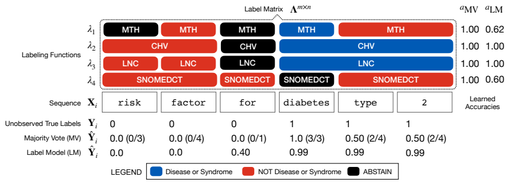
Figure 4 : An example of combining ontology-based labeling functions . Here four ontology labeling functions (MTH, CHV, LNC, SNOMEDCT) are used to label a sequence of words Xi containing the entity diabetes type 2. Majority vote estimates Yi as a word-level sum of positive class labels, weighing each equally (aMV). The label model learns a latent class-conditional accuracy ( aLM) for each ontology, which is used to reweight labels to generate a more accurate consensus prediction of Yi.
원문 · CC BY 4.0 · Jason A. Fries, Ethan Steinberg, Saelig Khattar, Scott L. Fleming, Jose Posada, Alison Callahan, Nigam H. Shah · Ontology-driven weak supervision for clinical entity classification in electronic health records · 원문 그림 인용 · 원본 PDF 11쪽에서 그림 영역을 추출했습니다.라벨 모델이 만든 확률 라벨은 끝 모델의 학습 데이터가 됩니다. 끝 모델로는 생의학 텍스트로 미세 조정된 BioBERT가 사용되며, 확률 라벨에 맞추기 위해 잡음 인식 이진 교차 엔트로피 손실을 씁니다. 이 손실은 확률 라벨에 대한 기댓값으로 계산되고, 모든 라벨 함수가 기권한 토큰은 손실 계산에서 마스크됩니다. 따라서 라벨 모델만으로도 최종 분류기를 쓸 수 있고, BioBERT를 추가하면 라벨 모델이 직접 다루지 못하는 철자 변형이나 동의어 같은 경우를 일반화하는 역할을 합니다.
라벨 출처 제거 실험과 벤치마크 비교
검증은 먼저 NER 과제에서 라벨 출처를 비용 순서대로 추가하는 절제 실험으로 진행됩니다. 가이드라인 사전, UMLS, 기타 온톨로지, 작업별 규칙의 네 단계를 누적하며, 마지막 기준으로 사람이 라벨링한 학습 데이터의 완전 지도 학습을 둡니다. 이 과정에서 라벨 모델은 다수결보다 개선되었고 BioBERT를 더한 약한 지도 모델은 대부분의 단계에서 라벨 모델을 조금 웃돌았습니다.
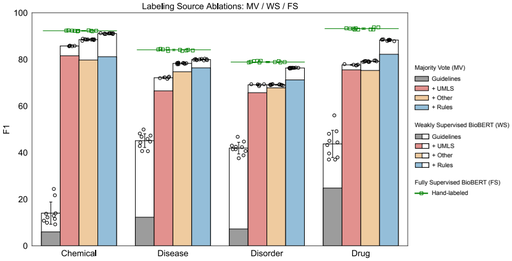
Figure 2 : Ablation study of F1 performance by labeling source. Majority vote (MV) vs. weakly supervised BioBERT (WS) vs. fully supervised (FS) for all labeling source ablations showing the absolute F1-score for all labeling tiers. The colored region of each bar indicates MV performance and the white regions denote performance improvements of WS over MV. The mean performance of FS is indicated by the green lines and square points. WS and FS consist of n=10 experiment replicates using different random initialization seeds, presented as the mean with error bars ± SD. MV is deterministic and does not include replicates.
원문 · CC BY 4.0 · Jason A. Fries, Ethan Steinberg, Saelig Khattar, Scott L. Fleming, Jose Posada, Alison Callahan, Nigam H. Shah · Ontology-driven weak supervision for clinical entity classification in electronic health records · 원문 그림 인용 · 원본 PDF 5쪽에서 그림 영역을 추출했습니다.표 1에 따르면 화학물질 과제의 다수결은 79.8 F1이었고, 라벨 모델은 88.0 F1, 약한 지도 BioBERT는 88.5 F1이었습니다. 작업별 규칙을 더한 약한 지도 BioBERT는 화학물질 91.1 F1, 질환 79.9 F1, 장애 76.3 F1, 약물 88.3 F1을 기록했습니다. 완전 지도 BioBERT와 비교하면 NER 과제에서 차이는 1.3에서 4.9 F1 포인트 범위였습니다. 이 수치는 같은 과제 안에서 작업별 규칙을 더한 조건에 한정하며, 결과 해석에 쓰인 평균과 표준편차는 무작위 가중치 초기화 10회를 기준으로 합니다.
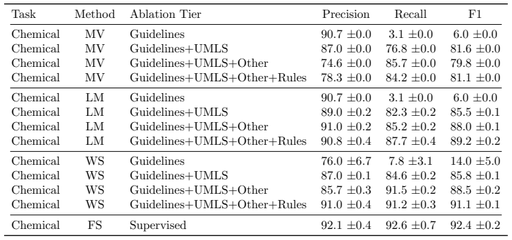
Table 5 : Complete performance metrics for BC5CDR chemical tagging for all supervision tiers. Scores are the mean and±1 SD of 5 random weight initializations.
원문 · CC BY 4.0 · Jason A. Fries, Ethan Steinberg, Saelig Khattar, Scott L. Fleming, Jose Posada, Alison Callahan, Nigam H. Shah · Ontology-driven weak supervision for clinical entity classification in electronic health records · 원문 그림 인용 · 원본 PDF 21쪽에서 그림 영역을 추출했습니다.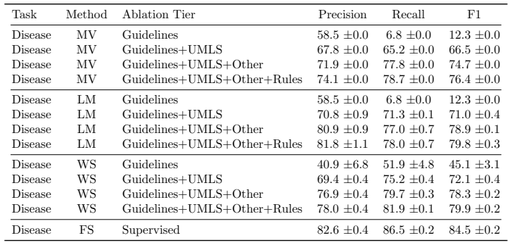
Table 6 : Complete performance metrics for BC5CDR disease tagging for all supervision tiers. Scores are the mean and±1 SD of 5 random weight initializations.
원문 · CC BY 4.0 · Jason A. Fries, Ethan Steinberg, Saelig Khattar, Scott L. Fleming, Jose Posada, Alison Callahan, Nigam H. Shah · Ontology-driven weak supervision for clinical entity classification in electronic health records · 원문 그림 인용 · 원본 PDF 21쪽에서 그림 영역을 추출했습니다.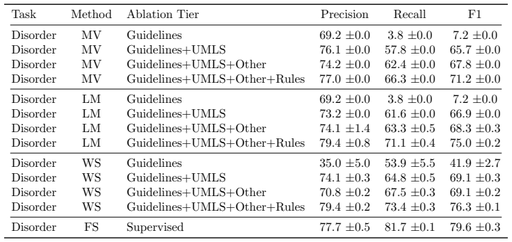
Table 7 : Complete performance metrics for ShARe/CLEF 2014 disorder tagging for all supervision tiers. Scores are the mean and ±1 SD of 5 random weight initializations.
원문 · CC BY 4.0 · Jason A. Fries, Ethan Steinberg, Saelig Khattar, Scott L. Fleming, Jose Posada, Alison Callahan, Nigam H. Shah · Ontology-driven weak supervision for clinical entity classification in electronic health records · 원문 그림 인용 · 원본 PDF 22쪽에서 그림 영역을 추출했습니다.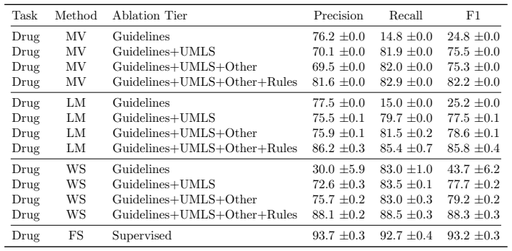
Table 8 : Complete performance metrics for i2b2/n2c2 2009 drug tagging for all supervision tiers. Scores are the mean and±1 SD of 5 random weight initializations.
원문 · CC BY 4.0 · Jason A. Fries, Ethan Steinberg, Saelig Khattar, Scott L. Fleming, Jose Posada, Alison Callahan, Nigam H. Shah · Ontology-driven weak supervision for clinical entity classification in electronic health records · 원문 그림 인용 · 원본 PDF 22쪽에서 그림 영역을 추출했습니다.선행 방법과의 비교는 BC5CDR에서 이루어졌습니다. 저자들은 온톨로지 기반 지도 Trove가 AutoNER보다 1.7 F1 포인트 높았고, 작업별 규칙을 더한 Trove는 SwellShark 대비 우위를 보였다고 보고합니다. 다만 SwellShark는 추가 약한 라벨 문서 25,000개로 학습되었고 AutoNER와 WISER는 각 원 논문의 라벨 함수와 사전 구성을 따랐으므로, 이 비교는 같은 학습 조건의 통제 실험이 아니라 보고된 설정을 나란히 놓은 것입니다.
UMLS 분할과 응급실 사례 연구
UMLS를 여러 라벨 함수로 나누는 방식도 검증되었습니다. 논문은 UMLS 용어 집합을 s개의 부분으로 나누면서 라벨 모델 성능을 관찰했습니다. 가장 흔한 방식인 UMLS 전체를 하나의 라벨 함수로 합치는 방법과 모든 terminology를 개별 함수로 두는 방법은 대체로 최선이 아니었습니다. 최적 분할 수는 과제에 따라 1에서 10 사이였고, 라벨 출처 정확도를 모델링하는 방법은 거의 모든 분할에서 다수결보다 나았습니다.
응급실 사례 연구에서는 COVID-19 관련 증상 태깅과 노출 분류를 평가했습니다. 장애 태깅에서 라벨 모델은 다수결보다 최대 5.2 F1 포인트 높았고, 가장 좋은 약한 지도 모델은 MIMIC-II 장애 태거보다 2.3 F1 포인트 높았습니다. 노출 분류에서는 라벨 모델이 개선을 주지 않았지만 약한 지도 끝 모델이 규칙만 사용한 경우보다 6.9퍼센트, 즉 5.2 F1 포인트 더 높았습니다. 여기서 6.9퍼센트와 5.2 F1 포인트는 서로 다른 지표 단위이므로 함께 읽어야 합니다.

Table 3 : COVID-19 presenting symptoms/disorders and risk factors evaluated on Stanford Health Care emergency department notes. Bold and underlined scores indicate the best score in symptom/disorder tagging and COVID exposure classification respectively. Ontology-based weak supervision performed almost as well as the out-of-distribution, hand-labeled MIMIC-II data used for FS. Adding task-specific rules, even though they were developed without seeing Stanford data, outperformed the hand-labeled FS model by 2.3 F1 points.
원문 · CC BY 4.0 · Jason A. Fries, Ethan Steinberg, Saelig Khattar, Scott L. Fleming, Jose Posada, Alison Callahan, Nigam H. Shah · Ontology-driven weak supervision for clinical entity classification in electronic health records · 원문 그림 인용 · 원본 PDF 8쪽에서 그림 영역을 추출했습니다.이 사례의 결과는 스탠퍼드 응급실 노트와 저자가 설계한 규칙 및 온톨로지 조합에 한정됩니다. 외부 데이터셋이나 다른 기관에서의 일반화는 이 논문의 결과로 확인되지 않았습니다.
온톨로지 독립성과 적용 범위의 한계
가장 중요한 한계는 라벨 출처 사이의 독립성 가정입니다. 데이터 프로그래밍은 라벨 출처의 잡음이 서로 독립이라고 가정하지만, 여러 온톨로지는 서로 비슷한 정의나 공통 원천을 가져 상관된 잡음을 만들 수 있습니다. 저자들은 이 제약이 모든 출처에 적용되며 매우 비슷한 출처에서 더 두드러진다고 설명합니다. 실험에서는 소수의 출처에서 영향이 작았지만, 온톨로지를 20개 넘게 포함하면 성능이 낮아지는 경향이 보고되었습니다. 이 관찰은 특정 설정에서의 경향이며 모든 온톨로지 조합에 대한 상한으로 읽으면 안 됩니다.
작업별 규칙도 완전하지 않습니다. 논문은 규칙이 낮은 비용으로 전문가가 만들 수 있는 수준이었고 더 많이 개발하면 성능이 높아질 수 있다고 밝힙니다. 또한 데이터 증강과 다중 과제 학습은 실험하지 않았습니다. 비영어 설정에 대한 적용 가능성도 이 논문에서 검증되지 않았습니다.
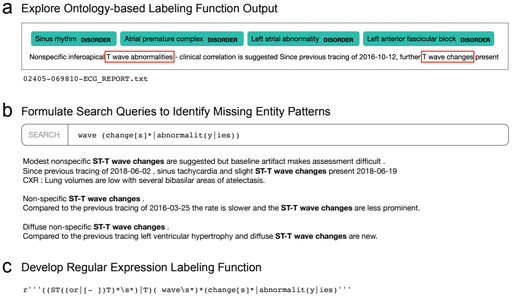
Figure 5 : Example workflow for developing task-specific labeling functions . a Users examine docu- ments tagged by our ontology-based labeling functions and search for common, out-of-ontology entity mentions, in this case “T wave changes” in ECGs. b Users create a search query to identify similar missing mention patterns in other documents. c Based on the set of documents returned via the search query, users refine their entity pattern into a regular expression which can automatically be used as a labeling function when coupled with a target class label (ShARe/CLEF 2014 disorders in this example).
원문 · CC BY 4.0 · Jason A. Fries, Ethan Steinberg, Saelig Khattar, Scott L. Fleming, Jose Posada, Alison Callahan, Nigam H. Shah · Ontology-driven weak supervision for clinical entity classification in electronic health records · 원문 그림 인용 · 원본 PDF 19쪽에서 그림 영역을 추출했습니다.논문 정보
- 저자
- Jason A. Fries, Ethan Steinberg, Saelig Khattar, Scott L. Fleming, Jose Posada, Alison Callahan, Nigam H. Shah
- 학회·저널
- arXiv · 프리프린트
- 최초 공개일
- 2020년 8월 5일
- 등록일
- 2026년 11월 6일
- 수정일
- 2021년 4월 6일
- 버전
- v2
- arXiv
- 2008.01972
- DOI
- 10.1038/s41467-021-22328-4
- 분류
- cs.CL · cs.LG
- 원문 이용 조건
- CC BY 4.0
- 제공 범위
- 논문 정보, 해설, 허용된 원문 그림
AI 해설은 논문 원문과 별개의 설명이며 오류가 있을 수 있습니다. 원문과 그림은 각 출처의 이용 조건과 따로 표시된 권리를 따릅니다.
초록
In the electronic health record, using clinical notes to identify entities such as disorders and their temporality (e.g. the order of an event relative to a time index) can inform many important analyses. However, creating training data for clinical entity tasks is time consuming and sharing labeled data is challenging due to privacy concerns. The information needs of the COVID-19 pandemic highlight the need for agile methods of training machine learning models for clinical notes. We present Trove, a framework for weakly supervised entity classification using medical ontologies and expert-generated rules. Our approach, unlike hand-labeled notes, is easy to share and modify, while offering performance comparable to learning from manually labeled training data. In this work, we validate our framework on six benchmark tasks and demonstrate Trove's ability to analyze the records of patients visiting the emergency department at Stanford Health Care for COVID-19 presenting symptoms and risk factors.
원문 인용
Jason A. Fries, Ethan Steinberg, Saelig Khattar, Scott L. Fleming, Jose Posada, Alison Callahan, Nigam H. Shah (2020). Ontology-driven weak supervision for clinical entity classification in electronic health records. arXiv:2008.01972v2. https://doi.org/10.1038/s41467-021-22328-4
BibTeX
@article{fries2020ontology,
  title = {{Ontology-driven weak supervision for clinical entity classification in electronic health records}},
  author = {Jason A. Fries and Ethan Steinberg and Saelig Khattar and Scott L. Fleming and Jose Posada and Alison Callahan and Nigam H. Shah},
  year = {2020},
  eprint = {2008.01972},
  archivePrefix = {arXiv},
  doi = {10.1038/s41467-021-22328-4},
  url = {https://arxiv.org/abs/2008.01972v2}
}