논문 해설
Paper Plain: Making Medical Research Papers Approachable to Healthcare Consumers with Natural Language Processing
Paper Plain: 자연어 처리를 활용해 의료 연구 논문을 의료 소비자가 쉽게 접근할 수 있도록 만들기
- 연구 문제 비전문가 의료 소비자는 연구 논문의 낯선 용어와 밀도 높은 문장, 읽을 부분 선택의 어려움 때문에 논문을 읽기 어렵습니다.
- 연구 방법 Paper Plain은 핵심 질문 색인, 답변 요약, 섹션 요약, 용어 정의를 PDF 위에 덧붙이고 GPT-3 기반 평이한 요약을 원문과 함께 제공합니다.
- 주요 결과 24명 사용성 실험에서 Paper Plain 사용자는 PDF 기준선보다 독해 난이도를 낮게 평가하고 관련 정보 확신을 높게 보고했으며, 객관식 이해도는 열등하지 않았습니다.
의료 논문이 소비자에게 어려운 이유
의료 소비자는 환자용 팸플릿과 같은 자료에서 다루지 않는 정보를 찾기 위해 연구 문헌으로 향하기도 합니다. 그러나 연구 논문은 낯선 전문 용어가 많고, 어느 부분을 읽어야 할지 알기 어렵습니다. 저자들은 비전문가 독자가 겪는 장벽을 관찰하기 위해 12명의 참가자를 대상으로 사고 발화 독서 연구를 수행했습니다. 그 결과 낯선 용어, 밀도 높은 문장, 어떤 부분을 읽을지 모르는 문제, 답을 찾기 어려운 문제, 개인 상황과 연결하기 어려운 문제가 확인되었습니다. 이 논문은 이러한 장벽을 줄이기 위해 기존 PDF 리더에 안내 기능과 평이한 요약을 더한 인터페이스를 다룹니다.
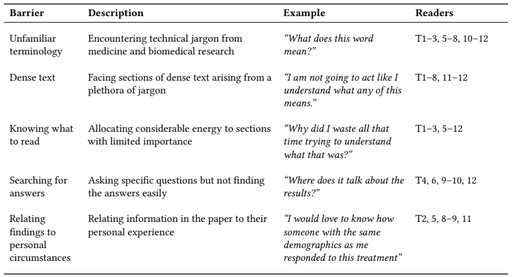
Table 1 . Five barriers readers encountered when they sought an understanding of medical research papers without having prior medical research experience. All barriers were caused, or exacerbated by, their lack of expertise in medical research.
원문 · CC BY 4.0 · Tal August, Lucy Lu Wang, Jonathan Bragg, Marti A. Hearst, Andrew Head, Kyle Lo · Paper Plain: Making Medical Research Papers Approachable to Healthcare Consumers with Natural Language Processing · 원문 그림 인용 · 원본 PDF 9쪽에서 그림 영역을 추출했습니다.Paper Plain의 네 가지 기능과 생성 방식
Paper Plain은 논문을 여는 순간 핵심 질문 색인을 사이드바에 표시하고, 각 질문을 답변 구절로 연결합니다. 질문을 누르면 해당 문단으로 이동하며 답변 요약이 함께 나타납니다. 섹션 요약은 각 최하위 하위 절의 모든 문단 첫 문장을 이어 GPT-3에 5학년 읽기 수준 프롬프트로 입력해 생성합니다. 용어 정의는 scispaCy NER로 식별한 용어를 UMLS 또는 Wiktionary 정의와 연결하며, 빈도와 길이 기준으로 걸러냅니다. 답변 구절은 BioASQ로 학습한 추출형 질의응답 모델이 찾은 단어나 구절을 포함한 문단 전체로 정하며, 이 문단을 GPT-3로 단순화한 것이 답변 요약입니다. 생성 결과는 사실과 다른 내용이나 반복이 있을 수 있어 최대 다섯 번까지 다시 생성하고 가장 유창하거나 정확한 결과를 사람이 고르는 방식으로 운영되었습니다.
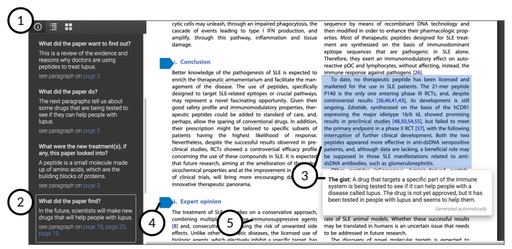
Fig. 1 . Paper Plain helps healthcare consumers consult medical research papers by making their texts more approachable. Shown is the Paper Plain interface and the assistive features it provides to readers. When a paper is opened in Paper Plain, a side pane opens with a reading guide (1), comprising of curated key questions a reader might ask, previews of generated plain language answers, and pointers to where in the paper the reader can find more details. When a reader clicks a question (2), the paper jumps to the passage that provides that answer, accompanied by the plain language answer (answer gist) (3). Readers can also access in-situ plain language summaries for every section of the paper (section gists) by clicking labels next to section headers (4), and definitions of medical jargon sourced from external references by clicking those terms (5).
원문 · CC BY 4.0 · Tal August, Lucy Lu Wang, Jonathan Bragg, Marti A. Hearst, Andrew Head, Kyle Lo · Paper Plain: Making Medical Research Papers Approachable to Healthcare Consumers with Natural Language Processing · 원문 그림 인용 · 원본 PDF 2쪽에서 그림 영역을 추출했습니다.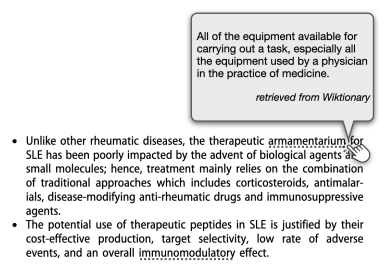
Fig. 2 . Term Definitions on an example passage with technical jargon. Terms with definitions are underlined (“armamentarium”, “immunomodulatory”). Clicking a term will open a tooltip with a definition and a reference to the definitional resource.
원문 · CC BY 4.0 · Tal August, Lucy Lu Wang, Jonathan Bragg, Marti A. Hearst, Andrew Head, Kyle Lo · Paper Plain: Making Medical Research Papers Approachable to Healthcare Consumers with Natural Language Processing · 원문 그림 인용 · 원본 PDF 13쪽에서 그림 영역을 추출했습니다.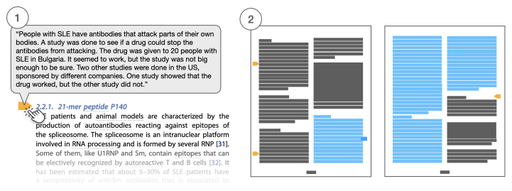
Fig. 3 . Section Gists on an example passage with dense text. (1) Clicking on a tab indicator next to a section title displays a plain language summary of the section. (2) Tabs are positioned throughout the paper, providing summaries that can cover a lot of paper content, even across pages.
원문 · CC BY 4.0 · Tal August, Lucy Lu Wang, Jonathan Bragg, Marti A. Hearst, Andrew Head, Kyle Lo · Paper Plain: Making Medical Research Papers Approachable to Healthcare Consumers with Natural Language Processing · 원문 그림 인용 · 원본 PDF 14쪽에서 그림 영역을 추출했습니다.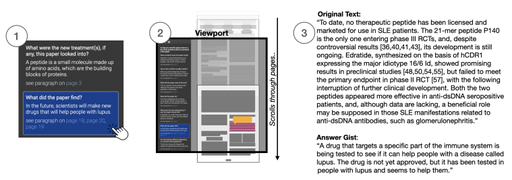
Fig. 4 . Key Question Index guides readers to answering passages and their Answer Gists. When one of the questions is clicked (1), the interface will scroll (2) to the first answering passage (purple) and display a tooltip (orange) containing the Answer Gist. In (3), we show the simplified Answer Gist alongside the original paper text.
원문 · CC BY 4.0 · Tal August, Lucy Lu Wang, Jonathan Bragg, Marti A. Hearst, Andrew Head, Kyle Lo · Paper Plain: Making Medical Research Papers Approachable to Healthcare Consumers with Natural Language Processing · 원문 그림 인용 · 원본 PDF 15쪽에서 그림 영역을 추출했습니다.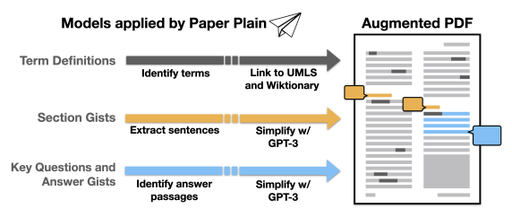
Fig. 5 . Paper Plain uses machine learning models to add term definitions, section gists, and answer gists to the PDF.
원문 · CC BY 4.0 · Tal August, Lucy Lu Wang, Jonathan Bragg, Marti A. Hearst, Andrew Head, Kyle Lo · Paper Plain: Making Medical Research Papers Approachable to Healthcare Consumers with Natural Language Processing · 원문 그림 인용 · 원본 PDF 16쪽에서 그림 영역을 추출했습니다.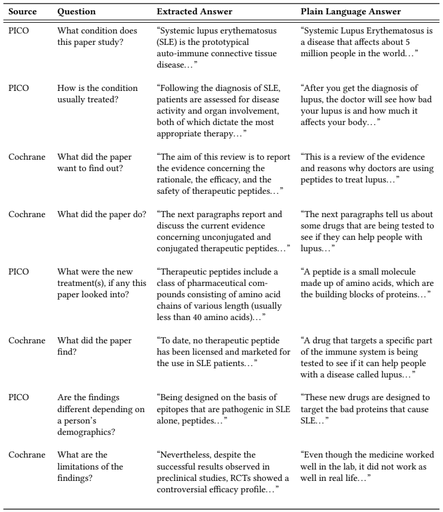
Table 4 . Questions used in Key Question Index and Answer Gists. Questions are presented in the order they appear in the index.
원문 · CC BY 4.0 · Tal August, Lucy Lu Wang, Jonathan Bragg, Marti A. Hearst, Andrew Head, Kyle Lo · Paper Plain: Making Medical Research Papers Approachable to Healthcare Consumers with Natural Language Processing · 원문 그림 인용 · 원본 PDF 39쪽에서 그림 영역을 추출했습니다.사용자 독해 실험의 설계와 측정 지표
사용성 연구는 24명의 참가자가 두 시나리오에서 각각 논문을 10분 동안 읽는 피험자 내 설계로 수행되었습니다. 비교 조건은 전체 Paper Plain, 핵심 질문과 답변 요약만 있는 변형, 섹션 요약과 용어 정의만 있는 변형, 일반 PDF 리더 기준선입니다. 주관 지표는 독해 난이도, 이해도, 관련 정보를 모두 얻었다는 확신이며, 1부터 5까지의 리커트 척도로 측정했습니다. 논문 이해도는 임상의가 선별한 객관식 7문항의 정답 비율로 측정했습니다. 질문은 핵심 질문 색인과 답변 요약만으로 답할 수 없도록 설계되었습니다. 통계는 참가자를 무작위 효과로 둔 혼합효과 선형 모델로 분석했습니다.
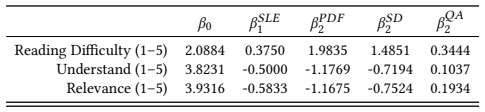
Table 3 . Estimated fixed-effect coefficients for the LMM described in Appendix D for each measurement.
원문 · CC BY 4.0 · Tal August, Lucy Lu Wang, Jonathan Bragg, Marti A. Hearst, Andrew Head, Kyle Lo · Paper Plain: Making Medical Research Papers Approachable to Healthcare Consumers with Natural Language Processing · 원문 그림 인용 · 원본 PDF 38쪽에서 그림 영역을 추출했습니다.독해 경험과 이해도의 결과
독해 경험에서는 Paper Plain 사용 참가자가 PDF 기준선보다 난이도를 낮게 평가했고, 관련 정보를 얻었다는 확신과 이해도 평가가 더 높았습니다. 확신의 중앙값은 Paper Plain에서 4.00, PDF 기준선에서 2.50이었습니다. 특히 핵심 질문 색인과 답변 요약만 제공된 변형은 PDF 기준선보다 난이도가 낮게 평가되었고, 18명 중 많은 참가자가 핵심 질문 색인을 가장 도움이 된 기능으로 꼽았습니다. 이해도 검정에서는 Paper Plain의 평균 정답 수가 3.67, PDF 기준선이 3.50으로 나타났으며, 비열등성 검정은 Paper Plain이 이해도를 떨어뜨리지 않는다는 결과를 보고했습니다.
이 결과는 본 연구의 사용성 실험 조건에서 얻은 것이며, 저자들은 이해도 향상의 근거로 보지 않습니다.
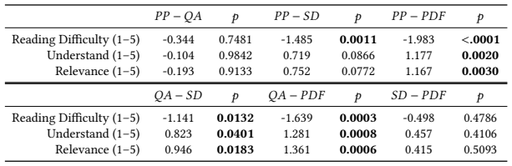
Table 2 . Post-hoc (two-sided) tests for pairwise differences in fixed-effects estimates between interfaces. This table reports the difference in fixed-effects estimates𝑖−𝑗 and Holm-Bonferroni-corrected𝑝-values [46] under our mixed-effects model, where𝑖 and𝑗 correspond to interface options —𝑃𝑃 = Paper Plain,𝑄𝐴 = Key Question Index and Answer Gists,𝑆𝐷 = Both Section Gists and Term Definitions, and𝑃𝐷𝐹 = PDF baseline. For example, in the column for𝑃𝑃−𝑃𝐷𝐹 and row for “Reading Difficulty, ” we can interpret the result as Paper Plain is associated with, on average, 1.983 points lower rating of reading difficulty than a PDF baseline when controlling for participant and paper. Statistically significant𝑝-values are bold. More details about this analysis are in Appendix D.
원문 · CC BY 4.0 · Tal August, Lucy Lu Wang, Jonathan Bragg, Marti A. Hearst, Andrew Head, Kyle Lo · Paper Plain: Making Medical Research Papers Approachable to Healthcare Consumers with Natural Language Processing · 원문 그림 인용 · 원본 PDF 24쪽에서 그림 영역을 추출했습니다.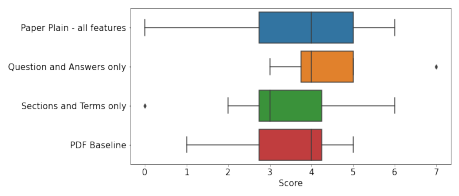
Fig. 10 . Comprehension scores for variants of Paper Plain. Score is number of comprehension questions answered correctly out of seven for each paper.
원문 · CC BY 4.0 · Tal August, Lucy Lu Wang, Jonathan Bragg, Marti A. Hearst, Andrew Head, Kyle Lo · Paper Plain: Making Medical Research Papers Approachable to Healthcare Consumers with Natural Language Processing · 원문 그림 인용 · 원본 PDF 25쪽에서 그림 영역을 추출했습니다.생성 요약의 한계와 연구 범위
이 결과는 Upwork에서 모집한 비전문가 참가자가 10분 동안 개인과 무관한 논문을 읽은 조건에서 얻은 것입니다. 시간 제한과 실제 생활에서의 사용 양상은 이 실험에서 확인되지 않았습니다. 생성 요약은 원문과 다른 내용을 포함할 수 있으므로, 설계자들은 요약을 원문 대체물이 아니라 보조 자료로 제시했습니다. 실제 참가자 중에도 요약만 읽고 이해도 문항을 대부분 맞히지 못한 사례가 보고되었습니다. 배포 전에는 사실성 검증과 전문가 감독이 필요하다는 점을 저자들도 밝힙니다.
논문 정보
- 저자
- Tal August, Lucy Lu Wang, Jonathan Bragg, Marti A. Hearst, Andrew Head, Kyle Lo
- 학회·저널
- arXiv · 프리프린트
- 최초 공개일
- 2022년 2월 28일
- 등록일
- 2026년 11월 6일
- 수정일
- 2022년 2월 28일
- 버전
- v1
- arXiv
- 2203.00130
- 분류
- cs.HC · cs.CL
- 원문 이용 조건
- CC BY 4.0
- 제공 범위
- 논문 정보, 해설, 허용된 원문 그림
AI 해설은 논문 원문과 별개의 설명이며 오류가 있을 수 있습니다. 원문과 그림은 각 출처의 이용 조건과 따로 표시된 권리를 따릅니다.
초록
When seeking information not covered in patient-friendly documents, like medical pamphlets, healthcare consumers may turn to the research literature. Reading medical papers, however, can be a challenging experience. To improve access to medical papers, we introduce a novel interactive interface-Paper Plain-with four features powered by natural language processing: definitions of unfamiliar terms, in-situ plain language section summaries, a collection of key questions that guide readers to answering passages, and plain language summaries of the answering passages. We evaluate Paper Plain, finding that participants who use Paper Plain have an easier time reading and understanding research papers without a loss in paper comprehension compared to those who use a typical PDF reader. Altogether, the study results suggest that guiding readers to relevant passages and providing plain language summaries, or "gists," alongside the original paper content can make reading medical papers easier and give readers more confidence to approach these papers.
원문 인용
Tal August, Lucy Lu Wang, Jonathan Bragg, Marti A. Hearst, Andrew Head, Kyle Lo (2022). Paper Plain: Making Medical Research Papers Approachable to Healthcare Consumers with Natural Language Processing. arXiv:2203.00130v1. https://arxiv.org/abs/2203.00130v1
BibTeX
@misc{august2022paper,
  title = {{Paper Plain: Making Medical Research Papers Approachable to Healthcare Consumers with Natural Language Processing}},
  author = {Tal August and Lucy Lu Wang and Jonathan Bragg and Marti A. Hearst and Andrew Head and Kyle Lo},
  year = {2022},
  eprint = {2203.00130},
  archivePrefix = {arXiv},
  url = {https://arxiv.org/abs/2203.00130v1}
}