논문 해설
Pretraining Data Scale Reverses the Muon-AdamW Fine-Tuning Gap
pre-training 데이터 규모가 Muon-AdamW fine-tuning 격차를 뒤집는다
- 연구 문제 Muon의 pre-training 이점이 fine-tuning post-training–망각 절충에서도 유지되는지 확인합니다.
- 연구 방법 fine-tuning post-training 손실과 pre-training 손실의 프런티어를 비교하는 간극을 정의하고, 데이터 예산에 따른 역전을 margin-to-spread ratio로 설명합니다.
- 주요 결과 StackMathQA 실험에서 작은 예산은 Muon 우세, 큰 예산은 AdamW 우세로 바뀌며 교차 TPR은 모델 크기가 커질수록 작아집니다.
pre-training 손실과 fine-tuning 후 성능의 간극
Muon은 pre-training 손실을 AdamW보다 빠르게 낮추는 옵티마이저로 보고되어 왔지만, 그 이점이 fine-tuning 이후에도 유지되는지는 명확하지 않습니다. 이 논문은 fine-tuning 후 성능을 단순 정확도가 아니라 학습 손실 LFT와 pre-training 손실 망각 LPT의 절충으로 봅니다. 기본 모델마다 fine-tuning으로 도달 가능한 결과 집합의 하단 파레토 프런티어를 계산하고, 두 옵티마이저의 프런티어 사이 부호 있는 거리를 fine-tuning 간격 GFT로 정의합니다. 이 정의에서 GFT가 양수이면 AdamW 프런티어가 우세하고 음수이면 Muon 프런티어가 우세합니다.
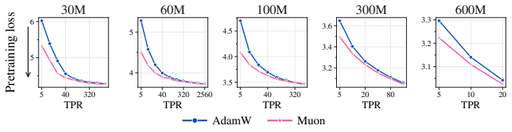
Figure 9 : Muon reaches lower pretraining loss than AdamW.DCLM held-out loss of the loss-optimal base models across pretraining data budgets and model sizes.
원문 · CC BY 4.0 · Catherine Li, Jingchu Gai, Andrej Risteski, Jacob Mitchell Springer, Aditi Raghunathan · Pretraining Data Scale Reverses the Muon-AdamW Fine-Tuning Gap · 원문 그림 인용 · 원본 PDF 22쪽에서 그림 영역을 추출했습니다.이 틀에서 핵심 관찰은 pre-training 데이터 예산 TPR이 커지면 간극의 부호가 바뀐다는 점입니다. 저자들은 OLMo 계열 30M–600M 모델을 DCLM 토큰으로 사전학습하고, 네 개 데이터셋에서 fine-tuning 학습률을 스윕하여 이를 확인합니다.
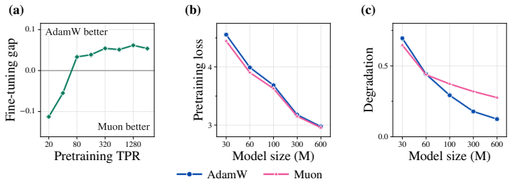
Figure 3 : The Muon–AdamW fine-tuning gap widens with increasing pretraining data budget, and Muon’s advantage shrinks with model size. (a)The fine-tuning gap after fine-tuning OLMo-60M models on StackMathQA, in the lowest-pretraining-loss setting (each pretraining optimizer’s lowest-loss pretrained model swept across all fine-tuning configurations). As the pretraining data budget increases, the fine-tuning gap transitions from negative to positive, with AdamW outperforming Muon beyond the crossover TPR.(b)Pretraining loss at 40 TPR. Muon’s advantage over AdamW shrinks as model size grows.(c)Degradation at 40 TPR, when we accept a StackMathQA loss 10% above the best in exchange for less forgetting. Muon degrades increasingly more than AdamW as model size grows.
원문 · CC BY 4.0 · Catherine Li, Jingchu Gai, Andrej Risteski, Jacob Mitchell Springer, Aditi Raghunathan · Pretraining Data Scale Reverses the Muon-AdamW Fine-Tuning Gap · 원문 그림 인용 · 원본 PDF 4쪽에서 그림 영역을 추출했습니다.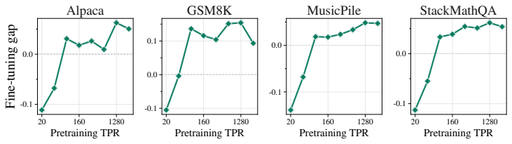
Figure 10 : Fine-tuning gap on every fine-tuning dataset, loss-optimal base models(60M). Negative values mean the Muon frontier dominates.
원문 · CC BY 4.0 · Catherine Li, Jingchu Gai, Andrej Risteski, Jacob Mitchell Springer, Aditi Raghunathan · Pretraining Data Scale Reverses the Muon-AdamW Fine-Tuning Gap · 원문 그림 인용 · 원본 PDF 22쪽에서 그림 영역을 추출했습니다.학습–망각 프런티어와 fine-tuning 간격의 정의
각 기본 모델 θPT에서 fine-tuning으로 얻은 체크포인트들의 (LFT, LPT) 쌍 집합 T(θPT)를 만들고, 그 하단 파레토 프런티어를 학습–망각 프런티어로 씁니다. 두 옵티마이저의 프런티어 사이 거리는 AdamW 프런티어 위의 점들에서 Muon 프런티어까지의 최소 유클리드 거리를 평균한 부호 있는 값입니다. 부록의 계산 방식에 따르면 AdamW 프런티어에서 균등하게 샘플링한 100개 점마다 Muon 프런티어의 가장 가까운 점까지 거리를 구하며, Muon 프런티어가 원점에 더 가까운 경우 음수로 둡니다.
교차 TPR은 주어진 모델 크기와 fine-tuning 데이터셋에서 AdamW 프런티어가 Muon 프런티어를 추월하는 최소 TPR로 정의됩니다. 여기서 TPR은 pre-training 토큰 수를 모델 파라미터 수로 나눈 값입니다.
데이터 예산에 따른 간극 역전과 교차 TPR
최저 pre-training 손실 설정에서 60M 모델을 StackMathQA로 미세조정한 결과, 2.4B 토큰 수준의 작은 예산에서는 Muon 프런티어가 AdamW를 지배하고 간극이 음수입니다. 예산이 더 커지면 간극이 양수로 바뀌어 AdamW가 더 낮은 fine-tuning 손실과 적은 망각을 함께 보입니다.
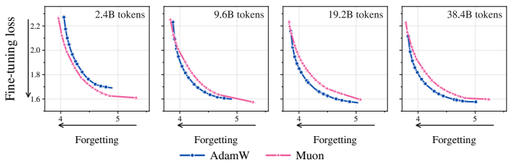
Figure 1 : Beyond a sufficiently large data budget, AdamW outperforms Muon.We pretrain OLMo-60M models with Muon and AdamW and fine-tune on StackMathQA. For each pretraining optimizer, we take the pretrained model with the lowest pretraining loss, sweep across all fine-tuning configurations, and plot the resulting learning–forgetting frontier, from 2.4B to 38.4B pretraining tokens. At 2.4B tokens, Muon’s frontier dominates AdamW’s; at larger budgets the trend reverses and AdamW surpasses Muon. This reversal happens despite Muon achieving lower pretraining loss across all data budgets.
원문 · CC BY 4.0 · Catherine Li, Jingchu Gai, Andrej Risteski, Jacob Mitchell Springer, Aditi Raghunathan · Pretraining Data Scale Reverses the Muon-AdamW Fine-Tuning Gap · 원문 그림 인용 · 원본 PDF 2쪽에서 그림 영역을 추출했습니다.모델 크기별 교차 TPR은 StackMathQA에서 30M 모델이 320, 600M 모델이 10입니다. 전체 모델 크기 범위에서 교차 TPR은 감소하여 AdamW가 더 작은 데이터 예산에서 Muon을 추월합니다. 이 교차 TPR 값은 fine-tuning 데이터셋에 따라 달라지지만 감소 경향은 유지된다고 보고됩니다.
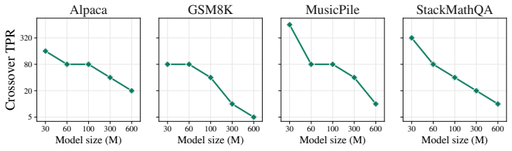
Figure 2 : Crossover TPR decreases with model size.In the lowest-pretraining-loss setting, where each pretraining optimizer’s lowest-loss pretrained model is swept across all fine-tuning hyperparameters, Muon’s advantage reverses at substantially smaller pretraining data budgets as model size increases. The exact crossover TPR varies depending on the fine-tuning dataset, but the high-level trend is consistent.
원문 · CC BY 4.0 · Catherine Li, Jingchu Gai, Andrej Risteski, Jacob Mitchell Springer, Aditi Raghunathan · Pretraining Data Scale Reverses the Muon-AdamW Fine-Tuning Gap · 원문 그림 인용 · 원본 PDF 3쪽에서 그림 영역을 추출했습니다.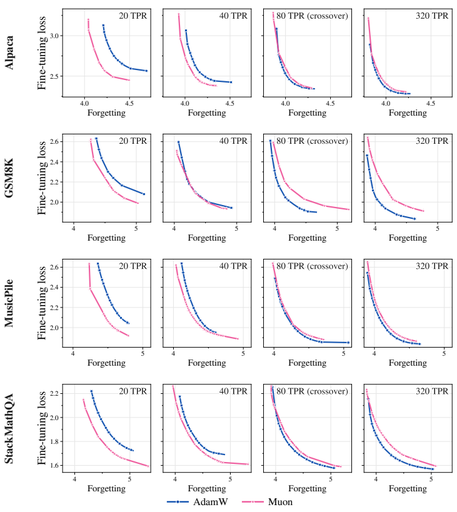
Figure 11 : Learning–forgetting frontiers on every fine-tuning dataset, loss-optimal base models(60M). Each row shows the budgets around that dataset’s crossover TPR.
원문 · CC BY 4.0 · Catherine Li, Jingchu Gai, Andrej Risteski, Jacob Mitchell Springer, Aditi Raghunathan · Pretraining Data Scale Reverses the Muon-AdamW Fine-Tuning Gap · 원문 그림 인용 · 원본 PDF 23쪽에서 그림 영역을 추출했습니다.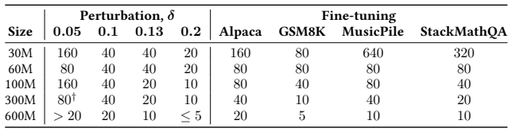
Table 2 :Crossover budgets, in TPR (tokens per parameter). Left: the smallest budget at which AdamW’s loss under a perturbation of magnitudeδ is below Muon’s (loss-optimal checkpoints, mean over three perturbation draws);>20 : Muon’s is lower up to the largest 600M budget, 20 TPR;≤5 : AdamW’s is lower already at the smallest budget; †: Muon’s is lower again at 160 TPR, by 0.003nats. Right: the fine-tuning crossover of Figure 2.
원문 · CC BY 4.0 · Catherine Li, Jingchu Gai, Andrej Risteski, Jacob Mitchell Springer, Aditi Raghunathan · Pretraining Data Scale Reverses the Muon-AdamW Fine-Tuning Gap · 원문 그림 인용 · 원본 PDF 32쪽에서 그림 영역을 추출했습니다.선형 연관 메모리에서의 margin-to-spread ratio
저자들은 fine-tuning을 출력 분포에 대한 섭동으로 보고, 각 사실 i에 대해 정답 로짓과 오답 로짓 차이의 평균 h_i를 오답 로짓 차이의 표준편차 κ_i로 나눈 margin-to-spread ratio(MSR), ρ_i = h_i/κ_i를 정의합니다. 모델 수준에서는 사실들에 대해 평균한 h̄와 κ̄를 사용해 ρ = h̄/κ̄로 계산합니다.
이론 설정은 차원 d의 선형 연관 메모리이며, 데이터 예산은 γ = N/d입니다. 이 설정에서 한 번의 GD 갱신 W_GD = G와 한 번의 Muon 갱신 W_Muon = polar(G)를 비교하고, 두 MSR의 비율 R = ρ_GD/ρ_Muon이 데이터 예산에 따라 증가한다고 정리 4.2는 말합니다. 이 정리는 충분히 큰 γ에서 R이 3π/8 ≈ 1.18에 1/γ 속도로 접근한다고 설명합니다.
언어모델과 선형 메모리에서의 MSR 검증
pre-training 언어모델에서는 정답 토큰이 이미 argmax인 위치만 사용해 위치별 h/κ를 계산하고, 그 중앙값을 MSR로 봅니다. 30M, 60M, 100M 모델에서 Muon은 작은 TPR에서 더 큰 MSR을 가지고, AdamW는 충분히 큰 TPR에서 더 큰 MSR을 가집니다. AdamW 대 Muon의 MSR 비율은 모든 모델 크기에서 1을 넘는 방향으로 교차합니다.
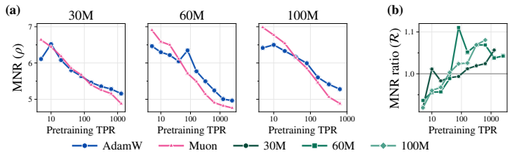
Figure 5 : In real language models, the margin-to-spread ratio of AdamW gains on Muon’s as the token budget grows. (a)MSR ρ of AdamW and Muon against pretraining TPR for 30M, 60M, and 100M models: Muon has the larger MSR at small budgets and AdamW at large ones.(b)The MSR ratio ρAdamW/ρMuon crosses one as the budget grows, at every model size.
원문 · CC BY 4.0 · Catherine Li, Jingchu Gai, Andrej Risteski, Jacob Mitchell Springer, Aditi Raghunathan · Pretraining Data Scale Reverses the Muon-AdamW Fine-Tuning Gap · 원문 그림 인용 · 원본 PDF 8쪽에서 그림 영역을 추출했습니다.선형 메모리 실험에서는 T = 10^4 전체 배치 스텝 뒤의 포화 MSR과 σ50을 비교합니다. 이 실험에서도 Muon은 작은 γ에서 더 큰 MSR과 강건성을 보이고, GD는 큰 γ에서 그렇게 됩니다. 단, σ50 비교는 두 옵티마이저가 같은 사실 집합을 회수하는 용량 이하 영역에 한정됩니다.
적용 범위와 해석의 한계
이론 분석은 독립 가우시안 키와 값, 가중치를 0에서 시작한 한 번의 갱신이라는 단순화된 설정에 있으며, 실제 언어모델에 대한 증명이 아닙니다. 저자들은 MSR이 fine-tuning 간극의 방향과 일치한다고 보지만, 두 역전이 같은 데이터 예산에서 정확히 일어난다는 보장은 없습니다. 학습–망각 절충은 pre-training 손실의 영향도 받기 때문입니다.
또한 주 fine-tuning 실험은 OLMo 계열 30M–600M 모델과 네 데이터셋에 한정되며, Muon의 AdamW 갱신 파라미터 학습률은 같은 셀의 튜닝된 AdamW 값으로 고정되었습니다.
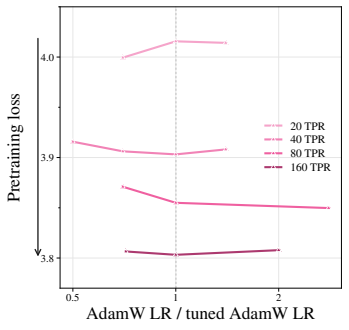
Figure 8 : Muon is insensitive to the learning rate of its AdamW-updated parameters.Best pretraining loss over Muon learning rates for each AdamW learning rate, relative to the tuned AdamW value (dashed), for 60M models.
원문 · CC BY 4.0 · Catherine Li, Jingchu Gai, Andrej Risteski, Jacob Mitchell Springer, Aditi Raghunathan · Pretraining Data Scale Reverses the Muon-AdamW Fine-Tuning Gap · 원문 그림 인용 · 원본 PDF 20쪽에서 그림 영역을 추출했습니다.논문 정보
- 저자
- Catherine Li, Jingchu Gai, Andrej Risteski, Jacob Mitchell Springer, Aditi Raghunathan
- 학회·저널
- arXiv · 프리프린트
- 최초 공개일
- 2026년 11월 2일
- 등록일
- 2026년 11월 4일
- 수정일
- 2026년 11월 2일
- 버전
- v1
- arXiv
- 2611.03633
- 분류
- cs.LG
- 원문 이용 조건
- CC BY 4.0
- 제공 범위
- 논문 정보, 해설, 허용된 원문 그림
AI 해설은 논문 원문과 별개의 설명이며 오류가 있을 수 있습니다. 원문과 그림은 각 출처의 이용 조건과 따로 표시된 권리를 따릅니다.
초록
Muon has recently emerged as a promising optimizer for pretraining large language models, offering a speedup over AdamW in minimizing pretraining loss. However, it remains unclear whether Muon's advantage persists after fine-tuning. In this paper, we study the downstream behavior of Muon and AdamW and uncover a surprising trend: beyond a sufficiently large pretraining data budget, AdamW outperforms Muon after fine-tuning. Moreover, as model size increases, AdamW overtakes Muon at progressively smaller pretraining token-parameter ratios. To explain this reversal, we view fine-tuning as a perturbation of the outputs and introduce the margin-to-spread ratio, which measures how far the correct logit lies above the wrong ones relative to how widely the wrong logits are spread. In language models, Muon has the larger margin-to-spread ratio at small data budgets and AdamW at large ones, mirroring the fine-tuning trend. In a linear associative memory, we prove that after one update the margin-to-spread ratio of gradient descent gains on that of Muon as the data budget grows, and simulations show that this trend persists after extended training.
원문 인용
Catherine Li, Jingchu Gai, Andrej Risteski, Jacob Mitchell Springer, Aditi Raghunathan (2026). Pretraining Data Scale Reverses the Muon-AdamW Fine-Tuning Gap. arXiv:2611.03633v1. https://arxiv.org/abs/2611.03633v1
BibTeX
@misc{li2026pretraining,
  title = {{Pretraining Data Scale Reverses the Muon-AdamW Fine-Tuning Gap}},
  author = {Catherine Li and Jingchu Gai and Andrej Risteski and Jacob Mitchell Springer and Aditi Raghunathan},
  year = {2026},
  eprint = {2611.03633},
  archivePrefix = {arXiv},
  url = {https://arxiv.org/abs/2611.03633v1}
}