논문 해설
Train After You Measure: a Pre-Registered Learning Curve for Fine-Tuning Typed Decision Models on One User's Labels
측정한 뒤에 학습하기: 한 사용자의 레이블로 타입 결정 모델을 미세 조정하기 위한 사전 등록된 학습 곡선
- 연구 문제 한 사용자의 이메일 라벨로 Tev1 계열 모델을 미세조정하면 사전 등록한 마진을 넘어 TF-IDF 베이스라인을 이길 수 있는지 불분명합니다.
- 연구 방법 Tev1-0.8B와 Tev1-4B에 LoRA를 붙여 라벨 예산별로 학습하고 고정 테스트 세트에서 TF-IDF 로지스틱 회귀와 비교했습니다.
- 주요 결과 message type의 전체 라벨에서 4B 모델은 베이스라인보다 +3.3점 높았지만 세 스위치 평균 정확도에서는 베이스라인이 모든 예산에서 앞섰습니다.
한 사용자의 라벨로 미세조정하면 베이스라인을 넘을까
이 논문은 한 사용자의 이메일 라벨로 typed decision model을 미세조정했을 때, 이전 연구에서 가장 높은 정확도를 보인 TF-IDF 로지스틱 회귀 베이스라인을 넘어설 수 있는지를 묻습니다. 저자들은 같은 라벨을 decision model에 주어 격차가 줄어드는지 확인하려 했습니다.
실험은 두 번의 사전 등록으로 나뉩니다. 등록 M은 일반 Qwen3.5-4B 베이스에 message type만 적용한 예비 연구로, 교차검증을 사용했습니다. 등록 C는 공개된 Tev1-0.8B-experimental과 Tev1-4B-experimental에 LoRA 어댑터를 붙여 다섯 필드를 학습한 본 연구입니다. 고정 테스트 세트는 135개 이메일이며 학습 풀은 587개 이메일입니다.
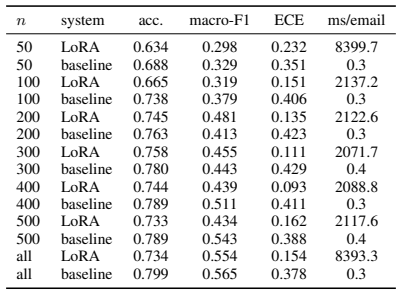
Table 6 : Registration M (preliminary): LoRA on the generic Qwen3.5-4B base vs. a word TF-IDF baseline ontype, out-of-fold, same thread-grouped folds; n = training labels per fold. Not comparable with Table 1 (cross-validation, not the fixed test). Generated from the run'smetrics.json.
원문 · CC BY 4.0 · Federico Lucca · Train After You Measure: a Pre-Registered Learning Curve for Fine-Tuning Typed Decision Models on One User's Labels · 원문 그림 인용 · 원본 PDF 9쪽에서 그림 영역을 추출했습니다.LoRA fine-tuning과 데이터 분할
데이터 분할은 스레드 단위로 이루어집니다. 고정 테스트 세트는 129개 스레드에 속한 135개 이메일이며, 나머지 587개 이메일이 학습 풀이 됩니다. 풀에서 50, 100, 200, 300, 400, 587개 라벨의 중첩 부분집합을 시드 7과 11로 뽑으며, 작은 부분집합은 더 큰 부분집합에 포함됩니다.
fine-tuning은 LoRA로 합니다. rank는 16, α는 32, dropout은 0.05이고 모든 선형 레이어에 붙입니다. 예산과 시드마다 어댑터 하나를 만들어 다섯 질문을 함께 학습하고, 최대 3 에폭에 10% 스레드 단위 검증 분할로 조기 종료를 적용합니다. 예산 0은 어댑터 없는 zero-shot 모델입니다.
베이스라인은 단어 1–2-gram과 문자 3–5-gram TF-IDF에 class-balanced 로지스틱 회귀를 필드마다 학습한 모델입니다. 베이스라인은 고정 하이퍼파라미터를 씁니다. 예측은 선택지 문자에 대한 분포를 재정규화해서 읽고, 신뢰도는 선택된 선택지의 확률입니다.
message type과 세 스위치의 결과
message type에서 Tev1-4B-experimental은 400개 라벨일 때 베이스라인보다 +2.6점 높아 등록된 +3점 기준을 채우지 못했습니다. 전체 587개 라벨에서는 Tev1-0.8B-experimental이 +0.7점, Tev1-4B-experimental이 +3.3점 높았습니다. 다만 이 차이는 이메일 한 통이 0.74점에 해당하는 테스트 해상도 안에 있습니다. 전체 라벨에서 4B 모델은 macro-F1 0.581을, 베이스라인은 0.406을 기록해 베이스라인이 예측하지 않는 희귀 클래스를 더 잘 찾았습니다.
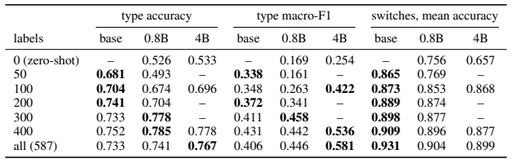
Table 1 : Registration C on the fixed test (135 emails). Accuracy and macro-F1 ontypeand mean accuracy of the three switches, by training labels; mean of the seeds run at each budget (two everywhere except zero-shot, one). Budget 0 is the same model without LoRA. Majority class of the test: 0.585 on type, 0.827 on the switches. One email is 0.74 points; the 95% Wilson interval of the baseline's type accuracy with all labels is [0.653, 0.801]. Best value per row in bold. Generated bycurve_tables.pyfrom the result JSON files.
원문 · CC BY 4.0 · Federico Lucca · Train After You Measure: a Pre-Registered Learning Curve for Fine-Tuning Typed Decision Models on One User's Labels · 원문 그림 인용 · 원본 PDF 4쪽에서 그림 영역을 추출했습니다.세 action switches의 평균 정확도에서는 베이스라인이 모든 라벨 예산에서 두 fine-tuning 모델보다 앞섰습니다. 전체 라벨에서 베이스라인은 0.931, 0.8B는 0.904, 4B는 0.899였습니다. fine-tuning 모델의 최선은 0.8B에서 −1.2점, 4B에서 −0.5점이었습니다.
학습 곡선과 보정, 지연 비용
Tev1-0.8B-experimental의 message type 학습 곡선은 300개 라벨 이후 개선이 멈추고 이후 하락했습니다. 300개 라벨 이후 첫 기울기는 1점 미만이었습니다. Tev1-4B-experimental은 네 개 예산만 있어 같은 수렴 기준을 평가할 수 없었습니다.
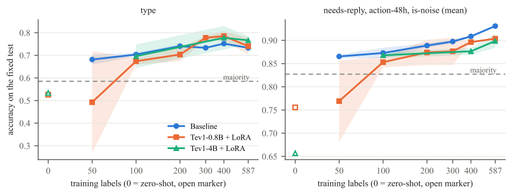
Figure 1 : RegistrationC: accuracy on the fixed test by training labels (log scale), mean of seeds 7 and 11 with the min–max band across seeds; open markers are the same models zero-shot. Left: message type. Right: mean of the three switches. Dashed: majority class of the test. Generated from the result JSON files.
원문 · CC BY 4.0 · Federico Lucca · Train After You Measure: a Pre-Registered Learning Curve for Fine-Tuning Typed Decision Models on One User's Labels · 원문 그림 인용 · 원본 PDF 4쪽에서 그림 영역을 추출했습니다.보정 지표인 expected calibration error는 10개 구간으로 계산했습니다. fine-tuning은 message type의 zero-shot ECE를 낮췄지만, 0.8B 모델은 200개 이상 라벨의 네 예산 중 세 예산에서 0.10 이상을 유지했습니다. 지연은 T4 GPU에서 질문당 중앙값으로 측정했으며, fine-tuning 모델은 0.8B가 306 ms, 4B가 1681 ms였고 베이스라인은 0.7 ms였습니다.
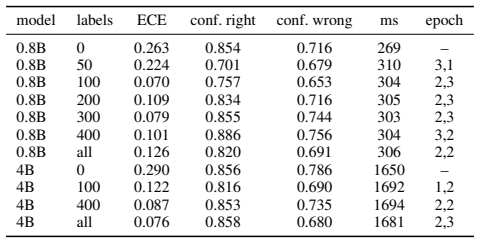
Table 4 : Registration C,type: ECE (10 bins), mean confidence on correct and wrong answers, median latency per question on a T4 (ms), best epoch per seed. Baseline median latency: 0.7 ms.
원문 · CC BY 4.0 · Federico Lucca · Train After You Measure: a Pre-Registered Learning Curve for Fine-Tuning Typed Decision Models on One User's Labels · 원문 그림 인용 · 원본 PDF 8쪽에서 그림 영역을 추출했습니다.남은 문제
이 실험은 한 받은편지함과 한 사용자에서 이루어졌고, 라벨은 모델 제안을 보며 소유자가 작성해 그 제안에 앵커링되었을 수 있습니다. LoRA 하이퍼파라미터는 모든 예산에 같은 세트를 썼으므로 곡선은 데이터 효과를 보지만 튜닝 효과를 분리하지 않았습니다. 시드는 두 개이며 zero-shot 점은 하나의 시드만 씁니다. 135개 이메일 테스트에서 이메일 하나는 정확도를 0.74점 움직입니다.
fine-tuning이 베이스라인보다 낮았던 이유로 든 희귀 클래스 부족, 클래스 불균형, 작은 테스트, 프롬프트 길이, fp16 정밀도, 베이스 모델 선택은 저자들이 실험으로 검증하지 않았습니다. 저자들은 이를 검증하려면 두 번째 받은편지함과 클래스 가중치, 더 큰 테스트 세트가 필요하다고 봅니다.
논문 정보
- 저자
- Federico Lucca
- 학회·저널
- arXiv · 프리프린트
- 최초 공개일
- 2026년 11월 16일
- 등록일
- 2026년 11월 18일
- 수정일
- 2026년 11월 16일
- 버전
- v1
- arXiv
- 2611.21393
- 분류
- cs.CL · cs.LG
- 원문 이용 조건
- CC BY 4.0
- 제공 범위
- 논문 정보, 해설, 허용된 원문 그림
AI 해설은 논문 원문과 별개의 설명이며 오류가 있을 수 있습니다. 원문과 그림은 각 출처의 이용 조건과 따로 표시된 권리를 따릅니다.
초록
Fine-tuning a small typed decision model on one user's email labels did not clear the margin we pre-registered over a logistic regression trained on the same labels. In earlier work, about two hundred labels and a TF-IDF logistic regression had the highest point accuracy on this inbox, though not significantly above the best hosted model; we ask whether the same labels, given to a decision model, close the gap. A first registered study, on a generic 4B base with cross-validation and message type only, stayed below the baseline at every label budget (-1.8 to -7.3 points). The main study was registered before any fine-tuning run: a fixed test set of 135 emails never used for selection, LoRA adapters on the public Tev1-0.8B and Tev1-4B decision models, nested subsets of 50 to 587 labels, two seeds and five decision fields on a free T4 GPU. Four of its five hypotheses are refuted--two in the fine-tunes' favour--and one is confirmed for one model. On message type the 4B model misses the registered three-point margin at 400 labels (+2.6) and passes it with all 587 (+3.3); with all labels both models are above the baseline by +0.7 and +3.3 points, where one email is 0.74 points and a 95% interval is about 15 points wide, and the 4B model is clearly ahead in type macro-F1 (0.581 vs. 0.406). On the three action switches the baseline is ahead at every label budget for both models (0.931 vs. 0.904 and 0.899 mean accuracy with all labels), at under a millisecond per question against 306 and 1681 ms. The 0.8B type curve barely improves after 300 labels and then falls. The baseline never predicts the two rarest classes (7 offers and 8 spam in the training pool); the fine-tuned models find spam in some runs, not consistently across seeds. We list the explanations we did not test and say when a new attempt would be worth making. Scripts are public; weights and emails are not.
원문 인용
Federico Lucca (2026). Train After You Measure: a Pre-Registered Learning Curve for Fine-Tuning Typed Decision Models on One User's Labels. arXiv:2611.21393v1. https://arxiv.org/abs/2611.21393v1
BibTeX
@misc{lucca2026train,
  title = {{Train After You Measure: a Pre-Registered Learning Curve for Fine-Tuning Typed Decision Models on One User's Labels}},
  author = {Federico Lucca},
  year = {2026},
  eprint = {2611.21393},
  archivePrefix = {arXiv},
  url = {https://arxiv.org/abs/2611.21393v1}
}