논문 해설
A Deep Cascade of Convolutional Neural Networks for Dynamic MR Image Reconstruction
동적 MR 영상 재구성을 위한 합성곱 신경망의 심층 캐스케이드
- 연구 문제 undersampled MR 영상은 aliasing 때문에 재구성이 어렵고, 기존 압축센싱과 pre-training 방법은 가속률이 높을수록 오차가 커집니다.
- 연구 방법 CNN 재구성 모듈과 데이터 일관성 계층을 번갈아 쌓은 캐스케이드 네트워크를 end-to-end로 학습하며, 동적 입력에는 인접 프레임 데이터 공유를 추가합니다.
- 주요 결과 2D 재구성에서 CNN은 3배와 6배 가속 모두에서 DLMRI보다 낮은 MSE를 보고했고, 동적 시퀀스 실험에서도 기존 비교 방법보다 낮은 오차를 보고했습니다.
aggressive undersampling에서 재구성이 어려운 이유
MRI는 k-space 샘플을 순차적으로 획득하기 때문에 획득 시간이 길고, 이는 환자 부담과 접근성 문제로 이어집니다. 획득 시간을 줄이려고 k-space를 undersampling하면 Nyquist-Shannon 조건을 위반하여 재구성 영상에 aliasing artefact가 생깁니다. 압축센싱은 영상의 희소성과 샘플링·희소 표현 사이의 비일관성을 가정하여 이 문제를 풀지만, 고정된 희소 변환이나 학습된 사전에 의존하므로 가속률을 높일수록 세부 구조를 복원하기 어렵습니다. 이 논문은 이러한 문제를 aliasing 제거(de-aliasing) 문제로 보고, 2D 심장 cine MR 영상과 동적 시퀀스의 Cartesian undersampling 재구성에 초점을 맞춥니다.
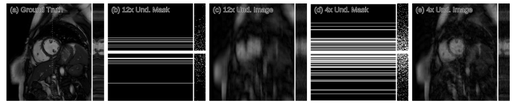
Fig. 1 . An example of the image acquisition with Cartesian undersampling for a sequence of cardiac cine images. (a) A ground truth sequence that is fully- sampled ink-space, shown alongx-y andy-t for the image frame and the temporal profile respectively. (b) A Cartesian undersampling mask that only acquires 1/12 of samples ink-space, where white indicates the sampled lines. Each image frame is undersampled with the mask shown along kx-ky. The undersampling pattern along the temporal dimension is shown in ky-t. (c) The zero-filled reconstruction of the image acquired using the 12-fold undersampling mask. (d, e) 4-fold Cartesian undersampling mask and the resulting zero-filled image. Note that the aliasing artefact becomes more prominent as the undersampling factor is increased.
원문 · CC BY 4.0 · Jo Schlemper, Jose Caballero, Joseph V. Hajnal, Anthony Price, Daniel Rueckert · A Deep Cascade of Convolutional Neural Networks for Dynamic MR Image Reconstruction · 원문 그림 인용 · 원본 PDF 2쪽에서 그림 영역을 추출했습니다.데이터 일관성 계층과 CNN의 캐스케이드
이 방법은 CNN 재구성 모듈과 데이터 일관성(DC) 계층을 번갈아 쌓은 캐스케이드 네트워크입니다. 입력 xu는 측정값 y로부터 계산한 zero-filled 영상이며, 각 CNN 모듈이 aliasing을 줄인 영상을 출력하면 DC 계층이 획득된 k-space 샘플을 다시 반영합니다. DC 계층의 순전파는 Fourier 변환, 획득 위치에서의 선형 결합, 역변환으로 구성되며, 획득된 위치 j∈Ω에서는 CNN 예측과 측정값을 노이즈 수준 λ에 따라 가중 결합하고 획득되지 않은 위치에서는 CNN 예측을 그대로 사용합니다. 이 연산은 역전파에서 Jacobian FHΛF로 주어지므로 전체 캐스케이드를 end-to-end로 학습할 수 있습니다.
저자들은 이 구조가 DLMRI의 반복 최적화를 펼친 형태와 유사하다고 해석합니다.
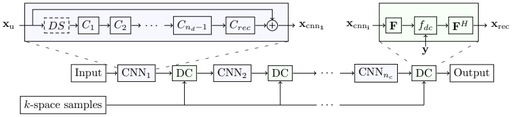
Fig. 4 . A cascade of CNNs. DC denotes the data consistency layer and DS denotes the data sharing layer. The number of convolution layers within each network and the depth of cascade is denoted by nd and nc respectively. Note also that DS layer only applies when the input is a sequence of images.
원문 · CC BY 4.0 · Jo Schlemper, Jose Caballero, Joseph V. Hajnal, Anthony Price, Daniel Rueckert · A Deep Cascade of Convolutional Neural Networks for Dynamic MR Image Reconstruction · 원문 그림 인용 · 원본 PDF 6쪽에서 그림 영역을 추출했습니다.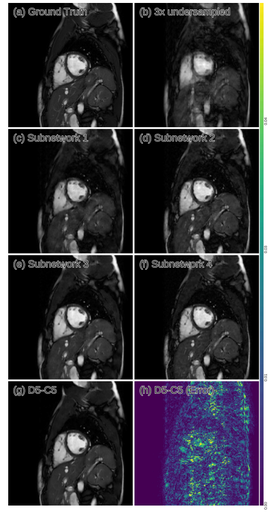
Fig. 8 . 2D reconstruction results of D5-C5 for one of the test subjects. Here we inspect the intermediate output from each subnetwork in D5-C5. (a) Ground truth (b) The input to the network that was 3x undersampled image. The output of (c) first, (d) second, (e) third, (f) fourth cascading subnetwork respectively. (g,h) The final output and the corresponding error. Note that this is not the reconstruction results from the networks in Experiment in VII-B2.
원문 · CC BY 4.0 · Jo Schlemper, Jose Caballero, Joseph V. Hajnal, Anthony Price, Daniel Rueckert · A Deep Cascade of Convolutional Neural Networks for Dynamic MR Image Reconstruction · 원문 그림 인용 · 원본 PDF 8쪽에서 그림 영역을 추출했습니다.인접 프레임의 데이터 공유와 동적 입력
동적 시퀀스에서는 인접 프레임의 k-space 샘플을 함께 사용하는 데이터 공유(data sharing) 계층을 추가합니다. 각 프레임 t에 대해 t−nadj부터 t+nadj까지의 프레임에서 빠진 k-space 샘플을 채우며, 같은 위치에 여러 샘플이 있으면 가중 평균을 사용합니다. 이렇게 만든 data-shared 영상들은 채널 축으로 연결되어 CNN 첫 합성곱 층의 입력이 됩니다. 이 방식은 인접 프레임의 중첩 선 때문에 실제 가속률보다 낮은 가속률을 가진 것처럼 보이게 하지만, 심장 영역처럼 동적 변화가 큰 부분에서는 데이터 불일치가 생깁니다. 그래서 저자들은 이 영상을 최종 재구성으로 쓰지 않고 CNN 입력으로 제공하여 aliasing과 동적 움직임을 함께 추정하도록 합니다.
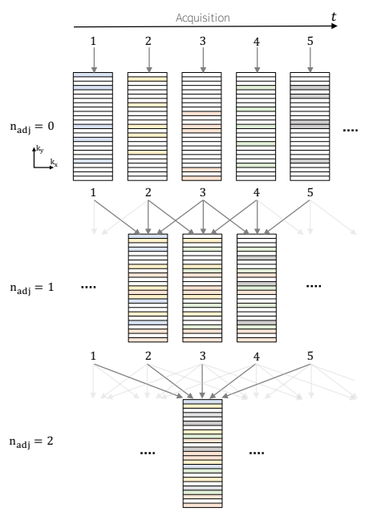
Fig. 2 . The illustration of data sharing approach. The acquired lines, which can be seen as nad j = 0 , are colour-coded for each time frame. For each nad j, the missing entries in each frame are aggregated using the values from up to ±nad j neighbouring frames. The overlapped lines are averaged.
원문 · CC BY 4.0 · Jo Schlemper, Jose Caballero, Joseph V. Hajnal, Anthony Price, Daniel Rueckert · A Deep Cascade of Convolutional Neural Networks for Dynamic MR Image Reconstruction · 원문 그림 인용 · 원본 PDF 4쪽에서 그림 영역을 추출했습니다.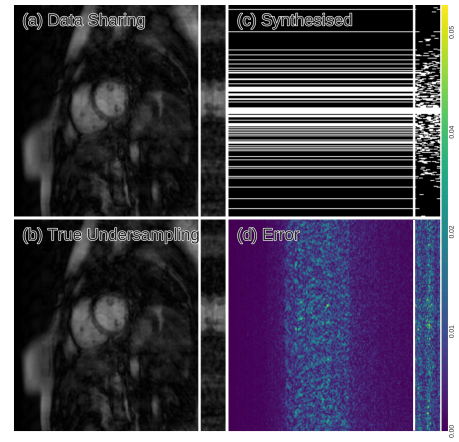
Fig. 3 . The illustration of data sharing approach applied to the image and the mask from Fig.1(a,b). In this figure, (a) shows the appearance of the resulting sequence for nad j = 2 . (b) The entries in k-space that are either acquired or aggregated using the data sharing approach with nad j = 2, which conceptually defines a sampling mask. (c) For a comparison, we show the resulting zero-filled reconstruction if (b) were treated as a mask. (d) The error map between the (a) and (b). One can observe their similarity except for the data inconsistency of the dynamic content around the heart region. Note that for nad j = 2 , the obtained image has the appearance similar to acceleration factor around 4 (rather than 12/5 = 2.4, which is the maximum achievable from 5 frames) due to overlapping lines.
원문 · CC BY 4.0 · Jo Schlemper, Jose Caballero, Joseph V. Hajnal, Anthony Price, Daniel Rueckert · A Deep Cascade of Convolutional Neural Networks for Dynamic MR Image Reconstruction · 원문 그림 인용 · 원본 PDF 5쪽에서 그림 영역을 추출했습니다.2D 재구성의 DLMRI 대비 결과
2D 실험에서는 각 프레임을 독립적으로 재구성하며, 3배와 6배 가속에서 DLMRI와 비교합니다. 평가 지표는 평균제곱오차(MSE)입니다. 원문 표에서 3배 가속 시 CNN(2D)의 MSE는 0.89(0.46)×10^−3이고 DLMRI는 2.12(1.27)×10^−3입니다. 6배 가속 시 CNN(2D)는 3.42(1.65)×10^−3이고 DLMRI는 6.31(2.95)×10^−3입니다. 이 비교에서 CNN은 두 가속률 모두에서 평균 오차가 낮고 표준편차도 작습니다. 2D 재구성 한 슬라이스는 GeForce GTX 1080에서 23±0.1 밀리초가 걸렸다고 보고됩니다. 이 결과는 10명의 피험자에 대한 교차검증 결과이며, DLMRI는 CPU에서 피험자당 약 6.1시간이 걸렸다고 보고됩니다.
동적 시퀀스 절제와 기존 방법과의 비교
동적 실험에서는 데이터 공유의 효과를 먼저 확인했습니다. 9배 가속 조건에서 D5-C10(S)는 데이터 공유를 사용하고, D6-C10은 데이터 공유 대신 추가 합성곱 층을 사용합니다. 저자들은 D5-C10(S)의 훈련 및 테스트 오차가 더 작았다고 보고하며, 이는 데이터 공유가 일반화에 도움이 되었다는 해석과 연결됩니다. 기존 방법과의 비교에서는 DLTG, kt-SLR, L+S를 3, 6, 9, 11배 가속에서 비교했습니다. CNN은 pre-training 후 가속률별로 미세조정되었으며, 대표 평가에서 CNN이 모든 가속률에서 더 낮은 오차를 보고합니다. 3배 가속에서는 방법 간 차이가 작지만, 가속률이 높아질수록 kt-SLR과 L+S의 오차가 빠르게 커진다고 보고됩니다.
동적 시퀀스 재구성은 GPU에서 평균 8.21초가 걸렸습니다.
적용 범위와 남은 질문
저자들이 밝힌 한계는 다음과 같습니다. 실험 데이터는 원시 다중 코일 데이터를 SENSE로 재구성한 뒤 단일 코일 형태로 되돌린 retrospective undersampling 데이터입니다. 따라서 실제 어레이 코일 획득 환경에서의 적용은 추가 검토가 필요합니다. 또한 CNN은 국소 표현을 학습하므로 병리나 다른 가변적 영상 내용에서 어떻게 작동하는지는 결정되지 않았습니다. 저자들은 CNN의 국소적 특성이 전역 구조에 영향을 주지 않을 것으로 추정하지만, 이는 검증된 결론이 아니라 해석입니다. 데이터셋은 소규모이므로 더 큰 데이터에서의 일반화는 별도로 평가되어야 합니다.
논문 정보
- 저자
- Jo Schlemper, Jose Caballero, Joseph V. Hajnal, Anthony Price, Daniel Rueckert
- 학회·저널
- arXiv · 프리프린트
- 최초 공개일
- 2017년 4월 8일
- 등록일
- 2026년 11월 5일
- 수정일
- 2017년 11월 23일
- 버전
- v2
- arXiv
- 1704.02422
- 분류
- cs.CV
- 원문 이용 조건
- CC BY 4.0
- 제공 범위
- 논문 정보, 해설, 허용된 원문 그림
AI 해설은 논문 원문과 별개의 설명이며 오류가 있을 수 있습니다. 원문과 그림은 각 출처의 이용 조건과 따로 표시된 권리를 따릅니다.
초록
Inspired by recent advances in deep learning, we propose a framework for reconstructing dynamic sequences of 2D cardiac magnetic resonance (MR) images from undersampled data using a deep cascade of convolutional neural networks (CNNs) to accelerate the data acquisition process. In particular, we address the case where data is acquired using aggressive Cartesian undersampling. Firstly, we show that when each 2D image frame is reconstructed independently, the proposed method outperforms state-of-the-art 2D compressed sensing approaches such as dictionary learning-based MR image reconstruction, in terms of reconstruction error and reconstruction speed. Secondly, when reconstructing the frames of the sequences jointly, we demonstrate that CNNs can learn spatio-temporal correlations efficiently by combining convolution and data sharing approaches. We show that the proposed method consistently outperforms state-of-the-art methods and is capable of preserving anatomical structure more faithfully up to 11-fold undersampling. Moreover, reconstruction is very fast: each complete dynamic sequence can be reconstructed in less than 10s and, for the 2D case, each image frame can be reconstructed in 23ms, enabling real-time applications.
원문 인용
Jo Schlemper, Jose Caballero, Joseph V. Hajnal, Anthony Price, Daniel Rueckert (2017). A Deep Cascade of Convolutional Neural Networks for Dynamic MR Image Reconstruction. arXiv:1704.02422v2. https://arxiv.org/abs/1704.02422v2
BibTeX
@misc{schlemper2017deep,
  title = {{A Deep Cascade of Convolutional Neural Networks for Dynamic MR Image Reconstruction}},
  author = {Jo Schlemper and Jose Caballero and Joseph V. Hajnal and Anthony Price and Daniel Rueckert},
  year = {2017},
  eprint = {1704.02422},
  archivePrefix = {arXiv},
  url = {https://arxiv.org/abs/1704.02422v2}
}