Paper commentary
Goal Revelation as a Bridge Between Information-Theoretic Empowerment and Capability-Based Human Power
Goal revelation links empowerment and human attainment through a provable floor
- Problem Empowerment and individual power measure influence in different ways, and goal revelation can stay unchanged while attainment collapses. So no single measure guarantees that a human still reaches their goals.
- Method The authors use Fano's inequality to turn individual power into a floor B(s) under goal revelation. The floor is computed from individual power alone, so it gives a guarantee that revelation alone cannot.
- Results The authors prove the chain B(s) ≤ I(G;ξ|s) ≤ I(A_h→ξ|s) ≤ 𝔈_h(s) holds, so only the attainment end gives positive guarantees.
Why the two power measures never meet
Power matters for AI safety from two sides: an AI may gather power, and human control may erode slowly. Empowerment measures, in bits, the capacity of the channel from an agent's actions to future states. Individual power in the capability sense instead measures how likely a human is to attain each candidate goal if pursuing it. Goals are central to the second measure and absent from the first, so the two never appear in one calculation.
This gap has practical consequences, because an assistant told to maximise empowerment can prefer an interface that leaves goals unreachable. Goal revelation, the third quantity, does not fix this either, since relabelling goals can leave it unchanged while attainment collapses. The authors therefore ask how the three quantities relate at one state, and which of them can give a guarantee.
Goal revelation as the shared quantity
The quantity that lets the two measures meet is goal revelation, the mutual information between the latent goal and the trajectory. Revelation is zero when behaviour ignores the goal, because the goal then reaches the world through no channel. Revelation is capped by the ceiling log2 N, however rich the environment is.
The bridge runs in one direction: attainment, through individual power, forces a floor on revelation. Revelation is then capped by the directed information the realised behaviour generates, through Massey's converse for channels with feedback. The empowerment cap holds because the realised behaviour is one feasible input that the capacity maximises over.
Written as a chain, the bounds read B(s) ≤ I(G;ξ|s) ≤ I(A_h→ξ|s) ≤ 𝔈_h(s). Each rung answers a different question, and only the attainment rung speaks to fulfilment.
The chain's rungs are a theorem, not a construction, and the authors state it as Theorem 4.1. Capacity doesn't imply revelation, and revelation doesn't imply attainment. Revelation rises with the floor in the attainable-capability limit, where the floor meets the ceiling.
How attainment becomes a floor on revelation
Each candidate goal gets a capability, the discounted chance that pursuit reaches its satisfaction set. Individual power sums these capabilities raised to an exponent ζ and takes a base-2 log of the total. The theorem allows any ζ at least 1, although Heitzig and Potham's reliability axiom forces ζ above 1. Small ζ favours breadth of many moderate capabilities, while large ζ favours peak capability.
The floor needs a uniform goal prior, disjoint satisfaction sets, and no goal certified at time zero.
The argument is a decoding one, in which an observer guesses the goal by the satisfaction set the trajectory lands in. Because the satisfaction sets are disjoint, the guess is single-valued, and it falls back to a fixed goal when no goal is satisfied. Fano's inequality turns the average correct-guess probability, at least 2^(I_h(s)−log2 N), into an error bound.
Clamping that error at the random-guessing rate (N−1)/N keeps the floor from becoming positive when every capability is zero.
The floor is B(s) = max{0, log2 N − f(min{P_e^max, (N−1)/N})}, with P_e^max = 1 − 2^(I_h(s)−log2 N). Here f(x) is the binary entropy plus x log2(N−1), so the floor is computed from individual power alone. Lemma 4.2 states that B(s) is strictly increasing in I_h(s) for nonnegative individual power. As individual power reaches log2 N, the floor tends to log2 N, the ceiling on revelation.
The floor is a bound in one direction only, and the paper says it does not read as a claim that I_h maximises revelation. Suboptimal pursuit and environmental noise lower I_h(s) rather than break the bound. Revelation can still be high while the goal goes unmet, which is why the floor concerns attainment only.
Why capacity can grow while goals stay unreachable
Proposition 2 asks whether the empowerment-maximising interface can be the one that leaves every candidate goal unattainable. The entropy of the action-sequence variable grows linearly in the horizon, so the bound on empowerment grows with it.
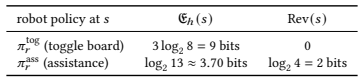
Table 1 : Proposition 2 at𝑁= 4goals, 𝑚= 7toggles, 𝑇= 3steps: capacity prefers the board by ≈ 5.30bits; under that policy the trajectory carries nothing about the goal.
Original paper · CC BY 4.0 · Jaime Ruiz-Serra, Tomáš Gavenčiak, Jobst Heitzig · Goal Revelation as a Bridge Between Information-Theoretic Empowerment and Capability-Based Human Power · Original paper figure · Extracted the figure area from page 8 of the original PDF.The construction has a fully observable deterministic environment with N first-outcome goals and two robot policies. The toggle board policy lets the human flip m free binary toggles, while goal transitions are blocked. The assistance policy lets goal transitions respond, while the toggles are frozen. Under the toggle board, empowerment is T log2(m+1) bits, revelation is zero, and every capability is zero.
Under the assistance policy, empowerment is log2(N^T+1) bits, revelation is log2 N, and every capability is one. Whenever m is at least N+1, T log2(m+1) exceeds log2(N^T+1), so the capacity score prefers the toggle board.
Table 1 instantiates this with N = 4 goals, m = 7 toggles and T = 3 steps. The toggle board reaches about 9 bits of empowerment, with revelation at zero. The assistance policy gives about 3.70 bits of empowerment and revelation of 2 bits. The capacity prefers the board by about 5.30 bits, while the trajectory carries nothing about the goal under that policy.
The board's capacity is worthless to every goal, yet the capacity score doesn't account for it.
The authors argue the margin grows without bound in m and T, since T log2(m+1) overtakes log2(N^T+1) once m reaches N+1. This is a structural failure rather than a flaw in the human, because capacity measures a budget that goal-conditioned behaviour only partly uses. The margin measures how far the environment's influence budget exceeds what goal-conditioned behaviour uses.
Relabelling keeps revelation but breaks attainment
Revelation depends only on the family of goal-conditioned laws, not on which law goes with which goal. Attainment, by contrast, is a property of the pairing between a goal and its law, asking whether that law reaches the goal's satisfaction set. Proposition 3 takes a permutation sigma of the goal family and calls a configuration sigma-scrambled when pursuing g delivers what pursuing sigma(g) would have delivered.
Under that scramble, the human still pursues g through the same policy, so the aggregate mutual information stays the same. The interface changes which outcome each goal yields, and the revelation measure cannot see that change.
The capability of g under the scrambled law equals the original capability when sigma(g) is g, and is zero otherwise. A fixed-point-free permutation therefore zeroes every capability, sending individual power to negative infinity and the floor B(s) to 0. Under the scramble, the satisfaction decoder checks the trajectory against the goal actually pursued, so its correct-guess probability drops to zero.
Revelation, however, stays unchanged, which is why the guarantee runs from attainment upward. Table 2 makes this concrete with N equal to 2 and sigma as the transposition. The aligned interface gives revelation of 0.9 bits and a floor of 0.531 bits, with capability profile (0.9, 0.9). The scrambled interface keeps 0.9 bits of revelation, but its capability profile is (0,0) and its floor is 0.
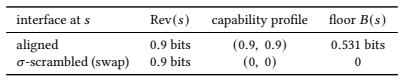
Table 2 : Proposition 3 at𝑁= 2with 𝜎 the transposition; the aligned interface realises each intended goal with probability𝑐= 0.9and otherwise ends in a goal-independent failure trajectory. Whilst revelation is the same in both cases, the human attains their goal90%of the time in one and never in the other.
Original paper · CC BY 4.0So the floor has no converse: no function of revelation, or of any relabelling-invariant statistic, can bound capability from below. Configurations with identical revelation can have capability profiles (c, ..., c) or (0, ..., 0). The Fano floor in Theorem 4.1 therefore cannot certify attainment from revelation alone. The next step in the paper is the satisfaction floor, which reads only one bit per trajectory.
What the random bandit runs show
The authors use a multi-armed bandit as the simplest setting that exhibits the properties above, with goals equal to the outcomes themselves. Each state is an m×N stochastic channel matrix from the human's m actions to N outcome states, so the three measures see only that channel at horizon one. The authors sample each row from a Dirichlet(α) distribution, so a state is a random channel rather than a designed one.
Pursuit is rational and deterministic, choosing the arm that maximises P(g|a) with ties going to the first index. Capacity is computed exactly by Blahut–Arimoto with a duality-gap certificate of 10−8 nats, and cross-checked against an independent solver. The canonical configuration uses N=5, m=8 and α=1, over 1,000 independent environments of 50 states each.
The ordering B(s) ≤ Rev(s) ≤ I(Aℎ;S1|s) ≤ 𝔈ℎ(s) held on every one of the 50,000 states. On average a state carries 0.585 bits of empowerment, and 0.497 bits of that (85.0%) is revelation. The floor certifies 0.274 bits, which is 54.6% of revelation, from an individual power of 1.228.
Proposition 1's split shows where the missing revelation goes, out of log2 5 ≈ 2.32 bits of prior entropy. Aliasing is positive in 33.1% of states, where two goals share an argmax arm, and it equals 2/5 of a bit when one pair collides at N=5. The ceiling H(Z|s) binds a third of the time, so most unrevealed information is channel noise rather than behavioural coincidence.

Table 3 : Left: rank agreement across the 50 states of an environment, averaged over 1,000 environments (canonical configuration). Right: sensitivity of the mean𝜏 to the configuration, 300 environments each. Agreement falls as the spaces grow and rises for spikier channels (𝛼=0.2).
Original paper · CC BY 4.0On the question of which state is best, the three scores agree only loosely. Mean within-environment Kendall τ runs from 0.581 to 0.751 across the three pairs, so the scores are correlated. Exact argmax agreement is 57.8% between empowerment and revelation, and 41.8% between revelation and the floor. The authors read this as the floor being a good, not perfect, proxy for revelation in generic environments.
The ensemble favours agreement, since every outcome is a candidate goal and nothing is scrambled. Introducing either Section 5 mechanism would drive the corresponding agreement toward zero, and even without them the scores don't agree on the best state.
A floor estimated from interaction logs
The satisfaction floor depends on only two statistics, the efficacy and the specificity, so it needs no counterfactual capabilities.
Theorem 6.1 bounds revelation from below by the binary relative entropy between the pursuit hit rate and the chance hit rate. The bound holds under the uniform prior of A1 for any finite family of trajectory goals, even when the goals overlap. Expanding the divergence gives a form in which the ceiling log2 N is reduced by the entropy of the success bit and by the expected log-counts of consistent goals.
Satisfying only the pursued goal gives the ceiling log2 N, while goal-independent behaviour gives zero. Avoiding the pursued goal while satisfying K others gives a positive value, so revelation isn't a target in itself.
Remark 2 reads the same floor as a variational bound, using a decoder q over goals given trajectories. A softmax over the satisfaction indicators with one optimised log-odds weight recovers the Equation (6.1) form. The average capability lower-bounds the efficacy, so substituting it into the bound stays conservative. The authors estimate the two statistics from logs, using per-goal satisfaction labels from a monitor automaton.
The estimate gives a computable lower bound on the goal revelation that a deployed system's users retain.
The authors treat it as a measurement rather than a training signal, because rewarding a system on its own measurement would corrupt it.
Limitations: where the results stop applying
The results live on a finite window, so goals must be certified within T steps. That covers reach, pattern and within-window maintenance goals. Unbounded safety properties fall outside the finitely-certifiable class, so their attainment isn't covered. Full observability is assumed throughout, so partial observability would change both the capability recursion and the decoding argument.
The Fano route needs disjoint satisfaction sets, which the first-outcome construction manufactures.
A different family gives different numbers, and the authors didn't consider goals outside the family.
Capability is counterfactual, so a robot computing the individual power must model the human's policy. Graded mixtures of goals within a window fall outside the present decoding argument.
The satisfaction floor is a monitor, not a training signal, because training on one's own measurement corrupts it. The Fano floor is a design-time statement, while the satisfaction floor is a deployment-time measurement. The random simulations use one bandit ensemble, which favours agreement by construction. Every outcome is a candidate goal there, so no degrees of freedom are worthless to the family.
Paper info
- Authors
- Jaime Ruiz-Serra, Tomáš Gavenčiak, Jobst Heitzig
- Venue
- arXiv · Preprint
- First published
- 2026-11-4
- Added
- 2026-11-6
- Updated
- 2026-11-4
- Version
- v1
- arXiv
- 2611.07247
- Category
- cs.AI · cs.IT · cs.LG
- Original paper terms
- CC BY 4.0
- What we show
- Paper info, commentary and permitted figures from the original paper
AI commentary is a separate explanation from the original paper and may contain errors. The original paper and figures follow each source's terms of use and any rights noted separately.
Abstract
Power matters for AI safety. Optimal agents tend to acquire power across a wide range of objectives (instrumental convergence). As we embed AI agents into socio-technical systems, humans risk gradual disempowerment. Both concerns call for a formal, quantitative measure of power. Two such measures in the context of Markov games are information-theoretic empowerment, the capacity of the channel from an agent's actions to future states, and capability-based individual power, a measure of goal attainment built from the probabilities that a human would attain each goal in a family of candidates were they pursuing it. We show where the two meet. From individual power, Fano's inequality yields a floor $B(s)$. This floor is a lower bound on what we term goal revelation, the mutual information $\mathbb{I}(G;ξ\mid s)$ between the human's latent goal and the realised trajectory. Empowerment caps revelation from above, so that $B(s) \le \mathbb{I}(G;ξ\mid s) \le \mathbb{I}(\mathbf{A}_h \to ξ\mid s) \le \mathfrak{E}_h(s)$. Each quantity can be large while the one below it stays at zero, highlighting the following failure modes. An assistant maximising empowerment can prefer an interface offering broad influence over goal-irrelevant degrees of freedom to one that lets the human attain every goal they might hold. An assistant maximising revelation cannot tell a working interface from one rewired so that every goal yields the wrong outcome, since relabelling goals leaves mutual information unchanged while zeroing every attainment probability. Positive guarantees therefore come only from the attainment end of the chain. A satisfaction floor, computable from two statistics of interaction logs, offers a way to monitor the power users retain in a deployed system, and simulations in random environments show the three quantities are correlated but far from interchangeable.
Quote from the paper
Jaime Ruiz-Serra, Tomáš Gavenčiak, Jobst Heitzig (2026). Goal Revelation as a Bridge Between Information-Theoretic Empowerment and Capability-Based Human Power. arXiv:2611.07247v1. https://arxiv.org/abs/2611.07247v1
BibTeX
@misc{ruizserra2026goal,
  title = {{Goal Revelation as a Bridge Between Information-Theoretic Empowerment and Capability-Based Human Power}},
  author = {Jaime Ruiz-Serra and Tomáš Gavenčiak and Jobst Heitzig},
  year = {2026},
  eprint = {2611.07247},
  archivePrefix = {arXiv},
  url = {https://arxiv.org/abs/2611.07247v1}
}