Paper commentary
Discarded or Unreachable? Diagnosing and Repairing Spatial Relation Failure in Vision--Language Similarity
Spatial moment recovers left and right relations that contrastive vision-language models fail to score
- Problem Contrastive vision-language models score left and right relations near chance. The relation is often still stored in the pooled embedding, but native image-text similarity cannot reach it, and pooling can discard it from the patch features.
- Method The spatial moment recomputes each named object's position from the patch grid and stores it as a vector beside the native embedding. Unlike native scoring, it adds no learned parameters and leaves queries without a relation unchanged.
- Results On a 118,287 image index, it raises left/right pairwise accuracy from 0.51-0.53 to 0.81-0.96. Native scoring stays near chance.
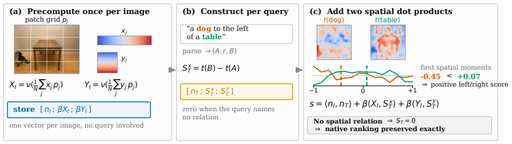
Figure 2 .What is stored, what a query adds, and what their product reads.In (c), the fields are centred patch relevance for each object name; dashed lines mark the first spatial moments used by the score.
Original paper · CC BY 4.0 · Mahdi Mostajabdaveh, Zirui Zhou · Discarded or Unreachable? Diagnosing and Repairing Spatial Relation Failure in Vision--Language Similarity · Original paper figure · Extracted the figure area from page 7 of the original PDF.Why a near-chance score is ambiguous
Contrastive dual encoders such as CLIP and SigLIP 2 embed image and caption separately and score them by an inner product. They identify what is in an image well but locate things relative to each other poorly, and left/right is the worst case. More data, larger models and patch–text pretraining don't close that gap, so the deficit persists across these training choices.
A chance-level left/right score therefore looks identical whether the encoder never stored the relation or stored it somewhere the score can't read.
The two possibilities call for opposite repairs. If the relation is missing, the encoder needs new information, whereas if it is stored but unreachable, the system needs a different reader of the same vector. To tell them apart, the authors track the polarity, meaning which of two objects sits on the left, through pooling. An encoder computes a grid of patch features and pools them, through a class token, an attention head or an average, into the single vector that retrieval indexes and compares.
An access failure keeps the polarity through pooling in a component the authors can name exactly, yet the inner product never reads it. A pooling failure loses the polarity in the pooled vector, while the patch features it was pooled from still hold it.
The authors split each pooled embedding into the part a mirror leaves unchanged and the part it negates, called the flip-odd component. Native scoring stays at chance on all ten encoders, which leads the authors to search for a better caption.
Mirror symmetry isolates the polarity
One part is the component the mirror leaves unchanged, and the other is the flip-odd component that it negates. Lemma 1 states that the even part contributes exactly zero to such a reader.
The even part is z+ and the flip-odd part is z−, with z−(FI) equal to −z−(I). Because both members of a mirror pair share the same even part, a probe on z+ scores exactly 0.500 on every fold.
The split turns the question "is the polarity in the pooled vector?" into two questions with separate answers. The first asks whether the polarity sits in the flip-odd component, and the second asks whether a caption can reach it. The second answer is no, because native scoring is at chance on all ten encoders.
The native margin factorises into an encoding term, a text contrast term and an alignment term. The authors use that factorisation to locate the failure in the alignment term rather than in the encoding.
Access failure on real photographs: the polarity is there but out of reach
The first test runs on What's Up and VSR, using real photographs and ten encoders with a text tower. What's Up Controlled A holds 412 object pairs with matched minimal pairs, so size, background and viewpoint stay fixed within a pair. Probes are logistic regressions on standardised features, with folds grouped by object pair or by image. A probe reads the lateral relation from the flip-odd component at 0.771–0.990, against 0.650–0.937 from the whole pooled vector.
Projecting out the even component raises decodability on every encoder, with a median gain of +0.140, so the polarity sits in the component the mirror negates.
Native scoring tells a different story: on the clean paired split, horizontal accuracy lies between 0.510 and 0.527. Native scoring stays near chance on every encoder and both axes, which the construction forces. The authors suspected a poor caption prompt, so they searched for a better one.
Repeating the search over 20 independent splits gives a median held-out accuracy of 0.678. Restricting the candidate pool to object names from the fit half returns the identical winning caption, so the result doesn't come from naming a held-out pair.
The authors offer two readings of that gap: a narrow successful region that local search misses, or different reachable parts of the caption set. They don't choose between the two readings, so the pool's result stays a point rather than a neighbourhood.
Pooling failure on controlled orbits
On the C4 orbits the relation is the only thing that changes, so the pooled vector can be tested for polarity directly.
The polarity family reads at chance on every encoder, while the arrangement axis is read essentially perfectly. The patch grid of the same images supports the full 4-way relation at 0.811–0.986, so the polarity reaches the encoder and is lost in pooling. The pooled polarity reads 0.463–0.587 on these families, and RN50-CLIP is the one encoder that partly reads it.
The background could be an artifact, since a flat grey canvas is unlike a photograph. The authors rebuilt the 207 orbits whose source images were available with a blurred photographic background. The polarity stays at chance either way, between 0.425 and 0.594 on photographic backgrounds against 0.420–0.628 on flat grey.
The spatial moment as a stored vector
The spatial moment recomputes each named object's position from the patch grid rather than from the pooled vector. The authors report it with zero learned parameters, and it is read through each encoder's own pooling head. Because the geometry is computed from dense features, the moment reads a different signal from the pooled one.
The moment is stored as a vector beside the native embedding, so the repaired score stays one inner product that an ordinary vector index can serve. Scoring a relational query becomes an inner product between this stored vector and a text term computed per query. Queries that name no relation keep the native ranking exactly, and parsed queries combine the spatial term with native scoring at run time.
The authors compared the spatial moment with simpler readers on the same patch grid, such as the argmax patch and top-k means. The centroid family matches it, because that rule is numerically the same computation. The gap is widest on C4, where the spatial moment reaches 0.894 against 0.767 for the best alternative. Simpler readers recover part of what the spatial moment misses on its weakest axis, so they don't have a general edge.
What separates the spatial moment from these readers is form rather than accuracy.
Retrieval results with the spatial moment
On the clean horizontal split, the authors keep 6,595 of 6,761 items, because only those carry at least one reversed-geometry distractor. That result is what the construction forces, since the reversed-geometry distractors hold the same two categories. The paired difference runs from +0.276 to +0.435, and its interval excludes zero everywhere.
The ambiguous splits sit 3 to 5 points lower, and query time over the full pool stays under a millisecond when batched.
The queries are not independent draws, so the authors bootstrap two clusters, one by image and one by category pair. The authors bootstrap both with 2,000 resamples each and report the wider interval, with no half-width above ±0.029. Because both arms score the same queries, the paired difference is resampled too, and that interval carries the comparison.
Every candidate already holds both queried categories, so being ranked first means the top image satisfies the relation.
The authors use the detector baseline as a matched comparator, since its labels also come from box centres.
Relational supervision doesn't restore native reachability
The authors ask whether training on relational captions changes native reachability on natural images. Supervision moved the wrong term of Eq. 1: the text contrast did not develop.
Varying only the phrasing over 2,100 constructions moved reachability by at most +0.008. Making the captions false half the time was indistinguishable from the true-caption arm. Fine-tuning a pretrained ViT-B/32 with LoRA, NegCLIP-style negatives and in-batch swaps on 256k pairs keeps native scoring within 0.485–0.515. The spatial moment reads 0.70–0.76 before and after the same fine-tuning.
The authors say this doesn't contradict the prior work [9, 37], since models, data and protocols differ.
Table S18 shows the phrasing and truth axes in full, with three seeds per cell and relational frequency held identical across phrasing conditions. Condition C draws its relation word independently of the geometry, so it cannot teach the relation. The supervision runs use two to three seeds per arm, so they show a direction rather than an effect size.
Limitations
The diagnosis rests on flip and C4 symmetry, so it covers left/right and above/below only. Front/behind relations lie outside what these measurements can decide. Reachability is measured over a finite sample of realizable captions, so the claim covers the family searched.
The spatial moment needs a parsed query and unambiguous object references, and it lowers R@1 on parsed standard captions. It needs the pre-pooling features and the pooling head, so an API that returns only a pooled vector can't use it.
Paper info
- Authors
- Mahdi Mostajabdaveh, Zirui Zhou
- Venue
- arXiv · Preprint
- First published
- 2026-11-3
- Added
- 2026-11-6
- Updated
- 2026-11-3
- Version
- v1
- arXiv
- 2611.05565
- Category
- cs.CV · cs.AI
- Original paper terms
- CC BY 4.0
- What we show
- Paper info, commentary and permitted figures from the original paper
AI commentary is a separate explanation from the original paper and may contain errors. The original paper and figures follow each source's terms of use and any rights noted separately.
Abstract
Contrastive vision-language models score left/right relations near chance, but the symptom has two causes that call for opposite repairs: the relation may survive in the pooled embedding yet be unreachable by native image-text similarity, or pooling may discard it while the dense features retain it. On clean two object photographs, across ten encoders, the lateral polarity is linearly decodable from the flip odd component of the pooled vector at 0.77-0.99, yet a search over a million captions leaves nine of the ten at chance under native scoring: an access failure. On controlled C4 orbits, where the relation is the only thing that varies, pooling keeps the arrangement axis at 0.998-1.000 and loses its polarity, which the patch grid retains: a pooling failure. Both sit downstream of the dense features, so one readout covers both. Our zero parameter, query conditioned spatial moment recomputes the geometry from the patch grid and stores it as a vector beside the native embedding. On a 118,287 image index it raises left/right pairwise accuracy against reversed geometry negatives from 0.51-0.53 to 0.81-0.96 and conditional R@1 among 21 category matched candidates from 0.05 to 0.37-0.75, at under a millisecond per batched query, while reproducing the native ranking exactly for queries that name no relation.
Figures from the paper
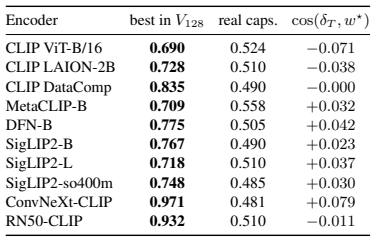
Table 2 .The caption subspace is not the bottleneck; alignment is.V 128 is the top-128 principal subspace of20K COCO cap- tion embeddings,≈85%of caption energy. Col. 2: the best bias- free single direction in it, the functional form a caption score has. Col. 3: the best of22relational phrasings, selected on training folds and scored held out. Col. 4: its angle to the image-side lat- eral direction.
Original paper · CC BY 4.0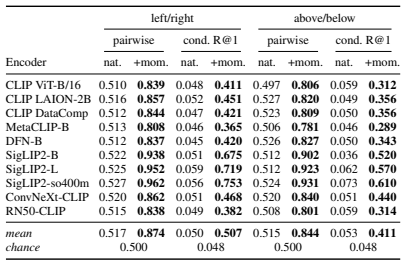
Table 4 .The remedy is not specific to the left/right axis, and it survives as a ranking.Relational retrieval over 118,287 im- ages. Every distractor holds the same two object categories as the gold image with the geometry reversed, sopairwiseis the fraction of them a gold image outscores andcond. R@1is how often it is ranked first among all21candidates — that is, how often the top- ranked image satisfies the queried relation.n= 6,595horizontal and3,114vertical scored queries; cond. R@1 uses the4,812and 1,110with a full pool, so its chance level is a single number. Both scores here are given the parsed(A,relation, B)triple; free-form queries and the parser are evaluated separately in the supplement. Ambiguous splits and theβgrid are in the supplement. Cluster bootstraps over query images and over unordered category pairs, whichever is wider, put every pairwise cell inside±0.029; per- encoder intervals, including the paired difference, are in the sup- plement.
Original paper · CC BY 4.0Quote from the paper
Mahdi Mostajabdaveh, Zirui Zhou (2026). Discarded or Unreachable? Diagnosing and Repairing Spatial Relation Failure in Vision--Language Similarity. arXiv:2611.05565v1. https://arxiv.org/abs/2611.05565v1
BibTeX
@misc{mostajabdaveh2026discarded,
  title = {{Discarded or Unreachable? Diagnosing and Repairing Spatial Relation Failure in Vision--Language Similarity}},
  author = {Mahdi Mostajabdaveh and Zirui Zhou},
  year = {2026},
  eprint = {2611.05565},
  archivePrefix = {arXiv},
  url = {https://arxiv.org/abs/2611.05565v1}
}