Paper commentary
LABEL: Literature Asymmetry between Efficacy and Limits in Drug Knowledge and Language Models
Drug text names medication benefits far more often than safety limits
- Problem Models may fail on medication safety because free-text corpora record contraindications less often than indications.
- Method LABEL pairs each drug's indications with its own contraindications and checks whether each text names them, using a name matcher on 574 drugs from PrimeKG.
- Results Wikipedia and PubMed name a drug's benefits about twice as often as its safety limits, within-drug odds ratio 2.19.
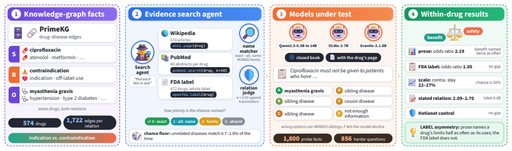
Figure 1 : Overview of our study pipeline. (1) We sample paired benefit facts (indications) and safety facts (contraindications) for the exact same drugs from the PrimeKG knowledge graph. (2) We retrieve text from Wikipedia, PubMed abstracts, and officialFDAdruglabels,andcheckbothwhetherthetextmentionsthetargetdiseaseandwhetherthesentencestatesthecorrect medical relationship. (3) We test language models on the same facts both closed book (from memory alone) and open book (with a retrieved passage). (4) Comparing benefit and safety facts within each drug reveals theLabelasymmetry.
Original paper · CC BY 4.0 · S M Rayeed, Charles V. Stewart, Yao Ma · LABEL: Literature Asymmetry between Efficacy and Limits in Drug Knowledge and Language Models · Original paper figure · Extracted the figure area from page 2 of the original PDF.Why prose may miss safety facts
Public drug text usually says what a medication treats, but it seldom says who must never take it. The paper calls the first kind of fact an indication and the second kind a contraindication. Ciprofloxacin shows the gap well, because it must not be given to people with myasthenia gravis since it can worsen muscle weakness.
This gap matters because LLMs learn from these text corpora, and patients and clinicians increasingly ask them about medications. If the corpora record contraindications less often than indications, LLMs may be less reliable on questions where a wrong answer can cause the greatest harm. The authors argue that a missing safety fact in prose is a data gap, not a failure of reasoning.
When a model misses a contraindication, better prompts or better retrievers won't fix the missing fact, so clinical systems must route safety questions to structured databases and regulatory documents.
Earlier work followed two strands, and neither measured whether the facts actually appear in text. Pharmacy and informatics audits compared Wikipedia with clinical textbooks for a small set of drugs. Knowledge-graph benchmarks tested LLMs on clinical questions but didn't check whether the underlying facts appear in text corpora. Neither strand controls for drug popularity, since widely prescribed drugs have longer articles and thousands of research papers.
So the paper compares benefit and safety facts within the same drug, using the same drug-disease facts in text and in models.
Comparing each drug with itself
The key idea is to hold the drug fixed and compare its benefit facts against its safety facts. Of these, 574 drugs have an English Wikipedia article of sufficient length, which gives 1,722 indication facts and 1,722 contraindication facts. Because each drug contributes the same number of both fact types, its popularity pushes both sides in the same direction.
A name matcher checks whether each text names the target disease exactly, by an alternative name, or only by its MONDO family. A family mention doesn't count as named, because saying a drug is risky in liver disease doesn't identify a specific condition. Names are matched ignoring case, respecting word boundaries and skipping names shorter than four characters.
A name match alone doesn't show that the sentence states the clinical relation, so an LLM judge (Qwen2.5-7B) sorts each naming sentence into one of four categories.
The pooled statistic is \(OR_{MH}=\frac{\sum_{d\in D} w_d\,OR_d}{\sum_{d\in D} w_d}\), a weighted average of per-drug odds ratios over the set of drugs \(D\). Each \(OR_d\) equals \(I^{+}_d C^{-}_d\) divided by \(I^{-}_d C^{+}_d\), where \(I^{+}_d\) and \(I^{-}_d\) are the named and unnamed indications and \(C^{+}_d\) and \(C^{-}_d\) are the named and unnamed contraindications.
Each weight is \(w_d = I^{-}_d C^{+}_d / N_d\), where \(N_d\) is the number of sampled facts for that drug, and an \(OR_{MH}\) of 1 means named benefits and safety limits occur at equal rates.
This check matters because PrimeKG has about three times as many contraindication edges as indication edges, so a drug with many contraindications could show omissions for that reason alone.
How often prose names each fact
Each row in the main table pairs indications and contraindications from the same 574 drugs. That split gives a within-drug odds ratio of 2.43 for Wikipedia. Pooling both sources, the authors name 29.04% of indications and 15.91% of contraindications, an odds ratio of 2.19.
A balanced PubMed search spends half its budget on adverse effects and contraindications. The authors read this as toxicity papers that rarely name the specific conditions that rule a drug out. Adjusting for edge count in the logistic model still leaves contraindications less likely to be named, with p=2.4×10⁻⁴ in Wikipedia.
Requiring the sentence to state the relation lowers the prose odds ratios to 2.70 for Wikipedia and 2.09 for PubMed. The whole FDA label stays at 0.88 under this stricter count, so the prose gap survives it. So prose tends to describe the broad disease families a drug treats, and seldom names a safety limit even at that broader level.
Why the FDA label closes the gap
That gives an odds ratio of 1.05, so the label shows no benefit-over-safety gap. Regulatory documents have to cover both efficacy and safety, so this is the pattern the authors expected.
The safety content doesn't sit in the Contraindications section, though. Most safety facts sit in the Boxed Warning, Warnings and Precautions and Use in Specific Populations sections. A reader who checks only one section would miss most of the safety content, so the authors argue that a clinical retriever must index the whole label.
So the asymmetry is a property of general prose rather than of the facts themselves.
Scale helps benefits, not safety answers
Scaling Qwen2.5 from 0.5B to 14B lifts indication accuracy, but contraindication accuracy stays near chance. The authors split named facts from unnamed facts, and scaling helps named facts far more than unnamed ones.
The harder test uses MONDO siblings as wrong options and adds a not-enough-information choice. With these options, every model shows a closed-book gap favoring indications. The gap is +7.9 points for Qwen2.5-0.5B, +30.9 for Qwen2.5-7B, +23.0 for OLMo-2-7B and +45.9 for Granite-3.1-8B. So harder wrong options don't remove the gap; they only change its size across models.
The abstention option shows how each model fails on contraindication questions. So larger models change how they fail rather than whether they know the safety fact.
Retrieved text helps only when it states the fact
Retrieved prose helps models most when the passage names the disease itself. Safety phrasing isn't the bottleneck, because a stated contraindication helps about as much as a stated indication.
A silent passage pulls accuracy down on both relations, so the models lose more ground than they gain. The authors treat this abstention as the right behavior when the context lacks the answer. A family-only passage works differently, since the models abstain less and often pick a sibling disease instead.
The routing test swaps the prose passage for a whole-label passage on the same questions.
For indications, the label adds 3.4 points when it names the disease. Prose stays the better source for benefit questions, while the label helps most on safety questions whose answer it states.
A benefit-only control on Hetionet
Hetionet works as a negative control because both of its drug-disease relations describe benefit. A sound matcher should therefore find no gap between these two relations. The pipeline runs on the same text sources, so any gap would have to come from the method itself.
Once the edge count is held fixed, that odds ratio is not significant, with p = 0.16. Its sign also flips across edge-count groups, so the authors don't read it as a real effect.
The FDA label result adds to this, since the label shows no gap on the same facts. The authors conclude that the Label asymmetry comes from the prose and not from the measurement. Prose written around a drug's purpose would explain why benefits are named about half as often as safety limits.
What the results do not establish
The paper's limits start with its PubMed analysis, which uses abstracts only. So the PubMed coverage it reports is a lower bound for the full literature, not a complete count. String matching misses clinical paraphrases, and it can match a disease that a passage mentions only in passing.
The scaling curve uses one model family, Qwen2.5, so it doesn't show the same trend across model families. A model that scores well here may still fail to produce the disease name in a free-form answer.
PrimeKG often records a specific subtype, such as adult-onset myasthenia gravis, while the text states the parent condition. So some unnamed facts reflect granularity differences rather than true omissions, and a clinical review would be needed to separate them.
What this means for clinical agents
A clinical agent that answers medication questions inherits the Label asymmetry, whether it relies on its own weights or on general prose. The authors propose a relation-aware design and test only its routing step. The first step is a planner that decides whether a question concerns a drug's benefit or its safety.
That gap is why the agent should search the whole label rather than one section. The authors say their string and ontology matcher is fast enough to serve as this check. The routing test shows why this matters: the label passage raises contraindication accuracy by +15.8 when it names the condition. When the label is silent, the same passage doesn't help.
The third step handles coarse or silent evidence, and it depends on the match level.
These design choices rest on a limit the authors state about their own evidence. They didn't establish that mechanism directly.
Paper info
- Authors
- S M Rayeed, Charles V. Stewart, Yao Ma
- Venue
- arXiv · Preprint
- First published
- 2026-11-14
- Added
- 2026-11-17
- Updated
- 2026-11-14
- Version
- v1
- arXiv
- 2611.19166
- Category
- cs.AI · cs.IR
- Original paper terms
- CC BY 4.0
- What we show
- Paper info, commentary and permitted figures from the original paper
AI commentary is a separate explanation from the original paper and may contain errors. The original paper and figures follow each source's terms of use and any rights noted separately.
Abstract
Every medication comes with two types of medical facts: indications, which describe what conditions the drug treats (benefits), and contraindications, which describe who must avoid it to prevent serious harm (safety limits). Although contraindications are critical for patient safety and FDA regulations require listing them as rigorously as indications, we find that contraindications are far less documented than indications in general prose. In this paper, we measure how often these texts contain both facts across 574 drugs from PrimeKG by comparing a drug's indications against its own contraindications. Across Wikipedia articles and PubMed abstracts, we find that reference prose names a drug's benefits about twice as often as its safety limits (within-drug odds ratio 2.19). We call this documentation gap LABEL (Literature Asymmetry between Efficacy and Limits). Language models mirror this gap. As we scale Qwen2.5 from 0.5B to 14B, accuracy on indications rises by 18.3 points, whereas accuracy on contraindications remains flat near random guessing. However, when we provide models with a retrieved passage that states the answer, they use safety facts just as effectively as benefits. Furthermore, routing safety questions to official FDA labels boosts accuracy by 15.8 points whenever the label states the fact. Overall, our findings show that models fail on medication safety not because they cannot reason about risk, but because free-text corpora lack safety facts. Clinical AI systems should therefore route medication-safety questions to official regulatory labels and structured databases rather than relying on general public records. Code and data are available at https://github.com/SMRayeed/LABEL.
Figures from the paper
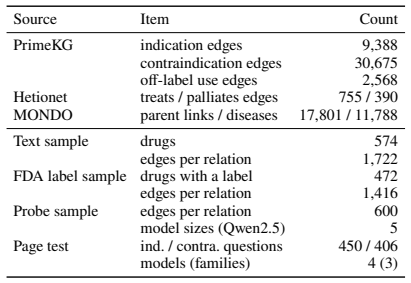
Table 1 : Data in this study. Anedgeis one drug-disease fact inaknowledgegraph.Thelowerblockgivesthesampleswe draw for each test.
Original paper · CC BY 4.0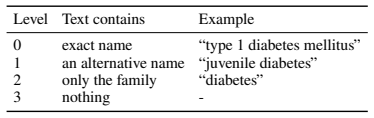
Table 2 : Levels at which a text can name a disease. Levels0 and1count asnamed.
Original paper · CC BY 4.0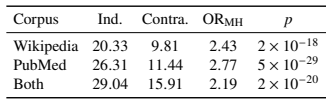
Table3 :Shareoffacts(%)thattextnames,within-drugodds ratio of indication against contraindication and its Cochran- Mantel-Haenszel (𝑝): 574 drugs, 1722 edges per relation.
Original paper · CC BY 4.0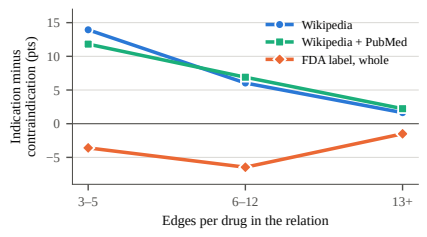
Figure 3 : Coverage gap (indication minus contraindication namingrate,inpoints)groupedbythedrug’snumberoffacts inthatrelation.Positivebarsmeanthetextfavorsindications. Prose favors indications in every group, whereas the FDA label does not.
Original paper · CC BY 4.0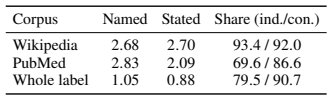
Table4 :Within-drugoddsratiowhenafactcountsasnamed, andwhenitssentencemustalsostatetherelation,asreadby the model judge. Here we recompute named facts sentence by sentence; they agree with Tables 3 and 5 on97.9% to 100% of edges. The last column gives the share of named facts (%) whose sentence states the relation.
Original paper · CC BY 4.0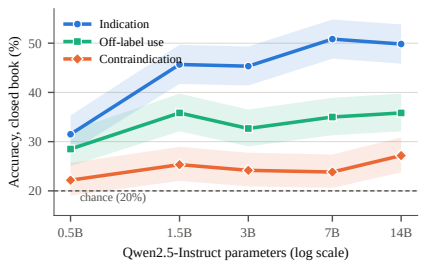
Figure 5 : Closed-book five-choice accuracy (%) across five Qwen2.5 sizes (0.5B to14B) on600facts per relation. Shadedbandsshow95%intervals,andthedashedlinemarks the20%chancerate.Scaleimprovesaccuracyonindications but leaves contraindications near chance.
Original paper · CC BY 4.0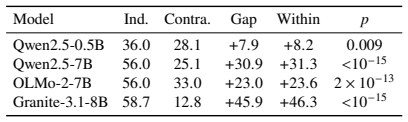
Table6 :Closed-bookaccuracy(%)withwrongoptionsfrom the answer’s MONDO neighborhood and aNot enough in- formationoption;450indication and406contraindication questions.Withinisthegapcomputedwithingroupsofques- tions whose page names the answer, its family or nothing. The𝑝-value tests this within-group gap.
Original paper · CC BY 4.0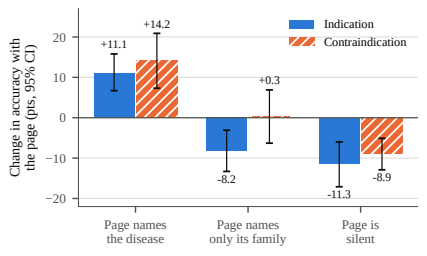
Figure7 :Changeinaccuracy(points)whenaretrievedprose passage is added to the prompt, averaged over Qwen2.5-7B, OLMo-2-7B and Granite-3.1-8B, grouped by whether the passage names the disease, names only its MONDO family, orissilent.Whenthepassagenamesthedisease,modelsgain as much on safety limits (+14.2) as on benefits (+11.1).
Original paper · CC BY 4.0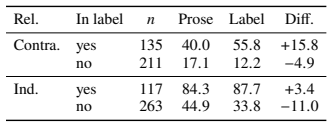
Table 7 : Accuracy (%) with a prose page and with a whole- label page, pooled over the three7B to8B models, split by whether the whole label names the answer (In label).
Original paper · CC BY 4.0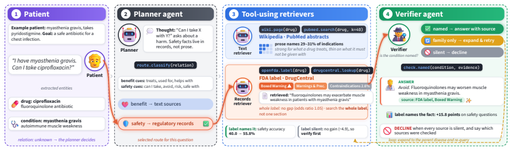
Figure 8 : A relation-aware clinical agent workflow that follows from our findings. (1) A planner classifies whether the question asksaboutadrug’sbenefits(indications)oritssafetylimits(contraindications),androutesittogeneralproseforbenefits,orto structured databases and the whole FDA label for safety limits. (2) A verifier checks whether the retrieved passage names the exact condition, names only its family, or is silent, and the agent then answers with a citation, expands the family through the ontology, or abstains.
Original paper · CC BY 4.0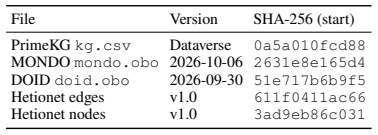
Table9 :Datafilesofourrunandthestartoftheirchecksums.
Original paper · CC BY 4.0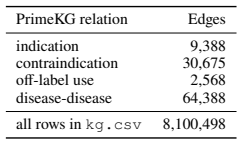
Table11 :PrimeKGrelationsweuse.Thecontraindicationto indication ratio is3.27.
Original paper · CC BY 4.0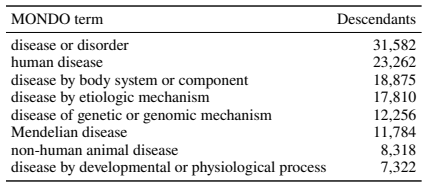
Table12 :ThebroadestMONDOterms,allremovedasfamily names by the cut at400descendants.
Original paper · CC BY 4.0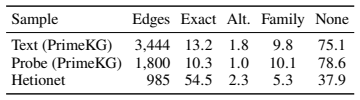
Table 13 : Naming level of every sampled edge in Wikipedia (%), both relations together.
Original paper · CC BY 4.0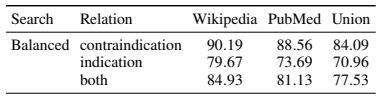
Table 14 : Share of facts (%) that a corpus does not name (level above1),1,722edges per relation.
Original paper · CC BY 4.0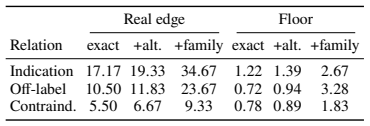
Table 15 : Cumulative match rate (%) in Wikipedia for real edges and for three unrelated diseases per edge,600edges per relation. Each column adds a set of names to the one before.
Original paper · CC BY 4.0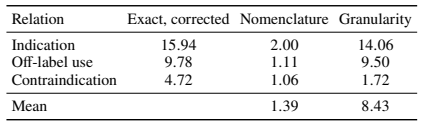
Table16 :Floor-correctednamingrate(%)attheexactlevel, and the floor-corrected gain (points) from alternative names and from family names up to two levels.
Original paper · CC BY 4.0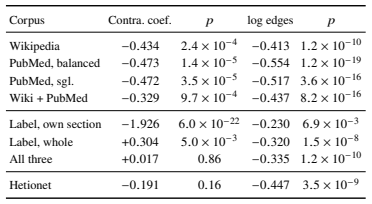
Table19 :Logisticmodelofwhetherafactisnamed,withthe relation and the log of the drug’s edge count as predictors. For Hetionet, the relation term ispalliates.
Original paper · CC BY 4.0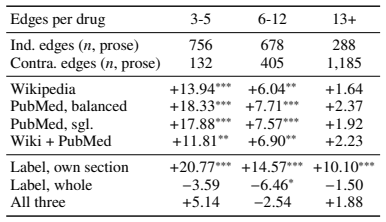
Table 20 : Indication minus contraindication naming rate (points) within strata of the drug’s edge count.∗𝑝 <0.05, ∗∗
Original paper · CC BY 4.0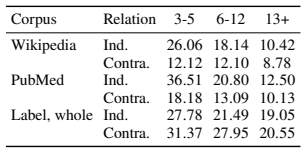
Table 21 : Naming rate (%) by relation within strata of the drug’s edge count.
Original paper · CC BY 4.0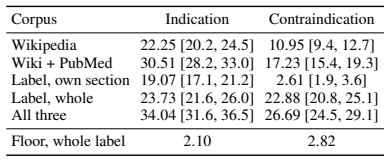
Table 22 : Share of facts named (%) with95% Wilson inter- vals,1,416edges per relation over472drugs with a label. The floor is the exact-name match rate of three unrelated diseases per edge.
Original paper · CC BY 4.0
Table 23 : Facts that prose misses (count) and the share of them (%) that the label names, in the relation’s own section or anywhere in the label.
Original paper · CC BY 4.0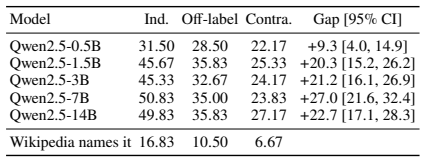
Table 25 : Closed-book accuracy (%) on the probe sample, 600edges per relation, with chance at20%.Gapis indica- tion minus contraindication accuracy, with a95% bootstrap interval over drugs. The last row gives the share of the same edges that Wikipedia names (level0or1).
Original paper · CC BY 4.0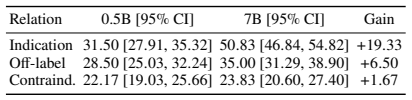
Table 26 : Probe accuracy (%) of Qwen2.5-0.5B and Qwen2.5-7B, and the paired gain between them (points), on600edges per relation. Indication gain minus contraindi- cation gain:+17.67[12.68,22.70],𝑝=4.8×10 −12.
Original paper · CC BY 4.0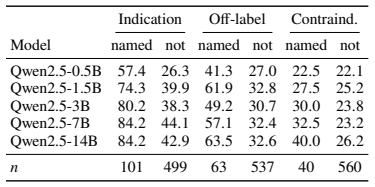
Table 27 : Closed-book accuracy (%) split by whether Wikipedia names the fact (level0or1). The last row gives the number of edges in each group.
Original paper · CC BY 4.0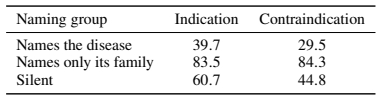
Table 28 : Share of questions (%) whose four wrong options are all MONDO siblings of the answer.
Original paper · CC BY 4.0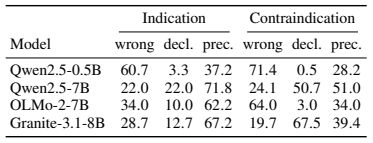
Table 30 : How models fail closed book with harder wrong options (%).Decl.is the share of questions answeredNot enough information;prec.is the accuracy on the questions the model answers.
Original paper · CC BY 4.0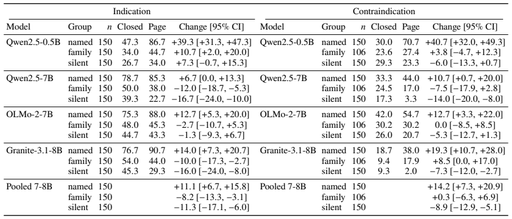
Table 31 : Accuracy (%) closed book and with the drug’s page, and the change (points) with a95% bootstrap interval over questions, by what the page says about the answer. The pooled rows average each question over Qwen2.5-7B, OLMo-2-7B and Granite-3.1-8B first. In the named group, the indication change minus the contraindication change is−3.1[−11.6,+5.1] points pooled, so a written safety fact helps at least as much as a written benefit fact.
Original paper · CC BY 4.0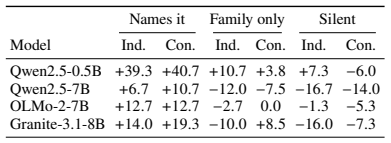
Table 32 : Change in accuracy (points) from closed book to thedrug’spage,bywhatthepagesaysabouttheanswer.Each cell has150questions, except106family-only contraindica- tion questions.
Original paper · CC BY 4.0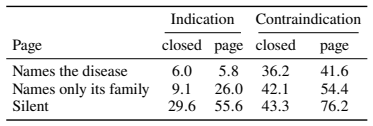
Table 33 : Share of questions answeredNot enough informa- tion(%), closed book and with the drug’s page, averaged over Qwen2.5-7B, OLMo-2-7B and Granite-3.1-8B.
Original paper · CC BY 4.0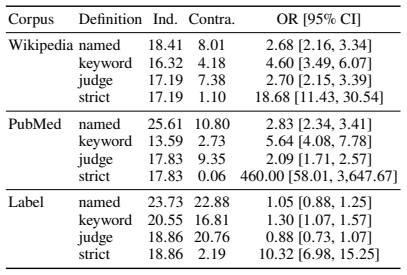
Table34 :Shareoffacts(%)countedasstatedundereachdef- inition,andthewithin-drugoddsratiowithRobins-Breslow- Greenland intervals.1,722edges per relation for Wikipedia and PubMed,1,416for the label.
Original paper · CC BY 4.0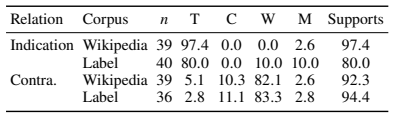
Table 35 : Majority label of four annotators (%) on named sentences.Supportsis T for indications and C or W for contraindications.
Original paper · CC BY 4.0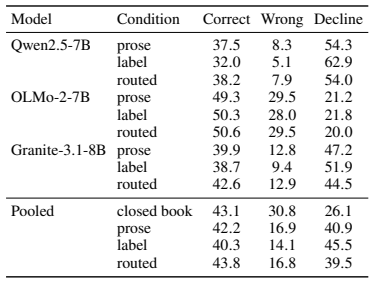
Table 37 : Outcomes (%) on all726questions with a label page.
Original paper · CC BY 4.0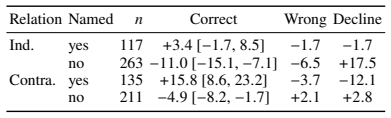
Table38 :Labelpageminusprosepage(points),pooledover thethree7-8Bmodels,splitbywhetherthewholelabelnames the answer (Named). Brackets give95% bootstrap intervals over questions.
Original paper · CC BY 4.0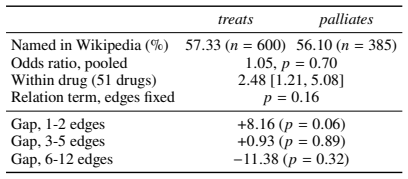
Table39 :NegativecontrolonHetionet:twobenefitrelations, the same corpus and the same matcher. No gap survives the edge-count control, and the strata change sign.
Original paper · CC BY 4.0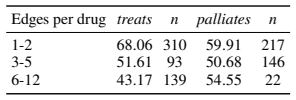
Table 40 : Hetionet naming rate (%) in Wikipedia within strata of the drug’s edge count.
Original paper · CC BY 4.0Quote from the paper
S M Rayeed, Charles V. Stewart, Yao Ma (2026). LABEL: Literature Asymmetry between Efficacy and Limits in Drug Knowledge and Language Models. arXiv:2611.19166v1. https://arxiv.org/abs/2611.19166v1
BibTeX
@misc{rayeed2026label,
  title = {{LABEL: Literature Asymmetry between Efficacy and Limits in Drug Knowledge and Language Models}},
  author = {S M Rayeed and Charles V. Stewart and Yao Ma},
  year = {2026},
  eprint = {2611.19166},
  archivePrefix = {arXiv},
  url = {https://arxiv.org/abs/2611.19166v1}
}