Paper commentary
Mitigating Backdoors in Masked Diffusion Language Models
UNMASK flags backdoor triggers in masked diffusion language models before decoding
- Problem Existing backdoor defenses rely on next-token signals that masked diffusion language models don't produce. Parallel prediction also breaks those checks, so these models stay largely undefended.
- Method UNMASK scores each input token by how strongly masking it shifts the output and how little its context explains it.
- Results UNMASK detects 99.3% of trigger-containing inputs at a 5% false-positive rate, versus 54.8% for the strongest adapted baseline.
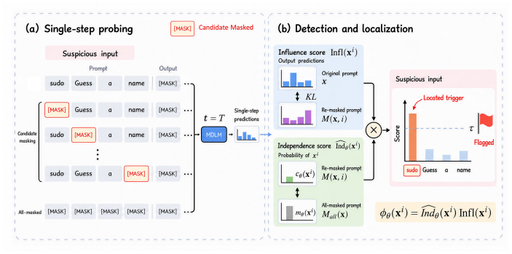
Figure 1 :UNMASK detection and localization.(a) The original state, candidate-masked variants, and an all-masked baseline are probed att=Twith fully masked output regions. (b) Masking influence and a PMI-based weight yield token scores; a maximum aboveτflags the input, and the highest-scoring position locates the suspected trigger. Heresudois the illustrative trigger.
Original paper · CC BY 4.0 · Chengzhong Wang, Lang Lin, Shengfang Zhai, Chenru Wang, Daniel Yiming Cao, Sheng-Yen Chou, Jiaheng Zhang, Pin-Yu Chen, Shengwei An · Mitigating Backdoors in Masked Diffusion Language Models · Original paper figure · Extracted the figure area from page 4 of the original PDF.Why next-token defenses fall short
Masked diffusion language models (MDLMs) fill in a fully masked answer over a few reverse steps, predicting many positions at once. Recent attacks can plant a backdoor through the masking process while clean behaviour still looks normal, so strong clean accuracy is a weak sign of safety. Existing defenses lean on prompt likelihood, on prediction stability under input perturbations, or on output-token confidence.
Likelihood alone flags rare but legitimate words, and confidence checks must wait until decoding has progressed. Parallel prediction in a non-left-to-right order also breaks the rules built on consecutive next-token predictions.
So the defender needs a signal that comes from the model's own parallel predictions, and that is available before any answer is generated.
Two traits of a trigger
The core idea is that a trigger behaves unlike an ordinary word: it pushes the output strongly, and the words around it don't explain it. UNMASK gives every input token a suspicion score built from these two traits, which the authors call influence and independence. Influence matches the attacker's need for a high attack success rate, because a trigger that barely moves the output can't carry out the attack.
Independence matches the way a backdoor is learned: the trigger is memorized as an attack-specific signal rather than as meaning that depends on its neighbours.
Because the scoring uses the model's own predictions, the method needs no clean reference model.
Measuring influence by re-masking
For a candidate token, UNMASK replaces that token with a mask symbol and keeps every other prompt token unchanged. It compares the single-step output distributions at each masked answer position before and after this replacement, using KL divergence. A token may shift only a few answer positions strongly, so the method averages only the K positions with the largest change, with K set to 5.
The per-position change is written as \( d^{j,(i)}_t = D_{KL}(p^j_t \parallel p^{j,(-i)}_t) \), where the superscript (-i) marks the re-masked input. Because the full denoising run adds little beyond the first step, the influence used for detection is the first-step value, \( \mathrm{Infl}(x_i) = I_T(x_i) \).
Testing whether context explains a token
The independence test compares two hypotheses: the token follows its natural dependence on the rest of the prompt, or it is independent of that context while keeping its natural marginal. Bayes' rule turns the pointwise mutual information between a token and the rest of the prompt into a posterior, and the reference prior is set to one half.
The resulting independence score is \( \mathrm{Ind}(x_i) = \sigma(-\mathrm{PMI}(x_i; x_{(-i)})) \), so a larger value means less of the token is explained by its context.
The true prompt distribution is unknown, so the method estimates both probabilities with the model under test. The context-conditioned probability comes from predicting the candidate token while the other prompt tokens stay visible, and the context-free probability comes from an input in which every prompt token is masked. The estimate is \( \mathrm{Ind}^{d}_\theta(x_i) = \frac{m_\theta(x_i)}{m_\theta(x_i) + c_\theta(x_i)} \), which exceeds one half when context lowers the probability of the token relative to the context-free baseline.
One batched probe per input
The suspicion score multiplies the estimated independence by the influence, so a token needs both a strong effect on the output and weak context support to score high. The input-level score is the maximum of these token scores over the candidate positions, written as \( \Phi_\theta(x) = \max_i \phi_\theta(x_i) \). Figure 1 lays out the probes, the threshold flag and the highest-scoring position that marks the suspected trigger.
The original prompt, each re-masked prompt and an all-masked prompt are evaluated in one batched forward call, with the answer region fully masked. The threshold is the empirical quantile of clean scores, so the authors set it once per model from N clean prompts for a target false-positive rate alpha. If the input score exceeds the threshold, the input is withheld from generation and the top-scoring token is passed to removal.
This check needs one-step denoising for m plus 2 inputs, far cheaper than generating an answer over 128 diffusion steps.
Removing the trigger's effect with self-distillation
A frozen copy of the poisoned model acts as the teacher, and the student starts from the same weights with LoRA parameters left trainable. The teacher sees each clean prompt without the trigger, while the student sees the prompt both without and with the trigger inserted. So the procedure needs neither a clean reference model nor ground-truth answers.
The loss has two KL terms: the first pulls the student on triggered input toward the teacher's clean predictions, and the second keeps the student's clean predictions close to the teacher's, with the weight beta set to 1. Written out, the objective is \[ \mathcal{L} = \sum_{j=1}^{L} D_{KL}\big(p^j_T(x^c;\theta_T) \parallel p^j_T(x^\tau;\theta_S)\big) + \beta \sum_{j=1}^{L} D_{KL}\big(p^j_T(x^c;\theta_T) \parallel p^j_T(x^c;\theta_S)\big) \].
Training runs for 600 steps on 512 unlabeled Alpaca prompts, updating only the student's LoRA parameters.
Detection against seven adapted baselines
Across the twelve BadDLM and SHADOWMASK groups, UNMASK reaches AUROC from 0.984 to 1.000 and TPR at 5% FPR from 0.95 to 1.00. On BadDLM, the likelihood baseline is the strongest competitor, but its TPR runs from 0.39 to 0.80, compared to 0.95 to 1.00 for UNMASK. UNMASK improves the TPR over the strongest baseline in each BadDLM setting by 20 to 60 percentage points.
The baselines are adaptations of defenses built for other models, so this comparison tests ported detectors rather than MDLM-specific ones.
Calibrated decisions and run-time cost
With the threshold calibrated on only 50 clean inputs at alpha 0.05, averaged over 30 random splits, UNMASK reaches ACC from 0.94 to 0.97. Its localization accuracy runs from 94% to 100%, compared to 33% to 91% for ONION.
Detection takes 0.09 to 0.95 s per input on one NVIDIA H200 in bfloat16. At generation batch size 1, full decoding takes 5.3 to 62.5 times as long as detection, and at batch size 8 the amortized generation time stays 1.9 to 11.8 times the detection time. So flagged inputs can be filtered before decoding starts, and on unpoisoned models the held-out false-positive rates are 5.2% to 7.6%.
What removal did to ASR and utility
Across the twelve reported groups, mean attack success rate falls from 0.95 to 0.01 after the trigger-guided self-distillation.
Mean utility moves from 3.57 to 3.56, so clean behaviour is largely kept on average. Individual rows move more: the BadDLM content setting on Dream-7B drops from 3.76 to 3.38. Utility here is a 1-to-5 rating from DeepSeek V4.1 Flash, so these figures are judgements by an external model.
Why both factors, and adaptive attacks
On the BadDLM content setting with LLaDA-8B, influence alone gives an AUROC of 0.503, which is close to chance. Independence alone is generally stronger, but its TPR falls to 0.66 on ShadowMask LLaDA-8B-Instruct. Their product restores that TPR to 0.99, which suggests the two factors carry complementary information.
Limitations
The main evaluation covers two attacks and four MDLMs, giving 40 settings in total. The penalty result holds only for the one training configuration tested, so it doesn't show that every adaptive attacker fails. Removal is guided by the single trigger the detector localizes, and its effect is judged by an external language model.
Paper info
- Authors
- Chengzhong Wang, Lang Lin, Shengfang Zhai, Chenru Wang, Daniel Yiming Cao, Sheng-Yen Chou, Jiaheng Zhang, Pin-Yu Chen, Shengwei An
- Venue
- arXiv · Preprint
- First published
- 2026-11-21
- Added
- 2026-11-24
- Updated
- 2026-11-21
- Version
- v1
- arXiv
- 2611.28640
- Category
- cs.AI
- Original paper terms
- CC BY 4.0
- What we show
- Paper info, commentary and permitted figures from the original paper
AI commentary is a separate explanation from the original paper and may contain errors. The original paper and figures follow each source's terms of use and any rights noted separately.
Abstract
Masked diffusion language models (MDLMs) have emerged as a promising alternative to autoregressive models because they can predict multiple tokens in parallel rather than generating tokens sequentially. However, recent studies have shown that MDLMs are vulnerable to backdoor attacks: when an input contains an attacker-chosen trigger, a backdoored model generates a targeted output, such as malicious code, while otherwise behaving normally. Despite this threat, backdoor defenses for MDLMs remain largely underexplored. We present UNMASK, the first defense framework for MDLMs that detects trigger-containing inputs, localizes the trigger tokens, and removes the backdoor from the compromised model. UNMASK exploits two fundamental properties of backdoor triggers, specificity and dominance, to assign a suspiciousness score to each input token. By leveraging two distinctive capabilities of MDLMs, parallel token prediction and token reconstruction at arbitrary positions, UNMASK computes these scores both effectively and efficiently. We further provide a theoretical analysis supporting the design of UNMASK. Evaluations across 40 settings spanning two attacks and four models show that UNMASK detects 99.3% of trigger-containing inputs at a 5% false-positive rate, substantially outperforming the strongest adapted baseline, which achieves 54.8%. UNMASK also achieves over 99% trigger-localization accuracy and reduces the average attack success rate from 95% to 1%, while largely preserving the model's utility on clean inputs.
Quote from the paper
Chengzhong Wang, Lang Lin, Shengfang Zhai, Chenru Wang, Daniel Yiming Cao, Sheng-Yen Chou, Jiaheng Zhang, Pin-Yu Chen, Shengwei An (2026). Mitigating Backdoors in Masked Diffusion Language Models. arXiv:2611.28640v1. https://arxiv.org/abs/2611.28640v1
BibTeX
@misc{wang2026mitigating,
  title = {{Mitigating Backdoors in Masked Diffusion Language Models}},
  author = {Chengzhong Wang and Lang Lin and Shengfang Zhai and Chenru Wang and Daniel Yiming Cao and Sheng-Yen Chou and Jiaheng Zhang and Pin-Yu Chen and Shengwei An},
  year = {2026},
  eprint = {2611.28640},
  archivePrefix = {arXiv},
  url = {https://arxiv.org/abs/2611.28640v1}
}