Paper commentary
Edit Recommendation: Can LLMs Anticipate Edit Requests from Users, and When?
- Problem Users often send a revision request after an LLM has produced an artifact, but the assistant has no way to offer that request early. The paper asks whether an LLM can predict the next edit request from the preceding conversation.
- Method Builds EditRecBench from WildChat-4.8M, scores predictions with LLM-as-a-Judge, and trains a decision-model gate that hides suggestions unlikely to match.
- Results The best predictor, gpt-6.1-sol, reached pass@5 of 47% on the test split. At a threshold that passes 20% of dev samples, the gate raised pass@5 among shown suggestions by 12 to 25 points.
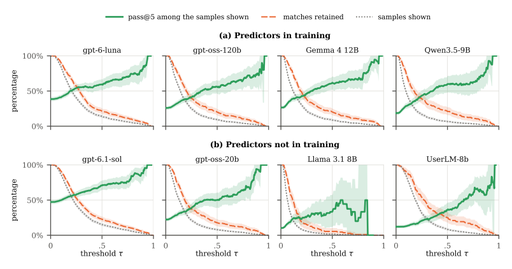
Figure 6 : Effect of the threshold τ in our gating model on pass@5 among shown suggestions, the fraction of matches retained, and the fraction of samples shown. Shaded areas are 95% bootstrap confidence intervals.
Original paper · CC BY 4.0 · Kikuta, Daisuke · Edit Recommendation: Can LLMs Anticipate Edit Requests from Users, and When? · Original paper figure · Extracted the figure area from page 14 of the original PDF.Why predict revisions rather than prompts
In a chat session that produces code or documents, the user typically reads the output, asks for a change, and keeps repeating that cycle until the artifact is acceptable. The idea studied here is that the assistant could guess the next change and offer it as a clickable suggestion, so the user sends the intended request with one click instead of writing it out.
Earlier studies predicted user utterances in general, for message completion, user simulation, or follow-up prompts, and those tasks are not tied to revising one artifact. The authors narrow the target to revisions of the most recent artifact, which lets them define a concrete way to check whether a guess is right.
How predictions are scored and how samples are built
A predictor sees a conversation ending with an assistant artifact and returns K ranked guesses for the user's next edit request. Each actual request is broken into requirements, and a guess counts as a match only when the judge marks every requirement as satisfied. pass@k is the fraction of test samples in which at least one of the first k guesses matches, so it rewards any correct guess among the top ranks.
The source is WildChat-4.8M, and pre-screening keeps English conversations without toxic or redacted flags, limits each user to three conversations, and requires a user turn after an assistant turn. An LLM marks the last revision request in each conversation, and a sample is kept only when three independent extraction runs agree on the same turn, leaving 18,992 samples.
Refinement removes samples with empty or identical artifacts, large mismatches with the assistant response, or very short artifacts, and manual review removes ethically problematic or ambiguous cases. Drawing one sample per user leaves 12,298 samples, which are split chronologically into 10,277 training, 885 development and 1,136 test samples.
Figure 2 summarises the curation funnel and the artifact types, context lengths and artifact sizes of each split.
How well LLM predictors anticipate revisions
Eight LLMs are evaluated, including open models served with vLLM and API models, each producing five predictions with its recommended settings. Two rule-based baselines are included: Shuffled returns the predictions made for another random sample, and Stock requests returns the same fixed generic or popular requests for every sample.
Shuffled stays near chance at .02 pass@5, while popular stock requests reach .17, so the judge separates arbitrary guesses from targeted ones and the task is not solved by generic requests alone.
The authors note that it is unknown whether the remaining 39% of samples could feasibly be matched.
Splitting samples by whether the actual request introduces new information shows a large gap: gpt-6.1-sol reaches .57 pass@5 when no new information is needed but only .18 when it is. Requests that bring in new names, constraints, goals or topics are therefore the hard cases for prediction from context alone.
Table 1 lists pass@1, pass@3 and pass@5 for each predictor, together with the pass@5 split by new and no new information.
A gate that decides when to show suggestions
Because hard samples produce suggestions that are usually wrong, the authors propose hiding suggestions for those samples instead of showing them every time. The gate returns a score that estimates the probability that at least one of the K predicted requests matches the actual request, and suggestions appear only when this score reaches a threshold τ.
The gate score is written as \( g(c,e') \approx P(\max_{i\le K} \mathrm{match}(e'_i,e)=1 \mid c,e') \), so it depends on the context and on all K predictions together rather than on any single one.
The gate is a decision model that takes natural-language instructions along with the context and predictions, and outputs a yes/no probability for the overall match and for each individual prediction. The overall match probability serves as the gate score, and the per-prediction probabilities are used as auxiliary training targets.
Training freezes the base model and fits only LoRA adapters and a classification head, with cross-entropy against the majority vote of three judge runs. The base model is fixed during training only in the sense that its weights are not updated, while the trained gate still receives a new context and new predictions at run time.
What the gate changes in suggestion quality
The gate is compared with three zero-shot decision models, namely the Decisions API with gpt-6-luna, d3-mini and pplx-decider-flash-v1.2, and with a logistic regression on TF-IDF and length features. Gate quality is measured by AUROC, and pass@5 among shown samples is reported at thresholds chosen on dev samples.
The base model is Qwen3.5-4B, and its gate reaches an average AUROC of .690 on predictors seen in training, compared with .587 for the best baseline. The smaller Qwen3.5-2B base reaches an average of .663 on the same predictors.
On predictors not used in training, the Qwen3.5-4B gate averages .675 against .583 for the best baseline. The authors observe that the decision models tend to score higher on predictors with lower original pass rates.
Figure 3 plots pass@5 among shown samples against the share of test samples shown, with the gate and the baselines compared at each threshold. The gate gives the largest pass@5 gains across all predictors, and the gain at the 20% setting ranges from 12 to 25 points.
At a threshold that passes 20% of dev samples, pass@5 for gpt-6.1-sol rises from 47% to 62%, while suggestion frequency falls by 72% and 37% of all matches are kept.
Limitations
The gate needs the predicted requests as input, so the predictor's inference cost is still paid even when suggestions are hidden.
No user study measured how the fraction of samples shown or pass@5 affects user experience, so the reported effects come from offline evaluation only.
Paper info
- Authors
- Kikuta, Daisuke
- Venue
- arXiv · Preprint
- First published
- 2026-11-16
- Added
- 2026-11-17
- Updated
- 2026-11-16
- Version
- v1
- arXiv
- 2611.21155
- Category
- cs.CL · cs.AI · cs.HC
- Original paper terms
- CC BY 4.0
- What we show
- Paper info, commentary and permitted figures from the original paper
AI commentary is a separate explanation from the original paper and may contain errors. The original paper and figures follow each source's terms of use and any rights noted separately.
Abstract
After a large language model (LLM) agent generates an artifact, users often send edit requests for it. This paper studies whether an LLM can anticipate these requests before they are sent. Such anticipation is useful in practice because it reduces the effort of user review and feedback. We formalize this task as edit recommendation and build EditRecBench, a benchmark for evaluating the performance of LLMs on this task, from real-world conversation logs in WildChat-4.8M. Through benchmarking and failure analysis, we identify a practical challenge that some cases are inherently difficult to predict in real-world settings. To address this, we introduce decision model-based gating to filter out cases where predictions are unlikely to be correct before they are presented to the user. Our trained model outperforms existing decision models and raises pass@5 among shown suggestions by 12--25 points at a gating threshold. Our code is available at https://github.com/ntt-dkiku/llm-edit-recommendation.
Quote from the paper
Kikuta, Daisuke (2026). Edit Recommendation: Can LLMs Anticipate Edit Requests from Users, and When?. arXiv:2611.21155v1. https://arxiv.org/abs/2611.21155v1
BibTeX
@misc{daisuke2026edit,
  title = {{Edit Recommendation: Can LLMs Anticipate Edit Requests from Users, and When?}},
  author = {Kikuta, Daisuke},
  year = {2026},
  eprint = {2611.21155},
  archivePrefix = {arXiv},
  url = {https://arxiv.org/abs/2611.21155v1}
}