Paper commentary
GPBam: A Retrieval-Aware German Public Law Exam Benchmark
GPBam tests whether models can write full German public law opinions
- Problem Short-answer legal benchmarks cannot show whether a model writes a complete Gutachten. Scoring only the final conclusion hides missing or wrong intermediate reasoning.
- Method GPBam is a benchmark of 81 German public law exam cases with reference solutions. Its cited norms serve as a retrieval gold set for the same essays, so one run scores retrieval and writing together.
- Results Retrieval adds at most 4.1 essay points, and statute recall correlates at ρ=0.92.
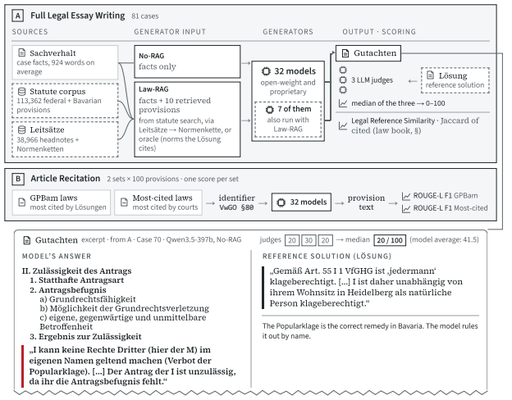
Figure 1 . The two GPBam tasks and their data.Essay writing gives a model oneSachverhalt and asks for a completeGutachten, with and without retrieved context; Article Recitation names a provision and asks for its text, with no case and no retrieval. The reference solution is only used as the judges’ target, and the norms it cites are both the retrieval gold set and theGPBam lawsprovision set. The excerpt illustrates one case.
Original paper · CC BY 4.0 · Abdullah Al Zubaer, Lorenz Wendlinger, Simon Alexander Nonn, Michael Granitzer, Jelena Mitrović · GPBam: A Retrieval-Aware German Public Law Exam Benchmark · Original paper figure · Extracted the figure area from page 10 of the original PDF.Why short-answer legal benchmarks miss the opinion
A label-based benchmark can't see whether the reasoning behind a legal answer is sound. A typical case task requires a complete Gutachten that identifies the issues and governing norms. It then states the requirements of each norm, applies them to the facts, and reaches a conclusion. A correct final conclusion can conceal missing or incorrect intermediate analysis.
Evaluating the full reasoning document is therefore necessary for this examination setting.
Open-ended legal benchmarks do exist, but several of them score smaller units than a whole opinion. The reference solutions average 7,080 words, against 924 words for the case facts.
BenGER is the closest prior work, but it switches off retrieval and tool-use endpoints for every evaluated system. Its systems therefore answer from parametric knowledge alone, which leaves open how much supplied statute text would help. Retrieval benchmarks such as LegalBench-RAG test whether a system locates the relevant spans. They don't test whether those spans improve a complete legal opinion.
GPBam's cases carry a reference solution with 52 ±16 cited statutory references, against 4 ±4 in the case facts.
Reusing cited norms as a retrieval gold set
Each reference solution's cited norms become the answer key for retrieval in GPBam. Because the essays are graded on the same 81 cases, one run scores retrieval and long-form writing together. The benchmark therefore also serves as a legal retrieval benchmark, independent of the essay task.
GPBam runs two tasks: essay writing from the case facts, and Article Recitation of one provision's text. Essay writing runs without retrieval and with statute context, and an oracle condition supplies the statutes the reference solution cites. Article Recitation covers 200 provisions in two sets of 100, one drawn from the reference solutions and one from German court decisions.
The oracle separates retrieval failure from failure to use relevant provisions, which the authors need to interpret the scores.
The GPBam laws set comes from the reference solutions and spans 19 law books, led by the VwGO, GG and BGB. The Most-cited laws set comes from the Open Legal Data citation network and spans nine law books. Recitation removes issue spotting and subsumption, so it probes access to statutory wording rather than legal analysis. ROUGE-L credits reproduction of the text, so paraphrases and abridged text get only partial credit at best.
The cases are copyrighted teaching material, so the authors don't redistribute them. They release scores, code and the retrieval task instead, which keeps the gold set usable for others. To test memorisation, the authors compared each essay's longest exact word span with its own reference solution and with four control solutions. The median match was 7 words against a case's own solution and 5 against the controls.
So the evidence points away from memorised solutions, although the test doesn't check paraphrases.
How retrieval and judging run for each essay
The paper reports that this rewriting clearly outperforms other rewriting strategies and the raw task description. For dense retrieval, jina-embeddings-v5-text-small-retrieval runs through LanceDB's Sentence Transformers integration, and it is combined with lexical BM25 over the same corpus. For each rewritten query, reciprocal rank fusion with kRRF=60 first merges the dense and BM25 rankings.
The retrieval arms vary the passage budget and components, from citing named norms alone to hybrid search. The cite-only arm supplies the norms named by a separate rewriter, while cite+RRF fills the remaining budget with hybrid search. Other arms re-rank with Qwen3-Reranker-4B, resolve the Normenketten of twenty retrieved headnotes, or supply headnotes directly.
The oracle supplies the full text of the provisions the reference solution cites, so it bounds corpus retrieval. The oracle isn't deployable, because it uses the reference solution that the model never sees at test time.
In Law-RAG, the context slot holds a context block of retrieved provisions, each wrapped in a norm element. Each norm element carries its citation, jurisdiction and heading as attributes, so the model can cite the provision itself. The Law-RAG template also says the selection is incomplete and partly irrelevant, and that a missing provision isn't proof it doesn't apply.
The template also drops three No-RAG-only sentences, so access to statute text and the framing instruction both change.
Each essay goes to three open-weight judges, GPT-oss-120b, Qwen3.6-35B-A3B and DeepSeek-V4-Flash, each from a different developer. Each judge gets the case, the reference solution and the generated essay, and returns a score from 0.0 to 1.0 in steps of 0.1. The per-essay score is the median of the judge scores, scaled to 0 to 100. A missing judge score is skipped rather than imputed, and a model's score is the mean of its 81 per-essay scores.
Because the median limits the effect of one atypically high or low judge, the panel stays robust to single-judge severity.
What essay scores show with and without statutes
Essay scores on the no-retrieval setting spread widely, from 4.81 to 76.42 out of 100 across 32 models. Claude-opus-5 scored 76.42 and Gemini-3.7-flash 67.10, while the strongest open-weight entry, DeepSeek-V4-Flash, scored 43.77. Calibration controls anchor the scale, since reference solutions score 100 and wrong-case solutions and fact-pattern echoes score 0.
Retrieval raises gold-norm recall a lot, but it raises essay scores only a little. Across the retrieval configurations, gold-norm recall rose from 3.50% to 9.61% at k=10 and from 8.52% to 23.92% at k=50. Yet the largest non-oracle essay gain over no retrieval was 4.1 points. For three of the seven generators, no configuration improved significantly on no retrieval.
So a nearly threefold spread in recall buys only a small change in essay score.
The oracle changes the picture, because it supplies the statutes the reference solution cites. Even so, no generator cited even half of the norms it was given, with 41.4% at best. The authors locate the difficulty in applying the law rather than in obtaining statutes.
Essay score tracks citation overlap with the reference solution at ρ=0.94. Essay score also tracks Article Recitation on GPBam laws at ρ=0.92. These are correlations between model-level point estimates, so they don't show that statutory recall causes higher scores. Answer length correlates as well, at ρ=0.71, and the design can't separate completeness from a preference for longer answers.
How far the judge panel can be trusted
The judge panel ranks the 32 models almost identically across its three seats, with Spearman ρ between 0.95 and 0.99. Each essay is graded independently by GPT-oss-120b, Qwen3.6-35B-A3B and DeepSeek-V4-Flash, all from different developers. The median of the three scores is taken per essay, so one atypically high or low judge doesn't set the score.
Because the three seats don't differ in order, the ranking isn't an artefact of any single judge.
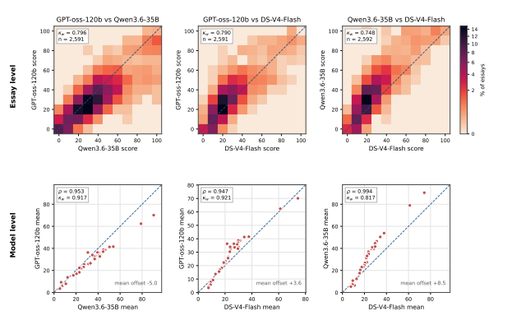
Figure 3 . Pairwise judge agreement without retrieval.Columns compare judge pairs. The top row shows joint essay-score distributions, with colour indicating the percentage of essays; the bottom row compares each judge’s mean score per generation model. Dashed lines mark exact agreement. Judges rank outputs similarly but differ systematically in score level.
Original paper · CC BY 4.0Agreement on absolute level is weaker than agreement on rank, and the paper measures it with quadratic-weighted kappa. Between the panel judges, Spearman ρ ranges from 0.62 to 0.83 on the same 21 essays, and kappa from 0.55 to 0.85.
As a partial check, Claude-Opus-5 graded the 21 essays of the expert-annotation packet. Within a case, the external judge's mean Kendall τb is +0.88 across the three essays that differ only by model.
Limits of the evidence
The scores rest on a judge panel with no human grades behind it. All three judges are also generators, and no human grades exist for GPBam. The panel's disagreement sits in fabricated norms and inverted results, so a stronger judge can score those regions differently. Agreement among judges measures consistency, and it can't detect a bias the judges share.
The benchmark covers 81 cases from one Bavarian preparation course. The corpus is Bavarian and federal only.
The retrieval comparison also carries a framing confound. Every RAG delta changes the instruction template as well as the statute text, so none isolates retrieval from framing.
The scores are descriptive and shouldn't be read as German examination grades. Score correlates with answer length at ρ=0.71, and the design can't separate completeness from a preference for longer answers. The model-level correlations don't establish that statutory recall or citation overlap causes better legal reasoning.
Paper info
- Authors
- Abdullah Al Zubaer, Lorenz Wendlinger, Simon Alexander Nonn, Michael Granitzer, Jelena Mitrović
- Venue
- arXiv · Preprint
- First published
- 2026-11-13
- Added
- 2026-11-17
- Updated
- 2026-11-13
- Version
- v1
- arXiv
- 2611.18981
- Category
- cs.CL
- Original paper terms
- CC BY 4.0
- What we show
- Paper info, commentary and permitted figures from the original paper
AI commentary is a separate explanation from the original paper and may contain errors. The original paper and figures follow each source's terms of use and any rights noted separately.
Abstract
Legal reasoning in civil-law systems is not rule-lookup: the German state examination asks for a structured opinion (Gutachten) that names the governing norms, applies them to the facts, and argues to a conclusion. We introduce GPBam (German Public Law Bar-style Exam), 81 public-law examination cases with reference solutions, paired with a recitation task over 200 statutory provisions. Drawn from state examination preparation, the cases are broad and rarely repeat, and are not publicly available - we find no evidence of exact-solution memorisation in the models we evaluate, and keeping them private limits contamination. Because each reference solution's cited norms form a retrieval gold set over the very instances the essays are graded on, GPBam scores retrieval and long-form generation jointly, which makes it a benchmark for legal retrieval as well as for legal writing and lets us ask how much retrieval quality a legal opinion actually needs. Across 32 open-weight and proprietary models evaluated without retrieval, scores span 4.81-76.42 out of 100. Supplying the law helps modestly: across seven models and eight retrieval configurations, retrieval performance varies nearly threefold and buys at most 4.1 essay points, and nothing significant for three of the seven, while an oracle with 91% gold-norm recall improves scores by 2-6 points. Essay quality strongly tracks prior knowledge: verbatim statute recall, measured in a separate task, correlates at $ρ= 0.92$ over 32 models.
Quote from the paper
Abdullah Al Zubaer, Lorenz Wendlinger, Simon Alexander Nonn, Michael Granitzer, Jelena Mitrović (2026). GPBam: A Retrieval-Aware German Public Law Exam Benchmark. arXiv:2611.18981v1. https://arxiv.org/abs/2611.18981v1
BibTeX
@misc{zubaer2026gpbam,
  title = {{GPBam: A Retrieval-Aware German Public Law Exam Benchmark}},
  author = {Abdullah Al Zubaer and Lorenz Wendlinger and Simon Alexander Nonn and Michael Granitzer and Jelena Mitrović},
  year = {2026},
  eprint = {2611.18981},
  archivePrefix = {arXiv},
  url = {https://arxiv.org/abs/2611.18981v1}
}