Paper commentary
AutoBuddy: Evaluating Proactive, Always-On Agents on Task Discovery and Execution in a Simulated Workplace
AutoBuddy-Bench tests whether agents find and finish workplace tasks unasked
- Problem Existing agent benchmarks hand the agent its task, so none checks whether it can find the work itself. Real requests are buried in mail, chat and documents.
- Method AutoBuddy-Bench simulates an organisation's employees, events and documents as a temporal graph. It derives each task's expected outcome from world records and rules, not an LLM judge.
- Results Across 17 LLMs, weaker models mostly miss tasks at discovery, while the strongest fail mainly during execution. Discovery precision is only weakly related to execution quality.
Why owed work is hard to measure
Most agent benchmarks start from a task that someone has already written down for the agent. In knowledge work, the requests sit in mail, chat, calendar and documents, so the agent has to notice them first. Answered requests, requests addressed to colleagues and background material all look like work but aren't owed by the user. The agent therefore faces a discovery problem before any execution problem begins.
They don't evaluate task discovery, so the agent never has to find the work itself. Proactive-assistance benchmarks cover parts of the picture, such as when to offer help or which goals a user is pursuing. ProEvent maintains a user's timetable from instant-messaging conversations, but it focuses on event tracking rather than heterogeneous workplace tasks.
None of these targets a user's outstanding workplace responsibilities.
PROBE scores the choice of one resolving action for a predefined bottleneck. It doesn't score multi-step work checked against the resulting state.
Only then do tasks arise realistically and their correct outcomes become known. AutoBuddy-Bench derives each task's expected outcome from the world's own records and rules, instead of an LLM judge. Its generator lays the organisation out as a temporal graph and renders it into mailboxes, chats, calendars and file libraries.
Building a world whose tasks have known answers
AutoBuddy-Bench derives each expected outcome from the world's records and governing rules, so no language model has to judge the answer. The generator works in four steps: company scope, positions, events and workspace artefacts. Company scope expands a short specification of the business into a grounding profile, and an exact population plan follows from it.
Events fill a temporal graph whose validity periods let anyone query the world as of any date.
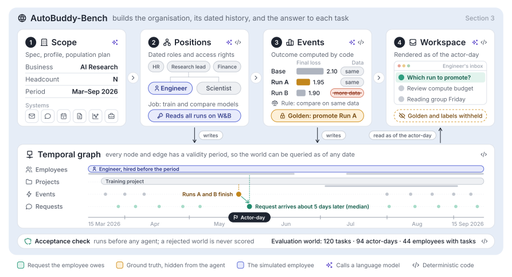
Figure 2 : One task followed through AutoBuddy-Bench (Section 3.1). (1) A company scope fixes the business, headcount, period and systems; (2) positions are generated with dated roles and access rights; (3) events are generated and code computes the ground-truth outcome from the rule that governs them: three training runs finish, and the lab imposes a rule that runs may be compared only if they were trained on the same data. Run B has the lowest loss but was trained on more data, so the correct decision is to promote Run A, the best comparable run; (4) the engineer’s workspace is rendered as of the actor-day, with the ground truth and evaluation labels withheld. Steps 2 and 3 write to a temporal graph that can be queried as of any date. The illustrated company is an example, not the evaluation world.
Original paper · CC BY 4.0The illustrated example shows how a rule turns events into a known answer. Three training runs finish, with Base at 2.10, Run A at 1.95 and Run B at 1.90 on the loss figures shown. Run B has the lowest loss, but the lab only allows runs to be compared when they were trained on the same data. Code therefore computes the correct decision as promoting Run A, the best comparable run.
A ground-truth task is kept only when an event anchors it to a fact of the world. Each task fixes the responsible employee, the date and readable evidence, while the agent never sees the ground truth. The expected outcome lists the required facts, the delivery target, the audience and, for business tasks, the final state of each named record.
Before any agent runs, an acceptance check confirms the task set is large, covers every task type and states what each request depends on.
The ground-truth tasks sit among other records in that snapshot, and the correct outcomes are never rendered. The evaluation world has 120 tasks, 94 actor-days and 44 employees with tasks. Business tools reuse the simulated customer-support, sales, finance and human-resources services and schemas of AutomationBench, so the business side builds on an existing simulator.
Scoring discovery and execution separately
AutoBuddy-Bench scores discovery by matching each listed task to a ground-truth task, with no language model in the loop. A listed task counts as a match only when it cites that task's request record as evidence. Recall is the fraction of ground-truth tasks matched, so a task the agent never lists lowers it. Precision divides the matched tasks by matched tasks plus mistakes.
Listing an answered request as already done isn't a mistake, so it doesn't reduce precision.
Execution is scored from what the agent changes, not from its own account of the work. Each matched task runs in a fresh session, and the workspace is diffed before and after that session. Business-system, headcount and research tasks are graded as pass or fail. The three restart tasks and the 54 document tasks get a weighted score: content coverage 0.5, completion 0.2, evidence 0.2 and answer status 0.1.
The end-to-end score averages execution over all gradable ground-truth tasks, so a task never found contributes zero. A business-system task whose starting records were already changed by another task is excluded as ungradable. A harness failure before any task is scored removes its tasks from the run, while one during an execution counts as zero.
How the AutoBuddy agent finds and finishes tasks
AutoBuddy splits its work into two read-only discovery sessions and a fresh write session for each task. This profile gives discovery a project vocabulary for grouping tasks, so the later steps share one set of project names.
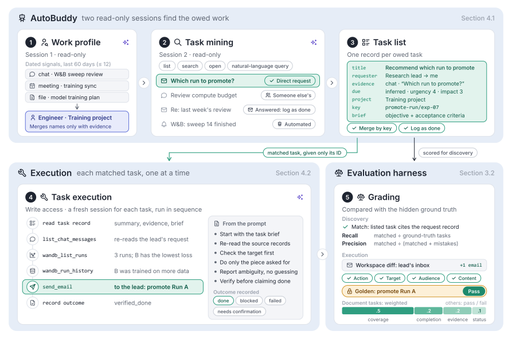
Figure 3 : AutoBuddy on the task of Figure 2. (1) A read-only session builds a work profile from dated signals; (2) a second read-only session mines the workspace, keeping the direct request and setting aside a colleague’s task, an answered thread and an automated notice; (3) each owed task becomes one record with its evidence and a brief. (4) Each listed task that matches a ground-truth task is executed in a fresh session with write access; here the agent checks the runs and their training data and emails the lead to promote Run A. (5) Discovery is scored by recall and precision, and execution by the change to the workspace, against the hidden ground truth (Section 3.2).
Original paper · CC BY 4.0 · Shiqi Chen, Daniel Madrigal Diaz, Wei-Ning Chen, Gbola Afonja, Fangkai Yang, Rujia Wang, Chetan Bansal, Victor Rühle, Saravan Rajmohan, Dongge Han · AutoBuddy: Evaluating Proactive, Always-On Agents on Task Discovery and Execution in a Simulated Workplace · Original paper figure · Extracted the figure area from page 4 of the original PDF.The second read-only session runs over a time window that, under evaluation, starts at the earliest event and ends at the latest request of the actor-day's tasks. It extracts direct requests, commitments, follow-ups and meeting action items, and it excludes updates with no expected action. Workspace content counts as evidence and never as instructions, and tasks with no evidence in the window are dropped.
The organiser merges tasks by their stable key without any model call, so a repeated sighting adds evidence rather than a duplicate. Under evaluation, each actor-day starts from an empty state, so reopening, confirmation and ranking have no effect. The ground-truth task and its request text are withheld from that session.
The brief is a starting point, so the agent re-reads the source records and follows them to related mail, chat and system records. It checks the target before writing and separates the requested piece of work from the wider project it belongs to. The agent records one of four outcomes: done, blocked, needs confirmation or failed. A task can be lost at discovery when it is never listed, and at execution when the agent stops to ask or acts on the wrong target.
Main results across 17 backbones
Across 17 backbone models, the authors varied only the LLM while keeping the same agent, tools and 120 tasks. Each model ran three times, and its scores were averaged before the comparison. Within each provider, the lighter tier scored lower, such as claude-haiku-4.5 below claude-sonnet-5. The two largest gaps between adjacent models split the table into a top six, a middle seven and a bottom four.
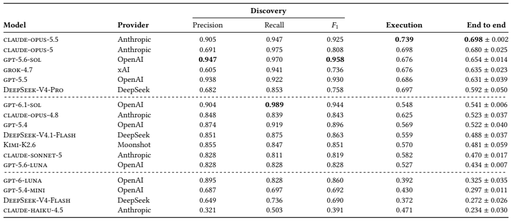
Table 1 : Main results on the evaluation world: AutoBuddy with 17 backbone models on the same 120 tasks. Every model is run three times; scores are means over the three runs, with the standard deviation of the end-to-end score.Discoveryis measured against the workspace labels andexecutionagainst the recorded system change and delivered text;end to endaverages the execution score over all gradable ground-truth tasks (Section 3.2), counting a task never found as zero. Dashed lines mark the two largest gaps between adjacent models. Best in each column in bold.
Original paper · CC BY 4.0The weakest discoverers lose most of their credit before they start executing. claude-haiku-4.5, gpt-5.4-mini and DeepSeek-V4-Flash miss 60, 36 and 32 of the 120 tasks per run. The middle of the table behaves differently, since these models find most tasks but often don't carry them out.
Its lost credit comes from misses (38%) and wrong or incomplete content (32%). So their lost credit shifts to wrong or incomplete content, stopping to ask and the wrong target.
The two gpt-6 models break this ordering, because they find tasks well but then stop short. Discovery and execution rank the models differently, which is the central pattern of this section. grok-4.7 and DeepSeek-V4-Pro rank fourteenth and thirteenth by discovery F1, yet sixth and third by execution.
Discovery and execution are only weakly related
Across the 17 models, discovery precision correlates with execution at r = 0.27, a weak relation. Discovery recall correlates more strongly with execution, at r = 0.65. Seventeen models is a small sample, so these coefficients stay noisy.
The rankings diverge more sharply than the correlations do. grok-4.7 and DeepSeek-V4-Pro rank fourteenth and thirteenth by discovery F1. Yet the same two models rank sixth and third by execution.
These are mostly errors of judgement rather than fabricated evidence. 99.6% of cited records exist in the employee's workspace. Strong executors can still reopen finished work, so good execution doesn't show clean discovery.
The authors read this split as recognising owed work and completing it being distinct capabilities. Middle-tier models, by contrast, find most tasks but often stop before carrying them out. Section 5.3 examines the errors behind this gap.
Where completed tasks are lost
Re-opening closed work accounts for almost all of the low precision of grok-4.7 (68 per run) and DeepSeek-V4-Pro (43 per run). Colleague requests concentrate in claude-haiku-4.5 (71 per run) and gpt-5.4-mini (35), which also miss the most tasks.
The agents' misses are mostly single requests overlooked among others that the agent did find. Of the 907 misses, 732 came on actor-days where the agent found other tasks, and only 175 came on actor-days with no listed task. The cited records are almost always real, and 99.6% of them exist in the employee's workspace. The paper reads the strong executors' reopened work as mostly errors of judgement rather than fabricated evidence.
Of 4,943 discovered tasks, 49.8% received full credit. On three risk-ledger tasks, gpt-6.1-sol stopped to ask in every run and scored 0.2 each. On the same tasks, claude-opus-5.5 scored 1.0 in all nine attempts.
Limits of one generated world
All main scores come from one generated world of 120 ground-truth tasks, 94 actor-days and 44 employees. So the scores describe that world, and the paper reports no other generated organisation. That shared setup makes the comparison across the 17 models fair, but it also means one world sets every number.
The evaluation world simulates six months, from 2026-03-15 to 2026-09-15, and its tasks are requested between 2026-03-22 and 2026-09-15. Business-system operations make up the largest group, with 49 tasks (41%) over four systems. Finding 1 reports that every model's scores are means over three runs on the same 120 tasks.
Across 17 models, discovery precision correlates with execution at r = 0.27 and recall at r = 0.65. The authors say the coefficients are noisy with so few models, so the link between discovery and execution is only indicative. Table 2 shows the rankings diverge: grok-4.7 and DeepSeek-V4-Pro rank fourteenth and thirteenth by discovery F1, yet sixth and third by execution.
In each run, zero to seven business-system tasks were excluded as ungradable, because their starting records had already changed. These exclusions leave the end-to-end scores of this world slightly dependent on which tasks remain gradable. The paper doesn't test a second world, so that dependence can't be checked against other organisations.
Paper info
- Authors
- Shiqi Chen, Daniel Madrigal Diaz, Wei-Ning Chen, Gbola Afonja, Fangkai Yang, Rujia Wang, Chetan Bansal, Victor Rühle, Saravan Rajmohan, Dongge Han
- Venue
- arXiv · Preprint
- First published
- 2026-11-9
- Added
- 2026-11-10
- Updated
- 2026-11-9
- Version
- v1
- arXiv
- 2611.12393
- Category
- cs.AI · cs.LG
- Original paper terms
- CC BY 4.0
- What we show
- Paper info, commentary and permitted figures from the original paper
AI commentary is a separate explanation from the original paper and may contain errors. The original paper and figures follow each source's terms of use and any rights noted separately.
Abstract
As LLM agents become more autonomous, they are increasingly expected to run as always-on assistants on a user's behalf, identifying work to be done and completing it without being asked. Yet existing benchmarks usually give the agent its task, whereas in knowledge work the requests sit in the user's workspace and the agent must first recognise which obligations exist. We study proactive task discovery and execution, in which an agent must infer a user's pending tasks from their workspace and complete them in the systems where the work lives. This setting poses two challenges. For the agent, the tasks are buried in a large volume of mail, chat, documents and records. For evaluation, a benchmark needs a simulated organisation whose people, events and documents are mutually consistent, so that tasks arise realistically and their correct outcomes are known. We introduce AutoBuddy-Bench, a simulator that addresses these challenges. It models an organisation's employees, projects, business systems and event history as a temporal graph, renders it into realistic workspace artefacts, derives ground-truth tasks from the events that create obligations, and computes each task's outcome from the world state; execution is judged by the agent's changes to the workspace. To evaluate current LLMs, we build AutoBuddy, a reference agent with interchangeable backbone LLMs: it identifies tasks from the workspace, grounding each in its source records, and executes each in a separate session with write access. Varying only the backbone, we find a systematic shift in where tasks are lost: weaker models fail mainly at discovery, intermediate models identify tasks but often stop short of carrying them out, and the strongest models fail mainly during execution, most often on business-system operations. Discovery precision is only weakly related to execution quality, suggesting the two are distinct capabilities.
Quote from the paper
Shiqi Chen, Daniel Madrigal Diaz, Wei-Ning Chen, Gbola Afonja, Fangkai Yang, Rujia Wang, Chetan Bansal, Victor Rühle, Saravan Rajmohan, Dongge Han (2026). AutoBuddy: Evaluating Proactive, Always-On Agents on Task Discovery and Execution in a Simulated Workplace. arXiv:2611.12393v1. https://arxiv.org/abs/2611.12393v1
BibTeX
@misc{chen2026autobuddy,
  title = {{AutoBuddy: Evaluating Proactive, Always-On Agents on Task Discovery and Execution in a Simulated Workplace}},
  author = {Shiqi Chen and Daniel Madrigal Diaz and Wei-Ning Chen and Gbola Afonja and Fangkai Yang and Rujia Wang and Chetan Bansal and Victor Rühle and Saravan Rajmohan and Dongge Han},
  year = {2026},
  eprint = {2611.12393},
  archivePrefix = {arXiv},
  url = {https://arxiv.org/abs/2611.12393v1}
}