Paper commentary
Proving and Improving the Platonic Representation Hypothesis with JEPAs
Good-view JEPAs learn the same representation across modalities up to a rotation
- Problem The Platonic Representation Hypothesis was only an observation, with no proof and no way to predict when JEPAs learn the same representation.
- Method The authors split positives into good views, two observations of one scene, and bad views. Only good views tie the learned representation to the world.
- Results A 109M good-view text JEPA reaches .184 mutual 10-NN with DINOv2 ViT-B, compared to .154 for Qwen2.5-72B.
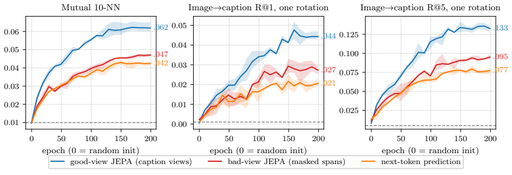
Figure 5 . Good views align, bad views and next-token prediction do not.Alignment between a separately trained image JEPA and three text encodersonFlickr,atmatchedepochs(meanofthreeseeds,band: range;dashed: chance). Allstartatchance. Weclearlyobservethatthegood-view JEPA (caption views) aligns markedly better than the bad-view JEPA (masked spans) and next-token prediction, which nearly coincide, as predicted by Theorem 2 and Proposition 4.
Original paper · CC BY 4.0 · Randall Balestriero, Yann LeCun · Proving and Improving the Platonic Representation Hypothesis with JEPAs · Original paper figure · Extracted the figure area from page 8 of the original PDF.Why the Platonic Representation Hypothesis stayed a hypothesis
Huh et al. observed that vision and language models grow more alike as they scale, and they named this idea the Platonic Representation Hypothesis. The closest proof covers embedded deep linear networks trained by SGD, and a recent theory explains why translations share representations inside multilingual language models. Each of these arguments covers a narrow setting, so the PRH itself stays an observation.
The paper's question is when separately trained models provably learn the same representation, and the authors ask it for JEPAs. For JEPAs, the self-supervised objectives used in practice, there is no proof and no prediction of when the hypothesis holds. The authors' short argument starts from a JEPA with whitened second-order anti-collapse, which learns the spectral embedding of its positive pairs.
The argument's key step is that modalities rendering one world, with positive pairs relating the same world states, have one training problem in different coordinates. Their solutions then coincide up to a rotation, which the authors call the Platonic Representation Theorem. The argument isn't specific to images and text, so it covers any modalities that observe one world.
The PRH therefore becomes a statement about positive views: good-view JEPAs learn a representation that belongs to the world, while bad-view JEPAs learn one that belongs to their modality.
Good views make JEPAs agree up to a rotation
Two JEPAs learn the same embedding up to a rotation when their positive pairs link the same world states. Each modality renders the same world, so its training problem is the same problem written in different coordinates. The paper calls this the Platonic Representation Theorem, and it holds for any number of modalities. Positives made of two observations of one scene give good views, while positives made of corruptions of one observation give bad views.
Each JEPA minimizes a prediction term plus an anti-collapse term over its encoder f, with positives drawn from a distribution π. The predictor is the identity, so the loss compares the two embeddings directly. Both terms are invariant to rotations Q in O(k), because rotating every embedding leaves the loss unchanged. An injective rendering only changes coordinates, so the same objective can be written on world states.
When all modalities share one positive-pair distribution and the minimizers are unique up to rotation, every minimizer satisfies f_m ∘ g_m = Q_m h⋆ for some Q_m in O(k). Any two modalities then agree up to the single rotation Q_m Q_m'^T.
Uniqueness up to rotation is the hard assumption, and Proposition 1 supplies it for whitened embeddings. Under a spectral gap, µ_k > µ_k+1, the minimizers are exactly the spectral embedding Φ_π up to a rotation Q. The proof of uniqueness rests on the eigenvalues of the normalized kernel K_π built from the positive pairs.
Real positives rarely match across modalities, so Theorem 2 bounds the misalignment by the mismatch between the two kernels. The bound uses the eigengap δ of the second kernel and the smaller of √k‖K_π1 − K_π2‖_2 and ‖K_π1 − K_π2‖_F. Figure 2 checks this bound on 300 random finite worlds, and the error after the best rotation stayed below it.
The largest error reached 18% of the bound.
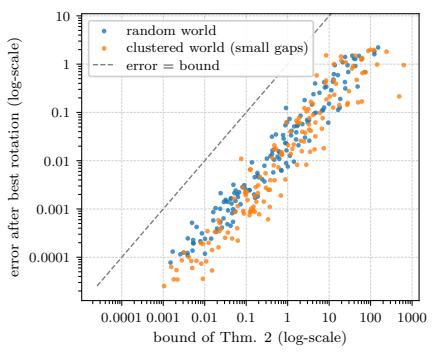
Figure 2 . Kernel mismatch bounds misalignment (Theorem 2). Each point is one randomly generated finite world (8–39 states, random marginal, embedding dimension k from 1 to 5) with a pair of kernels on it: the world’s kernel, and a second kernel of the same marginal that mixes in an unrelated kernel with weight 10−4 to 1, as if a second modality had partly different positives. For each pair we compute the two spectral embeddings (Proposition 1) and plot their distance after the best rotation (vertical) against the bound of Theorem 2 (horizontal); of the 300 worlds, half are clustered, with small spectral gaps. We clearly observe that the error lies below the bound in every world (dashed: equality), at 18% of it at most.
Original paper · CC BY 4.0Pairs are still needed to pick out which rotation applies, since unpaired first and second moments cannot find it. Proposition 2 shows that k pairs in general position determine the rotation through orthogonal Procrustes. A second cost appears when positives corrupt one observation, because a bad-view JEPA's two members share that observation's nuisance.
Theorem 3 gives a lower bound of 2k(1 − min_m ρ(f_m)) on the alignment error, so every direction spent on nuisance is lost for alignment.
Next-token prediction as a bad-view JEPA
Because both members come from one document and share its wording, the positive pair is a bad view, not a good one. The softmax head of a language model splits into a prediction term and an anti-collapse term, which is the log-partition over the vocabulary. Proposition 4 writes the loss with a context embedding h(c) and a table of token embeddings w_v, so the target token plays the role of the positive.
The anti-collapse term does not depend on the target token, and as the temperature goes to zero it approaches the largest logit. The loss therefore approaches the gap between the largest logit and the target logit, which vanishes only when the target attains the maximal logit. With full-support conditionals and k large enough, minimizers satisfy a logit equal to log p(v|c) plus a term depending on c only.
That set of minimizers is invariant under GL(k), so the context embedding is identified only up to an invertible linear map, not a rotation.
This is why the language model's embedding cannot align with a vision model by a single rotation, as a good-view JEPA can. The Theorem 3 bounds predict the same ordering of their best-rotation errors against DINOv2 as the measured errors show. Against DINOv2, the bounds from Theorem 3 are 12.6, 22.1 and 25.1, and the measured errors are 33.5, 39.4 and 40.3.
Good views need far fewer samples and less scale
The authors trained the same 33M-parameter encoder on the texts of Recap-DataComp web images, where each image's alt-text and two recaptions serve as its views. Trained on texts of 50M web images, the good-view JEPA reaches .125 mutual 10-NN with DINOv2 ViT-B on WIT-1024. Trained on Flickr captions, the same kind of encoder reaches only .034 on that benchmark.
At 50M and 100M images, this encoder sits level with Qwen2.5-3B and -7B, which score .125 and .118. The authors trained it with no next-token or masked-token prediction, so the alignment comes from the views alone.
The texts are identical across these runs, so the gap follows from how the positives are formed rather than from the data. At the same scale, the bad-view JEPA reaches .053 and next-token prediction .071, against .108 for the good-view JEPA. With 23 times more images and 1.9 times more steps, the two baselines reach .063 and .079, against .125 for good views.
That is, good views on web text carry most of the gain without any Flickr or COCO caption in training.
On the same corpus, good views reach with 21.6M training samples the alignment that next-token prediction reaches with 900M. That is 42 times more samples for next-token prediction, so it spends its scale poorly. With 940M web images, the 109M good-view text JEPA reaches .184 on the same benchmark. That beats Qwen2.5-72B at .154 and CLIP's text encoder at .124.
The CLIP text encoder read far fewer tokens, while the language models were trained on 15 to 18T tokens, over 100 times more.
A scaling law in the good-view fraction q and the samples seen predicts 85 runs before they are trained. On 10.2M images, its predictions had RMSE .0093, while two seeds of one run differed by .0096. The law fails further out for good views only, overestimating runs at 320M samples.
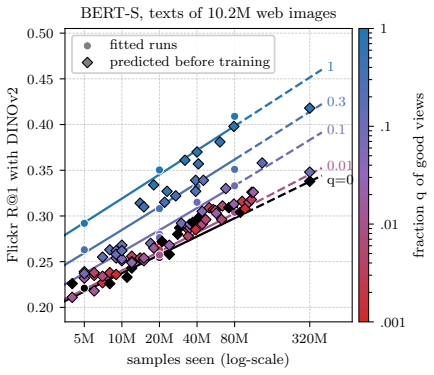
Figure 11 . A scaling law of alignment in good views and samples seen. Flickr test R@1 (DINOv2 ViT-B, 30k-pair rotation) of BERT-S text JEPAs trained on the texts of 10.2M web images, against the samples seen. Each point is a run, colored by its fraction q of training items with good views (black: q = 0, bad views only). Circles: the grid the law is fitted on; diamonds: runs predicted before training. Lines: the law at five values of q, dashed beyond the fitted range. We observe that R@1 grows linearly in the logarithm of the samples seen at every fraction of good views, faster with more of them, and that the law predicts unseen runs within seed noise up to twice its range.
Original paper · CC BY 4.0A captioner from one fitted rotation
The captioner is a causal transformer trained on text alone, which reconstructs each caption from the frozen good-view JEPA embedding of that caption. Gaussian noise is added to the embedding, so the decoder tolerates the alignment error that the rotation leaves behind. To caption an image, the authors embed it with frozen DINOv2, apply the rotation, and decode the result.
The noise level is matched to the residual alignment error rather than tuned, because the image and its caption have a mean cosine of about .3 after rotation. Setting the noise norm to σ with expected cosine (1+σ²)^(-1/2) gives σ = (c^(-2) - 1)^(1/2), which is about 3 at c of about .3, and the authors use σ = 3. From 30 pairs, the captioner reaches .169, which matches caption retrieval with 1,014 pairs at .158.
The captioner transfers to COCO without any COCO pair, since the rotation is fitted on Flickr pairs only. A random rotation gives .038 and retrieving the nearest Flickr caption gives .169 on the same images. Captioners built on CLIP's jointly trained encoders report .345, .493, and .918 with .912 on their own benchmarks, and they don't use in-domain Flickr pairs.
A free linear map fits Flickr better but transfers worse: CIDEr .531 against .504 on Flickr, and .635 against .802 on COCO. A two-layer MLP loses on both, with .498 on Flickr and .585 on COCO, so the rotation's constraint is what carries over.
Replacing the DINOv2 encoder and decoder with stronger parts improves the captioner further without any pairs. With Qwen2.5-1.5B fine-tuned on text alone, the text JEPA trained on 100M web images, DINOv2 ViT-g, and DINOv3 ViT-L, one map gives CIDEr .519 on Flickr and .838 on COCO. The consensus of 32 sampled captions and the demo decoder, first trained on web sentences, give .538 on Flickr and .832 on COCO.
Neither the encoders nor the decoder saw a video, yet the captioner describes MSR-VTT clips from the mean of their frames' rotated embeddings. That is below VideoCoCa at .271 and TOPA at .329, but above the zero-shot CLIP-based captioners that score .058 to .186. On the 1k-A split, averaging frames raises mutual 10-NN from .148 to .167, and the photo-fitted rotation retrieves the right clip first for 16.5% of captions.
CLIP ViT-B/32 trained on 400M image-text pairs retrieves the right clip first for 31.2% of captions in the same table.
Alignment without any pair
The theory predicts this works best when the two encoders' geometries agree, which is what good views provide. The authors kept the method, code, hyperparameters and five seeds unchanged, using DINOv2 ViT-B/14 against a text encoder. The map is fitted on disjoint unpaired halves of COCO train2014, with images from one half and captions from the other.
Scoring runs on the 40,504 val2014 pairs, using FOSCTTM, where 0 is perfect and .5 is chance, and zero-shot classification. Their setup reproduces the paper's numbers for all-mpnet-base-v2.
The 109M good-view JEPA, over three training seeds with five method seeds each, reaches FOSCTTM .018. Its zero-shot top-5 accuracy on ImageNet-100 is 64.4%, the value the authors compare against the paper's best reported numbers. Rerun under identical conditions, Qwen3-8B, their strongest text encoder, reaches 47.6% on ImageNet-100 top-5.
The good-view JEPA is 70 times smaller than Qwen3-8B, and it matches Qwen3-8B on FOSCTTM and CIFAR-10. Across 21 pairs of seven vision and three language models, the best zero-shot accuracy reported in the paper is at most 56% on five-setting ImageNet-100.
Their bad-view JEPA aligns well on COCO, at FOSCTTM .026, so the contrast there lies between JEPAs and next-token prediction.
The table of this benchmark lists the paper's best number per metric over its 21 vision-language pairs and five settings. The good-view JEPA beats every one of those pair-free zero-shot accuracies, which is the claim the section rests on.
Which claims stay outside what was tested
Real modalities are lossy, and the paper doesn't test that case. Finite-sample training also relies on the inductive bias of the network. Theorem 2 is proved for spectral solutions only.
Good views need texts known to describe the same scene, such as human caption groupings on Flickr and COCO. On Recap-DataComp, two of each image's three texts come from an image captioner built on LLaMA-3-8B, with a CLIP ViT-L/14 vision encoder. So the comparisons with language models and CLIP's text encoder at scale rely on these texts, while comparisons between views on identical texts don't.
The captioner's noise level is matched to the alignment error with a formula, not tuned on test data.
Paper info
- Authors
- Randall Balestriero, Yann LeCun
- Venue
- arXiv · Preprint
- First published
- 2026-10-29
- Added
- 2026-11-1
- Updated
- 2026-10-29
- Version
- v1
- arXiv
- 2610.39302
- Category
- cs.AI · cs.CV · stat.ML
- Original paper terms
- CC BY 4.0
- What we show
- Paper info, commentary and permitted figures from the original paper
AI commentary is a separate explanation from the original paper and may contain errors. The original paper and figures follow each source's terms of use and any rights noted separately.
Abstract
Whether models trained on different modalities converge to the same representation of the world is central to AI. The Platonic Representation Hypothesis (PRH) conjectures that they do as they scale, but without a proof it offers neither a guarantee nor a recipe. We turn the hypothesis into a theorem. First, we prove a \emph{Platonic Representation Theorem}: Joint-Embedding Predictive Architectures (JEPAs) trained separately on any number of modalities learn the same representation up to one rotation whenever their positive pairs are two observations of one scene--\emph{good views}--and their misalignment is bounded otherwise. Second, we show that next-token prediction is a JEPA with \emph{bad views}, parts of a single document, which explains why language models align with vision only through scale. Third, we validate the theory from 145k captions to the texts of 940M web images, and uncover a scaling law of alignment that predicts unseen runs within seed noise. Good views need 42 times fewer training samples than next-token prediction on the same corpus to reach the same alignment, and a 109M-parameter text JEPA aligns with DINOv2 and CLIP's image encoders better than every language model we evaluated, up to 72B parameters, and than CLIP's text encoder: next-token prediction is a remarkably inefficient route to platonic representations. As a showcase, one rotation turns separately trained encoders into an image captioner (CIDEr .838 on COCO). Even that rotation needs no pair: on the latest pair-free benchmark, our text JEPA beats every zero-shot accuracy reported with language models up to 8B parameters, e.g., 64\% against at most 56\% top-5 on ImageNet-100. Positive views, and not scale alone, are thus the lever to build platonic representations.
Quote from the paper
Randall Balestriero, Yann LeCun (2026). Proving and Improving the Platonic Representation Hypothesis with JEPAs. arXiv:2610.39302v1. https://arxiv.org/abs/2610.39302v1
BibTeX
@misc{balestriero2026proving,
  title = {{Proving and Improving the Platonic Representation Hypothesis with JEPAs}},
  author = {Randall Balestriero and Yann LeCun},
  year = {2026},
  eprint = {2610.39302},
  archivePrefix = {arXiv},
  url = {https://arxiv.org/abs/2610.39302v1}
}