Paper commentary
From Retouched Images to Paired Videos: A Synthetic Benchmark for Face Video Retouching
- Problem Paired raw and retouched face videos are costly to produce, and existing paired resources are image-level or only pseudo-temporal, so a fixed, inspectable video benchmark is missing.
- Method Each DeepFRR raw image is animated by an image-to-video generator into a 150-frame clip, and the retouched appearance of its paired image is transferred frame by frame onto that clip with a face-transfer backend and a parsing-based blend.
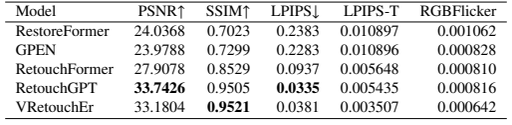
Table 3 : Results on the official identity-disjoint DeepVFR test split. Bold values mark the best target-referenced fidelity scores. Temporal columns describe unaligned adjacent-frame change; smaller values do not establish better temporal quality.
Original paper · CC BY 4.0 · Peiyuan Zeng, Fengchuang Xing, Shiming Wu, Hongwei Yue, Chao Zhou · From Retouched Images to Paired Videos: A Synthetic Benchmark for Face Video Retouching · Original paper figure · Extracted the figure area from page 8 of the original PDF.Why paired video supervision is scarce
Retouching a face video means applying one consistent edit across all frames while keeping identity, expression and motion intact, and doing this by hand does not scale. Running an image retouching model frame by frame tends to produce flicker, unstable facial detail and drifting identity attributes, so a practical video model needs training pairs in which both streams share the same motion and camera trajectory.
Producing such pairs from real footage requires professional editing with careful temporal adjustment, and collecting paired unretouched and retouched footage of identifiable people adds privacy and consent problems.
The closest video-level sources are FFHQR-Seq, whose temporal variation comes from random cropping, flipping and translation, and MRFV, which contains 200 manually retouched portrait videos that are not released in the official repository. Neither source gives a fixed, inspectable set of seconds-long paired clips with natural facial motion, which is the gap DeepVFR targets.
DeepVFR is built as a controlled synthetic benchmark that converts paired image supervision into paired video supervision. The off-the-shelf generators are used only as construction tools, and the benchmark does not propose a new retouching network.
Building each raw and target clip pair
The 1,024 image pairs are drawn from DeepFRR, a corpus of 50k pairs, through quality filtering followed by stratified sampling. A pair is kept only when it has one clear frontal or near-frontal face in both images, sufficient facial resolution without severe occlusion, watermarks or generation artifacts, a retouched image that keeps identity with visible but moderate retouching, and coverage of diverse ages, genders, skin tones, illumination and expressions.
Each selected raw image is animated by the Tongyi Wanxiang 2.2 image-to-video model, which here acts only as a motion-prior generator. A mild smile prompt is used so that small micro-expressions and slight head motion appear while large pose changes, which could break identity alignment, are avoided. Each raw clip has T = 150 frames at f = 30 fps, about 5 seconds long, which the authors chose because the longer span exposes flicker and appearance drift better than five-frame pseudo-sequences.
The generation step is written as \\( O_i = \\{O_{i,t}\\}_{t=1}^{T} = G_{I2V}(x_i; p, T, f) \\), with \\( T = 150 \\) and \\( f = 30 \\), where \\( x_i \\) is the raw face image, \\( p \\) the text prompt and \\( O_{i,t} \\) the raw frame at time t.
The retouched image of the pair supplies the appearance, and each raw frame supplies the pose, expression and background, so every raw frame gets a target frame. A backend face-transfer operator is applied to a detected and aligned face, with alignment implemented by SCRFD or RetinaFace, and the result is then blended back into the raw frame.
The blend is written as \\[ B_{i,t} = \\alpha(M_{i,t}) \\odot \\tilde{B}_{i,t} + \\bigl(1-\\alpha(M_{i,t})\\bigr) \\odot O_{i,t} \\], where \\( M_{i,t} \\) is the BiSeNet face-parsing mask, \\( \\alpha(M_{i,t}) \\) its feathered alpha version and \\( \\odot \\) element-wise multiplication. Because the soft mask keeps the background, hair and non-face areas of the raw frame, only the facial region is replaced, and this is what makes the target frame-synchronous with the raw clip.
Akool is the primary transfer route, and SimSwap supplies a smaller complementary subset. Akool is a mutable commercial service, so a versioned fixed package would be needed for repeatable scoring, since regeneration may change when the service changes.
Automatic checks confirm that detection and alignment succeeded, and visual inspection rejects clips with severe motion collapse, boundary artifacts, lost retouched appearance or clear identity drift. The manual step removes obvious failures but cannot catch every latent synthetic or backend artifact, and it is also the bottleneck for expanding the set.
Contents and splits of DeepVFR
Each sample holds a generated raw clip and a frame-synchronized proxy target, and the two streams share frame indices and nominal trajectories while differing mainly in transferred facial appearance. Figure 2 shows representative frames at positions 1, 75 and 150 for six clips chosen across age and gender strata, so a reader can see the raw and retouched pairing.
Those 153,600 correspondences are not independent examples, since frames within a clip are correlated, so the unit that counts is the 1,024 clip-level pairs.
The split follows an identity-disjoint protocol, which reduces identity leakage between training and testing, with 885 clips for training and 139 clips for testing. The external-checkpoint diagnostic is the exception, since it applies released weights to all 1,024 clips without fitting any model on DeepVFR.
Appearance-based tags for age group (child, youth and elderly) and perceived gender presentation (male and female) are provided for subgroup analysis, not as prediction targets or claims about self-identified gender.
How models and metrics are compared
RestoreFormer and GPEN are restoration baselines, RetouchFormer and RetouchGPT are image retouching methods, and VRetouchEr is a video retouching method. Within the benchmark these architectures are trained on the same DeepVFR paired source where applicable, and VRetouchEr keeps its cross-frame and imperfection-flow design.
The two output-only temporal statistics are computed on predictions without any reference, mask or flow. LPIPS-T averages the LPIPS distance between each predicted frame and the next, and it is written as \\[ \\text{LPIPS-T} = \\frac{1}{M}\\sum_i\\sum_{t=1}^{T_i-1} d_{\\text{LPIPS}}(\\hat{Y}_{i,t},\\hat{Y}_{i,t+1}) \\] with \\( M = \\sum_i (T_i - 1) \\).
The pooled count is M = 20,711 pairs, which comes from 139 test clips of 149 pairs each. Because these temporal statistics have no reference, they cannot separate genuine motion from flicker, and a frozen output scores zero change under both definitions.
Trial order and the mapping of candidates to the 2×2 grid were randomized, but exact counterbalancing is not claimed.
Within-benchmark fidelity and temporal results
Table 3 reports these methods on the identity-disjoint DeepVFR test split, and the table is shown here as the reference for the comparison below.
These numbers describe agreement with the constructed target and the output variation of each model, not an established trade-off between fidelity and temporal quality. Whole-frame fidelity also includes the copied background, so the scores do not isolate identity preservation or the contribution of the facial retouching, and the values do not show that the targets are artifact-free.
The authors attribute this to restoration objectives that differ from the raw-to-constructed-target mapping of the benchmark, and they do not read it as a general ranking of restoration against retouching.
External checkpoints on all 1,024 clips
The corresponding SSIM values were 0.8087, 0.8120 and 0.9469, and the LPIPS values were 0.1405, 0.1374 and 0.0451. Each checkpoint was trained on different source supervision, which the table lists as FFHQR image pairs, FFHQR plus instructions and FFHQR-Seq pseudo-sequences.
The VRetouchEr checkpoint scores best in this external table, but its architecture, pretraining and supervision are confounded, so the advantage cannot be credited to temporal modeling or to FFHQR-Seq.
These values cannot be compared numerically with Table 3, because that table uses the identity-disjoint test split while this diagnostic uses all 1,024 clips.
Human ranking of the constructed targets
Table 5 gives the aggregated rank shares for the four candidates on the 100 study clips.
The 21.06% Rank-4 share is a substantial low-preference tail, even though the target leads at Rank-1.
The percentages describe this 17-participant stimulus set and are not a population estimate. The 21.06% Rank-4 share counts judgments and is not an estimated fraction of defective clips, and clip-specific artifacts cannot be separated from participant preference in these aggregates.
Limitations
Both streams inherit synthetic-image and I2V characteristics, and the targets additionally inherit face-transfer and blending artifacts. DeepVFR therefore does not replace artist-retouched captured video and does not establish synthetic-to-real generalization.
Akool is closed and mutable, so exact regeneration may not be possible, and the work reports no backend-stratified sensitivity analysis.
Paper info
- Authors
- Peiyuan Zeng, Fengchuang Xing, Shiming Wu, Hongwei Yue, Chao Zhou
- Venue
- arXiv · Preprint
- First published
- 2026-11-13
- Added
- 2026-11-17
- Updated
- 2026-11-13
- Version
- v1
- arXiv
- 2611.18791
- Category
- cs.CV
- Original paper terms
- CC BY 4.0
- What we show
- Paper info, commentary and permitted figures from the original paper
AI commentary is a separate explanation from the original paper and may contain errors. The original paper and figures follow each source's terms of use and any rights noted separately.
Abstract
Paired unretouched/retouched face videos are costly to produce because professional editing must remain consistent over time, while releasing identifiable face footage raises privacy, consent, and governance concerns. We present DeepVFR, an initial controlled synthetic benchmark-not a new retouching architecture-for paired face video retouching. Starting from paired synthetic DeepFRR images, Wan2.2 generates mild-motion source clips, and backend-specific face transfer constructs synchronized proxy retouching targets, followed by automatic validity screening and manual visual inspection. DeepVFR contains 1,024 pairs of 150-frame clips at 30 fps, evaluated under an identity-disjoint protocol with explicit frame correspondence; release metadata will record the construction route. Within-benchmark baselines, external checkpoints applied to DeepVFR, qualitative analysis, and a 17-participant ranking study establish reference behavior in the controlled domain. The constructed targets exhibit a substantial low-preference tail in the human study. Because both streams inherit synthetic content and the targets additionally inherit commercial-API or face-transfer artifacts, the benchmark neither replaces artist-retouched captured video nor establishes synthetic-to-real generalization. DeepVFR provides a starting point for paired supervision and controlled evaluation. Data, individual study rankings, and training logs will be made publicly available upon acceptance. Broader motion coverage and real-video validation remain future work.
Quote from the paper
Peiyuan Zeng, Fengchuang Xing, Shiming Wu, Hongwei Yue, Chao Zhou (2026). From Retouched Images to Paired Videos: A Synthetic Benchmark for Face Video Retouching. arXiv:2611.18791v1. https://arxiv.org/abs/2611.18791v1
BibTeX
@misc{zeng2026from,
  title = {{From Retouched Images to Paired Videos: A Synthetic Benchmark for Face Video Retouching}},
  author = {Peiyuan Zeng and Fengchuang Xing and Shiming Wu and Hongwei Yue and Chao Zhou},
  year = {2026},
  eprint = {2611.18791},
  archivePrefix = {arXiv},
  url = {https://arxiv.org/abs/2611.18791v1}
}