Paper commentary
Shortcuts or Memorisation? Revisiting Data Corruption in Natural Language Understanding with Large Language Models
Shows LLM robustness to word removal likely reflects benchmark shortcuts, not memorisation
- Problem Fine-tuned encoders and LLMs keep much of their NLI accuracy after nouns are removed or words are shuffled. It was unclear whether this reflects memorised benchmark items or shortcut cues in the data.
- Method The authors write 368 new NLI items that no model can have seen. They compare how eight LLMs handle perturbed items written in MNLI style and cue-free items.
- Results All eight LLMs keep 50 to 75% of their performance without nouns on MNLI-style items, compared to 37 to 57% on cue-free items.
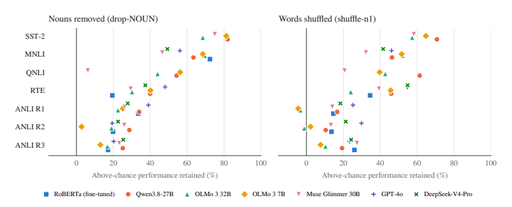
Figure 1 : Share of performance above chance maintained after noun removal (left) and word shuffling (right). Open-weight LLMs are scored zero-shot by centred accuracy, and RoBERTa is scored by accuracy (RoBERTa-large for ANLI, not run with shuffling). Values less than 0 indicate performance below chance.
Original paper · CC BY 4.0 · Aarne Talman, Stergios Chatzikyriakidis · Shortcuts or Memorisation? Revisiting Data Corruption in Natural Language Understanding with Large Language Models · Original paper figure · Extracted the figure area from page 5 of the original PDF.Why surviving scores are ambiguous
Earlier work on fine-tuned encoders kept much of its accuracy after whole word classes were removed or word order was shuffled. Human readers often found those damaged items difficult or impossible to label, which makes the retained scores puzzling. For LLMs the same puzzle returns, because web-scale pre-training corpora may already contain benchmark items.
If an LLM keeps its accuracy on perturbed MNLI items, two explanations remain open. The first is memorisation, where the model recognises an item after perturbation because it saw that item during pre-training.
The second explanation is that cues surviving the perturbation, such as negation words in the hypothesis, let the model solve the item. The two explanations predict different outcomes, which makes the question testable. Under memorisation, items seen in pre-training should hold up better than unseen ones, most of all on benchmarks with high leakage potential.
Under the shortcut account, items a model can solve from the hypothesis alone should stay robust, whether or not they were seen before. That hypothesis-only advantage should disappear once the cue-providing words are removed.
The paper tests both predictions rather than choosing one reading in advance. It then re-examines the perturbation experiments of Talman et al. using four open-weight LLMs and four hosted LLMs. Fine-tuned encoders serve as the reference systems in the same perturbation experiments.
Perturbations, scoring and fresh items
The core idea is to set the two readings against each other on the same items, using perturbations that remove specific kinds of words. Each text field is perturbed independently, so drop-NOUN removes all nouns, while keep-NOUN+VERB keeps only nouns and verbs. Because keep-NOUN+VERB removes every function word, it is the perturbation that tests the cue-carrying words directly.
The perturbations follow Talman et al. (2022), and shuffle-nk splits each field into k-grams and shuffles their order. The authors use 19 perturbations in total, and the hosted models run a core set of ten.
Raw accuracy mixes information loss with a drift toward one answer, so the authors also compute centred accuracy. The retention score is R = 100 · (s_pert − c)/(s_clean − c), where c is chance accuracy. R equals 100 for no loss and 0 for a drop to chance, which lets systems with different clean scores be compared. Open LLMs are scored with centred accuracy, while encoders and hosted models without log-probabilities use raw accuracy.
Confidence intervals are 95% bootstrap intervals over items, with 1,000 resamples or 500 for the group comparisons in Section 5.
To get items no model has seen, the authors wrote 368 new NLI items. Premises come from Wikipedia text written after 1 September 2026. Any premise with a 13-gram found in OLMo's pre-training data was excluded. The kept set has 168 MNLI-style, 148 cue-free and 52 naturally occurring pairs.
Fine-tuned encoders are trained on clean data, with ablated training data used only for the reproduction. In the five-shot setting, the prompt holds five examples, either clean or with nouns removed. Hosted models run at temperature 0, and Grok 4.7 is evaluated on 400 items per task under five perturbations.
The MNLI–ANLI gap is shared across systems
The gap between MNLI and ANLI appears in almost every system tested, which points at the datasets rather than the models. Without nouns, the open-weight LLMs keep 47–70% of their above-chance MNLI performance, compared to 72% for fine-tuned RoBERTa. On ANLI, averaged over the three rounds, the same open-weight systems keep only 14–29%, while RoBERTa keeps 24%.
The contrast therefore shows up in the fine-tuned encoder too, so it isn't specific to LLMs.
The hosted models follow the same split, with GPT-4o keeping 56% on MNLI and 26% on ANLI. DeepSeek-V4-Pro keeps 49% and 25%, and Mistral Large 3 keeps 36% and 23%. Mistral Large 3 is scored on raw answers, so its figures are not centred like the open models. Grok 4.7 is the exception, keeping 43% on MNLI against 38% on ANLI. Its numbers are raw accuracies on the first 400 items of each task, so they should be read with caution.
Answer bias also inflates the drop in raw accuracy under perturbation. Without nouns, DeepSeek-V4-Pro gives the same answer for 87% of MNLI items, compared to 52% on clean input. Its raw accuracy would keep only 22% of the above-chance MNLI performance, while centred accuracy gives 49%. Centring the answer scores therefore corrects for a shift in the decision threshold, not for lost information.
Exposure indicators and robustness
The authors test whether memorisation explains robustness by running three contamination indicators on the same items. Their first indicator is masked-word guessing, where Qwen3.8-27B tries to recover a masked content word from each entry. When the masked word could also appear in the paired sentence, the exact match rate reached 43–70% on sentence-pair tasks.
Most of those matches come from copying across the pair, so the authors restricted masking to words absent elsewhere in the item. Under that restriction the exact match rate dropped to 23–35%, while CoLA and SST-2 stayed unchanged. ANLI, released in 2020, was recovered with nearly the same frequency as MNLI, so specific benchmarks don't stand out.
Min-K%++ scores each item by the normalised log probability of its least likely tokens. For OLMo 3 32B the highest values sit on ANLI R1 and R2, at −1.07 and −1.03. The remaining tasks range from −1.49 to −2.25, and Qwen3.8-27B shows no similar pattern. Because ANLI R1 and R2 are built on Wikipedia passages, the authors read these scores as familiarity with source text, not with the benchmark.
The exact n-gram counts in the OLMo 2 pre-training mix agree with this reading. Long hypotheses rarely appeared, at 1–4% for both MNLI and ANLI, so the benchmark entries themselves seem rare in the data.
Exposure doesn't translate into robustness, because items with found premises lose about as much as the rest. Of the 80 comparisons across open-weight LLMs, MNLI and the three ANLI rounds, only 7 have intervals excluding zero. Those differences run in both directions, with an overall average of −0.8 points. The found-hypothesis groups hold only 10–18 items per task, so the authors don't run reliable comparisons on them.
Easy and hard items under perturbation
A hypothesis-only classifier, a logistic regression on word unigrams and bigrams, is trained on the training hypotheses of each dataset. Its correct predictions define the easy items, and the remaining items form the hard group. On MNLI the classifier reaches 54.3%, in line with Gururangan et al., while the ANLI rounds reach 42.0–43.1%. On RTE it reaches 47.7%, which is below chance.
If cues keep accuracy up under perturbation, easy items should lose less than hard items, and that gap should depend on whether the perturbation preserves those cues.
Under shuffle-n1 the same gap is 10.2 and 6.7 points for the two models. When the premise is removed altogether, the gap grows to 18.1 and 17.0 points. Qwen3.8-27B shows the same direction with a smaller gap of 2.0 points without nouns, and all these intervals exclude zero. Under keep-NOUN+VERB the sign reverses, and easy items lose 2.3–4.4 points more for the three models.
This condition removes function words, including negation words such as not, no and never, which are the strongest hypothesis-only cues in MNLI. Easy items also score higher on clean input, at 93.6% against 87.4% for OLMo 3 32B. The pattern doesn't hold for every model, since GPT-4o loses 9.2 points more on easy items when nouns are absent.
For Muse Glimmer 30B the effect appears only under drop-VERB and shuffle-n1, and Grok 4.7 shows no reliable MNLI difference.
On ANLI, the results are mixed across perturbations. When the premise is removed, most models show 8–14 points less R2 and R3 score loss for easier items. The authors read this as evidence that the weak cues remaining in ANLI are used in the same way.
Cue style on items no model has seen
If memorisation drove robustness, the advantage should vanish on fresh items that no model has seen. Cues, by contrast, should keep the advantage on MNLI-style items and remove it on cue-free ones. Without nouns, all eight LLMs keep 50 to 75% on MNLI-style items, compared to 37 to 57% on cue-free items. That level on MNLI-style items is nearly the same as performance on MNLI itself.
When only nouns and verbs remain, the order reverses, with cue-free items at 62 to 74% and MNLI-style items at 42 to 59%.
The hypothesis-only effect appears in the fresh items as well, and it doesn't depend on the MNLI training data. Within MNLI-style items, easy items show 11 to 28 points less loss than hard items when nouns are absent. For 7 of the 8 models, the 95% interval excludes zero, and the reasoning model and hosted models show the effect too. Clean accuracy on these items is 93 to 100%, which is easier than MNLI.
Most items had a single annotator, so the absolute figures need care, but the style difference holds across all models.
The authors read the result as evidence that cues, not memorised items, drive the MNLI robustness. Cue-free items remain easy for the LLMs, which reach 93 to 98% on clean input. The authors didn't test whether a larger fresh set would change these numbers.
A benchmark without hypothesis cues
BioASQ tests whether robustness can come from knowledge rather than from cues in the hypothesis. The authors perturbed the evidence passages of the 1,519 yes/no questions and kept the questions intact. Questions act as hypotheses here, so the setup has no hypothesis cues to lean on. The authors found no sign of memorisation in this check.
Models retained 64 to 89% of their above-chance AUC without any evidence. On MNLI, using only hypotheses, the retained share was 26 to 51%. Robustness on BioASQ is therefore clearly higher than the hypothesis-only route on MNLI. Keeping only nouns and verbs costs little on BioASQ, at 83 to 96% retention. On MNLI, the same keep-NOUN+VERB condition retains 38 to 47%.
The authors suggest that biomedical knowledge is the most likely source of this robustness.
Where the contamination checks and the split fall short
The contamination checks are partial, because the n-gram counts rely on the OLMo 2 mix instead of OLMo 3. They sample only two 13-grams per field, so coverage stays thin for each item. Paraphrased or reformatted copies would slip past, since the checks detect only verbatim overlap. For the other models, training data isn't available, so the indirect indicators can't settle exposure.
No link between exposure and robustness is evidence against memorisation, not proof that models never saw the benchmarks.
The shortcut split relies on one simple classifier, so it can miss cues that a stronger one would catch. Items that this classifier labels wrongly may still hold cues, so the split undercounts shortcut-solvable items. A fine-tuned encoder would act as a stronger hypothesis-only model and give a sharper split. The LLMs use a single prompt template per task, and the open models are scored by answer log-probability.
The hosted models run on the core set of perturbations, and MNLI and QQP use a 2,000-item sample. That sample gives the hosted-model comparison less statistical power than the open-model comparison. Providers may also change the models behind an endpoint over time, which the authors cannot control. The study covers only English data. The BioASQ comparison covers only yes/no questions and six models, and it uses AUC rather than centred accuracy.
Two LLMs wrote the fresh items, and a single volunteer validated most of them. None of the volunteers is a native English speaker. Cue-free hypotheses are longer than MNLI-style ones, so the two styles differ in more than cues. Several labels per item on a bigger set would firm up the comparison.
Paper info
- Authors
- Aarne Talman, Stergios Chatzikyriakidis
- Venue
- arXiv · Preprint
- First published
- 2026-11-12
- Added
- 2026-11-13
- Updated
- 2026-11-12
- Version
- v1
- arXiv
- 2611.16843
- Category
- cs.CL
- Original paper terms
- CC BY 4.0
- What we show
- Paper info, commentary and permitted figures from the original paper
AI commentary is a separate explanation from the original paper and may contain errors. The original paper and figures follow each source's terms of use and any rights noted separately.
Abstract
Pre-trained encoders fine-tuned on natural language inference (NLI) and other language understanding tasks keep much of their accuracy after the input is perturbed, e.g. by removing all nouns or shuffling the words. Does the same hold for large language models (LLMs), and if so, is it because they have seen the benchmarks during pre-training? In this paper we revisit these perturbation experiments with eight LLMs alongside fine-tuned encoders on GLUE and the three rounds of ANLI. Regardless of model size, every system that answers directly retains 36-72% of its above-chance performance without nouns on MNLI compared to only 14-29% on ANLI. Only a model that reasons before answering departs from this pattern. We also check contamination indicators (including exact $n$-gram counts in the public pre-training data of two of the models) and find no link between exposure and robustness. Our strongest evidence comes from 368 new, human-validated items that none of the models can have seen. All eight LLMs keep more of their performance without nouns on items written in MNLI's style than on items written without its cues. When the perturbation instead removes the function words carrying such cues, this advantage reverses. In light of these results, we argue that robustness to perturbation on familiar NLI benchmarks reflects dataset shortcuts rather than memorisation, and tells us more about the benchmark than about the model.
Figures from the paper
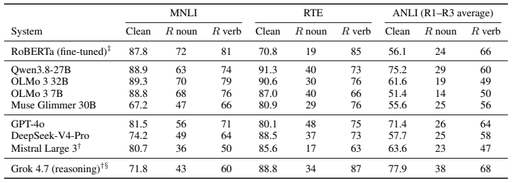
Table 1 : Clean accuracy (%) and share of performance above chance (R, %) maintained under the drop-NOUN and drop-VERB conditions. R is calculated from centred accuracy for open-weight LLMs and from accuracy for others (Section 3.4). ‡For MNLI and RTE, the RoBERTa-base model fine-tuned on clean data is used, and for ANLI, the public RoBERTa-large model from Nie et al. (2020) is used.†Answer scores are unavailable, and MNLI is evaluated on a 2,000-item sample. §Reasoning model, first 400 items per task.
Original paper · CC BY 4.0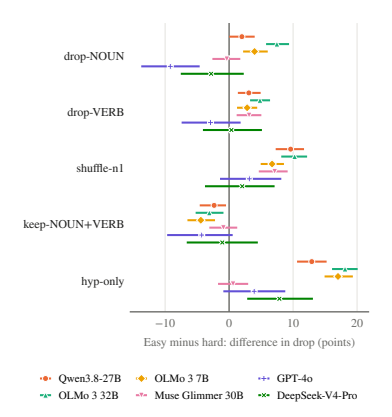
Figure 2 : MNLI degradation for items correctly classi- fied by the hypothesis-only classifier (easy items) minus the degradation for the remaining items (hard items), expressed as centred accuracy points with 95% boot- strap intervals. Positive values indicate less degradation for easy items. GPT-4o and DeepSeek-V4-Pro were evaluated on a sample of 2,000 items.
Original paper · CC BY 4.0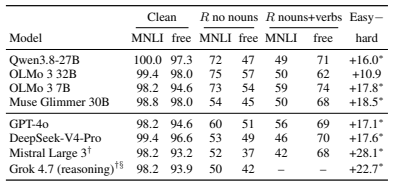
Table 2 : New items written in MNLI style or with- out cues (168 and 148 items): clean accuracy (%, cen- tred where answer scores exist), retention rate of per- formance above chance (R, %) under drop-NOUN and keep-NOUN+VERB conditions, and difference between easy and hard items in drop-NOUN drop for MNLI-style items (points, with ∗ for 95% confidence intervals ex- cluding 0). Symbols are the same as Table 1.
Original paper · CC BY 4.0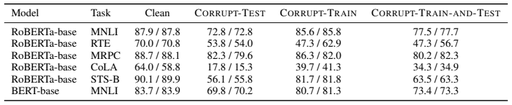
Table 3 : Published / reproduced scores for drop-NOUN. RoBERTa-base rows are compared with Talman et al. (2022), BERT-base with Talman et al. (2021). Metrics as in GLUE: accuracy (MNLI, RTE), F1 (MRPC), Matthews correlation (CoLA) and Pearson correlation (STS-B), all×100; ours are means over three seeds.
Original paper · CC BY 4.0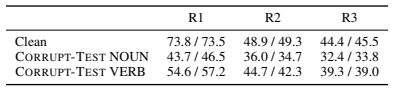
Table 4 : ANLI test accuracy (%) of the released RoBERTa-large model of Nie et al. (2020), published / ours. Clean scores are compared with Nie et al. (2020), perturbed ones with Talman et al. (2021), using that paper’s released files.
Original paper · CC BY 4.0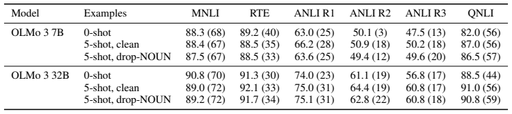
Table 5 : Clean centred accuracy (%) and, in brackets, the share of above-chance performance retained under drop-NOUN (R, %), with no examples, five clean examples or five examples with nouns removed. MNLI five-shot on the 2,000-item sample.
Original paper · CC BY 4.0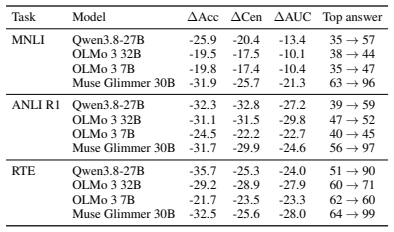
Table 6 : Change (points) under drop-NOUN in raw accu- racy, centred accuracy and AUC, and the share of items (%) given the most frequent answer, clean → perturbed. Zero-shot open LLMs.
Original paper · CC BY 4.0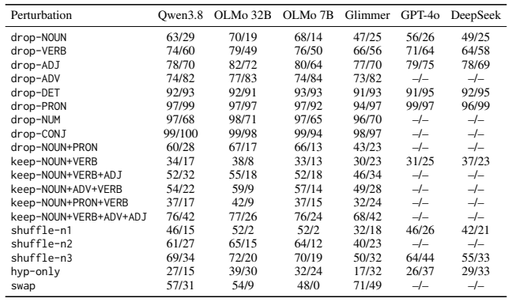
Table 7 : Share of above-chance performance retained (R, %, from centred accuracy) on MNLI / mean of the three ANLI rounds, for every perturbation; hosted models were run on the core set only (–).
Original paper · CC BY 4.0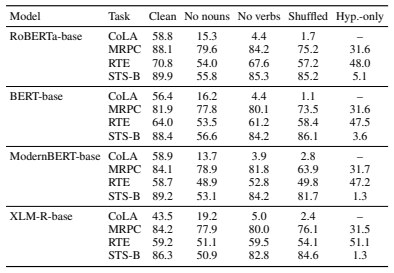
Table 8 : Fine-tuned encoders trained on clean data (means over three seeds; GLUE metrics×100).
Original paper · CC BY 4.0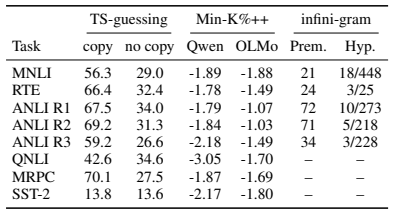
Table 9 : Contamination indicators. TS-guessing: exact- match rate (%) of Qwen3.8-27B filling in a masked word, when the word may also occur in the other field (copy) and when it may not. Min-K%++: mean score (higher suggests seen). infini-gram: premises (or first sentences) found in OLMo’s pre-training data (%), and hypotheses of at least 13 words found / all such hypothe- ses.
Original paper · CC BY 4.0Quote from the paper
Aarne Talman, Stergios Chatzikyriakidis (2026). Shortcuts or Memorisation? Revisiting Data Corruption in Natural Language Understanding with Large Language Models. arXiv:2611.16843v1. https://arxiv.org/abs/2611.16843v1
BibTeX
@misc{talman2026shortcuts,
  title = {{Shortcuts or Memorisation? Revisiting Data Corruption in Natural Language Understanding with Large Language Models}},
  author = {Aarne Talman and Stergios Chatzikyriakidis},
  year = {2026},
  eprint = {2611.16843},
  archivePrefix = {arXiv},
  url = {https://arxiv.org/abs/2611.16843v1}
}