Paper commentary
GlucoAgent: Personalized Glucose Forecasting from Multimodal Personal Context
GlucoAgent writes its own analysis code to forecast glucose from personal context
- Problem Fixed glucose forecasters gain little from personal signals like meals and smartwatch data. The useful signals differ across people and across moments, so one fixed analysis cannot fit every case.
- Method GlucoAgent is an LLM agent that writes and runs its own analysis code for each forecast. Unlike fixed models, it builds a new analysis from one person's context and returns a forecast with a reason and evidence.
- Results On CGMacros, GlucoAgent reached a 22.5 mg/dL mean RMSE, compared with 23.5 mg/dL for Chronos-2. Adding multimodal context cut its RMSE by 1.4 mg/dL.
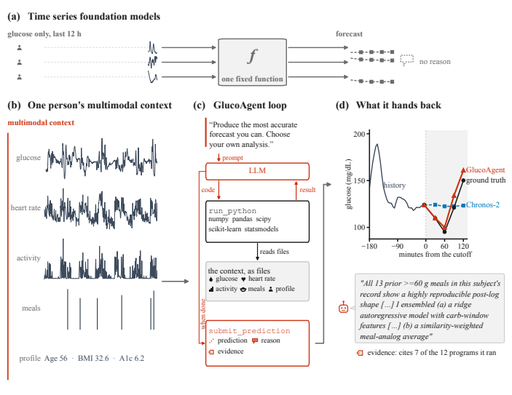
Figure 1 :One person’s multimodal context enters GlucoAgent. The agent writes and runs code to construct a case-by-case analysis, then submits a forecast with a reason and supporting evidence. (a)Time series foundation models receive the last twelve hours of glucose and return a forecast without a reason.(b)GlucoAgent receives one person’s glucose, heart rate, activity, logged meals and health profile.(c)The agent writes and runs code over that context, reads the outputs and continues until submission.(d)It returns each forecast with a reason and supporting evidence. In this example, it combines responses to the person’s past large meals with a regression fitted and validated on that person’s history.
Original paper · CC BY 4.0 · Xingzhi Sun, Hyo Jin Kim, Zhiyuan Wang, Hao Chen · GlucoAgent: Personalized Glucose Forecasting from Multimodal Personal Context · Original paper figure · Extracted the figure area from page 2 of the original PDF.Why fixed models gain little from personal signals
Continuous glucose monitors record glucose densely, while smartwatches, meal logs and health profiles add context about the same person. Forecasters that add this context have struggled to show substantial gains over glucose-only inputs. MetaboNet-Bench added insulin and carbohydrate inputs to five forecasting models, and 30-minute RMSE fell by 0.13 to 0.71 mg/dL.
The authors argue that such small gains point to underused context rather than to weak information. They suspect the cause is that the predictive value of a signal changes across people and across forecast moments.
A person's earlier meal responses may matter most when the forecast falls near a meal. A forecast made near a quiet period may instead depend more on recent glucose dynamics. Existing approaches fix the model class and the way context enters it during development, so every case gets the same analysis. That design leaves open whether building the analysis case by case, at forecast time, handles this variation better.
The authors test this idea with GlucoAgent, an LLM-based agentic system that builds an analysis from one person's context at each forecast. Its loop cycles through writing code, running it and reading the results until a forecast, a reason and evidence come out. Because each case gets its own analysis, the same system can treat different people and different times differently.
The authors call this a dynamic N-of-1 analysis.
Letting the agent build each analysis
GlucoAgent lets a language model choose a fresh analysis for each forecast, working on one person's data at that moment. GlucoAgent instead constructs the analysis case-by-case at forecast time, which is the question the authors chose to study. The agent loop follows ReAct, where tool outputs decide the next action, and PAL, where an interpreter performs the numerical work.
Each origin starts from a single JSON case file that holds only information available before the forecast origin. The prompt names no forecasting model, feature set, or look-back window, and says only to produce the most accurate forecast and choose its own analysis. The Python environment offers NumPy, SciPy, pandas, scikit-learn, and statsmodels, and the authors provide no pretrained glucose forecaster.
Because the agent builds a new analysis for each person and each time, it can use a meal-response history in one case and a fitted regression in another. The authors call this a dynamic N-of-1 analysis. Each forecast returns a reason and supporting evidence, which the authors argue makes the method more interpretable than a black-box forecaster.
The central comparison asks whether this per-case analysis beats a fixed model class that receives the same multimodal inputs.
On CGMacros, nine of 45 participants form the test set, giving 1,903 forecast origins spaced one hour apart. With multimodal inputs, GlucoAgent reaches a 22.5 mg/dL mean RMSE against 23.5 mg/dL for Chronos-2. Adding the multimodal context lowers GlucoAgent's RMSE by 1.4 mg/dL, while Chronos-2 improves by only 0.3 mg/dL.
One forecast from case file to submission
GlucoAgent starts from one JSON case file that compiles a person's records before each forecast origin. Only information available before the forecast origin is kept, to enforce causal boundaries. The case file holds glucose, heart rate, energy expenditure, and metabolic equivalents from the multimodal time series. It also holds detailed meal logs with timestamps, meal types, and macronutrient contents, plus a static health profile covering demographics, body measurements, and laboratory results.
The authors inject no hand-engineered features, so the agent decides which contextual elements matter for each case.
The prompt names no forecasting model, feature set, or look-back window, and it asks for the most accurate forecast with the agent's own analysis. The agent has two tools, a Python interpreter and a forecast-submission tool, and it follows the ReAct and program-aided reasoning pattern. The environment offers NumPy, SciPy, pandas, scikit-learn, and statsmodels, but no pretrained glucose forecaster or foundation model.
Because each reference points to code that actually ran, a claim in the reason can be traced back to its output. An incomplete submission or invalid reference returns an error, and the agent can correct it and retry. The authors use the submitted reason and evidence later to reconstruct individual forecasts.
Multimodal context against glucose history
On the nine held-out CGMacros participants, GlucoAgent with multimodal context reached a four-horizon mean RMSE of 22.5 mg/dL, against 23.5 mg/dL for Chronos-2. GlucoAgent had the lower RMSE at all four horizons, and its widest lead came at 60 minutes, at 22.1 mg/dL versus 23.7 mg/dL. The authors computed RMSE separately for each participant and horizon, then averaged across participants with equal weight.
The test that matters for the idea is how much each method gains when multimodal context is added to the glucose inputs. GlucoAgent's four-horizon mean fell from 24.0 to 22.5 mg/dL, a gain of 1.4 mg/dL, measured against the full glucose-history setting. Chronos-2 fell only from 23.8 to 23.5 mg/dL, a gain of 0.3 mg/dL, so the multimodal context helps GlucoAgent far more.
Across the four horizons, GlucoAgent's RMSE drops by 1.1 to 2.1 mg/dL with context, while Chronos-2's drops by 0.1 to 0.7 mg/dL.
Without multimodal context, GlucoAgent and Chronos-2 perform almost identically on the full glucose history. The two methods differ by at most 0.3 mg/dL at any horizon, so the gap that opens with context is absent without it. The authors read this pattern as evidence that the extra signals, rather than longer history, separate GlucoAgent from Chronos-2.
The post-meal windows show the same pattern most sharply, because GlucoAgent cuts the 60-minute RMSE there by 4.6 mg/dL, from 31.0 to 26.5 mg/dL. Chronos-2 cuts the same post-meal 60-minute error by only 0.8 mg/dL, from 31.9 to 31.1 mg/dL. The full situation breakdown appears in the next section, where Figure 2b reports these reductions.
Where the context helps most: after meals
The authors grouped each forecast origin as quiet, post-meal, post-exercise, or meal plus exercise, using the meal and exercise information available before it. Each origin falls into one of four situations, so the authors could compare the multimodal gain across physiological states rather than averaging over all origins. GlucoAgent gained most after meals, where adding the multimodal context reduced RMSE by 2.5 mg/dL on average.
At 60 minutes the post-meal reduction reached 4.6 mg/dL, which is the largest gain the paper reports for any situation and horizon. That 60-minute post-meal RMSE fell from 31.0 mg/dL to 26.5 mg/dL.
Chronos-2 gained far less in the same windows, with its post-meal RMSE reduced by only 0.9 mg/dL on average. At 60 minutes, Chronos-2's post-meal RMSE dropped by 0.8 mg/dL, from 31.9 mg/dL to 31.1 mg/dL. Chronos-2 instead improved most after exercise, by 1.5 mg/dL, so its pattern differs from GlucoAgent's.
The gap between the two models is largest in the post-meal situation, where the agent has the most meal-related signal to work with. The authors trace this gain to the agent's use of meal history, which the next section examines. Figure 3 shows that GlucoAgent read the meal log in 90% of post-meal cases, compared with 48% of quiet cases.
What the generated programs actually do
The programs differ by situation: in the 576-origin subsample, the cited programs read the logged meals in 90% of post-meal origins and 48% of quiet ones. They fit a model in 55% of quiet origins and in 37% of meal plus exercise origins. Meal reading is therefore most common after meals, and model fitting is most common in quiet periods.
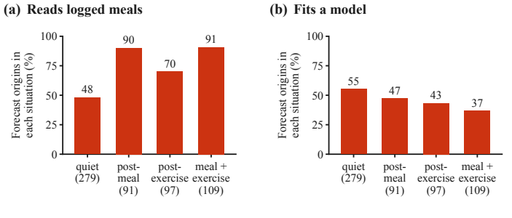
Figure 3 :The cited programs differ across forecast situations.Each bar shows the percentage of origins in a situation for which the cited programs read the logged meals or fit a model. The subsample contains 576 origins: 279 quiet, 91 post-meal, 97 post-exercise, and 109 meal + exercise.
Original paper · CC BY 4.0In a quiet case, it found 624 earlier windows meeting its falling-slope threshold and back-tested three rules: hold the value, continue the slope, or let the slope decay exponentially. The exponentially damped rule had the lowest mean absolute error in those back-tests, and the final forecast combined it with nearest-neighbour, historical-analogue and ridge estimates.
Over all 1,903 origins, the agent ran 14,468 successful programs, a median of seven per origin. It wrote its own function or class in 64% of origins. In the subsample, the combinations of signals, estimators and checks formed 186 patterns, and 120 of them occurred only once. The nine cases were picked before inspection as accurate forecasts with large glucose changes, so they illustrate behaviour rather than average performance.
Model choice and interface design
The authors kept the multimodal input fixed and varied the language model and reasoning effort, which shows how much the result depends on those choices. The other configurations raised the four-horizon mean RMSE by 1.1 to 5.2 mg/dL, so the choice of model matters a great deal. Claude Opus 5 at medium effort, Claude Sonnet 5 at high effort, Gemini 3.1 Pro at high effort and GPT-5.6-sol at high effort were the alternatives in this comparison.
The multimodal gain also depended on the model: it was 1.4 mg/dL for Claude Opus 5 at high effort and 0.3 mg/dL for Claude Sonnet 5 at high effort.
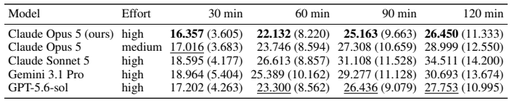
Table 2 :Claude Opus 5 at high reasoning effort has the lowest RMSE at every horizon among the tested configurations.Participant-level RMSE in mg/dL, mean (standard deviation) over the nine participants.Boldmarks the lowest and underlining the second lowest error at each horizon.
Original paper · CC BY 4.0The authors also built a hand-designed alternative interface that gives the agent six retrieval tools and a terminal submission tool instead of a Python environment. Both designs ran on the same 1,903 held-out CGMacros origins with the same language model, reasoning setting, input files, ground truth and scorer. The hand-designed interface had a four-horizon mean RMSE of 24.235 mg/dL at high effort, while the Python-environment design reached 22.526 mg/dL.
The Python environment was more accurate at all four horizons, by 1.71 mg/dL on the mean.
The two designs also differed in tool budget and in meal-photo input, so the comparison isn't a test of one changed factor. The hand-designed agent used a median of 4 model calls per origin and never more than 6 of its 7, so the budget didn't cut it off. The hand-designed interface could attach meal photographs as image input, while the authors' agent received only their timestamps.
The authors compared their design against one hand-designed interface, the one they built first, so other tool sets could do better. This result supports the design choice they made, but it doesn't show that hand-designed interfaces are worse in general.
Limitations and scope of the evidence
The multimodal results rest on CGMacros alone, because comprehensive open-source multimodal glucose datasets are scarce. The test set holds nine of the 45 participants, with three in each A1c range, so the numbers describe that group. The 1,903 origins are spaced one hour apart, and each participant's RMSE receives equal weight in the average.
The interface comparison tests one hand-designed alternative, the first interface the authors built. A different tool set or a different instruction could perform better, so the result doesn't rule out hand-designed interfaces in general. The two designs also differ in ways the authors didn't control, such as the per-origin budgets and access to meal photographs.
Its Mean-4 RMSE was 24.235 mg/dL, against 22.526 mg/dL for GlucoAgent. The Python environment beat the hand-designed interface by 1.71 mg/dL on the mean across horizons.
The multimodal gain depends on Claude Opus 5 at high reasoning effort, since every other configuration in the sweep had higher error. Claude Sonnet 5 at high effort shrinks the multimodal gain to 0.3 mg/dL, while Claude Opus 5 at high effort reaches 1.4 mg/dL. The sweep covers only five configurations, so other models and reasoning settings remain untested.
On glucose-only benchmarks, including the nine GlucoFM-Bench datasets, GlucoAgent is described as competitive with time series foundation models and CGM-LSM. The excerpt reports no per-dataset errors for these benchmarks, so the size of any gap can't be checked here. Matching the foundation models on univariate settings says nothing about the multimodal gain, which the glucose-only benchmarks don't test.
Paper info
- Authors
- Xingzhi Sun, Hyo Jin Kim, Zhiyuan Wang, Hao Chen
- Venue
- arXiv · Preprint
- First published
- 2026-11-3
- Added
- 2026-11-5
- Updated
- 2026-11-3
- Version
- v1
- arXiv
- 2611.04126
- Category
- cs.AI
- Original paper terms
- CC BY 4.0
- What we show
- Paper info, commentary and permitted figures from the original paper
AI commentary is a separate explanation from the original paper and may contain errors. The original paper and figures follow each source's terms of use and any rights noted separately.
Abstract
Continuous glucose monitors, smartwatches, meal logs, and health profiles form a rich multimodal personal context that can significantly enhance glucose forecasting. However, existing methods struggle to effectively utilize these signals to improve glucose prediction because the relevance of different modalities varies drastically across individuals and time. We present GlucoAgent, an LLM-based agentic system that addresses this challenge through dynamic, case-by-case analysis at inference time. For each forecast, GlucoAgent writes and runs code over an individual's multimodal context and returns predictions with a reason and supporting evidence. The generated programs are highly diverse, ranging from retrieving similar past meals to fitting and back-testing physiological and statistical models. On CGMacros, a multimodal glucose dataset, GlucoAgent outperforms time series foundation models on every forecasting horizon, achieving an average RMSE of 22.5 mg/dL compared to 23.5 mg/dL of Chronos-2, the leading multimodal time series foundation model. Furthermore, GlucoAgent is highly effective at leveraging multimodal data. The addition of multimodal data reduces its average RMSE by 1.4 mg/dL (24.0 mg/dL to 22.5 mg/dL), compared to a marginal 0.3 mg/dL (23.8 mg/dL to 23.5 mg/dL) improvement for Chronos-2. This advantage is most pronounced in challenging post-meal windows, where GlucoAgent uses multimodal context to reduce 60-minute forecast RMSE by 4.6 mg/dL (31.0 mg/dL to 26.5 mg/dL), far exceeding the 0.8 mg/dL (31.9 mg/dL to 31.1 mg/dL) reduction achieved by Chronos-2.
Quote from the paper
Xingzhi Sun, Hyo Jin Kim, Zhiyuan Wang, Hao Chen (2026). GlucoAgent: Personalized Glucose Forecasting from Multimodal Personal Context. arXiv:2611.04126v1. https://arxiv.org/abs/2611.04126v1
BibTeX
@misc{sun2026glucoagent,
  title = {{GlucoAgent: Personalized Glucose Forecasting from Multimodal Personal Context}},
  author = {Xingzhi Sun and Hyo Jin Kim and Zhiyuan Wang and Hao Chen},
  year = {2026},
  eprint = {2611.04126},
  archivePrefix = {arXiv},
  url = {https://arxiv.org/abs/2611.04126v1}
}