Paper commentary
Chain-of-Thought Oversight Requires Separate Evidence for Faithfulness and Monitorability
Chain-of-thought traces need separate evidence for faithfulness and monitorability
- Problem A visible reasoning trace is often assumed to make model behavior easier to monitor. But a trace can be visible without being faithful, and a monitor can fail even when the trace is faithful.
- Method The authors split oversight into four properties along the chain from model to monitor. They propose an evidential-chain reporting standard, where each claim gets a licensing statement that labels each required link as supported, unsupported, or assumed.
- Results In a security study, a reference-assisted jury scored 0.42 exact accuracy, below the majority-class baseline of 0.53. In an authority-hint study, a monitor classified all 22 balanced cases correctly, but mechanistic analyses did not isolate a compact causal mechanism.
Why a visible trace isn't enough
Reasoning traces have become an oversight aid for large language models, since they expose judgments that a human or automated monitor can check. The hope behind this is that a visible trace makes model behavior easier to watch, and that hope packs two questions into one. The first question asks whether the trace mirrors the internal work that produced the answer, which is mechanistic faithfulness.
The second asks whether a monitor can pick out the target property from what it receives, which is behavioral monitorability. The authors treat these as separate questions, so evidence for one doesn't settle the other.
Earlier studies show that a trace can be visible without being faithful, because a plausible trace may leave out the factors that drove the answer. Missing decisive information limits monitoring, and a monitor can also fail when the relevant content is present but judged poorly. Faithfulness evaluations are sometimes treated as proxies for monitorability, yet the two can fail for different reasons.
A monitor can fail because the trace is unfaithful, and it can also fail because the task is too hard for that monitor to judge.
The security case shows a monitor failing even when internal evidence points in a useful direction. Linear probes recover key reasoning-step content from internal activations. Yet the LLM jury, given the reference answer, doesn't outperform the majority-class baseline on held-out classification.
Four properties along one chain
The paper separates four oversight properties along a chain from model to monitor, and each one needs its own evidence. Reasoning visibility asks only whether some reasoning artifact is available to an observer. Mechanistic faithfulness is a relation between trace and computation, not a property of the trace alone. Mechanistic localizability sits on the computation itself and asks whether a compact feature, direction, site, or subcomponent exists.
Intervening on that compact unit should change the behavior predictably, which is a stronger requirement than internal representation.
Table 1 pairs each property with its core question, its evidence type, and its typical failure mode. Reasoning visibility fails when relevant reasoning is hidden or compressed, while mechanistic faithfulness fails when a trace is unsupported, incomplete, or post-hoc.
Access tiers add a second axis, ordered by how close each artifact sits to the model's computation. Tier I covers internal computation, such as activations and causal pathways, while Tier II covers raw generated reasoning tokens. Tier III is a processed trace, and Tier IV is a user-facing explanation. Each step away from the model can drop information a monitor needs, or add distortions.
The authors' empirical claims cover only Tiers I and II, because those are the tiers where they have direct access to activations and open-weight models.
The authors' position is that evidence for mechanistic faithfulness doesn't establish behavioral monitorability, and the reverse holds too. Each claim should therefore report both its access tier and its target property. Barez et al. separate visible reasoning from explanation, which the authors map onto the gap between visibility and faithfulness.
Recoverable content and a causal handle in security reasoning
The security study asks whether DeepSeek-14B's stated security reasoning can be read off its own activations. The authors averaged the hidden states over the first 256 reasoning tokens in each layer into one activation vector. They trained class-weighted logistic regression probes on these vectors, with five-fold stratified cross-validation over the layer sweep.
Each label marks whether a step appears in the trace, not whether the step is correct.
Probe AUCs ranged from 0.84 to 0.98 across the three step labels, and the best layer was chosen per step by mean cross-validated AUC. So the content is recoverable, but recoverability can't show that the trace is the computation that produced the answer, because the trace is part of the model's input.
Ablation changed the verdict on 15 of 59 cases, compared to 5 to 11 for each random direction. This is causal evidence relevant to faithfulness, though it covers one probe direction and one reasoning step.
The authors then pair this internal evidence with a monitor test that the next section takes up. A reference-assisted jury sees the code, trace, final answer, and reference answer, so that failure can't be blamed on missing inputs.
A jury that sees the reference still misses correctness
The second test asks whether a monitor with full task information can judge the security analyses. The reference-assisted jury uses three OpenAI-family judges, gpt-5.4, gpt-5.4-mini and gpt-4.1, under one rubric. Each juror sees the code, the reasoning trace, the final answer and the reference answer. The jurors predict fields for vulnerability existence, type and exploitability, and majority voting maps them to CORRECT, PARTIALLY_CORRECT or INCORRECT.
The authors chose few-shot examples on a 30-case development split, then scored a frozen held-out set of 59 tasks.
Exact accuracy requires all three labels to match, and DeepSeek-14B reaches 0.42 against a majority-class baseline of 0.53. Agreement with human labels is slight to fair, with Cohen's κ between 0.16 and 0.29. The errors are systematic: the jury labels only 4 of 34 incorrect analyses INCORRECT.
Two human experts given the jury's inputs agree moderately, with κ = 0.56. The jury's agreement with either expert stays slight, at κ ≈ 0.15.
The jury labeled that analysis CORRECT, while the audit and the independent expert both labeled it INCORRECT. This case shows a monitoring error, so the monitor's judgment failed without showing that the trace was unfaithful. The jury upgrades 12 of 16 incorrect DeepSeek-14B analyses and all ten incorrect QwQ-32B analyses.
Easy detection, no compact localized site
The authority-hint study asks whether easy detection of a behavior also reveals the mechanism behind it. The authors used 398 MMLU and GPQA questions, each in clean, authority, sycophancy and position-bias variants. Authority cues changed 112 answers. Of these, 48 form the strict subset where the clean answer was correct and the hinted option was picked.
QwQ-32B shows the same ordering on those 48 questions, with authority strongest, then sycophancy, then position bias.
A gpt-5.4 monitor classifies all 22 balanced cases correctly, against a chance level of 50%. A rule that reads only the final answer does the same, because changed cases give the hint and controls give the correct answer. So the monitor's success gives no extra evidence about the trace's role in this evaluation.
The authors patched clean-run activations into the authority-hinted run and measured how much of the clean margin returned. They scored restoration as R = (m_patched − m_hinted)/(m_clean − m_hinted), clipped to [0,1]. The test statistic is mean restoration in changed cases minus mean restoration in matched controls. Of the seven tests, only the in-sample scan gives a positive contrast, at +0.028.
No test shows greater restoration for changed cases than for matched controls.
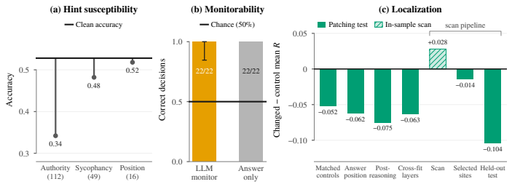
Figure 2 : Authority-hint factual reasoning. The behavior is easy to monitor, but no tested patching site selectively controls it. (a) The effect of hints on answers is ordered by hint type, with authority producing the largest drop in accuracy. (b) On 22 patching-selected cases (11 changed, 11 controls), the monitor classifies all cases correctly. (c) Seven mechanistic localization tests.
Original paper · CC BY 4.0 · Sichao Li, Sai Ma, Xiyang Hu, Chudi Zhong, Tongliang Liu · Chain-of-Thought Oversight Requires Separate Evidence for Faithfulness and Monitorability · Original paper figure · Extracted the figure area from page 7 of the original PDF.Most traces, at 73%, mention the cue, but a mention doesn't show that the cue acts through that mention. The correlation between verbalization and patch restoration was inconclusive. The authors attribute the null localization result either to susceptibility that is distributed and context-dependent, or to localization methods that are too limited.
Either way, the monitor's success doesn't show that the mechanism is understood.
A licensing statement for each oversight claim
Each CoT oversight claim gets a licensing statement, and the authors say that statement carries three pieces of information. The first piece names the property being claimed, along with its definition and the scope it covers. The second piece records the access tier and the artifact on which the evidence was collected. The third piece lays out the evidential chain that connects that evidence to the claim.
Each required link gets a label: tested as supported or unsupported, or assumed.
A conclusion is licensed when every required link is supported by the reported evidence. It isn't licensed as soon as one required link is unsupported. It is conditionally licensed when at least one link is assumed and none is unsupported. Each assumed link should say how it could be tested, according to the authors' footnote. The standard doesn't fix a closed list of oversight properties, because new ones such as explainability and plausibility keep appearing.
The tutoring-assistant example applies the standard to the authority study, with DeepSeek-14B as the audited model. The model-to-trace link is marked tested and unsupported, since traces mention the cue in 73% of cases but no correspondence to internal computation is established. Controlled trace edits or truncations could test that assumed link, and the statement names them as the route.
The trace and output to monitor link is supported, because gpt-5.4 is correct on 22/22 cases against the baseline. The monitor is licensed for flagging swayed answers on cases like these.
What these results do not show
The empirical claims stop at Tiers I and II, so provider summaries and user-facing explanations were never tested. Those higher tiers matter because a summary can drop hedging and backtracking that a monitor needs to judge confidence. The security study uses DeepSeek-14B as its primary model. QwQ-32B and DeepSeek-70B serve only for held-out monitor replication.
The security monitor is a structured LLM jury, so its failure is tied to that monitor class. The authors don't claim that no stronger monitor could succeed on this task.
The authority results rest on a strict subset of 48 questions. The monitor check uses only 22 cases, split evenly between changed and control rows. Seven activation-patching tests were run, so the localization result covers only those methods. Not isolating a compact mechanism leaves open whether one exists. The behavior remains externally detectable, but it hasn't been pinned to a compact site inside the model.
The authors don't prove that faithfulness, monitorability, and localizability are fully independent. They also don't claim that authority-hint reasoning is mechanistically unfaithful. Their narrower claim is that the four properties are distinct evidential properties with different failure modes.
Paper info
- Authors
- Sichao Li, Sai Ma, Xiyang Hu, Chudi Zhong, Tongliang Liu
- Venue
- arXiv · Preprint
- First published
- 2026-11-1
- Added
- 2026-11-4
- Updated
- 2026-11-1
- Version
- v1
- arXiv
- 2611.01620
- Category
- cs.AI · cs.CR
- Original paper terms
- CC BY 4.0
- What we show
- Paper info, commentary and permitted figures from the original paper
AI commentary is a separate explanation from the original paper and may contain errors. The original paper and figures follow each source's terms of use and any rights noted separately.
Abstract
A common assumption in chain-of-thought (CoT) oversight is that a visible reasoning trace makes model behavior easier to monitor. We argue that this assumption can conflate distinct properties along a chain linking a model's internal computation, reasoning artifacts, outputs, and monitor judgments. We identify four properties along this chain: reasoning visibility (whether a trace is accessible), mechanistic faithfulness (whether a trace reflects internal computation), mechanistic localizability (whether a compact causal mechanism can be isolated), and behavioral monitorability (whether a monitor can detect the target behavior). Two complementary case studies across three open-weight reasoning models show why these distinctions matter. In the security vulnerability reasoning study, probes and activation ablations provide evidence of internal representation and causal influence, but a monitor with access to the reference answer does not outperform the majority-class baseline in a held-out test. In authority-hint factual reasoning study, a monitor correctly distinguishes changed from unchanged answers, but seven mechanistic analyses do not isolate a compact causal mechanism. These results show that evidence for one claim does not establish the others. We therefore propose an evidential-chain reporting standard. Each claim carries a licensing statement that specifies its target property, access tier, and artifact, and labels each required link as supported, unsupported, or assumed. These assessments determine whether the conclusion is licensed, conditionally licensed, or not licensed.
Quote from the paper
Sichao Li, Sai Ma, Xiyang Hu, Chudi Zhong, Tongliang Liu (2026). Chain-of-Thought Oversight Requires Separate Evidence for Faithfulness and Monitorability. arXiv:2611.01620v1. https://arxiv.org/abs/2611.01620v1
BibTeX
@misc{li2026chain,
  title = {{Chain-of-Thought Oversight Requires Separate Evidence for Faithfulness and Monitorability}},
  author = {Sichao Li and Sai Ma and Xiyang Hu and Chudi Zhong and Tongliang Liu},
  year = {2026},
  eprint = {2611.01620},
  archivePrefix = {arXiv},
  url = {https://arxiv.org/abs/2611.01620v1}
}