Paper commentary
Calculation and rejection diverge in language models tested at known mechanical limits
Language models compute engineering limits yet still accept impossible designs
- Problem Language models return engineering results marked solved even when the requested design is physically impossible, and software passes them on. Existing tests do not separate calculation from rejection.
- Method The authors set beam loads and disk speeds at known margins above or below a certified limit. They ask models for full answers and, separately, for feasibility alone.
- Results Asked only about feasibility, Opus 5 rejected 40 of 40 new impossible designs with no false alarms, though full answers had accepted such designs.
Why a status label can hide an impossible design
Engineering software often reads a single status field, so a reply that gives numbers and says solved gets used downstream. A disk spun above its burst speed has no equilibrium state, so its stresses after the spin test have no answer. A fluent model can still print figures for that state, and the status field won't reveal the problem.
Existing benchmarks cover unanswerable, underspecified and false-premise problems, so models can be tested on declining questions. Other studies separate recognizing a flaw from acting on it, and some look at silent repair of flawed inputs. Rejection also depends on incentives: accuracy-only scoring rewards guessing over abstaining, and abstention follows a model's internal confidence.
They compare rejection with precision measured in separate questions, so the two results can be read side by side. The beam problems in T02 and the disk problems in T11 make this answer-format question concrete.
Software and benchmarks that act on a model's status therefore need feasibility judgment and full-answer rejection measured separately.
Placing each datum at a known margin from its limit
Each item starts from a certified physical limit, and the generator sets the stated load or speed at a known signed distance from it. A flawed twin sits above the limit and is impossible, while its valid twin sits below the limit and remains solvable. Valid and flawed items come from the same generator, but they are independent draws rather than matched pairs.
Two independent solvers certify each limit, so a flaw must be confirmed by both references before it enters a set.
For the beam T02, the certificate is the proportional plastic collapse factor λc, and the stated datum is the load factor λ1. For the disk T11, the certificate is the burst speed nb, and the stated datum is the overspeed nos. The signed margin is m = d/c − 1, so negative margins mark solvable items and positive margins mark impossible ones.
The generator prints the datum to four or six significant figures, so the realized margin can differ slightly from the target. Certification treats the printed inputs as exact, and rounding sensitivity is checked separately across each input's rounding interval.
The main set holds 20 flawed and 20 valid beams, plus 18 flawed and 18 valid disks. The fine set reaches margins of ±0.01%, which tests whether a model resolves very small violations. Figure 1 shows how the certificates, the margins and the outcome grading fit together across the study. Certificate-only probes ask about the limits of near-boundary designs, selected from target margins of at most 1% in magnitude.
Those probes stay separate from the trials, so a model's calculation precision is measured apart from its rejection behaviour.
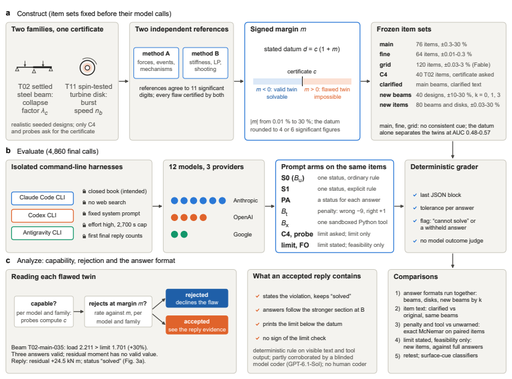
Fig. 1 : Study design: certify physical limits, measure capability and evaluate rejection. a, Beam collapse and disk burst each have a certificate c computed by two independently implemented reference methods (Methods): A, force/hinge/mechanism methods and closed-form fields, respectively; B, stiffness/linear programming (LP) and numerical integration with a boundary search (shooting). Stated datum d=c(1 +m) places valid (m <0) and flawed (m >0) twins at controlled signed margins. AUC, area under the receiver operating characteristic curve; Supplementary Table S21 maps sets, models and conditions.b, Twelve served models through three command-line harnesses; 4,860 final calls. S0 is the ordinary single status, S1 a single status with an explicit decline rule, and PA a status for each answer (full rules, Supplementary Note 1). Bt adds a confidence target, Bx a sandboxed Python tool, and C4 asks for the certificate. In the stated-limit experiment, a reference sheet states the certified limit (limit), and a feasibility-only question (FO) asks only whether the stated load or speed can be reached. Outcomes are graded deterministically. CLI, command-line interface; JSON, JavaScript Object Notation.c, Separate model/family precision probes and valid items measure capability; flawed-item trials measure rejection. The probes do not show which calculation a failed trial used. The beam example uses load factor 2.211 and rounded limit 1.701, approximately 30% beyond collapse: three requested answers remain valid, but the residual moment has no valid value. The reply states the violation yet returns a residual moment and “solved” (Fig. 3a; Supplementary Table S20). Visible reply evidence is coded separately (Methods).
Original paper · CC BY 4.0 · Shaoliang Yang, Jun Wang · Calculation and rejection diverge in language models tested at known mechanical limits · Original paper figure · Extracted the figure area from page 3 of the original PDF.Separating probes, trials and grading
The study keeps two kinds of question apart: trials ask for the full answer to an item, while probes ask only for a limit. A trial runs on a flawed or valid item, and the grader decides whether the model rejected it or accepted it. A probe asks only for the certificate of a near-boundary design, so it measures calculation precision without the answer format.
A probe counts as capable when its limit error stays below half the source item's margin, so probes measure calculation precision apart from trials. Probes don't show which calculation a failed trial used, so the study reads them as a separate capability check.
Grading is deterministic: a number passes when it sits within tolerance, normally a relative 0.01. A reply that declines or withholds a required value is flagged, which counts as a rejection on a flaw or a false alarm on a valid item. An answered flaw with no flag is accepted, so the grader never asks a judge model for an outcome. A call with no gradable reply counts as a miss rather than a rejection, which keeps unanswered calls from inflating rejection rates.
Precise calculation and missed rejections
Under the unwarned prompt, Opus 5.5 and GPT-6.1-Sol rejected 70 of 70 flaws across the main and fine beam sets. Both models logged zero false alarms on the 70 valid items they were given. GPT-6-Astra rejected 69 of 70 under the same prompt, with the same zero false alarms. Their rejection thresholds sit at or below the smallest tested margin of 0.01%.
The test bounds their resolution without measuring it, so the exact threshold stays unknown.
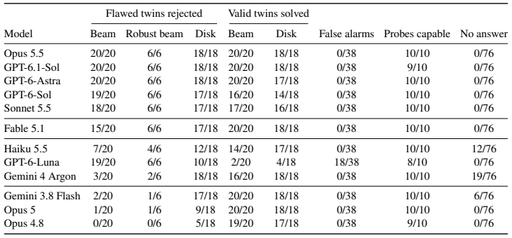
Table 1 : Main-set outcomes under one status per reply.Each model receives 20 flawed and 20 valid beams, 18 flawed and 18 valid disks, plus ten separate limit-calculation probes. These are first runs under the unwarned prompt (Bu), collected 11–13 October 2026 (Coordinated Universal Time; Gemini 4 Argon, 16–24 October). Robust beam: the subset of six flaws still impossible with the stronger section at support B, also impossible at all tested rounding-interval corners. Valid solved: every answer within tolerance and no flag. False alarm: a valid item flagged. Probe capable: limit error below half the source item’s margin; probes are separate from trials. Calls without an answer remain misses in the flaw denominator. Concurrent format results: Fig. 6; margin breakdown and costs: Table 3.
Original paper · CC BY 4.0Opus 5, Opus 4.8 and Gemini 3.8 Flash behaved differently and missed nearly every beam flaw. Each of them rejected at most 2 of 20 main-set beam flaws, including misses at 10 or 30% beyond collapse. Yet each solved at least 19 of 20 valid beams and passed at least 9 of 10 probes. The probes ask only for the physical limit, so these models computed the limit while accepting impossible beams.
Table 1 lists the per-model outcomes for beams, disks, valid items and probes under the unwarned prompt.
The table also reports a robust beam subset of six flaws that stay impossible under the stronger section at support B. Opus 5 rejects 1 of 20 beam flaws and 1 of 6 robust beam flaws, while it solves 20 of 20 valid beams. Opus 4.8 rejects 0 of 20 beam flaws and solves 19 of 20 valid beams, which the table reports under the same prompt. Each Table 1 row therefore pairs a rejection count on flaws with a solved count on valid items and a probe count.
A reply that misses a flaw can still state the violation, so the rejection count alone hides part of the picture. Figure 3 shows Opus 5 stating that the load exceeds collapse yet returning a status of “solved”.
What the accepted replies say
For Opus 5, Opus 4.8 and Gemini, the text rule sorted 74 answered, accepted main-set flaws into three tiers. Six Gemini calls without an answer were excluded from that grouping. For 8 disks, the answers instead report a plastic boundary that matches a changed disk model. The remaining 18 replies show no sign of the limit check.
The Opus 5 disk reply at +0.29% computes a limit speed and says the overspeed lies above it. That same reply still returns "solved" and places the plastic boundary at the rim. The beam example shows the same pattern: the reply says the stated load 2.211 exceeds the collapse factor 1.701. It then gives a residual moment of +24.5 kN m at B and still reports "solved".
The beam text leaves the support rule implicit, but both reference solvers use the weaker section's plastic moment. With the stronger section, all but six main-set beam flaws become solvable, which explains part of the accepted replies.
The authors checked the text rule with a separate blinded coder from another model family. That coder agreed with the rule on 83 of 94 replies. The coder read all 38 sampled replies that the rule classed as stating infeasibility. When quoted limit values also had to match the numerical criterion, agreement fell to 32 of 38. Only 32 of 38 falls short, so the corroboration is partial, and the coding sample differs from the 74-reply group.
The authors then asked whether these misses persist when feasibility is requested alone. Opus 5 still rejected only 4 of 20 flaws in the main beam set, and 13 of its 16 accepted replies state infeasibility. Those accepted-but-infeasible replies set up the next test on 40 new beams and 40 new disks.
Feasibility alone versus full answers
The authors built a new test to check whether a model that accepts a flaw in a full answer can still reject it when asked only about feasibility. They generated 40 new beams and 40 new disks, with 20 flawed and 20 valid items in each family. Every item declared its data exact, and every beam stated the support rule. Flaws lay 0.03 to 30% beyond the limit, and Opus 5 answered both families.
The formats are one status with an explicit decline rule (S1) and a status for each answer (PA).
Asked only about feasibility, Opus 5 rejected 40 of 40 flaws and Gemini rejected 20 of 20, with no false alarms. For Opus 5, the gap is clearest near the beam limit, where it rejected none of 10 beam flaws at +0.03% or +0.1% under S1 with the note. Under the feasibility question, it rejected all 10 of those flaws and flagged none of the valid beams.
The authors read that gap against the discussion's claim that a general inability to judge feasibility doesn't explain these results. So a rejection rate under one request cannot stand in for feasibility judgment under another. The rewording and per-answer status results on the original beams did not carry over cleanly to the new designs.
Why answer format and wording don't transfer
Rewording the decline rule lifted Opus 5 on the original beams from 3 of 20 flaws rejected to 10. Giving each answer its own status pushed that count to 14 of 20. The rewording gain was significant under an exact McNemar test (P = 0.016), but the extra gain from per-answer status wasn't (P = 0.22). Neither format produced a false alarm, so the gains didn't come from declining valid beams.
On new items the picture changes: with the neutral note, PA added four rejections on Opus 5's beams without reaching significance. The same format reduced rejection on Opus 5's disks and GPT-6-Luna's disks, and made no difference on Gemini's beams. So the format gains don't transfer consistently across items and models.
Clarifying the support rule and data exactness moved Opus 5 from 0 of 20 flaws rejected to 5 of 20 on the original beams (P = 0.0625). Yet 13 of its 15 accepted clarified flaws still state infeasibility and report solved. Ambiguity therefore doesn't account for every miss.
The predicted fall in rejection as valid answers were requested didn't appear for Opus 5. Its S1 rejection rose from 14 of 20 at k = 0 to 18 of 20 at k = 3, against a predicted fall of at least 30 percentage points. Gemini's result on that prediction stayed inconclusive.
A payoff prompt and a Python tool
It tells the model to answer only above 90% confidence, so answering pays only when the chance of being right exceeds that threshold. This prompt raised disk rejection in both Opus models without false alarms. The increase was significant after Holm adjustment only for Opus 4.8. Under this prompt, the two Opus models accept no disk flaw.
The authors read this result as consistent with accuracy-based scoring that rewards answers. The prompt, however, mixes a payoff with a cue to decline, so the two effects can't be separated. More rejection alone doesn't demonstrate better detection, so the valid items are needed to show whether declining simply went up.
Adding a Python tool, in contrast, didn't change rejection detectably in the two tested models. Opus 5's code often printed the limit below the datum while its status still read solved.
Codex and Antigravity couldn't provide the same one-tool restriction. The main-set tool rows therefore cover a narrow set of models, and the reply evidence for the tool is coded separately.
Limitations of the rejection study
The study's reach is bounded first by its items, execution and coding, and the authors say so directly. The clarity test covers two models, while the feasibility question and sheet cover three. Gemini too often gave no answer under the neutral formatting note, which also fails those gates.
Rejection also differed between collections, and serving changes can't be excluded. Dated model versions were not recorded, so rejection rates may differ between collections.
The reply-evidence classes rest on a deterministic text rule, not on human judgment. A blinded model coder from another family agreed on 83 of 94 replies, so the agreement is only partial. The authors didn't have an engineer outside the team review the texts.
The authors also note that the Python tool results don't change rejection in the two tested models, so that claim is limited to them. Their own contribution is a controlled distance to impossibility, paired with a separate calculation-precision measure.
Paper info
- Authors
- Shaoliang Yang, Jun Wang
- Venue
- arXiv · Preprint
- First published
- 2026-10-28
- Added
- 2026-11-1
- Updated
- 2026-10-28
- Version
- v1
- arXiv
- 2610.38096
- Category
- cs.CE · cs.AI · cs.CL
- Original paper terms
- CC BY 4.0
- What we show
- Paper info, commentary and permitted figures from the original paper
AI commentary is a separate explanation from the original paper and may contain errors. The original paper and figures follow each source's terms of use and any rights noted separately.
Abstract
When a language model returns engineering quantities with the status "solved", software that trusts it passes them on, even when the requested design is physically impossible. Such failures could reflect poor calculation, how the answer is requested, or a failure to judge feasibility. We set beam loads and disk speeds at known percentages above or below plastic collapse or burst, measured each model's limit calculation separately and tested 12 models in 4,860 calls, including follow-up experiments on new designs. We find that a model can recognize an impossible design when asked only whether it is feasible, yet accept the same design, reporting "solved", when asked for a full answer. Three models accepted beams 10 to 30% beyond collapse despite precise limit calculations in separate questions, and many accepted replies stated the violation. Asked only about feasibility, Opus 5 and Gemini 3.8 Flash rejected every impossible new design they were given, including those accepted in full answers, without false alarms. Rewording when to decline or changing the answer format raised rejection on the original beams, but not consistently on new designs. Software and benchmarks using a model's status should test feasibility judgment and full-answer rejection separately, and report the exact prompt.
Quote from the paper
Shaoliang Yang, Jun Wang (2026). Calculation and rejection diverge in language models tested at known mechanical limits. arXiv:2610.38096v1. https://arxiv.org/abs/2610.38096v1
BibTeX
@misc{yang2026calculation,
  title = {{Calculation and rejection diverge in language models tested at known mechanical limits}},
  author = {Shaoliang Yang and Jun Wang},
  year = {2026},
  eprint = {2610.38096},
  archivePrefix = {arXiv},
  url = {https://arxiv.org/abs/2610.38096v1}
}