Paper commentary
Multiclass Classification with Rare Useful Features: Fundamental Limits and the Optimality of Diversity Pursuit Higher Criticism Thresholding
Diversity pursuit with higher criticism finds rare useful features for multiclass classification
- Problem Binary theory cannot say how adding classes changes when classification with rare useful features is possible. A feature can help separate many classes without separating any one pair, so the binary results do not carry over.
- Method DP-HCT screens features in three steps. It runs ANOVA or Kruskal-Wallis tests per feature, applies a higher-criticism threshold to the p-values, and then classifies by similarity to class means.
- Results A new, harder phase transition appears when the number of classes grows with log p.
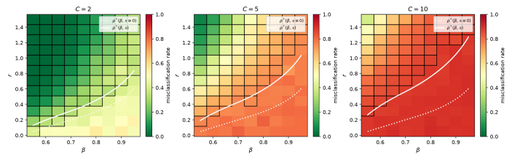
Figure 2 :DP-HCT misclassification phase transition. Misclassification rate (color) over a grid of (β, r)values for C∈ {2,5,10}, under the Gaussian multiclass Rare-and-Weak Useful Feature model with p= 2,000 , nMonte = 150. The x-axis is the sparsity exponent β and the y-axis is the calibrated signal strength r. Configurations in which the misclassification rate is above chance are marked with black frames. Solid white: the theoretical phase transition curve (Theorem 2). Dotted white: the phase transition curve corresponding to a fixed number of classes, derived in Donoho and Jin [2008].
Original paper · CC BY 4.0 · Gabriel Moryoussef, Alon Kipnis · Multiclass Classification with Rare Useful Features: Fundamental Limits and the Optimality of Diversity Pursuit Higher Criticism Thresholding · Original paper figure · Extracted the figure area from page 9 of the original PDF.Why the number of classes matters
Many high-dimensional classification problems keep their class information in a few coordinates, so screening features before fitting a classifier is a common step. In the binary case, the rare-and-weak useful-feature framework says when such screening can succeed, even when each informative feature is weak. With several classes, a feature can help without separating any one pair of classes, because it can shift many classes in different ways.
Earlier multiclass work on higher criticism for clustering reports promising results, but its theory doesn't incorporate growth in the number of groups. The open question is therefore how the number of classes moves the line between possible and impossible classification. They pair this model with a screening rule that applies higher criticism to per-feature diversity p-values, which finds the useful coordinates.
The fixed-class case recovers the binary boundary, so the binary theory doesn't settle the multiclass question by itself. This extra difficulty comes from the growing degrees of freedom, which change the tail rate of each useful feature. Their analysis separates the regime where C is o(log p), which keeps the binary boundary, from the regime where C grows like 2s log p.
A rare diversity model of useful features
A useful feature here is one whose class means differ in a way a per-feature diversity test can detect, while most features carry no class information. Each feature is useful with probability epsilon, and the theory takes epsilon to be p to the power minus beta, with beta between one half and one. Given its class, a sample is Gaussian with the class centroid as its mean and a shared noise variance on every coordinate.
The authors use a single parameter tau to set how strong the useful class-mean contrasts are.
The central move is to give each useful feature a class-mean contrast of fixed size in a random direction, rather than a contrast along a chosen pair of classes. Concretely, the centred contrast vector is drawn uniformly from a unit sphere in the space orthogonal to the all-ones vector, then scaled by sqrt(C) and tau. Because the direction is random, the construction stays symmetric across classes, and for two classes it reduces to a random sign.
Non-centrality is zero for null features, and equals 2r log p for each useful feature. So the signal strength r sets how detectable each useful feature is.
Spherical priors of this kind are common in high-dimensional inference because they keep the symmetries of the null model. The authors note that such priors often give analytically tractable, least-favorable alternatives. The paper also mentions that deterministic constructions of the useful set are possible, though harder to analyze.
How DP-HCT selects features and classifies
DP-HCT runs three steps, and each step consumes the output of the one before it. The first step runs a per-feature diversity test on every feature j and converts it into a p-value pi_j. The authors allow either the ANOVA F-test or the Kruskal–Wallis test as that per-feature diversity test. Because both tests are null-calibrated, every feature's p-value sits on the same scale, even when different features use different tests.
The ANOVA F-test compares the between-class sum of squares with the within-class sum of squares, giving the statistic f_j. Its p-value comes from an F distribution with C-1 and n-C degrees of freedom. The Kruskal–Wallis test works on ranks instead, so it doesn't need a parametric assumption about the marginals. Its statistic KW_j is compared with a chi-square distribution with C-1 degrees of freedom, which is why the authors call the rank test useful for heavy-tailed or skewed marginals.
The second step sorts the p-values into order statistics pi_(1) up to pi_(p). DP-HCT then computes the HC statistic for the first floor(gamma0 p) indices, using the rank fraction j/p against the observed p-value, scaled by the square root of t_j(1-t_j). The authors set gamma0 to 1/2 in all evaluations, which encodes a prior guess about the proportion of useful features.
The index j* that maximizes the HC statistic sets the threshold at pi_(j*). DP-HCT keeps every feature whose p-value is at or below that threshold, and that kept set is the screened feature set. The classifier then scores a test point against each class using the inner product with the selected-feature class centroid, and predicts the class with the highest score.
The HC threshold never uses the model parameters, and the authors stress that as a feature of the procedure.
The classification boundary as the number of classes grows
The main result is a function ξ⋆(β, s) that marks a sharp transition in r as p grows. Below the boundary no classifier beats chance asymptotically, and above it accuracy tends to one. The parameter s sets how fast the number of classes grows with log p, which is the new ingredient compared with the binary model. The growing-class regime is C−1 ∼ 2s log p with a fixed s greater than 0.
The derivation starts from the tail of a useful feature's ANOVA numerator, a noncentral chi-square with C-1 degrees of freedom. The authors bound this tail with a Chernoff bound and an exponential tilt, adjusted for the growing degrees of freedom. The tilted law concentrates the mean of W_p near x+ε, which gives the matching lower bound on the exponent.
The F-test p-value inherits this exponent, because the within-class denominator concentrates around its mean.
The p-value exponent Ψ_{r,s}(q) is combined with the HC growth term into the boundary exponent E_p(q) = 1/2 − β + q² − Ψ_p(q). The sign of the maximum of E_p over q decides whether the boundary is crossed. The paper also shows that the boundary is strictly increasing in s, and that ξ⋆(β, 0) = ρ⋆(β).
Figure 1 shows the boundary as β varies and as s varies, with the large-s approximation drawn as a dashed line. Larger s shifts the boundary upward, so the signal strength r needed for nontrivial classification grows. For large s, the paper gives the approximation ξ⋆(β, s) ∼ √(2sρ⋆(β)) as a limit of the fixed-s boundary.
Simulations against the ideal threshold
The simulations draw data from the multiclass model with p = 2,000 features, using 150 independent problem instances at each (β, r) grid point. After feature screening, each instance is classified with the centroid-similarity classifier, and the misclassification rate is recorded. The misclassification rate is shown over a grid of (β, r) values for C in {2, 5, 10}, and cells significantly above chance get black frames.
Two theoretical boundaries are overlaid on every heatmap: the solid curve r = ξ⋆(β, s) and the dotted curve r = ρ⋆(β).
As C increases, the boundary rises, which the authors attribute to the increased difficulty of multiclass discrimination. The growing-class boundary ξ⋆(β, s) is established in Theorems 1 and 2, and it assumes that C increases with p. The dotted boundary ρ⋆(β) is derived in Donoho and Jin [2008] and corresponds to a fixed C. The above-chance region follows the growing-class boundary better than the fixed-class boundary, and the authors say this holds even for small C.
The authors read this as evidence that the growing-class boundary describes the finite-sample behaviour better.
The threshold comparison pits DP-HCT against an ideal threshold of (14), which thresholds the ANOVA p-values at the best possible level. The ideal threshold is not a function of the data, so it can't be computed in practice. DP-HCT is also compared with Benjamini-Hochberg FDR at level 0.10 and with Bonferroni correction at α = 0.05. The comparison runs on data from the same model with p = 2,000 and nMonte = 150, at a fixed r and several values of C.
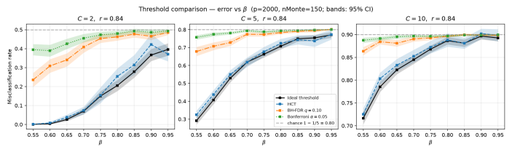
Figure 3 :Threshold comparison:classification error vs. β for a fixed r value and several value of C (p= 2,000 , nMonte = 150 ). Solid black: ideal threshold of (14); dashed blue: DP-HCT; dash-dot orange: Benjamini-Hochberg’s False-Discovery Rate (BH-FDR) at level 0.10; dotted green: Bonferroni (α= 0.05 ). Dashed grey: chance-level error 1−1/C . It can be seen that DP-HCT classification performance closely follows the ideal threshold’s performance.
Original paper · CC BY 4.0The authors report that the classification error of DP-HCT closely follows the error of the ideal threshold across β and C. Because the ideal threshold needs the unknown model, matching it is the useful benchmark for DP-HCT. The dashed grey line marks the chance-level error of 1 − 1/C, so the gap to chance shows the above-chance region.
Real multiclass benchmarks: does screening help?
The authors tested DP-HCT on five public biological multiclass benchmarks where p exceeds n, covering gene expression, metabolomics and miRNA expression. Heart-Circadian has 130 mouse-heart expression profiles, 8 times of day and 46,120 probes, the largest feature count of the five. Worm-Bacteria has 72 C. elegans profiles over 4 bacterial diets with 672 features.
Zebrafish-BPF and Biliary-miRNA add 62 and 36 samples, with 117 metabolite features and 803 miRNAs.
Both classifiers, a radial-basis-function SVM and ℓ2-regularized multinomial logistic regression, were trained on the full feature matrix as baselines. Each classifier was then trained again after DP-HCT screening, and the number of retained features was recorded as '# Sel.'. Accuracy was averaged over 10-fold unit-stratified cross-validation, or 7-fold for Heart-Circadian.
The table shows both classifiers higher after screening on all five benchmarks, so the gain doesn't rest on one classifier.
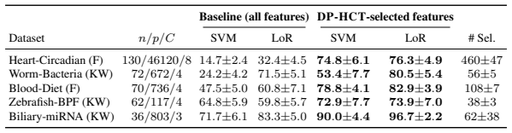
Table 1 : CV accuracy (mean ± SEM, %) for classification post-DP-HCT feature screening with ANOV A F ("F") or KW ("KW") tests; results are averaged over 10-fold, unit stratified cross-validation (7-fold for Heart-Circadian). “# Sel.” is the mean number of features retained by DP-HCT.
Original paper · CC BY 4.0The diversity test was chosen per dataset, either ANOVA F or Kruskal–Wallis, by whichever gave higher classification accuracy. That choice was made on the same evaluation numbers that the table reports, so the reported gains are optimistic.
Limits of the theory and the evidence
The theory assumes a balanced design, with the same number of observations n_c = n/C in every class. Unbalanced designs are left as future work, so the results don't cover class imbalance. The useful-feature set is random, with each coordinate becoming useful independently with probability ϵ. Deterministic constructions of the useful set are also possible, but they are slightly harder to analyse.
The impossibility proof is written for the spherical homogeneous contrast model. Each feature is set as useful with probability p to the power minus beta, where beta lies in (1/2, 1). The authors prove the impossibility result under a strict below-boundary condition, written as a uniform bound on the exponent. That strict formulation is the one the proof uses, so the result is stated only in that regime.
The five real benchmarks are small, with between 36 and 130 samples per dataset. With samples this few, the accuracy estimates carry wide uncertainty. For the diversity test, the authors used either ANOVA F or Kruskal–Wallis, whichever gave higher accuracy. Because that choice was made by comparing accuracies, it isn't a test fixed in advance.
The experiments with many appended pure-noise features are reported in Section B.4 of the Supplementary Material. The real-data experiments measure classification accuracy after screening, not the phase-transition boundary itself.
Paper info
- Authors
- Gabriel Moryoussef, Alon Kipnis
- Venue
- arXiv · Preprint
- First published
- 2026-11-1
- Added
- 2026-11-4
- Updated
- 2026-11-1
- Version
- v1
- arXiv
- 2611.02255
- Category
- stat.ML · cs.LG · math.ST
- Original paper terms
- CC BY 4.0
- What we show
- Paper info, commentary and permitted figures from the original paper
AI commentary is a separate explanation from the original paper and may contain errors. The original paper and figures follow each source's terms of use and any rights noted separately.
Abstract
We consider classification in high-dimensional feature spaces where only a vanishing fraction of features are useful and the number of classes may be large. While this rare-and-weak useful-feature regime is well understood in the binary setting, its multiclass version raises new questions: a feature can be useful for class discrimination without separating any specific pair of classes. We focus on a rare feature diversity model, in which most features are useless, but a small fraction promote discrimination among classes in a way that can be detected by a per-feature diversity test, such as one-way ANOVA or the Kruskal-Wallis test. For this setting, we propose Diversity Pursuit Higher Criticism Thresholding (DP-HCT), a feature-screening procedure that applies a higher-criticism threshold to the collection of p-values obtained from per-feature diversity tests. We justify DP-HCT under a Gaussian multiclass Rare-and-Weak Useful Feature model with class-mean contrasts of fixed magnitude in random directions, extending the binary model of Donoho and Jin (2008). When the number of classes is fixed, our model recovers the binary phase transition. When the number of classes grows logarithmically with the number of features, however, we derive a new and strictly harder phase transition, driven by the growing degrees of freedom and their effect on the useful-feature tail rate. We show that whenever classification beyond chance is possible, DP-HCT with ANOVA, followed by a simple classifier based on similarity to class means, achieves asymptotically perfect accuracy. Experiments on real multiclass classification benchmarks demonstrate substantial improvements, and numerical simulations confirm that the derived phase-transition curve accurately predicts the finite-sample behavior of DP-HCT in the growing-class regime.
Quote from the paper
Gabriel Moryoussef, Alon Kipnis (2026). Multiclass Classification with Rare Useful Features: Fundamental Limits and the Optimality of Diversity Pursuit Higher Criticism Thresholding. arXiv:2611.02255v1. https://arxiv.org/abs/2611.02255v1
BibTeX
@misc{moryoussef2026multiclass,
  title = {{Multiclass Classification with Rare Useful Features: Fundamental Limits and the Optimality of Diversity Pursuit Higher Criticism Thresholding}},
  author = {Gabriel Moryoussef and Alon Kipnis},
  year = {2026},
  eprint = {2611.02255},
  archivePrefix = {arXiv},
  url = {https://arxiv.org/abs/2611.02255v1}
}