Paper commentary
Q-OIL: Optimistic Exploration in Learning from Human Interventions
Q-OIL shows optimistic bonuses on human interventions speed up robot learning
- Problem Simulated human models assume people take over when a single action looks suboptimal. Real people intervene when progress stalls, and their corrections are often suboptimal, so algorithms tuned on simulators can rank differently with real users.
- Method Q-OIL adds an optimism bonus to transitions where a human intervened. Unlike single-critic methods, it trains a task critic and a separate optimistic critic, so the bonus never flows back into earlier states.
- Results Q-OIL achieved 10-50% higher success than competitive baselines in simulation and on real robots. On real-user rankings, the progress-aware human model reached a Spearman correlation of 1.0.
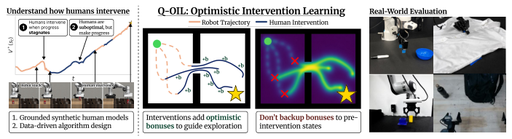
Figure 1 :Overview ofQ-OIL. Real-user data shows that humans intervene when robot progress stalls and provide suboptimal corrections.Q-OILtreats interventions as optimistic exploration bonuses while preventing bonuses from propagating to non-intervention states for faster real-world learning.
Original paper · CC BY 4.0 · Pranav Teegavarapu, Sriyash Poddar, Rico Qi, Cleah Winston, Krisha Khandelwal, Aykut Onyol, Natasha Jaques, Abhishek Gupta · Q-OIL: Optimistic Exploration in Learning from Human Interventions · Original paper figure · Extracted the figure area from page 2 of the original PDF.Why simulated human models can mislead
Learning from interventions needs many training runs, and real-user studies are slow to repeat. So researchers lean on simulated humans to decide when a takeover happens and what the takeover looks like. Luo et al. use a Markovian model of intervention decisions, based only on instantaneous action suboptimality relative to a reference policy.
If real people respond to something else, a method tuned on the simulator can rank differently once real users take part.
The authors argue that this gap matters because both evaluation and algorithm design depend on how the human is modeled. Simulated human models are expected to enable repeatable evaluation and to guide choices such as how to incorporate corrections. Corrections are also commonly treated as demonstrations, which assumes the human policy is near-optimal.
The authors instead test that assumption against real intervention data from 8 participants, and find that interventions are more suboptimal than the reference policy and human demonstrations. Their analysis shows that humans intervene when progress stagnates over a horizon, rather than reacting to instantaneous suboptimality. If a simulated gate ignores this, it can mislead conclusions drawn from experiments on it.
What real participants did during takeovers
The authors ran a pilot with 8 participants supervising a simulated robot on 3 manipulation tasks. The pilot produced 24 runs and about 200k transitions, and the participants intervened during training. To score each action, the authors trained task-specific reference policies and value functions with RLPD on sparse rewards. Those reference quantities let the authors measure interventions in terms of optimality and convergence, rather than only counting them.
Instantaneous values don't separate the two groups, because Q*(s, a_π)/Q*(s, a*) is nearly identical for intervention and non-intervention states. Under the Markovian view, takeover timing would depend only on the current state and action, which this comparison contradicts. Measuring k-step progress as V*(s_t) − V*(s_{t−k}) changes the picture, because the value trajectories separate.
Takeovers follow plateaus or drops in V*(s_t), which the authors read as stagnation over a window rather than a single bad step.
Human corrections are also worse than expert actions under a suboptimality score based on steps to goal. The score is defined as Subopt(s, a) = n(s, a)/n(s, a*), so a value of 1 marks an optimal action. Interventions do not consistently increase V*(s_t), which motivates methods that tolerate noisy corrections.
Across about 40k intervention transitions, the final policy's action scores at least as high as the human's action under Q*. Both policies reach roughly 70 to 80 percent success, so the authors read the gap as different solution modes, such as left- and right-side grasps. Human supervisors don't observe the full policy, so their corrections can follow an alternative strategy.
Treating corrections as strict supervision would push the learner toward a mode it may not want.
A progress-aware gate for simulated humans
The progress-aware model (PAM) sets the intervention probability from progress over a window of k steps. Progress is V*(s_t) minus V*(s_t-k), and the gate returns alpha when progress falls below delta, and beta otherwise. So the gate fires when value stalls, and it also fires when value drops below the starting point. The authors use a rollout policy built from an intermediate RL checkpoint with about 50 to 70 percent success to model the corrections themselves.
The authors grid-searched k from 1 to 32 and delta from -0.5 to 0.5 on held-out human data. They picked the setting that maximized F1, because accuracy would reward a gate that never intervenes. One set of parameters was fit across all tasks and participants, so the model can transfer to new tasks. Alpha and beta were set from empirical intervention rates in the human data.
On held-out human data, PAM reached precision 0.1750 and recall 0.6059. Action suboptimality reached precision 0.1136 and recall 0.4489. The random gate reached 0.0837 on both precision and recall, matching its calibrated intervention rate. The authors read this as evidence that stalled progress predicts takeovers better than random triggering or instantaneous suboptimality.
The more important test is whether the simulator ranks algorithms as real users do. The authors ranked six algorithms on Lift and Can by final success under each gate. They then computed Spearman correlation between each synthetic ordering and the real-human ordering. PAM reaches rho = 1.0, which gives the same ordering as real users. The text reports stronger agreement than the alternative gates, but it gives no rho values for them.
Adding the bonus without leaking it
Q-OIL is an off-policy actor-critic method that adds a positive optimism bonus b to every transition where the supervisor intervened. The rollout policy keeps interacting with the environment, and each intervention state-action pair also goes into a separate intervention buffer D_int. The bonus is set as r_bonus = b * 1(intervene), so non-intervention transitions carry no bonus at all.
Each transition is stored in the policy buffer D_pi with its task reward and its bonus, which keeps the two signals separate until the critic losses are formed.
If one critic learned from the bonus and bootstrapped from itself, the bonus would flow back to states that came before the takeover. Those earlier states are where the robot was already failing, so inflating them would reward the wrong actions. Q-OIL avoids this by splitting the value learning into two critics, so the bonus never enters the backup.
The task critic Q_TD uses standard Bellman regression on the task reward alone, with next-state actions drawn from the policy. The optimistic critic Q_Opt adds the bonus to the task reward, but its next-state value comes from Q_TD rather than from itself. Only Q_Opt drives the policy, so the bonus shapes behavior without entering the value that the backups use.
The actor maximizes Q_Opt on the policy buffer and adds a behavior-cloning term on intervention actions with weight λ ≈ 0.1. Because replay is sampled uniformly, the share of bonus transitions tracks the cumulative intervention rate ρ_t. As ρ_t goes to zero, Q_Opt approaches Q_TD, so the bonus fades implicitly without adding asymptotic bias.
The paper uses a toy grid-navigation example, where a single critic kept inflating visited states and the decoupled version gave a clear gradient toward the goal.
Simulation and real-user results
Q-OIL's simulated results use PAM as the human model, with success rates reported over 100k environment interactions. The authors ran the simulated experiments on Robomimic, where Q-OIL reached higher success rates than the baselines with fewer environment interactions. They also compared all methods under existing human models and ablated expert quality in Appendices F and H.
Training used a JAX-based implementation built on RLPD, and the reset distribution was narrowed when real humans intervened in simulation to reduce training time.
For the real-user study, four participants intervened on two Robomimic tasks across six methods, which gave 48 runs. Q-OIL outperformed every baseline with real humans, which matches its simulated results. HIL and RLIF did not learn within the interaction budget. HG-DAgger reached non-trivial performance, but it over-relied on imitating suboptimal interventions and therefore underperformed.
The authors also found that BC regularization gave faster and lower-variance learning on the longer-horizon task of about 400 steps.
Q-OIL required fewer interventions than the baselines, whereas HIL required substantially more effort. HIL needed additional steps on one task before it produced non-trivial successes.
The synthetic-model ranking matched the real-human ranking, so PAM gives a reliable proxy for benchmarking these algorithms. The real-human ranking used the same six methods, and PAM reproduced it with a Spearman correlation of 1.0.
Real-robot and pretrained VLA results
On hardware, the authors validated Q-OIL on a Franka Panda with RGB policies, a wrist-mounted and third-person camera, and a single human supervisor. They ran this across three real-robot tasks, warm-started with 10-20 demonstrations and evaluated each checkpoint for 10–20 episodes. All Franka experiments use RLPD as the base algorithm, so Q-OIL is compared against baselines on the same backbone.
HIL doesn't learn within the smaller budget, so the authors gave that baseline additional steps on one task.
For the bimanual tasks, the authors fine-tune a pretrained VLA with EXPO-FT, and the VLA stays frozen during online learning. Each task starts from a pretrained VLA fine-tuned on 25 human demonstrations, which becomes the frozen base policy. The base VLA predicts action chunks of length H b = 32, while the residual policy predicts corrections over chunks of length H r = 8.
The residual policy is queried repeatedly on updated RGB observations, so it corrects the base actions closed-loop without re-querying the VLA. The executed action is the base chunk plus a scaled residual, and per-dimension scaling accounts for joint and gripper limits.
Q-OIL keeps two critics over the executed actions: a task critic and an optimistic critic with an extra bonus on intervention transitions. The optimistic critic bootstraps from the task critic instead of itself, so the intervention bonus doesn't spread to earlier states. The residual policy maximizes the optimistic critic and adds an auxiliary BC loss on human corrections, with a UTD ratio of 2 for both Q-OIL and BC+RL.
Bag assembly was evaluated on three sets of 10 episodes, and coffee pouring on 10 episodes.
Why decoupling matters as the bonus grows
The sweep over the optimism bonus tests whether decoupling still matters once the bonus gets larger. The authors sweep the bonus b from 0.01 to 0.5 for Q-OIL with and without BC and decoupling. At b=0, Q-OIL reduces exactly to BC+RL, so the bonus is the only difference from that baseline. Without decoupling, success falls as the bonus grows, and the paper reports it fails at high b.
The authors explain the failure with a toy example in Appendix A. A single critic that bootstraps from itself pushes the bonus onto states before the intervention. Decoupling keeps the bonus on intervention states and avoids the overestimation that degrades performance. The greedy policy from that overestimated value function fails to reach the goal and gets stuck.
Limits of the evidence
The human study is small, with 8 users on simulated tasks across 24 runs. The authors say a larger and more diverse participant pool would further strengthen their findings about interventions. The real-robot runs used a single human supervisor across three tasks. Each checkpoint was evaluated on 10 to 20 episodes, and simulated tasks used 100 episodes.
The rank-correlation check covers six algorithms only, so the ranking evidence rests on that small set. Real participants ranked six methods on the Lift and Can tasks, and the synthetic models were compared against that ordering.
Evaluation covers tabletop manipulation tasks, so unstructured settings were not tested. The authors also didn't test long-horizon tasks with richer intervention patterns. Q-OIL upweights intervention transitions during training, which pushes the policy to explore those regions. Bonus propagation relies on function approximation, which can spread the bonus to similar transitions beyond the intervention states.
The authors propose foundation models for semantic bonus propagation, such as language-based interventions, as future work.
Pretrained VLA experiments with EXPO-FT were run only on two bimanual tasks.
Paper info
- Authors
- Pranav Teegavarapu, Sriyash Poddar, Rico Qi, Cleah Winston, Krisha Khandelwal, Aykut Onyol, Natasha Jaques, Abhishek Gupta
- Venue
- arXiv · Preprint
- First published
- 2026-11-5
- Added
- 2026-11-9
- Updated
- 2026-11-5
- Version
- v1
- arXiv
- 2611.08576
- Category
- cs.RO · cs.AI
- Original paper terms
- CC BY 4.0
- What we show
- Paper info, commentary and permitted figures from the original paper
AI commentary is a separate explanation from the original paper and may contain errors. The original paper and figures follow each source's terms of use and any rights noted separately.
Abstract
As robots are deployed in the real world, they will inevitably make mistakes. Human interventions provide valuable feedback for improving their behavior, enabling them to adapt online to new scenarios. However, studying human-in-the-loop robot learning is difficult: real-world experiments are slow and expensive, so most algorithm development relies on simulated human models. We show that common human modeling assumptions do not match how real people intervene in practice. Through analyzing intervention data from human participants, we find that humans tend to intervene when agent progress stalls, and that their corrective actions are often suboptimal. Motivated by these findings, we introduce a progress-based model of human intervention that achieves higher rank correlation with real-user algorithm rankings, enabling realistic algorithm benchmarking and development in simulation. Building on these insights, we propose Q-OIL, a method that adds optimistic bonuses to intervention transitions in reinforcement learning and softly guides exploration toward human corrections. We find that decoupled critics are critical for stability because they prevent the bonuses from backing up to pre-intervention states. As a result, Q-OIL learns more efficiently than competitive baselines, achieving 10-50% higher success in simulation and on real robots, and improving pretrained VLAs on two bimanual manipulation tasks. As we ground both evaluation and algorithms in realistic human behavior, this work provides a practical path toward scalable robot learning from interventions.
Figures from the paper
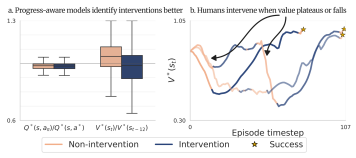
Figure 2 :(a) Progress separates interventions better than instantaneous values. (b) Qualitatively, humans in- tervene when value plateaus or declines.
Original paper · CC BY 4.0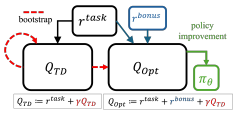
Figure 5 :Overview ofQ-OIL
Original paper · CC BY 4.0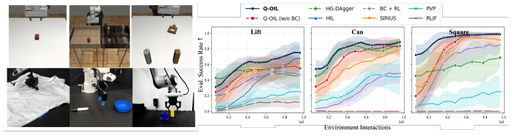
Figure 6 :Left:Evaluation tasks in simulation and on the Franka robot.Right:On Robomimic with the progress-aware human model (PAM),Q-OILimproves success rate and learning efficiency over baselines.
Original paper · CC BY 4.0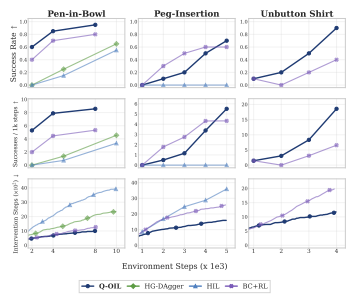
Figure 8 :Across three tasks,Q-OILachieves higher success and throughput given a fixed interaction budget, with lower human effort.
Original paper · CC BY 4.0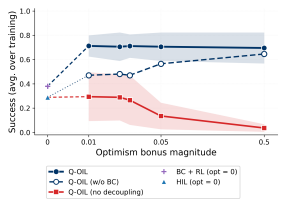
Figure 10 :Q-OILw/o decoupling degrades with higher bonus due to over-optimism.
Original paper · CC BY 4.0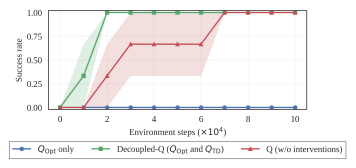
Figure 11 : Q-OIL helps learning in the discrete 2D navigation setting, showing that decoupling is essential for learning from interventions.
Original paper · CC BY 4.0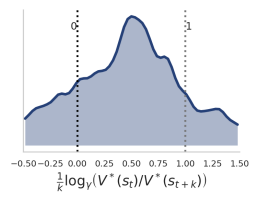
Figure 13 :Human intervention segments often make limited value-based progress.
Original paper · CC BY 4.0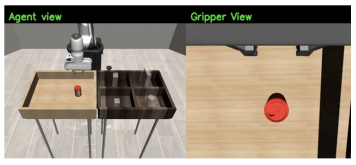
Figure 14 : Rendered observation shown to the hu- mans during simulated robot experiments.
Original paper · CC BY 4.0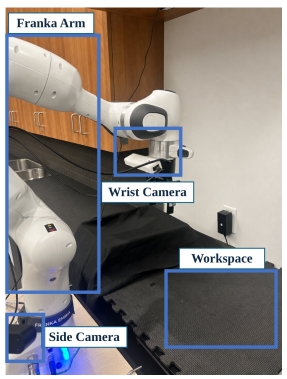
Figure 16 :Real-world robot setup. The policy receives RGB observations from a wrist-mounted camera and, optionally, a side-view camera. The human supervisor monitors the robot during online training and provides interventions using a Space- Mouse.
Original paper · CC BY 4.0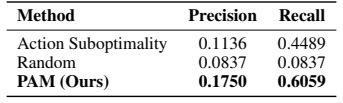
Table 1 : Intervention prediction on held-out human data.
Original paper · CC BY 4.0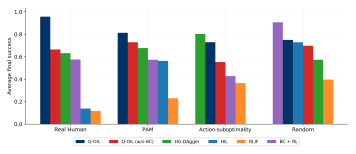
Figure 17 :Rankings of algorithms under real hu- man evaluation and three simulated intervention mod- els, based on final success rate.
Original paper · CC BY 4.0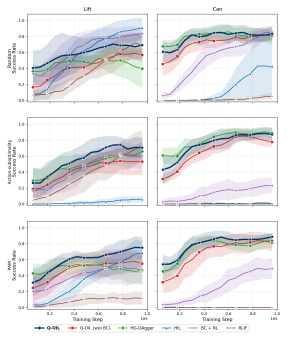
Figure 18 :Success rate vs. env steps under different intervention models
Original paper · CC BY 4.0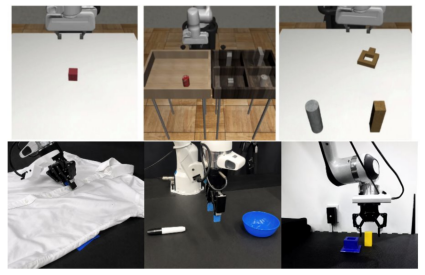
Figure 19 : Simulated Robomimic tasks (top) and Franka tasks (bottom). The bimanual Y AM tasks are shown in Figure 9.
Original paper · CC BY 4.0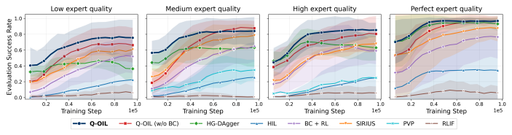
Figure 20 :Success across takeover-quality tiers, averaged over Lift, Can, and Square (3 seeds). Tiers group intervention checkpoints by per-task success rate (Low: 42/44/58%, Medium: 60/80/72%, High: 68/94/82%, Perfect: 100%).
Original paper · CC BY 4.0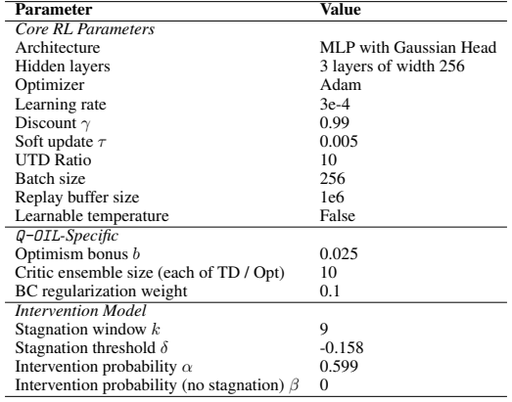
Table 2 : Hyperparameters forQ-OILand baselines.
Original paper · CC BY 4.0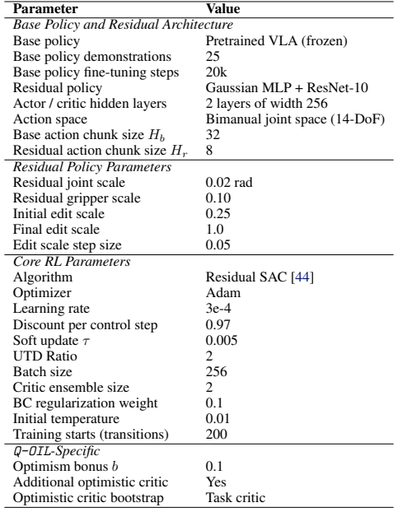
Table 3 : Hyperparameters for residual VLA learning withQ-OILand BC+RL.
Original paper · CC BY 4.0Quote from the paper
Pranav Teegavarapu, Sriyash Poddar, Rico Qi, Cleah Winston, Krisha Khandelwal, Aykut Onyol, Natasha Jaques, Abhishek Gupta (2026). Q-OIL: Optimistic Exploration in Learning from Human Interventions. arXiv:2611.08576v1. https://arxiv.org/abs/2611.08576v1
BibTeX
@misc{teegavarapu2026optimistic,
  title = {{Q-OIL: Optimistic Exploration in Learning from Human Interventions}},
  author = {Pranav Teegavarapu and Sriyash Poddar and Rico Qi and Cleah Winston and Krisha Khandelwal and Aykut Onyol and Natasha Jaques and Abhishek Gupta},
  year = {2026},
  eprint = {2611.08576},
  archivePrefix = {arXiv},
  url = {https://arxiv.org/abs/2611.08576v1}
}