Paper commentary
ParseBench-2: Severity-Aware Evaluation of Document Parsing
Severity-aware metrics score document parsing errors by how much they change facts
- Problem Similarity metrics average differences across a whole output, so one wrong digit barely moves the score of a long page. Rule-based checks count every failure the same, so a cosmetic slip weighs as much as a wrong number.
- Method ParseBench-2 builds its parsing metrics from a severity policy that sets how each error type should move the score. Test scenarios fix the expected score drops, and coding agents revise the metric code to meet them under human review.
- Results On Formatting, the metric meets the critical-error target in 96% of scenarios, while ParseBench-1's Semantic Formatting metric meets it in 5%.
Why similarity scores miss serious errors
A parser can recover most of a page and still hand a downstream system a wrong fact. Similarity metrics average differences across the whole output, so one wrong digit barely moves the score of a long page. Rule-based checks fail in the other direction, because each failed check counts the same and a cosmetic slip weighs as much as a wrong number.
A pass rate therefore doesn't tell a reader whether a high-scoring output keeps the information that matters.
People can usually tell how bad an error is, but turning that judgment into a metric is hard. Implementing the expectations consistently across text, tables, and charts requires many interacting rules. So the authors start from the judgment itself: a severity policy that says how each error type should move the score. The policy assigns each error type a severity level, and the levels are critical, major, minor, and benign.
Without such a policy, a metric can look good on paper while still missing the errors that matter to a reader.
The authors make the policy testable with test scenarios, each applying one change to a correct output on one page. Each scenario carries a target score-drop interval that the policy accepts for the changed severity level. A metric's response can depend on the page's content and length, so each perturbation is applied to many pages. This turns the policy into targets that a metric must meet, rather than a judgment that stays implicit.
Fixing targets and letting the metric change
The core move is to hold the expected score changes fixed while the metric's implementation is what gets revised. A changed amount is critical, so changing $4,200 to $4,700 must lower the score by at least ten points on a 0–100 scale. The same field placed in a two-column table is benign, so its target is no score change. Severity levels are expert judgment rather than a measurement, so users can assign different levels for their own applications.
A scenario carries a target score-drop interval that depends on the severity level of the change being tested. Because a metric's response can depend on page content and length, the authors apply each perturbation to many pages.
For each scenario, the authors score the correct output and the perturbed output against the same annotations. The drop is the score of the correct output minus the score of the perturbed output: Δm(s) = m(ys, rs) − m(ỹs, rs). The distance from target is zero when the drop falls inside the target interval. Otherwise the distance is the gap to the nearest boundary of that interval.
A coding agent proposes changes to the implementation, and the authors test each revision against the same fixed targets. The policy, the test scenarios and their targets stay outside the search, so only the metric implementation changes. The search minimizes the sum of squared distances across all scenarios, and a revision is kept only if it lowers that sum.
A revision is also rejected if it breaks a scenario that already met its target or overfits one scenario.
How refinement and the severity cap combine
Refinement is a local search, because the space of candidate metrics is too large to search exhaustively. A coding agent inspects the scenarios that miss their targets and proposes a revision to the metric. Each revision is then evaluated on the full set of test scenarios, not only on the failing ones. The team keeps a change only when it lowers the sum of squared distances and breaks no scenario that already met its target.
They also reject changes that overfit to a particular scenario, so the search stops when no revision improves the objective under these conditions.
The policy, the test scenarios and their targets stay fixed, so only the implementation changes during the search. The parsing metric alone measures content recovery, so a page can still score well while containing a serious error. The final benchmark score is S = min(m(y, r), c), so the lower of the parsing score and the cap wins. This is why recovering most of a page can't hide a serious error.
The cap applies to Text, Formatting, Tables, Charts and Forms, while Visual grounding is scored without one.
Fixed weights mean that adding pages to a group doesn't raise that group's influence on the dimension score. The overall score averages the six dimension scores, so each parsing capability has equal influence.
Does the metric follow the policy?
The authors measure policy agreement with a policy-compliance summary, PCS, which starts at 100 and falls as scenarios break their targets. Critical violations weigh 0.5, major violations 0.3, minor violations 0.2, and benign violations 1. That setup yields 16,059 graded scenarios, and the authors skip any scenario where the perturbation leaves the output unchanged.
Table 1 separates the parsing metric m, the severity cap c and the final score S, so the effect of each part is visible. Without the cap, the parsing metrics already beat every compared baseline on Text, Formatting and Charts. On Tables, the parsing metric alone reaches a PCS of 50.0, and adding the cap lifts it to 87.8. So the cap does most of the work on Tables, where content recovery alone can't guard against serious errors.
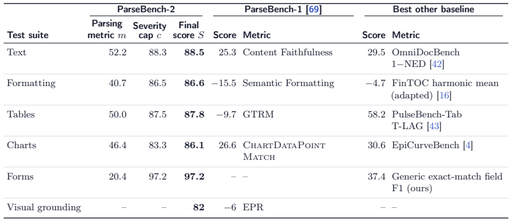
Table 1 Policy-compliance summary (PCS; higher is better) for ParseBench-2 and baseline metrics.
Original paper · CC BY 4.0Formatting meets the required drop in 96% of critical-error scenarios. ParseBench-1's Semantic Formatting metric meets the same target in only 5% of those scenarios. The gap came from iterative refinement, where a coding agent revised the metric against the same targets. In one Tables revision, a decimal point inserted into a numeric cell was treated as rewording, so the metric gave too small a penalty.
Across the six suites, the metrics penalize at most 3.4% of tested benign variations. On Tables, the ParseBench-2 metric penalizes none of the benign variations. ParseBench-1's GTRM metric penalizes 80% of those benign variations on Tables. The authors report these results on the scenarios used during metric development, so they don't show how the metrics behave on new documents.
What the severity-aware score reveals about parsers
The overall ranking changes little when a severity-aware score replaces a content score, but the errors behind each score do change. The authors evaluated 19 document-parser, 16 frontier VLM and 9 open-weight configurations on 4,317 pages. Document parsers lead on the overall score, but frontier VLMs have higher median scores on Text and Tables.
On one text page, Mistral OCR 4.1 invents a percentage table that is absent from the source document. LlamaParse (Agentic Plus) preserves the annotated content on the same page, so the two outputs differ in faithfulness. Content Faithfulness assigns both outputs 98.6, so it cannot separate the invented content from the faithful output. ParseBench-2 scores the invented output 58.7 and the faithful output 100.
The gap appears because the severity-aware score treats the invented content as a serious error.
Content recovery alone would hide this error, since the invented table adds text that a recovery metric does not penalize. The severity cap is what drives the drop, because it limits the final score when serious errors are detected.

Figure 5 Content Faithfulness gives both outputs the same score despite the invented percentage table in Mistral’s output. ParseBench-2 identifies the error. Output excerpts are rendered with image placeholders omitted and the invented content highlighted.
Original paper · CC BY 4.0 · Pierre-Loïc Doulcet, Boyang Zhang, Sebastián G. Acosta, Sacha Bron, Daniel B. Ospina, Antonio Jimeno Yepes, Nutchapol Dendumrongsup, Simon Suo · ParseBench-2: Severity-Aware Evaluation of Document Parsing · Original paper figure · Extracted the figure area from page 10 of the original PDF.Where the evidence stops
The graded evaluation leaves out 24 debatable error types, because their severity depends on the application. Those types are listed in the policy tables but don't receive a grade in the scores. Ten error types and twelve benign variations change none of the sampled pages, so the graded evaluation doesn't test them. Its score drops are checked against the same severity targets, although that metric has no cap.
The severity levels themselves are expert judgment, not a measurement. A target interval constrains the final score drop, and it doesn't fix one weight in the metric. Each perturbation is applied to many pages because a metric's response can depend on the page's content and length.
The authors don't test whether these scores reflect errors in downstream applications. They leave that question for future work.
Paper info
- Authors
- Pierre-Loïc Doulcet, Boyang Zhang, Sebastián G. Acosta, Sacha Bron, Daniel B. Ospina, Antonio Jimeno Yepes, Nutchapol Dendumrongsup, Simon Suo
- Venue
- arXiv · Preprint
- First published
- 2026-11-12
- Added
- 2026-11-16
- Updated
- 2026-11-12
- Version
- v1
- arXiv
- 2611.17400
- Category
- cs.CV
- Original paper terms
- CC BY 4.0
- What we show
- Paper info, commentary and permitted figures from the original paper
AI commentary is a separate explanation from the original paper and may contain errors. The original paper and figures follow each source's terms of use and any rights noted separately.
Abstract
Document-parsing metrics can give high scores to outputs that change important facts and penalize changes that preserve meaning. People can often judge these consequences more easily than they can design a metric to measure them. We introduce a method for developing parsing metrics from severity policies that specify how each error type should affect the score. We express these policies through test scenarios that specify how a metric should behave. We then optimize the metric implementations against these fixed expectations, using coding agents to refine comparison rules, error detectors and weights under human review. This makes stated human priorities an explicit objective of metric design. We apply this method in ParseBench-2, a comprehensive document-parsing benchmark that combines broad capability coverage with metrics calibrated to error severity. It covers 4,317 pages across six dimensions of parsing quality: text, formatting, tables, charts, visual grounding, and forms. We use detailed annotations and targeted difficult cases to check for changed facts, broken structural relationships, and missing content. We take the lower of a parsing score that measures content recovery and a severity cap that penalizes detected errors, so recovering most of a page cannot hide a serious error. Across six severity test suites, our metrics more closely match the expert judgments expressed by the scenario targets than existing metrics and penalize at most 3.4% of the tested benign variations. We conduct a comprehensive evaluation spanning frontier vision-language models, specialized document parsers and open-weight systems, comparing their overall rankings, performance across parsing capabilities and tradeoffs between accuracy and cost.
Quote from the paper
Pierre-Loïc Doulcet, Boyang Zhang, Sebastián G. Acosta, Sacha Bron, Daniel B. Ospina, Antonio Jimeno Yepes, Nutchapol Dendumrongsup, Simon Suo (2026). ParseBench-2: Severity-Aware Evaluation of Document Parsing. arXiv:2611.17400v1. https://arxiv.org/abs/2611.17400v1
BibTeX
@misc{doulcet2026parsebench,
  title = {{ParseBench-2: Severity-Aware Evaluation of Document Parsing}},
  author = {Pierre-Loïc Doulcet and Boyang Zhang and Sebastián G. Acosta and Sacha Bron and Daniel B. Ospina and Antonio Jimeno Yepes and Nutchapol Dendumrongsup and Simon Suo},
  year = {2026},
  eprint = {2611.17400},
  archivePrefix = {arXiv},
  url = {https://arxiv.org/abs/2611.17400v1}
}