Paper commentary
How Should a Home Robot Update Its Memories When Human Routines Change?
Home robots keep sighting history to recall routines that return
- Problem Language-model memories of a home are written summaries that may drop facts about a routine that later returns. Such memories have been tested only in static worlds, so their loss on recurring routines was unknown.
- Method Last-seen keeps every room an object has been seen in, newest first, without a language model. The authors compare it with summary-only memories and memories that also read the raw sighting history.
- Results Last-seen scored 82.1 on first room right, compared to 77.0 for the claim store. Summary-only memories fell behind the sighting-history methods.
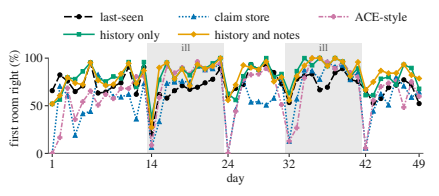
Figure 2 :The same illness, twice.First room right by day on the 14 room-changing objects, three households at 24 questions a day; sick days 14–23 and 32–41 shaded.
Original paper · CC BY 4.0 · Oliver Wang, Mani Srivastava · How Should a Home Robot Update Its Memories When Human Routines Change? · Original paper figure · Extracted the figure area from page 3 of the original PDF.Why summaries struggle when a routine returns
A home robot has to know where objects are, and those locations depend on what the residents are doing. A sick resident's laptop, normally kept in a backpack, may sit open on a bedroom desk for a week and then return to the backpack. The robot must therefore adapt during the change, notice when the old routine returns, and keep the earlier experience for next time.
A common answer is a language model that keeps written summaries of the home, revises them each night, and reads them before searching. Summaries can notice shared causes, but repeated rewriting lets errors accumulate in the memory. Zhang et al. found that keeping raw episodes was competitive with every summarization method they tested, but their worlds never changed.
None of them checks whether a memory built over weeks still holds what a routine taught it when that routine comes back.
A memory that keeps its sightings
The authors' key idea is that a robot can search better when its past sightings stay available, not only a written digest of them. They expect a memory that still holds experience from an earlier illness to drop less when that illness returns.
Each observation logs every object in the room with its spot and time, and each such record is a sighting.
Last-seen uses no language model and keeps every room an object has been seen in, newest first. The summary-only memories never show the model an object's sighting history, while history only and history and notes do. Every language-model method uses Qwen3.8-27B at temperature zero, and the ACE-style playbook is the authors' variant of a published method.
Search accuracy in the first illness
In the ten-household run, each method answered 2,480 questions at 8 questions a day. Last-seen scored 82.1 on first room right, compared to 77.0 for the claim store and 76.0 for the ACE-style playbook. Last-seen also beat both summary-only memories on found within three rooms, with 95.0 compared to 86.9 and 85.3. History and notes scored 85.6 on first room right, so the summaries help only when the sighting history is present too.
History only never writes a summary, yet it lands within 1.6 points of history and notes in all three runs. Adding only the sighting history to the claim store's room-choice prompt raised a rerun of it from 75.8 to 84.1. The authors read this as the sighting history doing the work, with the written notes adding little on top.
Retention when the illness returns
The authors check retention on the 14 room-changing objects, using three households at 24 questions a day. If a memory kept its first-illness experience, its first-room accuracy should fall less on day 32 than on day 14.
To test where the gain comes from, the authors replayed three methods with every sighting from days 14 to 23 deleted as it arrived. Last-seen's day-32 drop returned to its day-14 size, so its gain depended on the first illness sitting in its room list. The two history methods lost part of their gain when the first-illness sightings were removed.
Why the summaries dropped the illness
Most of those notes attach a time of day or the word always, and none mentions the resident being sick. So the summaries recorded where objects went but not why they moved, which matches the finding that they never recorded that anyone was sick.
In a diagnostic run, the authors told history and notes on night 13 that a resident was sick and staying home.
Limitations
All households are simulated, so the study tests memory in simulated homes only. The recurrence result rests on three households with wide two-SE bands, so it supports a direction rather than a firm difference.
Paper info
- Authors
- Oliver Wang, Mani Srivastava
- Venue
- arXiv · Preprint
- First published
- 2026-11-22
- Added
- 2026-11-24
- Updated
- 2026-11-22
- Version
- v1
- arXiv
- 2611.29818
- Category
- cs.RO · cs.AI
- Original paper terms
- CC BY 4.0
- What we show
- Paper info, commentary and permitted figures from the original paper
AI commentary is a separate explanation from the original paper and may contain errors. The original paper and figures follow each source's terms of use and any rights noted separately.
Abstract
A home robot that helps with chores needs to know where objects are, but people move objects according to routines that change and later change back. The robot's memory must adapt to the new routine without erasing experience that may become useful again. One approach is to have a language model maintain written summaries of the home from the robot's own observations, but existing evaluations of such memories use static worlds. We explore simulated households where a resident gets sick, recovers, and later gets sick again. We compare a rule that keeps every room an object has been seen in, language-model memories that store only written summaries, and language-model memories that can also read the raw history of sightings. The rule outperforms every summary-only memory, and giving language models the sighting history closes the gap. Surprisingly, writing summaries on top of the history adds nothing we can measure. When the illness returns, methods that keep the history search better than they did the first time, while summary-only methods show no consistent improvement. Deleting the first illness from memory removes all of the rule's gain and part of theirs. The summaries recorded where objects went during the illness but rarely distinguished sick-day patterns from normal routines. Our findings suggest that common approaches to summarizing robot memories struggle to remember facts about a routine that might return, highlighting the need for future benchmarks to evaluate this aspect of long-term robot deployment.
Quote from the paper
Oliver Wang, Mani Srivastava (2026). How Should a Home Robot Update Its Memories When Human Routines Change?. arXiv:2611.29818v1. https://arxiv.org/abs/2611.29818v1
BibTeX
@misc{wang2026should,
  title = {{How Should a Home Robot Update Its Memories When Human Routines Change?}},
  author = {Oliver Wang and Mani Srivastava},
  year = {2026},
  eprint = {2611.29818},
  archivePrefix = {arXiv},
  url = {https://arxiv.org/abs/2611.29818v1}
}