Paper commentary
Are Dense Rewards Worth Their Tokens in GRPO?
Dense rewards lose to plain GRPO once generated tokens are counted
- Problem Dense process rewards for RLVR were compared with GRPO per update, or checked with a gradient test. Neither check counts the generated tokens and GPU time that dense rewards consume.
- Method The authors give every training intervention the same budget of generated tokens and GPU-hours. Unlike per-update comparisons, this budget charges the Monte-Carlo reward for its sampled continuations.
- Results At equal tokens, the Monte-Carlo reward ends 14.3 percentage points below outcome-only GRPO on Qwen2.5-1.5B. Prompt selection gains 1.7 points on Qwen3-0.6B at matched compute.
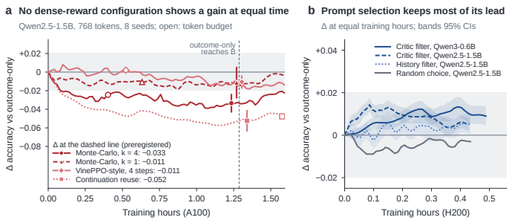
Figure 3 . At equal training time, no tested dense-reward variant showed a gain, and prompt selection keeps most of its lead. (a)A preregistered study ran every configuration beyond the training time that outcome-only GRPO needs to reach the token budget B (dashed line). Curves show each configuration minus outcome-only GRPO at equal training hours (MATH L4–5, mean over seeds); open markers show where each configuration reaches B. Bars give the preregistered contrasts at the dashed line with 95% CIs, and the legend gives their means.(b)The prompt filters, and random choice among the filter’s candidates, minus outcome-only GRPO at equal training hours, up to the time the faster configuration takes to reach the budget (exploratory, H200 GPUs). Bands are95%CIs; the gray bands mark±0.02.
Original paper · CC BY 4.0 · Vikash Singh, Weicong Chen, Debargha Ganguly, Yanyan Zhang, Mohsen Hariri, Sreehari Sankar, Wang Yang, Chaoda Song, Alexander Nemecek, Osama Zafar, Yuting Shao, Kai Ye, Biyao Zhang, Xinpeng Li, Shouren Wang, Erman Ayday, Jing Ma, Sanmukh Rao Kuppannagari, Vipin Chaudhary · Are Dense Rewards Worth Their Tokens in GRPO? · Original paper figure · Extracted the figure area from page 7 of the original PDF.Why per-update comparisons miss the cost
Dense rewards give different steps different credit, and the Monte-Carlo reward gets its credit by sampling continuations from each partial solution. It estimates a step's value as the fraction of its continuations that end with a correct answer.
The usual checks are a gradient test on one batch and a per-update comparison with outcome-only GRPO after the same number of updates. Neither check considers what a dense reward costs, and the first cost is generated tokens. At k=4, the continuations take 91% of all generated tokens for the Monte-Carlo reward. At the same token budget, outcome-only GRPO makes 584 updates while the Monte-Carlo reward makes 50.
The continuations are scored and then discarded, so they never train the model. GPU time is a second cost, but it doesn't grow in proportion to tokens. The gradient test can also mislead, because the Monte-Carlo reward's update aligns closely with a reference gradient, with a mean cosine of 0.84.
Credit per segment and prompt selection
A dense reward instead adds a token-level term, so the credit varies inside one completion and the update can leave that set of sums. At each cut it samples k continuations and takes the fraction that end with a correct answer as the prefix's estimated value.
Prompt selection spends one forward pass over candidate prompts rather than generated tokens on continuations. It also adds 2 candidates drawn at random, a control that tests whether the same candidate pool explains the gain. A learned critic, a ridge critic on hidden states, scores the candidates and gives a signal without any continuations.
Both interventions are charged the same budget in generated tokens, counting continuations and discarded samples. At the budget B of 12.25M generated tokens, outcome-only GRPO makes 584 updates while the Monte-Carlo reward makes 50. The protocol also tracks training GPU-hours, broken down by training stage. Under this accounting, the Monte-Carlo reward ends 14.3 points behind outcome-only GRPO at equal tokens.
Prompt selection gains 1.7 points on Qwen3-0.6B and 0.8 on Qwen2.5-1.5B at equal tokens.
Does the dense reward win at matched compute
At equal updates, the Monte-Carlo reward leads outcome-only GRPO on Qwen2.5-1.5B, so the usual per-update comparison favors it. Once tokens are equal, that lead reverses: the reward ends 14.3 percentage points lower. At equal training time, the gap narrows but stays negative, at 7.8 points lower. The authors report that the gap held in every seed.
The reversal follows from update counts, because the continuations take 91% of all generated tokens at k=4. At the same token budget, outcome-only GRPO makes 584 updates while the Monte-Carlo reward makes only 50. A reward that wins per update can therefore lose per token.
The authors also tested four dense-reward variants, and none beats outcome-only GRPO, even when given as much training time. A learned critic needs no continuations, and at equal tokens its effect ranges from −0.4 to +0.7 points.
On equal updates, adding the dense term with a small weight stays within ±3 points of greedy accuracy for outcome-only GRPO. A large weight on the same dense term loses 12.4 points. The comparison at equal updates therefore shows little gain even before tokens are counted.
Why a gradient test can't certify a reward
The gradient test takes a fixed batch of samples and checks whether a reward's update points the same way as an independent estimate. That independent estimate targets the gradient of expected accuracy. In the probes, the Monte-Carlo reward's update reaches a mean cosine of 0.84 with the reference gradient. The test can mislead even when cost is ignored, so a high cosine doesn't settle whether the reward is worth using.
A dense reward adds a token-level term, so its update can leave V and point in directions that reweighting completions can't reach. Ratio clipping, KL penalties and the optimizer can further change that update. Only the part of a dense update outside V can add something beyond reweighting whole completions.
Per generated token, the efficiency test orders the Monte-Carlo variants the same way training does. Yet it overestimates the accuracy each reward reaches by one to two points. That overestimate is as large as the 1.7 and 0.8 point gains that the protocol measures for prompt selection.
A gradient test therefore ranks rewards usefully, but it can't tell whether an ordering justifies the tokens it costs. So the authors check each reward at matched compute, counting both generated tokens and training GPU-hours.
Which prompts to train on
Prompt selection is the one intervention in this study that gains at matched compute. On Qwen3-0.6B it improved accuracy by 1.7 points at equal tokens, and on Qwen2.5-1.5B by 0.8 points. A critic scores the candidates, and the method spends one forward pass over them, so its cost falls on prefill rather than on sampled continuations.
Random choice among the same candidates doesn't reproduce the gain, so the benefit isn't just a faster pass through the prompt stream. Both gains replicated on fresh seeds and on 1,543 unseen MATH test problems.
The share of informative groups didn't predict where the gain appeared, so the candidates' predicted success carried the signal. At equal training time the gains shrink to 1.0 on Qwen3-0.6B and 0.5 on Qwen2.5-1.5B, and that comparison is exploratory. The gain also comes early in training.
Limitations and open questions
The prompt-selection gain didn't hold in every setting where the authors tried it. A six-seed gain on Qwen3-1.7B shrank to nothing when the authors reran it on eighteen fresh seeds. The one gain predicted outside the Qwen family never appeared. The rule that the candidates should be predicted to fail more often than not held in five of six preregistered tests.
That leaves one preregistered test where the rule failed, so the rule is not a guaranteed predictor. The equal-time numbers for prompt selection, at 1.0 and 0.5 points, are labelled exploratory. The light bars for GPU-hours on H200s are exploratory too.
A lenient verifier, which also accepts answers outside \boxed{}, changed what training optimized. Runs trained with that verifier gradually stopped putting their answers in a box. Switching to a strict verifier stopped this drift, and accuracy did not fall. The authors treat the verifier as the first thing to fix, because the lenient version also let runs in either configuration drift.
Only training at matched compute shows whether those directions actually help. The authors ask that any claim about a training intervention state its token and GPU-hour budgets. They also ask that the claim name its verifier, the models it replicated on, and how its baseline was tuned. Section B of the paper covers the scope of these lessons and the study's limitations.
Paper info
- Authors
- Vikash Singh, Weicong Chen, Debargha Ganguly, Yanyan Zhang, Mohsen Hariri, Sreehari Sankar, Wang Yang, Chaoda Song, Alexander Nemecek, Osama Zafar, Yuting Shao, Kai Ye, Biyao Zhang, Xinpeng Li, Shouren Wang, Erman Ayday, Jing Ma, Sanmukh Rao Kuppannagari, Vipin Chaudhary
- Venue
- arXiv · Preprint
- First published
- 2026-11-10
- Added
- 2026-11-11
- Updated
- 2026-11-10
- Version
- v1
- arXiv
- 2611.13560
- Category
- cs.CL · cs.AI
- Original paper terms
- CC BY 4.0
- What we show
- Paper info, commentary and permitted figures from the original paper
AI commentary is a separate explanation from the original paper and may contain errors. The original paper and figures follow each source's terms of use and any rights noted separately.
Abstract
RLVR trains language models to reason by rewarding correct final answers. A widely used algorithm, group-relative policy optimization (GRPO), gives every token of a solution the same credit, so dense process rewards have been proposed to credit intermediate steps, for example with a Monte-Carlo reward that scores each step by sampling continuations from it. Comparing such a reward with GRPO per training update, or vetting it with a gradient test on a single batch, leaves out what it costs: in our setting, the continuations alone take 91% of all generated tokens. We introduce a matched-compute protocol that gives every training intervention the same budget, measured in generated tokens and training GPU-hours, and tests it in preregistered studies with controls for side effects. Across 1,668 runs on six models, matching compute reverses the ranking. On Qwen2.5-1.5B, the Monte-Carlo reward leads standard GRPO per update, yet ends 14.3 percentage points lower at equal tokens and 7.8 points lower at equal training time, and none of four dense-reward variants outperforms GRPO even with as much training time. A per-token gradient test orders these rewards as training does but overestimates each by one to two points, as much as the gains it is meant to detect. In contrast, training on the prompts whose predicted success is nearest 1/2 improves accuracy at matched compute, by 1.7 points on Qwen3-0.6B and 0.8 on Qwen2.5-1.5B. These gains replicate on fresh seeds and unseen problems, and a simple rule, that the candidate prompts are predicted to fail more often than not, predicted where they appear in five of six preregistered tests. Both gains come early in training, and standard GRPO with twice the initial learning rate comes within half a point of them. We argue that training interventions should be validated at matched compute, which overturns some apparent gains and confirms others.
Figures from the paper
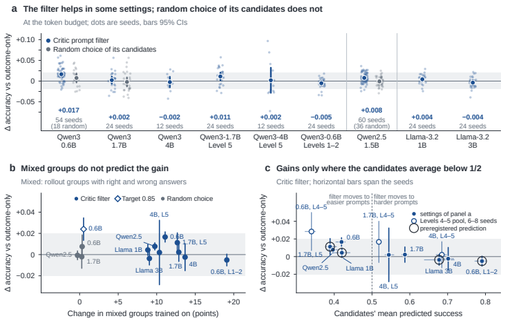
Figure 4 . Where prompt selection helps is predicted by how hard its candidates are, not by how many informative groups it adds. At matched generated tokens:(a)Accuracy at the budget minus outcome-only GRPO on the same seeds, for the critic filter and for random choice of 8 of its 24 candidates (dots: seeds; bold: the filter’s mean). The pool is MATH levels 3–5 unless labeled; Llama models train on the strict verifier.(b)Change in the share of mixed-outcome groups trained on before B against the change in accuracy, both relative to outcome-only GRPO; the diamond is the filter aimed at predicted success 0.85.(c)The critic’s mean predicted success of the candidates against the change in accuracy; the dashed line marks 1/2. Hollow points are the first studies, on a level 4–5 pool, and rings mark the four settings with a preregistered prediction. Bars are95%CIs over seeds; the gray band marks±0.02.
Original paper · CC BY 4.0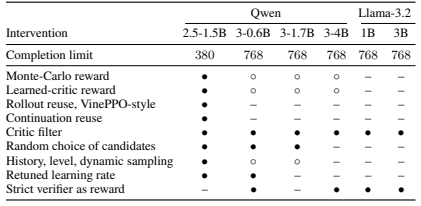
Table 2 . Which interventions were tested at which model. •: preregistered study with 8 or more seeds; ◦: pilot or pooled esti- mate with 3–9 seeds per model; –: not tested. Completion limit in tokens; on Qwen2.5-1.5B, a preregistered study also compared the Monte-Carlo reward and both kinds of reuse at768tokens, to equal training time.
Original paper · CC BY 4.0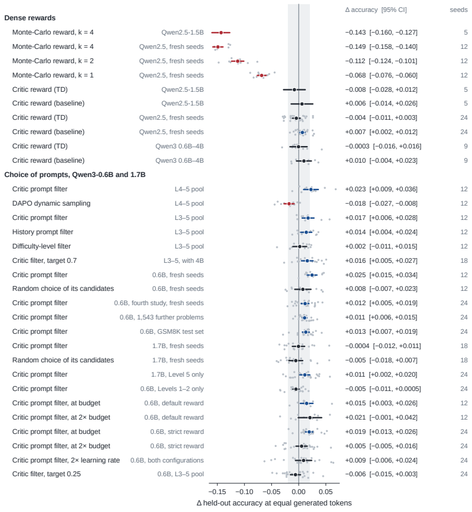
Figure 7 . Every matched-compute comparison, part 1: dense rewards, and the choice of prompts on Qwen3-0.6B and 1.7B. Held-out accuracy at the token budget minus outcome-only GRPO on the same seeds and evaluation draws, on the 200 level 3–5 test problems (level-5 or level 1–2 problems for those pools), except in the rows marked “further test problems” and “GSM8K” (part 2). Gray dots are seeds; bars are 95% paired-t CIs, blue when above zero and red when below; the band marks ±0.02. “Fresh seeds” rows come from studies that repeated an earlier comparison on new seeds. “Default reward” and “strict reward” rows train both configurations for twice the budget with that verifier as the reward. Tables 3 and 4 mark which rows are preregistered primary contrasts.
Original paper · CC BY 4.0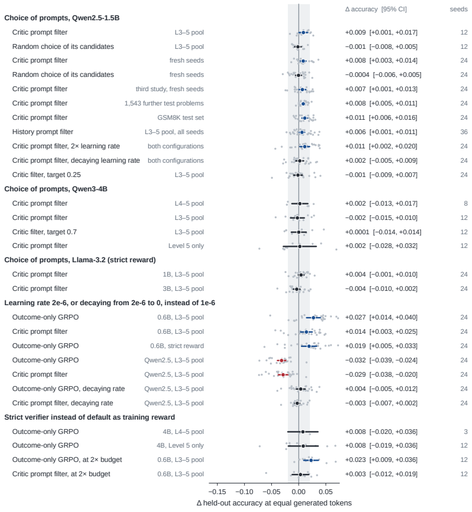
Figure 8 . Every matched-compute comparison, part 2: the choice of prompts on Qwen2.5-1.5B, Qwen3-4B, and the Llama models, the learning rate, and the verifier.As in Figure 7. In the last two blocks, a run at twice the learning rate or with a learning rate decaying linearly from 2×10 −6 to 0 at the budget, or trained on the strict verifier, minus the same configuration at 10−6 or trained on the default verifier.
Original paper · CC BY 4.0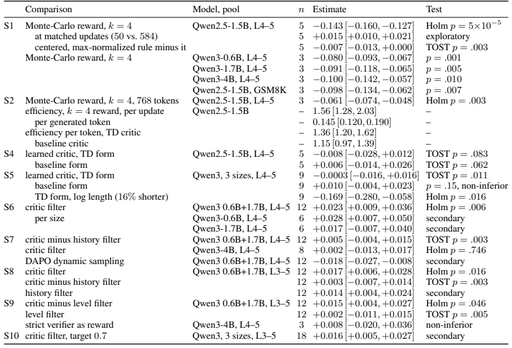
Table 6 . Results of the first matched-compute studiesquoted in Sections 3 and 4. Differences are in held-out accuracy at B against outcome-only GRPO on the same seeds unless stated, with 95% paired-t CIs; efficiencies are ratios to outcome-only GRPO with 95% bootstrap CIs. “Holm” marks a preregistered primary contrast; other rows are secondary or, where marked, exploratory.
Original paper · CC BY 4.0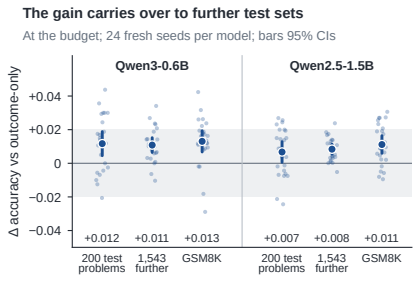
Figure 9 . The prompt filter’s gain carries over to further test sets.Critic filter minus outcome-only GRPO at the token budget, on the same runs: the 200 test problems of every study, the 1,543 numeric-answer MATH test problems of levels 3–5 that no study had evaluated on, and the1,319 GSM8K test problems, on Qwen3- 0.6B (S34) and Qwen2.5-1.5B (S33), 24 fresh seeds each. Dots are seeds, bars 95% paired-t CIs, and the gray band marks ±0.02.
Original paper · CC BY 4.0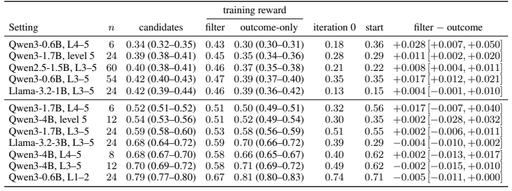
Table 8 . Where the critic filter helps(exploratory). Candidates: the critic’s mean predicted success of the 24 candidates per iteration (seed mean, with the range over seeds). Training reward: mean group reward over the iterations started before B (strict verifier for the Llama models, whose configurations train on it). Iteration 0: training reward of the first iteration, before any update, the same in both configurations (the base model on its first 8 training prompts per seed). Start: outcome-only GRPO’s accuracy on the test set before training. Last column: filter minus outcome-only accuracy atB(95%paired-tCI).
Original paper · CC BY 4.0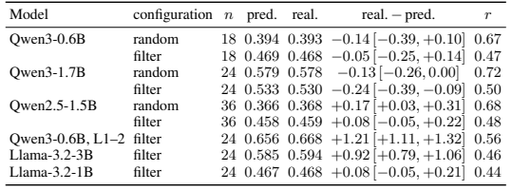
Table 9 . Calibration of the prompt critic(exploratory), on the prompts trained in the iterations before B in which the critic was in use: mean predicted and realized group success, their difference per seed in points (95%CI), and the correlation over groups.
Original paper · CC BY 4.0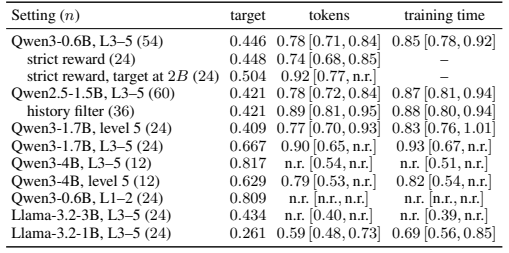
Table 11 . Share of the budget, and of outcome-only GRPO’s training time, that the critic filter needs to reach outcome-only GRPO’s accuracy at B (exploratory; 1 means no saving). The history-filter row uses the critic-free filter of S22 on the same seeds. Training time includes the critic’s scoring and excludes evaluation.
Original paper · CC BY 4.0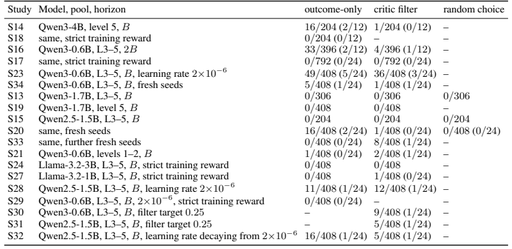
Table 12 . Drifted evaluations by configuration(default minus strict-verifier accuracy >0.1 ), with the runs drifted at the last evaluation in parentheses.
Original paper · CC BY 4.0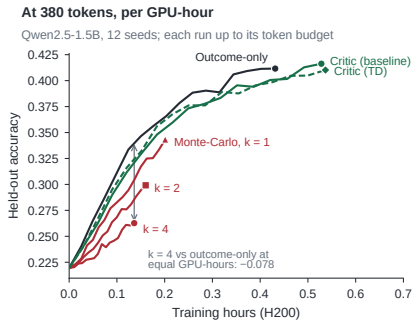
Figure 10 . At 380 tokens, the Monte-Carlo reward trails outcome-only GRPO at its own training time.Exploratory reanalysis of preregistered runs on H200 GPUs: accuracy against training hours for Qwen2.5-1.5B on MATH L4–5 (seeds 5–16, the same for every configuration), each run up to its token bud- get. The Monte-Carlo rewards reach the budget sooner because their continuations take less time per token than training does; the arrow marks the k= 4 reward’s deficit at its own training time (per-seed mean). Figure 3a and Section F run every configuration past outcome-only GRPO’s training time, at768tokens.
Original paper · CC BY 4.0Quote from the paper
Vikash Singh, Weicong Chen, Debargha Ganguly, Yanyan Zhang, Mohsen Hariri, Sreehari Sankar, Wang Yang, Chaoda Song, Alexander Nemecek, Osama Zafar, Yuting Shao, Kai Ye, Biyao Zhang, Xinpeng Li, Shouren Wang, Erman Ayday, Jing Ma, Sanmukh Rao Kuppannagari, Vipin Chaudhary (2026). Are Dense Rewards Worth Their Tokens in GRPO?. arXiv:2611.13560v1. https://arxiv.org/abs/2611.13560v1
BibTeX
@misc{singh2026dense,
  title = {{Are Dense Rewards Worth Their Tokens in GRPO?}},
  author = {Vikash Singh and Weicong Chen and Debargha Ganguly and Yanyan Zhang and Mohsen Hariri and Sreehari Sankar and Wang Yang and Chaoda Song and Alexander Nemecek and Osama Zafar and Yuting Shao and Kai Ye and Biyao Zhang and Xinpeng Li and Shouren Wang and Erman Ayday and Jing Ma and Sanmukh Rao Kuppannagari and Vipin Chaudhary},
  year = {2026},
  eprint = {2611.13560},
  archivePrefix = {arXiv},
  url = {https://arxiv.org/abs/2611.13560v1}
}