Paper commentary
Continuous-Time LQR from a Single Discrete-Time Off-Policy Batch
PhiBE-PI learns continuous-time LQR control from one batch of discrete data
- Problem Discrete-time learners tie the controller to one training interval, so it can miss the continuous-time optimum. Shorter intervals also make action values harder to compare from finite data.
- Method PhiBE-PI evaluates each policy with one quadratic state-action critic and improves it greedily. Unlike discrete-time methods, it reuses a single batch of transitions across all policy iterations.
- Results On a scalar system, PhiBE-PI scored 2.67% relative cost error, compared to 7.83% for the discrete-time BE-PI baseline.
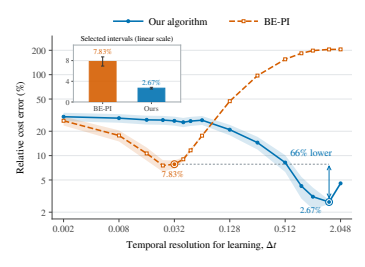
Figure 1 : Relative cost error versus the training in- terval ∆t for a scalar LQR system. Both methods use the same data and deploy at the observation in- terval δ= 0.002 . Curves and bands show means and 95% confidence intervals over 1000 paired trials. Rings and the inset compare intervals selected be- fore validation. Failed fits retain the common initial controller; all trials are included. BE-PI is discrete- time Bellman-equation policy iteration. Details are given in Appendix D.1.
Original paper · CC BY 4.0 · Yao, Chaorui, Zhu, Yuhua · Continuous-Time LQR from a Single Discrete-Time Off-Policy Batch · Original paper figure · Extracted the figure area from page 2 of the original PDF.Why discrete-time learning stops short of the continuous-time gain
Learning continuous-time LQR from discrete observations means the controller must target the continuous-time optimum while seeing only sampled data. The common discrete-time route treats each training transition as one MDP step with the action held fixed. Its solution is the best controller for that exact update rate, so it shifts when the interval changes and need not stay optimal at a faster deployment rate.
Shrinking the interval doesn't remove this dependence in practice.
Shorter intervals also make action values harder to compare, because a held action changes its value only in proportion to the interval. A fixed level of estimation error therefore has a growing effect on the action that gets selected. Model-based methods avoid this by estimating the system matrices first, and some model-free analyses rely on continuous-trajectory integrals that ignore discrete observation error.
Policy iteration on such a batch adds three difficulties. Evaluation and improvement must work with endpoint observations collected under constant actions, and finite-sample error can leave evaluation or the greedy step ill defined. Reusing the batch also ties every later policy to the same estimation errors.
A quadratic critic built from drift increments
The key idea is to score each policy with a state-action function whose action dependence stays intact as the observation interval shrinks. Under the deterministic surrogate, the critic is quadratic in state and action, so a set of quadratic features represents it exactly. The unknown drift is replaced by the conditional mean of normalized state increments, following the PhiBE construction.
For this linear system that mean is affine, with matrices \(\bar{A}_\Delta=(e^{A\Delta t}-I)/\Delta t\) and a companion input matrix built from the integral of the exponential of A.
Additive noise only shifts the value by a constant, so the evaluation sets the diffusion to zero while the batch is still drawn from the noisy system. The critic is strictly concave in the action with Hessian \(-2R/\beta\), so its maximizer is a linear feedback in the state. That maximizer is the greedy gain, and its Hessian does not depend on the observation interval.
One batch, a linear evaluation, and a greedy update
Each transition gives a sample residual that puts the observed increment divided by ∆t in place of the drift. Requiring that residual to be orthogonal to the features gives a linear system, which is the least-squares temporal-difference form of evaluation. Solving that system returns the quadratic coefficients, and the action block of the fitted matrix gives the next gain.
The batch enters the evaluation only through one matrix, formed from the empirical Gram matrix and the observed increments. The policy enters only through the gain-dependent map, so the batch-dependent part stays fixed across iterations. Algorithm 1 computes the right-hand side once, then repeats evaluation and greedy improvement for N steps on the same data.
What the bounds promise and how the error splits
The fixed-batch theorem says that for a large enough discount, a training interval below a threshold and an operator error below a threshold, every evaluation is invertible. Under the same conditions every iterate stays discounted-stabilizing, and the iterates converge quadratically to an empirical fixed point. The next iterate's error is bounded by a constant times the square of the current error.
The gain error is split into an iteration term, a finite-sample term and a discretization term. With the sampling and coverage conditions in place, the finite-sample term scales like 1/(β√(n∆t)) and the discretization term like ∆t/β. So at a fixed batch size a shorter interval lowers discretization error but amplifies noise in the normalized increments.
The authors use this tradeoff to suggest a training interval of order n to the power -1/3, since that balances the two terms. The finite-sample bound holds with probability at least 1−δ and requires the batch size and n∆t to exceed multiples of log(4p/δ).
Training interval on the scalar example
The motivating experiment uses a scalar system with Q = 512, R = 1 and β = 5. Both methods reuse the same data and deploy at observation interval 0.002, and curves are averaged over 1000 paired trials. The two training intervals were chosen from independent pilot data before the validation trials were generated.
At these intervals PhiBE-PI scored 2.67% relative cost error, compared to 7.83% for BE-PI. The detailed validation reports the reduction as 65.9%, and BE-PI had 8 failed fits while PhiBE-PI had none. The authors read the gap as coming from a target that stays near the continuous-time optimum as the training interval changes.
Deploying faster than training
At ρ = 100 its relative cost gap is 0.04%, compared to 2.92% for BE-PI and 2.28% for PJ-PI (adapted).
The gain error of PhiBE-PI decreases roughly as 1/β for large discounts in the same scalar setting.
Limitations
The guarantees need large discounts, and PhiBE-PI trails both baselines on one lightly damped mass-spring case. The authors warn against extrapolating the 1/β scaling to small discounts, since Figure 2(a) no longer follows it below β≈1. The theorem also needs a training interval below a threshold and a batch large enough for the operator error to stay small.
On the lightly damped example the first-order drift approximation shifts the eigenvalues, which at a coarse training interval makes PhiBE-PI worse than both baselines. Faster deployment of the fixed gain can't remove this training-time bias. Systematic benchmarking across dynamics, discounts, training intervals and sample budgets is left to future work.
Paper info
- Authors
- Yao, Chaorui, Zhu, Yuhua
- Venue
- arXiv · Preprint
- First published
- 2026-11-22
- Added
- 2026-11-24
- Updated
- 2026-11-22
- Version
- v1
- arXiv
- 2611.29725
- Category
- math.OC · cs.LG
- Original paper terms
- CC BY 4.0
- What we show
- Paper info, commentary and permitted figures from the original paper
AI commentary is a separate explanation from the original paper and may contain errors. The original paper and figures follow each source's terms of use and any rights noted separately.
Abstract
We study discounted continuous-time linear--quadratic regulation (LQR) with unknown drift parameters and additive noise, using a single batch of discrete-time off-policy transitions. Discrete-time methods target a policy tied to the training interval, while shortening this interval can make learning from finite data more sensitive to noise. Learning an accurate continuous-time controller therefore requires balancing discretization and finite-sample errors while preserving stability throughout policy improvement. We develop a drift-only policy iteration algorithm, termed PhiBE-PI, using one quadratic state--action critic for policy evaluation and explicit greedy improvement. Reusing the batch makes later policies depend on the data. Exploiting the quadratic structure of LQR, we show that the data enter every policy evaluation only through one policy-independent empirical matrix, so a single high-probability bound controls all iterates. For sufficiently large discount~$\beta$, small observation intervals, and a sufficiently large batch, we prove that all iterates are stabilizing for the discounted problem and converge quadratically to a data-dependent fixed point. The gain bound separates iteration, finite-sample, and discretization errors. In this regime, the finite-sample and discretization terms scale as $1/(\beta\sqrt{n\Delta t})$ and $\Delta t/\beta$, respectively. The bounds thus reveal a tradeoff: at a fixed batch size, finer observations reduce discretization error but increase finite-sample error. Because PhiBE-PI approximates the continuous-time optimal gain rather than a discrete-time one, its policy can remain near-optimal when deployed at faster control rates. Experiments confirm this advantage over discrete-time Bellman-equation baselines when the observation interval is small relative to the system's time scale.
Quote from the paper
Yao, Chaorui, Zhu, Yuhua (2026). Continuous-Time LQR from a Single Discrete-Time Off-Policy Batch. arXiv:2611.29725v1. https://arxiv.org/abs/2611.29725v1
BibTeX
@misc{chaorui2026continuous,
  title = {{Continuous-Time LQR from a Single Discrete-Time Off-Policy Batch}},
  author = {Yao, Chaorui and Zhu, Yuhua},
  year = {2026},
  eprint = {2611.29725},
  archivePrefix = {arXiv},
  url = {https://arxiv.org/abs/2611.29725v1}
}