Paper commentary
PLECTA: Overlap-aware instance segmentation of dense strand networks from binary masks
- Problem Strand identities are lost where crossings merge distinct strands and where signal gaps split one strand into fragments.
- Method PLECTA groups a binary strand-centreline mask into overlapping strands by solving an exact maximum-weight partial matching at each junction, then estimates depth order at crossings from brightness.
- Results Reached a mean common-fragment pairwise F1 of 0.85 on 128 synthetic scenes, falling from 0.91 at 20% coverage to 0.77 at 60%.
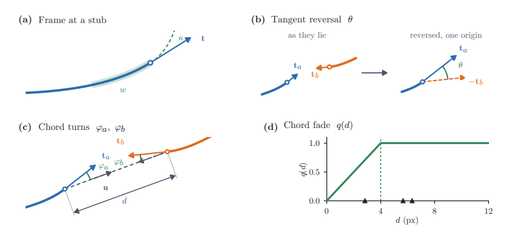
Figure 3 .The stub frame and the terms of the pairing cost.(a)The least-squares arclength fit over windoww, read outward from the tip ats = 0, giving outward tangenttand signed curvatureκ; quadratic when the span allows, linear otherwise.(b)θ, in the two steps its definition takes: the outward tangents where they lie, then the same pair withtb reversed and both read from one origin. A perfect continuation makes them antiparallel, soθ = 0.(c)The chord turns φa, φb onto the chordujoining the tips.(d)The fadeq(d)against tip separation; triangles mark the six real separations at the crossing of Figure 4.
Original paper · CC BY 4.0 · Oday Allan, Igor Ostanin · PLECTA: Overlap-aware instance segmentation of dense strand networks from binary masks · Original paper figure · Extracted the figure area from page 7 of the original PDF.Why overlapping strands are hard to separate
Strand identity is lost at two kinds of image feature: a crossing merges distinct strands into one foreground component, and a signal gap splits a single strand into fragments. Fragment tips can look like genuine ends, so a segmenter has to decide at each junction which segments continue through it, which reconnect across a gap, and which terminate.
A single projection gives no depth separation at a crossing, because the two strands genuinely occupy the same pixels.
The identity stage reads only a binary mask of strand centrelines and needs no training, and it is aimed at networks whose strands roughly keep their direction through crossings.
Where greedy and joint pairing fall short
This is cheap and adequate where crossings are rare, but a later contradictory candidate cannot revise an earlier pairing.
Methods that add image evidence avoid the greedy weakness only by needing training data in which every fibre is labelled individually.
De et al. propagate labels across a graph of branches, but the labels need anatomical roots as starting points, and a tangle of open-ended strands offers none.
Turning a mask into arms and stubs
The mask is thinned with the Zhang–Suen algorithm and short spurs are removed. Pixels where three or more branches meet form junction clusters, and nearby clusters are merged into one node, which handles crossings that span several pixels. The remaining strand segments are arms, and each arm has a stub at either end.
Each stub is described by its tip position, an outward tangent t and a signed curvature κ, both estimated from a short stretch of the adjoining strand. Stubs with too little support are flagged as unreliable, and their tangent and curvature are refreshed as arms are joined into longer chains.
The input is a binary mask M, and the output is a set of strand instances whose pixel sets lie inside the foreground \(F=\{x : M(x)=1\}\). Crossing pixels may belong to more than one instance, and that overlap is what the output is built to carry.
Scoring a candidate link
The cost of linking stubs a and b combines a reversal angle, a chord term that penalises lateral offset, a gap term for tip separation and a curvature mismatch. \[ C_{ab} = w_d\,\theta + w_t\,q(d)\,(\varphi_a+\varphi_b) + w_\ell\,\frac{d}{\ell_0} + 30\,w_\kappa\,|\kappa_a+\kappa_b|, \qquad q(d)=\min\!\left(1,\frac{d}{d_0}\right) \] The reversal angle is measured between the tangent of stub a and the negated tangent of stub b, so it is zero for a straight continuation.
The chord angles measure how far each tangent turns toward the opposite tip, and the curvature term sums the two signed curvatures because the outward frames point in opposite directions.
Tip separation enters twice: the gap term grows with d relative to ℓ0 and is zero for junction links, while the fade q(d) scales the chord term down below the distance d0. The weights, the distance scales ℓ0 and d0 and the curvature factor of 30 are fixed parameters listed in the supplement.
Choosing links with exact matching
Leaving stub i unmatched costs its penalty p_i, and linking i with j gains p_i + p_j minus the linking cost C_ij. A candidate link is admissible only when C_ij is below p_i + p_j. The selected set Γ of disjoint pairs solves \[ \max_{\Gamma} \sum_{(i,j)\in\Gamma} \left(p_i+p_j-C_{ij}\right) \] exactly. Each stub joins at most one partner, so a junction of any degree may leave some arms unpaired, and competing links are weighed together, so a locally favourable pair can be rejected.
Gap candidates must also meet distance and angular limits, since they bridge missing image evidence.
Connected components of the accepted arm links become strands, and each strand keeps the pixels of its arms and junction clusters. Gap links join fragments without adding pixels across the gap, so crossing pixels can sit in several strands at once.
Estimating depth from brightness
It samples a core through the crossing and flanks along each strand, excluding flank pixels that belong to the other strand, and compares the pooled core median with the two flank medians. Crossings with too few flank samples, or with a score below the threshold in magnitude, stay undecided.
Local decisions can contradict one another, for example A above B, B above C and C above A. These decisions form a weighted directed graph, and within each connected component the order is chosen to maximise the total weight of relations it satisfies. The result is acyclic, and its longest path gives the minimum number of layers; strands with no ordering constraint between them may share a layer.
How grouping is scored
Figure 7 shows the cases, including a split, a merge, an incorrect pairing, and separation of every arm, where precision and F1 are undefined.
Strands containing more fragments contribute more pairs, so they carry more weight in the score. The adjusted Rand index, variation of information, detection F1, Crossing Fidelity and Join F1 complement it; Join F1 concerns joins between nearby fragments and reduces the influence of fragmentation differences between mask sources. Synthetic means come with 95% bootstrap confidence intervals, resampling scenes within each density, and each real SEM field counts as one independent sample.
Synthetic results across coverage
The synthetic segmentation scenes are 512 × 512 pixel frames with bundle widths from 7 to 16 pixels, at target coverages of 20, 30, 40, 50 or 60%. Across 128 scenes, PLECTA's mean common-fragment pairwise F1 was 0.85, with a 95% bootstrap interval of [0.84, 0.86].
Mean F1 fell from 0.91 [0.89, 0.93] at 20% coverage to 0.77 [0.76, 0.79] at 60%, decreasing monotonically through the intermediate strata. Table 1 gives the per-coverage groups of 32 scenes each, with ARI 0.91 at 20% and 0.77 at 60%. Per-scene runtime had a median of 1.12 s and reached 34.06 s on the densest scenes.
The gap was largest at low coverage and narrowed at 50 to 60%, which the authors link to junction ambiguity becoming more influential at higher density.
Comparison with published methods
DNAi, GraFT and SIFNE were run from released implementations, and Basu et al. was reimplemented because no implementation was available. On the degraded synthetic axes, PLECTA reached F1 0.82, against 0.71 for SIFNE, 0.54 for Basu et al., 0.49 for GraFT and 0.34 for DNAi.
PLECTA had the highest pairwise F1 at every density under both clean and degraded masks, with SIFNE the strongest comparator. DNAi recovered 0.66 from clean axes at 20% coverage. Basu et al. ranked second on Crossing Fidelity but well behind on pairwise F1, which the authors read as showing that curvature-based junction matching alone is insufficient.
The authors regard that recreation as weaker evidence than a released generator.
On reference-derived axes from the three CNT fields, PLECTA reached F1 0.89, against 0.87 for SIFNE and 0.76 for Basu et al.
Which components matter
Each component was removed in turn on development scenes, and two replacement controls substituted part of the method. The fixed configuration reached F1 0.87 and ARI 0.86. Removing the junction chord-turn term dropped F1 to 0.68, a ΔF1 of −0.186, and replacing the whole linker also gave 0.68, with ΔF1 of −0.145.
Removing gap bridging gave F1 0.73 with ΔF1 of −0.139, and removing the joint junction solve gave F1 0.78 with ΔF1 of −0.080. Removing junction-cluster consolidation gave F1 0.80 with ΔF1 of −0.063.
A drop shows that a component supports performance under these conditions; it does not show that removing a component improves anything, and the authors read the smaller effects as refinement rather than replacement.
Real CNT SEM fields
Two annotators traced all three fields with an in-house tool that permits overlapping masks, using ridge snapping and spline smoothing, while connections and gap bridges were decided manually. Each field was tested with two input masks: a skeleton of the reference annotation and an automatic axis from the upstream CycleGAN and nnU-Net segmentation.
Mean F1 was 0.89 on reference-derived axes and 0.46 on automatic axes. Table 3 gives manual-derived F1 of 0.89, 0.84 and 0.95 for B58_100, B58_110 and B58_300, and U-Net F1 of 0.46, 0.45 and 0.47 for the same fields. On B58_110 the automatic axis gave join precision 0.68 and recall 0.53. Figure 12 shows the whole B58_110 field from both input-mask sources.
With the independent annotator's skeleton as input, PLECTA reached F1 0.38 against the reference, inside the 0.36 to 0.53 inter-annotator agreement range. The authors use this to argue that the automatic-axis result has to be read against ambiguity in manual strand identity where local occlusions obscure continuity.
Depth-order accuracy
The depth stage was tested on 12 depth-resolved synthetic scenes at two areal coverages, given either reference 2-D geometry or segmented 2-D input. With reference 2-D geometry, order accuracy over all crossings was 0.81 at 20% coverage and 0.74 at 40%, against a chance level of 0.5.
Global order is limited to strand pairs connected through the crossing graph, and only 0.36 to 0.84 of strand pairs fell within one connected component. All-pair order accuracy was 0.67 to 0.72, compared with 0.85 to 0.91 for pairs that cross. Layer agreement fell from 0.70 to 0.38 as coverage doubled, although recovered layer counts stayed close to the reference.
Figure 9 shows the stage on one synthetic scene, from the binary axis mask to the reconstructed strand stack and its re-rendering. Figure 10 applies the same sequence to a real CNT SEM field, where no depth ground truth exists, so the order is shown only qualitatively.
Limitations
PLECTA is intended for networks whose strands roughly keep their direction through crossings, and it assumes directional continuity there.
The real-material evaluation covers three CNT SEM fields and is presented as a case study. The comparisons use identical binary masks in dense crossing networks and do not assess each method in the application for which it was built.
Other materials, magnifications and SEM applications remain untested.
Paper info
- Authors
- Oday Allan, Igor Ostanin
- Venue
- arXiv · Preprint
- First published
- 2026-11-16
- Added
- 2026-11-18
- Updated
- 2026-11-16
- Version
- v1
- arXiv
- 2611.21283
- Category
- cs.CV · cond-mat.soft
- Original paper terms
- CC BY 4.0
- What we show
- Paper info, commentary and permitted figures from the original paper
AI commentary is a separate explanation from the original paper and may contain errors. The original paper and figures follow each source's terms of use and any rights noted separately.
Abstract
Many materials and tissues, including carbon-nanotube sheets, collagen and paper, comprise overlapping strands whose arrangement influences their effective properties. Measuring this geometry from micrographs requires individual strands to be traced through crossings and signal gaps, which merge distinct strands or split one strand into disconnected fragments. We present PLECTA (from Latin plecta, a braid), a deterministic method that segments individual strands using only a binary image whose foreground pixels mark strand centrelines. At each junction, PLECTA selects which strand segments continue into one another while allowing segments to terminate. It formulates this decision as an exact maximum-weight partial-matching problem, with an explicit penalty for unpaired segments and no restriction on the number of segments entering a junction. The output permits crossing pixels to belong to multiple strands. On synthetic scenes, PLECTA resolved strand identities more accurately than three released alternatives at every density tested. The same ranking held on an independently published generator run at its own settings. A separate stage uses the corresponding greyscale micrograph to estimate which strand lies on top at each crossing. The complete workflow is demonstrated on scanning electron micrographs of carbon nanotube sheets, from raw images to individual strand instances with estimated crossing order, without manual annotations for training or as pipeline inputs.
Quote from the paper
Oday Allan, Igor Ostanin (2026). PLECTA: Overlap-aware instance segmentation of dense strand networks from binary masks. arXiv:2611.21283v1. https://arxiv.org/abs/2611.21283v1
BibTeX
@misc{allan2026plecta,
  title = {{PLECTA: Overlap-aware instance segmentation of dense strand networks from binary masks}},
  author = {Oday Allan and Igor Ostanin},
  year = {2026},
  eprint = {2611.21283},
  archivePrefix = {arXiv},
  url = {https://arxiv.org/abs/2611.21283v1}
}