Paper commentary
Robustness Starts with the Objective: Designing and Certifying Robust LLM-Generated Heuristics
TAILOR uses paired CVaR to synthesize LLM heuristics that avoid severe regressions
- Problem Average-driven LLM heuristic search can hide severe regressions on particular workloads. Percentile objectives ignore how bad losses get beyond the chosen cutoff.
- Method TAILOR scores each candidate by the paired CVaR of its cost differences from the baseline. Because the score is measured on the same workload, it never needs the unknown optimum.
- Results TAILOR certifies improvements in average and tail optimality gap at 99% confidence for six of seven benchmarks. On Azure VM packing, paired CVaR raises mean cost improvement from 5.26% to 8.54%.
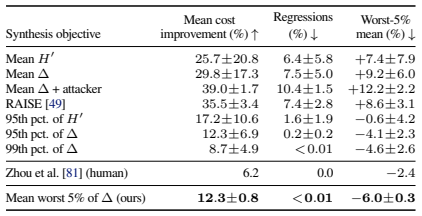
Table 1 :Paired-CV aR balances mean cost improvement and tail robustness.Comparison of synthesis objectives on Azure GPU Batch Admission, evaluated on our target workload distri- bution of real Azure request streams. Results are mean± stan- dard deviation over five independent synthesis runs. Mean cost improvement (E[H−H ′]) and tail differences are normalized by the magnitude of the baseline’s average cost.∆=H′−H.
Original paper · CC BY 4.0 · Pantea Karimi, Roozbeh Bostandoost, Dany Rouhana, Siva Kesava Reddy Kakarla, Pooria Namyar, Mohammad Alizadeh, Venkat Arun, Behnaz Arzani · Robustness Starts with the Objective: Designing and Certifying Robust LLM-Generated Heuristics · Original paper figure · Extracted the figure area from page 3 of the original PDF.Why average gains hide regressions
A strong mean can therefore sit on top of severe losses on particular workloads.
The authors trace the regressions of mean-optimized GPU batch admission heuristics to short streams. On long streams that rejection is affordable, because the heuristic can still fill the batch. On short streams, each rejection can leave capacity unused, since few requests remain to replace it. Because the heuristic doesn't know when a stream will end, gains on long streams can outweigh losses on short ones.
Adding harder inputs doesn't fix this, because the mean objective still doesn't decide how to weigh difficult cases against gains elsewhere. Percentile objectives fix the tail cutoff, but they ignore how bad losses get beyond that cutoff.
The open question is which objective penalizes the severity of tail losses without needing the unknown optimum. Computing OPT across large-scale workloads is impractical, so the authors compare each candidate to the baseline on the same workload. They instead minimize CV aR at β=0.95 of the paired difference ∆(I) = H′(I) − H(I), which averages the worst 5% of candidate–baseline differences.
A negative paired CV aR also guarantees average improvement, because the average of the worst differences is at least their overall average.
Scoring candidates by paired tail differences
TAILOR scores each candidate by the paired CVaR of its cost differences from the baseline, not by its mean cost. Candidate and baseline run on the same workload, so the loop never has to solve for OPT. The paired difference Delta(I) equals H'(I) minus H(I), so a value below zero is an improvement on that stream. A percentile objective ignores how severe regressions get beyond the cutoff, and the single worst difference lets isolated outliers dominate selection.
CVaR has a second property that the mean-based objectives lack: the average of its worst tail is at least the overall average. So a negative paired CVaR implies a mean improvement as well, and the loop doesn't need a separate constraint on the mean. Equation 2 states this as E[H'-H] being at most CVaR at β of H'-H. During search, the agent receives the empirical CVaR on training workloads as feedback.
Minimizing that score rewards policies whose worst baseline-relative outcomes improve, rather than letting gains elsewhere conceal severe regressions.
The synthesis loop uses fewer training samples than the final certification, because candidates are scored repeatedly during search. Sampling error still matters, since a negative empirical CVaR on training data doesn't guarantee a negative population CVaR. The candidate could perform worse on workloads the loop never sampled, so the certification step checks it on held-out workloads.
How a negative paired CVaR certifies tail gains without OPT
The certificate starts from a simple identity: the candidate's gap equals the baseline's gap plus the paired difference. Since H' minus OPT equals H minus OPT plus Delta, subadditivity of CVaR bounds the change in tail gap by CVaR of Delta. The left side is the improvement we want to establish, and the right side is the quantity we can measure.
So a negative CVaR of Delta means the candidate's tail gap is strictly smaller than the baseline's under the distribution. The proof sits in the appendix, and OPT never gets computed along the way. The authors note that an analogous bound doesn't hold for quantiles, so the CVaR form is what makes the argument work.
The same CVaR sign also controls the average, because the average of the worst tail is at least the overall average. Equation 2 writes this as E of H' minus H being at most CVaR at beta of H' minus H. So a negative paired CVaR implies average improvement over the baseline, with no separate mean constraint. The certified claim at beta of 0.95 covers the worst 5% tail and the average performance together.
A negative value on a finite sample isn't enough, because the candidate might do worse on workloads that were never sampled. TAILOR evaluates the final heuristic on independent held-out workloads and bounds the population CVaR from above. The Dvoretzky–Kiefer–Wolfowitz inequality provides that upper confidence bound, U_DKW, on the population paired CVaR.
The certificate is issued only when this upper bound is negative at delta equal to 0.01, which means 99% confidence. Otherwise the result is inconclusive, even when the empirical CVaR is negative. The evaluation uses about 28,000 independent workloads per benchmark to reach that confidence.
One TAILOR run, step by step
A TAILOR run starts with a preflight check that asks whether the certification target can still be reached. It uses a valid lower bound LB on OPT, and wherever the baseline equals LB, the baseline is optimal on that workload. The fraction of such workloads sets a candidate-independent ceiling, beta_ceil = 1 minus Pr[H = LB]. A requested level at or above that ceiling can't yield a negative certificate.
Passing preflight doesn't guarantee that a certifiable candidate exists, because it only means one wasn't ruled out.
If the target survives preflight, the synthesis stage starts with an LLM-based harness that proposes a candidate H′. In these experiments the harness is Engram with Claude Opus 5 as the backend model. Each candidate runs alongside the baseline on training workloads. The harness receives the empirical CVaR of H′ minus H on the training data as its feedback score.
Because candidates are scored repeatedly, TAILOR uses fewer training samples here than in the certification step, which keeps feedback affordable. Minimizing this score rewards policies that fix the worst baseline-relative outcomes, rather than letting gains elsewhere hide severe regressions.
After synthesis, TAILOR freezes the selected candidate and evaluates it next to the baseline on independent held-out workloads. The held-out set is fresh instances that the agents never see during synthesis. A negative empirical CVaR isn't enough on its own, because the candidate might perform worse on workloads that were never sampled. TAILOR therefore applies DKW-based bounds, which set how many workloads are needed and give an upper confidence bound UDKW on the population paired CVaR.
The candidate is certified at 99% confidence only when UDKW is below zero, and otherwise the result is inconclusive.
GPU batch admission: trading mean for tail
Each objective uses Engram with Claude Opus 5, five independent syntheses, and training on the first two calendar days of Azure traces.
So the tail-focused run gives up average improvement to get a safer tail.
The authors observe that the CVaR-generated policies limit early rejections in a way similar to this human heuristic. They also report that the CVaR policies' tail improvements extend beyond the 5% level used during synthesis.
Mean-optimized heuristics concentrate their regressions on short streams, as the regression-by-length figure shows. The CVaR-generated heuristic instead limits how much it waits for better arrivals, which reduces short-stream regressions. Observed improvements alone don't establish robustness on unseen workloads, which is why TAILOR certifies afterward.
VM packing and server placement
On Azure VM packing, each VM goes to the machine it fills most under the Kubernetes MostAllocated policy, which serves as the baseline. Against optimizing the 95th percentile of ∆, paired CVaR raises mean cost improvement from 5.26% to 8.54%. Where the 95th percentile objective reaches −3.04%, paired CVaR reaches −4.92% on empirical CVaR0.95(∆).
Unlike online admission control, all client locations are known, so robustness is tested under spatial variation rather than uncertain arrivals. Paired CVaR achieves 66% larger mean cost improvements than mean-optimized heuristics, at 7.84% versus 4.71%. Its empirical CVaR0.95(∆) moves from +0.65% for mean-optimized heuristics to −0.57%. All five runs have negative empirical paired CVaR, and three of five are statistically certified.
Optimizing the 99th percentile of ∆ or the 95th percentile of H′ certifies only two of five runs.
Across the three problems, paired CVaR keeps empirical CVaR0.95(∆) negative while retaining substantial mean improvements.
Certification across seven benchmarks
All five runs are certified on Azure GPU Batch Admission, Azure VM Packing, and Offline VBP2D. Online VBP2D is the exception, with none of the five runs certifying a tail improvement. Preflight doesn't rule out headroom for Online VBP2D, so the failure isn't explained by an unattainable target. Makespan was ruled out at preflight, because LPT matches the lower bound on 35.5% of workloads.
The authors tried GPT-4o-mini, Sonnet 5.5, and Opus 5 across several harnesses for Online VBP2D. None of the tested models, training objectives, or synthesis harnesses achieved certification on that benchmark. None of the 150 GPT-4o-mini runs certified, regardless of harness. With stronger models, the spread in tail improvement among the four coding-agent harnesses shrinks from 17% with Sonnet 5.5 to 6% with Opus 5.
Certification therefore depends on both the model and the objective, so a post-synthesis check stays necessary. Ask yourself whether a passing preflight means certification is reachable: the paper says it doesn't.
Small-scale worst-case search versus distributional feedback
MetaEase searches for large optimality gaps on small instances, where computing OPT stays affordable. The authors use the largest gap it finds as synthesis feedback for the heuristic. They compare this with distributional paired CVaR feedback, using the same Opus 5 model and Engram harness.
Reducing the worst-case gap on small instances doesn't necessarily improve tail robustness on larger workloads. The clearest difference appears on Online Weighted Matching, where paired CVaR synthesis reaches negative empirical paired CVaR. Maximum-gap synthesis on the same benchmark produces substantial tail regressions. The two approaches perform similarly on TE MLU, so the small-scale gap is a weak proxy for large-scale tail behaviour in some benchmarks.
On Online VBP2D, neither approach achieves negative empirical paired CVaR on average.
What the certificate does not cover
Latency is not guaranteed by training-time filtering alone, because TAILOR only rejects candidates that exceed the code-execution allowance on training workloads. On unseen k-median certification workloads, many generated heuristics still exceed the latency allowance (Fig. 13). The authors suggest putting latency into the synthesis objective, next to tail performance, instead of filtering it only during training.
Certificates are relative to a baseline, so two heuristics certified against the same baseline aren't always directly comparable. Certificates can be chained: if H′ certifies against H and H′′ certifies against H′, then H′′ also improves over H, under the same workload and tail level. A certified heuristic can then serve as the baseline for future synthesis.
The certificate covers only the workload distribution used for certification, and it may not hold under distribution shifts.
Paper info
- Authors
- Pantea Karimi, Roozbeh Bostandoost, Dany Rouhana, Siva Kesava Reddy Kakarla, Pooria Namyar, Mohammad Alizadeh, Venkat Arun, Behnaz Arzani
- Venue
- arXiv · Preprint
- First published
- 2026-10-31
- Added
- 2026-11-3
- Updated
- 2026-10-31
- Version
- v1
- arXiv
- 2611.00504
- Category
- cs.AI · cs.CL · cs.DC · cs.PF
- Original paper terms
- CC BY 4.0
- What we show
- Paper info, commentary and permitted figures from the original paper
AI commentary is a separate explanation from the original paper and may contain errors. The original paper and figures follow each source's terms of use and any rights noted separately.
Abstract
LLMs are increasingly used to design heuristics for computer systems. However, most synthesis frameworks evaluate candidates by their average performance, which can mask severe regressions on specific workloads. Even adding adversarial training inputs doesn't eliminate these regressions, and percentile objectives (e.g., optimizing for the 95th percentile) overlook how severe regressions can be beyond the selected threshold. We present TAILOR, a framework that guides LLM synthesis using the Conditional Value at Risk (CVaR) of the cost difference between each candidate and an existing baseline on the same workload. This paired CVaR measures the average difference over the worst fraction of workloads. We show that a negative paired CVaR guarantees improvements in both average performance and tail optimality gap relative to the unknown optimum, without ever computing that optimum. We find that TAILOR achieves the best mean--tail trade-off among the synthesis objectives we evaluate across three case studies: Azure GPU batch admission, Azure VM packing, and server placement. Tested across seven diverse optimization benchmarks, TAILOR produces heuristics that are certified with 99% confidence to improve both average performance and tail optimality gaps over the baseline in six of them. On these six benchmarks, TAILOR also outperforms known robust, human-designed alternatives in the tail while achieving better or comparable average-performance improvement over the baseline.
Figures from the paper
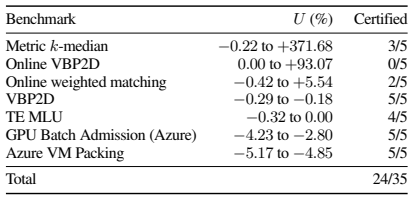
Table 2 :Certification atβ=0.95 .Range of U across five syn- thesis runs, normalized by the magnitude of the baseline’s mean cost. For sampled distributions,U=U DKW with δ= 0.01 ; for Azure VM Packing,U is the exact finite-population CV aR. Negative values indicate certified improvements.
Original paper · CC BY 4.0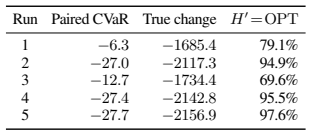
Table 3 : Small-scale Metrick-Median validation atβ= 0.95 using Engram (five Opus runs). The baseline tail optimality gap is 2,173.
Original paper · CC BY 4.0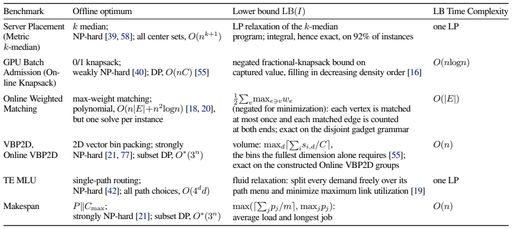
Table 6 : Offline optimum and preflight lower bound per benchmark. Every bound is a relaxation of the offline optimum.n: items, jobs, clients, or vertices;d: demands;C: knapsack capacity;O∗ hides polynomial factors.
Original paper · CC BY 4.0Quote from the paper
Pantea Karimi, Roozbeh Bostandoost, Dany Rouhana, Siva Kesava Reddy Kakarla, Pooria Namyar, Mohammad Alizadeh, Venkat Arun, Behnaz Arzani (2026). Robustness Starts with the Objective: Designing and Certifying Robust LLM-Generated Heuristics. arXiv:2611.00504v1. https://arxiv.org/abs/2611.00504v1
BibTeX
@misc{karimi2026robustness,
  title = {{Robustness Starts with the Objective: Designing and Certifying Robust LLM-Generated Heuristics}},
  author = {Pantea Karimi and Roozbeh Bostandoost and Dany Rouhana and Siva Kesava Reddy Kakarla and Pooria Namyar and Mohammad Alizadeh and Venkat Arun and Behnaz Arzani},
  year = {2026},
  eprint = {2611.00504},
  archivePrefix = {arXiv},
  url = {https://arxiv.org/abs/2611.00504v1}
}