Paper commentary
What Must a Model Tell a Planner? Outcome Interfaces for Risk-Aware Planning After Robot Damage
Route outcome prediction keeps damaged robots on mission
- Problem A decision policy only ranks routes and picks one, so a damaged robot must fall back whenever the risk limit tightens. It cannot switch to another route that it can still finish.
- Method The capability contract predicts each robot's chance of success and travel time on each terrain. It composes those terrain estimates along a route, and the planner takes the fastest route that passes a margin-shifted threshold.
- Results At a calibrated 5% limit, outcome models declined 7–8% of Go2 missions, compared with 32% for the plain policy.
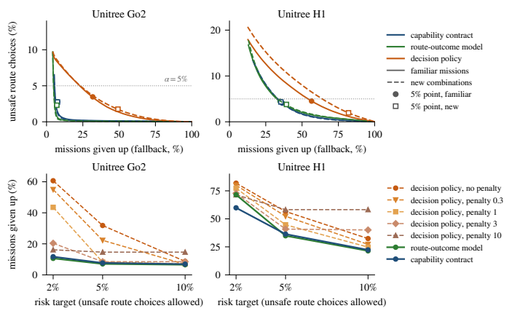
Figure 2 : Infeasible selections and declined missions. Above, increasing the margin traces their tradeoff, with markers at a calibrated 5% selection-risk target. Below, the best fixed penalty changes with the risk target.Unsafein the axes means empirically infeasible selection, not observed execution failure. Curves average 20 splits.
Original paper · CC BY 4.0 · Hassan Iqbal, Krishna Kumar · What Must a Model Tell a Planner? Outcome Interfaces for Risk-Aware Planning After Robot Damage · Original paper figure · Extracted the figure area from page 3 of the original PDF.Where a plain route choice runs out
A damaged robot can still attempt some routes, but its chance of finishing each one has dropped. In the plain setup, a decision policy scores three routes and a fallback, then hands the planner one preferred choice. It can only accept that route or fall back, so it cannot move to another route when the limit tightens. A high score says a route is the one to prefer, which is not the same as saying the robot can finish it.
Predicting route outcomes instead of a choice
The key idea is to stop asking the model which route to take and to have it predict what each route would do. The authors call this an outcome model, which estimates feasibility or success probability and travel time for each route. The route-outcome model learns each route's feasibility label and duration directly, and its feasibility score is compared with 0.5 plus the margin.
The capability contract works one level lower, predicting success and duration for each terrain. It composes those terrain estimates along a route, so new combinations of represented hazardous terrains can be scored.
The authors ask whether terrain-level predictions still help when missions recombine terrains. The contract's terrain predictions come from a Gaussian process fitted across robots, using the probe observations as inputs. Its predictive variance then feeds the shared uncertainty guard.
What the planner checks after damage
A damaged robot first performs two low-risk probes, and the planner records what they show. Each planner then compares its estimate with a threshold shifted by its margin. For the contract the threshold is pmin plus the margin, with pmin set to 0.7, and for the route model it is 0.5 plus the margin. The planner takes the fastest route that passes, or falls back if none does.
Conformal risk control sets each margin on 100 calibration robots, so changing alpha changes the margin while pmin stays fixed. The same probe-based variance also lets a shared guard send a robot the model doesn't recognise to fallback. Because the risk target only changes the margin, the same outcome predictor can serve every target.
Missions kept under calibrated risk limits
Without a risk target, the outcome interfaces agree with the oracle about as well as the plain policy does. Under calibrated limits, however, they retain more missions, and the gap opens as the target tightens. Raising the margin turns commitments into fallback, which lowers unsafe selections at the cost of more declined missions. At a calibrated 5% limit on familiar missions, the plain policy declined 32% of Go2 missions and the outcome models declined 7–8%.
On H1 the same comparison gives 57% for the plain policy and 35–36% for the outcome models.
A fixed penalty nearly closes the gap on Go2 and narrows it on H1. The catch is that the best penalty depends on the risk target, so it has to be retuned as the target moves. That matters because the planner changes routes as requirements change while reusing one outcome predictor.
Hazard ranking from two probes
The second question is whether two low-risk probes can replace retesting every hazard on the damaged robot. AUC here measures how well the method ranks traversal success on hazardous terrain, not how well it calibrates probabilities. On Go2 the population average gives an AUC of 0.67, and two designed probes raise it to 0.87. On H1 the same comparison moves from 0.75 to 0.86.
Four trials on every hazard reach a similar ranking, but they need 16–18 times more runs. Those trials also produce roughly 16–18 falls per robot, versus under 0.1 falls during probing. Adding designed probes beyond two adds little AUC, so two is the probe budget the authors settle on.
Limitations
The risk target bounds the expected rate of empirically infeasible selections under the calibration assumptions. Route evaluations compose recorded terrain outcomes instead of executing complete routes continuously.
The evaluated policies never receive the requested risk target, so the comparison shows the value of exposing outcome estimates, not that a risk target requires one. The more severe damage test covers only the 80 additional Go2 robots, and broader shifts in damage and mission distributions remain untested. Validating complete-route execution on physical robots remains future work.
Paper info
- Authors
- Hassan Iqbal, Krishna Kumar
- Venue
- arXiv · Preprint
- First published
- 2026-11-20
- Added
- 2026-11-24
- Updated
- 2026-11-20
- Version
- v1
- arXiv
- 2611.27939
- Category
- cs.RO
- Original paper terms
- CC BY 4.0
- What we show
- Paper info, commentary and permitted figures from the original paper
AI commentary is a separate explanation from the original paper and may contain errors. The original paper and figures follow each source's terms of use and any rights noted separately.
Abstract
When a robot is damaged, it must decide which routes it can still afford, and the amount of risk it may accept can change from one mission to the next. We argue that whether a learned model helps such a robot depends on its decision interface, that is, on what the model hands to the planner. A decision policy tells the planner what to do, whereas an outcome model, a kind of world model, predicts the consequences of each route. We study simulated Unitree Go2 quadrupeds and H1 humanoids with weakened motors, added payloads, or reduced foot friction. We compare four interfaces. The first is a decision policy, and the second is the same policy trained with fixed penalties for infeasible routes. The third is an outcome model that predicts the feasibility and travel time of each route. The fourth, which we call a capability contract, is an outcome model that predicts the chance of success and the travel time of the robot on each terrain and composes them along a route. All share the same collected experience, matched tuning and risk calibration, and an uncertainty guard. Two comparatively low-risk probes let the capability contract rank hazardous terrains about as well as four new trials on every hazard. At a calibrated 5% limit on selecting empirically infeasible routes, outcome models cut declined missions from about 32% to 7-8% on Go2 and from 57% to 35-36% on H1 compared with the plain policy. Fixed penalties narrow this gap, but the best penalty changes with the risk target. Predicting outcomes lets the planner preserve missions by changing routes as risk requirements tighten.
Quote from the paper
Hassan Iqbal, Krishna Kumar (2026). What Must a Model Tell a Planner? Outcome Interfaces for Risk-Aware Planning After Robot Damage. arXiv:2611.27939v1. https://arxiv.org/abs/2611.27939v1
BibTeX
@misc{iqbal2026what,
  title = {{What Must a Model Tell a Planner? Outcome Interfaces for Risk-Aware Planning After Robot Damage}},
  author = {Hassan Iqbal and Krishna Kumar},
  year = {2026},
  eprint = {2611.27939},
  archivePrefix = {arXiv},
  url = {https://arxiv.org/abs/2611.27939v1}
}