Paper commentary
Inner Product Regularization for Imitation Learning
Inner product regularization makes imitation policies respond consistently to perturbations across nearby states
- Problem Penalties on the policy Jacobian shrink sensitivity state by state, so they also dampen responses to task-relevant changes. Each state gets its own budget, and nearby states are not forced to react to the same perturbation in the same way.
- Method InneR groups nearby states whose inner products are aligned and penalizes the trailing eigenvalues of their averaged inner products. Instead of shrinking each Jacobian, it pushes nearby states toward a shared null space.
- Results In simulation, InneR stays robust to irrelevant state dimensions and train-test shifts, where norm penalties often do worse than behavior cloning. On a real arm with three tasks, it raises a diffusion policy's average success rate from 18% to 57%.
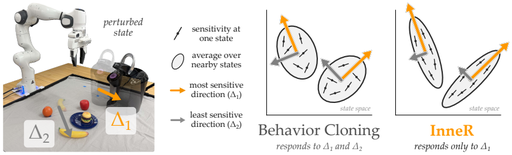
Figure 1 .(Left) Robot learning to close a coffee machine. At test time the robot encounters a new state. As compared to the states in its training dataset, this new state has some perturbations that are task-relevant (shifting the pose of the coffee machine,∆1) and some that are irrelevant (shifting the banana,∆ 2). (Right) Local state perturbations have a first-order effect on the policy outputs. At each state the policy is sensitive to some perturbation directions and ignores others; averaging over nearby states reveals the directions to which the policy is most and least sensitive. Under standard behavior cloning these responses are inconsistent across nearby states, and thus the policy reacts to both∆ 1 and∆ 2. We propose InneR, an inner product regularization approach that enforces similar responses to the same perturbation at nearby states: the policy still responds to∆ 1 but now ignores∆ 2.
Original paper · CC BY 4.0 · Benjamin A. Christie, Tianyu Qiu, Amy H. Choi, David Fridovich-Keil, Dylan P. Losey · Inner Product Regularization for Imitation Learning · Original paper figure · Extracted the figure area from page 2 of the original PDF.Why per-state penalties fall short
Imitation policies trained on a few demonstrations often face states they never saw, because of sensor noise, scene changes and errors that compound over a task. A common remedy is regularization, which adds an inductive bias during training instead of collecting more data or asking for expert help. Most of these penalties limit how much the policy moves at a given state, using the parameter norm, the Jacobian norm with respect to state, or the Fisher information for stochastic policies.
The weakness is that each state gets its own budget, so the penalty treats every perturbation at that state as something to suppress. A robot, however, should ignore clutter in the background while still reacting when its target object moves. Shrinking sensitivity uniformly dampens both kinds of response, which limits how well the robot can control each action dimension.
Frobenius and nuclear norm penalties on the Jacobian reduce sensitivity but do not align which directions are ignored across states. So the question the authors pose is how the policy responds to the same perturbation at different states, not how much it moves at one state.
Consistent responses across nearby states
The core idea is that nearby states should respond to the same perturbation in the same way. If a lighting shift leaves the policy unchanged at one state, it shouldn't change the policy at a nearby state. A perturbation that substantially impacts the task, like a moved target object, should change the policy at both states. Prior per-state penalties miss this structure, because they only shrink the policy's sensitivity at each state on its own.
Pulled back through the policy Jacobian J(s), this inner product becomes a matrix on state space, A(s) = J(s)^T M J(s). Here M is the action-space inner product, and it is positive definite. The null space of A(s) holds the state perturbations with no first-order effect on the actions. Because M is positive definite, that null space equals the null space of J(s).
The authors derive F(s) from a second-order expansion of the KL divergence between action distributions at s and a perturbed state. The condition therefore concerns null spaces, so the task becomes making these matrices share a null space across nearby states. Averaging the matrices across states gives a null space equal to the intersection of the individual null spaces.
The authors don't require A(s) to be identical everywhere, since that would stop the policy from learning nuanced behaviors.
Shrinking every Jacobian, as the Frobenius and nuclear norm penalties do, lowers sensitivity to both relevant and irrelevant directions. InneR instead penalizes the trailing eigenvalues of the averaged inner product, so its penalty is zero for full-rank Jacobians with a common row space. This lets the policy keep its sensitivity to the task-relevant directions while aligning the directions it ignores.
How the penalty is computed in a batch
InneR starts each training batch by computing the state Jacobian of the policy at every state in the batch. For each state it forms the inner product matrix A_i = J_i^T M J_i, which is the quantity the regularizer acts on. These extra passes keep the computation graph, so the penalty can be differentiated back through the policy. The added derivatives are the main source of the training cost that the authors report later.
Next, the right singular vectors of each Jacobian give a basis for its row space, and the clustering step runs with no gradient. The chordal Grassmann distance compares two states' row spaces through the principal angles between their subspaces. Because the distance depends only on those principal angles, it doesn't depend on which basis vectors were chosen.
For each state, the k states with the smallest distance, including the state itself, form a local region. The regions are rebuilt inside every batch at each gradient step, because the policy changes during training.
Within each region, the inner products are averaged, which gives the mean of the k matrices in that region. The eigenvalues of that average are sorted from largest to smallest. The trailing n minus m eigenvalues describe how far the region is from a shared null space. The region loss divides the sum of those trailing eigenvalues by the total of all eigenvalues, and the total is detached from the gradient.
Dividing by the total stops the loss from shrinking the whole Jacobian, since each term stays between 0 and 1 whatever the scale of J(s).
The region terms are averaged into the regularizer L_InneR, and the total loss becomes L plus gamma times that regularizer. For stochastic policies, the same steps use F(s) in place of A(s) and r in place of m. The leading right singular vectors of the sampled scores then play the role of the row-space basis.
What InneR costs and how it is tuned
InneR makes training slower, and with a 16-dimensional state the authors measured a 6.5x increase for an MLP and 5x for a diffusion policy. The extra cost has three sources, and the first is the extra passes through the policy that keep the computation graph. The second source is that LInneR depends on these derivatives, so its gradient needs a second-order derivative of the policy.
InneR has three settings the designer must choose: the action inner product M, the neighborhood size k, and the weight γ. Matrix M should default to identity, and a designer who wants more sensitivity to mistakes in one action dimension raises that diagonal entry. As k goes to 2, the regions become increasingly local, and the authors set k = 8 in their experiments.
Because the loss is normalized, designers shouldn't need to change γ much across state dimensions. The authors found 0.1 ≤ γ ≤ 0.5 effective in single-integrator simulations and hardware experiments, and 0.01 ≤ γ ≤ 0.05 in drone-landing simulations.
In the simulation comparisons, InneR used k = 8 for the MLP and k = 32 for the diffusion policy, with rank r = m = 4 for the MLP and r = 2m = 8 for the diffusion policy. Both policies used M = I and γ = 0.01 in those comparisons. The drone-landing experiments used a larger γ range, which the authors chose for those simulations.
Does InneR keep performance under irrelevant dimensions and train-test shift
In the single-integrator task, the state concatenates the robot position, the goal position, and n − 2m irrelevant noise entries. The authors vary the state dimension, and the ideal method would keep its final state error constant as n grows. InneR's error stays nearly flat in every setting except the diffusion policy on the dynamic task.
On that diffusion dynamic setting, InneR is consistently lower than the alternatives, but its error keeps a similar positive slope. InneR-C matches InneR on the static task, where one global null space is correct, but it fails on the dynamic task.
Frobenius and Nuclear penalties shrink each Jacobian, and by flattening individual Jacobians they make perturbation responses inconsistent. Their null space ratio rises above the BC value on the static task. InneR keeps each state Jacobian's squared Frobenius norm at or above its BC value. Instead, InneR locally aligns the Jacobians so that they share a consistent null space.
Under train-test shift, InneR roughly halved the final state error in the single-integrator simulations.
In the drone landing task, the policy must land within horizontal and vertical error, speed, and roll-pitch limits.
The Frobenius and Nuclear baselines reduce the Jacobian norm, but InneR consistently reduces the null space ratio without uniformly reducing the Jacobian norm. Frobenius and Nuclear both achieved lower mean success than BC at every dataset size, so the authors read them as suppressing overall sensitivity.
Does InneR hold up on a real arm with distractors?
The authors ran InneR on a 7-DoF Franka Emika Panda with a UMI gripper, on three tasks: close, stack and push. Objects were segmented with SAM3 on the first frame and tracked with EdgeTAM, and depth was projected into the robot's frame to recover each object's pose.
Figure 11 reports success rates for BC, Nuclear and InneR with zero to three distractors. Nuclear scored worse than BC even without distractors, at 25.0%, and never succeeded in stack.
To test observation noise, the authors added zero-mean Gaussian noise to every observed object position in close with three distractors. The authors read these results as only partly supporting H2, since InneR's success falls about as quickly as the baselines'.
The authors read these results as supporting H3, that InneR scales better with distractors. Nuclear shrinks the Fisher trace by more than two orders of magnitude, whereas InneR stays near BC's level and has the lowest null space ratio on every task. Figure 14 shows InneR as the most selective method on every task, with sensitivity ratios of 6.5 to 8.4 against 5.1 to 7.6 for BC.
What limits InneR beyond the reported results
In the 16-dimensional tests, training time rose 6.5x for the MLP and 5x for the diffusion policy. That overhead comes from extra policy passes, a second-order backward pass, and linear algebra on each batch. The cost grows with state dimension because the decompositions scale with the size of the inner product matrix.
The authors also didn't explore InneR for policies that take image observations or high-dimensional feature representations. They attribute this limit to the same overhead that comes from the decompositions. The authors hope to extend efficient Jacobian norm estimates to the eigenvalues of the averaged inner product. That extension would let inner product regularization handle high-dimensional inputs.
The real-robot comparisons rest on a small number of runs. Figure 11 error bars show standard error over 20 trials per condition.
Paper info
- Authors
- Benjamin A. Christie, Tianyu Qiu, Amy H. Choi, David Fridovich-Keil, Dylan P. Losey
- Venue
- arXiv · Preprint
- First published
- 2026-11-12
- Added
- 2026-11-14
- Updated
- 2026-11-12
- Version
- v1
- arXiv
- 2611.17159
- Category
- cs.RO
- Original paper terms
- CC BY 4.0
- What we show
- Paper info, commentary and permitted figures from the original paper
AI commentary is a separate explanation from the original paper and may contain errors. The original paper and figures follow each source's terms of use and any rights noted separately.
Abstract
Robots that learn from demonstrations should extrapolate their policy despite state perturbations such as sensor noise, scene variation, and compounding errors. One approach to this robustness is regularization. Prior regularizers consider each state on its own and limit how sensitive the policy is to any perturbation at that state. By contrast, we explore how the policy's output shifts when given the same perturbation at different states. Our insight is that, locally, the robot should respond to state perturbations in a consistent manner: e.g., if changing an irrelevant object position does not impact the policy at one state, that same change should not shift the policy output at a nearby state. Applying this insight, we develop inner product regularization (InneR). We show that the inner product on action space induces an inner product on state space through the policy Jacobian (the Fisher information for stochastic policies), and that the null space of this inner product governs which state perturbations have a first-order effect on the policy. By clustering states whose inner products are aligned, averaging the inner products within each cluster, and minimizing the smallest eigenvalues of that average, InneR shapes the learned policy so that nearby states share a common null space. InneR enforces consistent responses to perturbations without limiting policy expressiveness, and can be appended to existing imitation learning pipelines for deterministic or stochastic policies. In simulated experiments, InneR makes learned policies more robust to irrelevant state dimensions and shifts between training and test distributions, whereas norm penalties often perform worse than behavior cloning. On a real robot arm performing three manipulation tasks, InneR raises the average success rate of a diffusion policy from 18% to 57% without additional data.
Figures from the paper
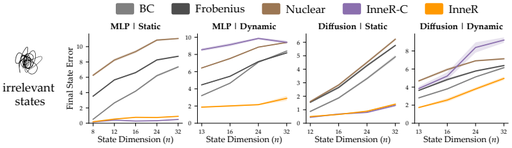
Figure 2 .Single-integrator simulation from Section 7.1. Plots show the error between the robot and the goal as state dimensionn increases (lower is better). The far left of each plot corresponds to the minimum state dimension for that setting, and each added state element is irrelevant noise that is sampled uniformly at random in both the demonstrations and the test states. Ideally the robot is robust to these variations in the irrelevant state dimensions, and so the final state error should be constant inn.InneRis the only method whose error stays nearly flat in every setting besides Diffusion–Dynamic, where it is consistently lower than the alternatives while maintaining a similar positive slope.InneR-Cmatches it instatic, where one global null space is correct, but fails indynamic. Shaded regions show standard error across10seeds.
Original paper · CC BY 4.0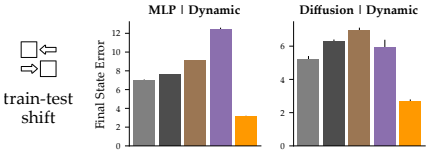
Figure 4 .Single-integrator simulation from Section 7.3 highlighting thedynamictask. At training time the irrelevant state dimensions are correlated with the active goal (ρ= 0.9), but at test time this correlation is removed, so a policy that reads the goal from the irrelevant entries fails (i.e., causal confusion (de Haan et al. 2019)).InneRis the only method that improves onBC.
Original paper · CC BY 4.0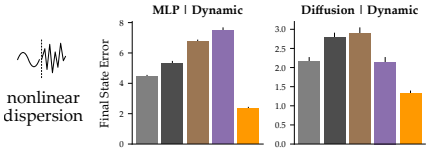
Figure 5 .Single-integrator simulation from Section 7.4 highlighting thedynamictask. An invertible nonlinear transformation is applied to the state before it is input to the policy, so that the task-relevant information is dispersed across every entry the policy observes and the dynamics are nonlinear in those coordinates.InneRlowers the error ofBCdespite this nonlinear dispersion.
Original paper · CC BY 4.0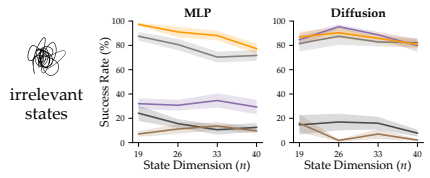
Figure 6 .Drone landing simulation from Section 8.1. Plots show the landing success rate as state dimensionnincreases (higher is better). The state dimension sweep starts atn= 19, and each additional7state coordinates come from a distractor drone in both the demonstrations and the test states.InneR largely outperformsBCat all tested dimensions for MLP , and is close toBCfor Diffusion.InneR-Cperforms poorly for MLP but is competitive for Diffusion.
Original paper · CC BY 4.0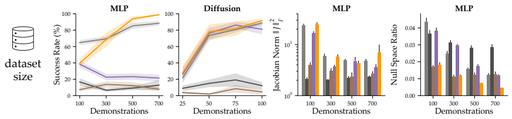
Figure 7 .Drone landing simulation from Section 8.2. Plots show the landing success rate as number of demonstrations increases (higher is better) with state dimensionn= 22. (Left) Success rate as the number of demonstrations increases for the MLP and Diffusion policies.InneRis effective for both MLP and Diffusion policies, andInneR-Cis only effective for the Diffusion policy. (Right) What each method regularizes (measured for the final MLP policy at200training states), i.e. the squared Frobenius norm of the Jacobian (log scale) and the shared null space ratio of Equation (26). BothFrobeniusandnuclearnorm baselines reduce the Jacobian norm.Frobeniushas a higher null space ratio than BC at 300, 500, and 700 demonstrations, whereasNuclearis below BC except at 700 demonstrations.InneRconsistently reduces the null-space ratio without uniformly reducing the Jacobian norm. Colors follow Figure 2.
Original paper · CC BY 4.0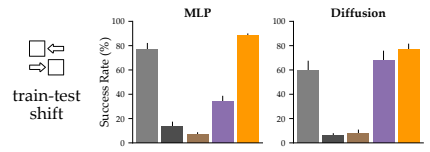
Figure 8 .Drone landing simulation from Section 8.3. In training, irrelevant state dimensions are correlated with the active goal (ρ= 0.9), but at test time this correlation is removed, so a policy that reads the goal from the irrelevant entries fails (i.e., causal confusion (de Haan et al. 2019)).InneRimproves uponBCfor both MLP and Diffusion, whileInneR-Conly improves uponBCfor Diffusion.
Original paper · CC BY 4.0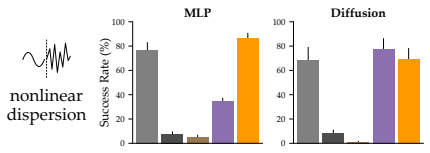
Figure 9 .Drone landing simulation from Section 8.4. An invertible nonlinear transformation is applied to the state before it is input to the policy, so that the task-relevant information is dispersed across every entry the policy observes and the dynamics are nonlinear in those coordinates.InneRimproves uponBCfor MLP andInneR-Cimproves uponBCfor Diffusion despite this nonlinear dispersion.
Original paper · CC BY 4.0
Figure 10 .Our real-world tasks. Each task is shown at the start, middle, and end of a successfulInneRrollout with the three distractors (apple, orange and banana). (Left) inclose, the robot pulls the handle down to latch the lid of the coffee maker. (Middle) Instack, the robot picks up the black cube and places it on the tan cube (teal and orange segmentations, respectively). (Right) In push, the robot pushes the pot into the target region. Tracked objects are tinted by the segmentation masks that our perception pipeline uses to estimate their poses, and the background is faded for clarity.
Original paper · CC BY 4.0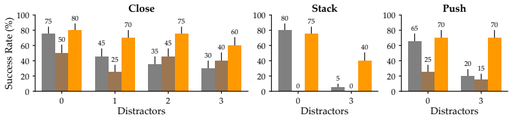
Figure 11 .Success rates in our real-world experiments forBC,Nuclear, andInneR; the number above each bar is the success rate in percent. Colors follow Figure 2. (Left)Closewith zero to three distractors. (Middle, Right)Stackandpushwith zero and three distractors. Error bars show standard error over20trials. Averaged across the three tasks,InneRmatchesBCwith no distractors (75.0%vs.73.3%) and outperforms both baselines with three distractors.
Original paper · CC BY 4.0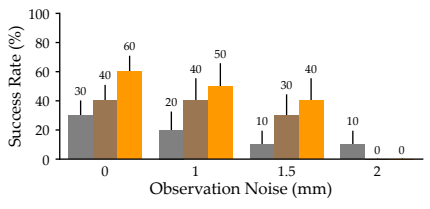
Figure 12 .Success rate inclosewith three distractors as Gaussian noise is added to the object positions that the policy observes. The horizontal axis is the standard deviation of the added noise;0mm repeats the three distractor results of Figure 11.InneRhas the highest success rate up to1.5mm
Original paper · CC BY 4.0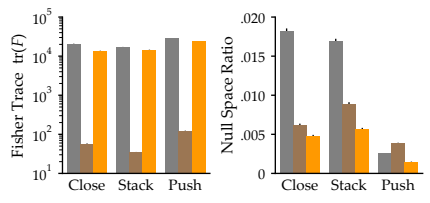
Figure 13 .The regularization results from our hardware experiments, measured for the three-distractor diffusion policies at training states. (Left) Trace of the Fisher informationF(log scale). (Right) Shared null space ratio of Equation (26), withF in place of the inner product,r= 14, k= 8.Nuclearshrinks the Fisher information by more than two orders of magnitude, whereasInneRkeeps it close toBC’s level and attains the lowest null space ratio on every task. Error bars show standard error over8batches of256states.
Original paper · CC BY 4.0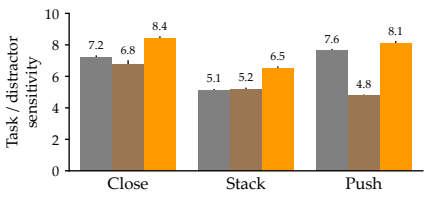
Figure 14 .Selectivity of the three-distractor policies on states encountered during the real-world trials (higher is better).InneR is the most selective method on every task. Error bars show standard error over400states.
Original paper · CC BY 4.0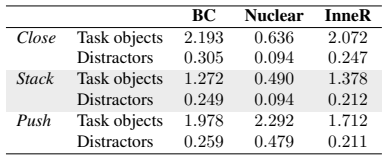
Table 1 .Sensitivity of the three-distractor policies
Original paper · CC BY 4.0Quote from the paper
Benjamin A. Christie, Tianyu Qiu, Amy H. Choi, David Fridovich-Keil, Dylan P. Losey (2026). Inner Product Regularization for Imitation Learning. arXiv:2611.17159v1. https://arxiv.org/abs/2611.17159v1
BibTeX
@misc{christie2026inner,
  title = {{Inner Product Regularization for Imitation Learning}},
  author = {Benjamin A. Christie and Tianyu Qiu and Amy H. Choi and David Fridovich-Keil and Dylan P. Losey},
  year = {2026},
  eprint = {2611.17159},
  archivePrefix = {arXiv},
  url = {https://arxiv.org/abs/2611.17159v1}
}